
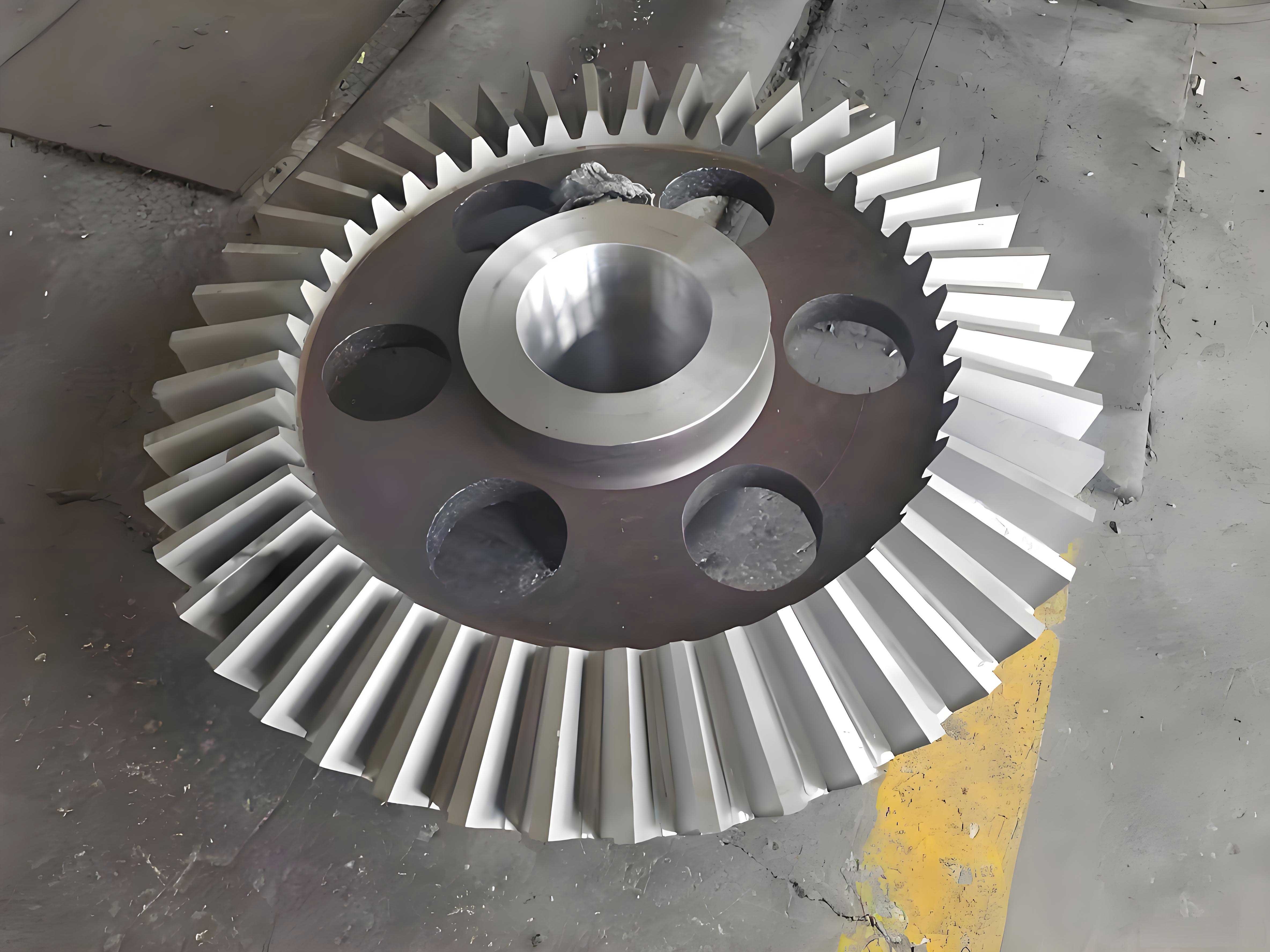
In the agricultural machinery industry, the reliability of components is paramount for efficient harvesting operations. Recently, I encountered a critical issue with miter gears used in the peeling rollers of a corn harvester, where frequent tooth fractures occurred during initial field operations. These miter gears are essential for transmitting torque and altering motion direction in the peeling mechanism; their failure directly halts the peeling process, impacting overall harvest productivity. This analysis aims to investigate the root cause of the tooth fractures in these miter gears through a comprehensive approach involving material testing, hardness measurements, metallographic examination, and carburization depth assessment. The findings will provide insights into improving manufacturing processes and quality control for such miter gears.
The miter gears in question were manufactured from 20CrMnTi steel, a common alloy for carburized components due to its good hardenability and toughness. According to design specifications, the miter gears were to undergo carburizing and quenching heat treatment, with a carburized layer depth of 0.8 to 1.2 mm, surface hardness of 58 to 62 HRC, and core hardness of 33 to 48 HRC. However, in service, multiple miter gears exhibited brittle fractures at the tooth roots, prompting this failure analysis. I received two samples: one fractured miter gear (Sample A) and one unused miter gear from the same batch (Sample B), both processed identically. Visual inspection of the miter gears revealed no obvious stress concentrators like machining marks, but the fracture surfaces indicated brittle failure, typical of overload or material embrittlement.
To begin the analysis, I first verified the material composition of the miter gears. Since both samples had been carburized, which could skew surface composition readings, I obtained raw forged steel from the same batch used for manufacturing these miter gears. Using optical emission spectrometry, I analyzed the chemical composition, as summarized in Table 1. The results confirm that the material complies with the standard requirements for 20CrMnTi steel, as per GB/T 3077-1999, ensuring that the base material was not the primary cause of failure.
| Element | C | S | Mn | Si | P | Cr | Ti |
|---|---|---|---|---|---|---|---|
| Measured Value | 0.20 | 0.021 | 0.97 | 0.24 | 0.02 | 1.15 | 0.06 |
| Standard Range (20CrMnTi) | 0.17–0.23 | ≤0.035 | 0.80–1.10 | 0.17–0.37 | ≤0.035 | 1.00–1.30 | 0.04–0.10 |
Next, I conducted hardness tests on the miter gears to evaluate both surface and core hardness. Using a Rockwell hardness tester, I measured the hardness at the tooth surface near the pitch circle and at the core region, defined as the intersection of the tooth centerline and root circle on the transverse cross-section. Samples were prepared by wire-cutting complete teeth from both miter gears, followed by sectioning and polishing. The hardness values, averaged from three points each, are presented in Table 2 and Table 3. While the surface hardness met the specified range, the core hardness exceeded the upper limit of 48 HRC, indicating potential over-carburization or improper heat treatment for these miter gears.
| Measurement Point | 1 | 2 | 3 | Average |
|---|---|---|---|---|
| Tooth Surface Hardness | 60 | 61 | 60 | 60.3 |
| Tooth Core Hardness | 57 | 57 | 56 | 56.7 |
| Measurement Point | 1 | 2 | 3 | Average |
|---|---|---|---|---|
| Tooth Surface Hardness | 60 | 60 | 60 | 60.0 |
| Tooth Core Hardness | 57 | 57 | 58 | 57.3 |
The elevated core hardness in these miter gears suggested that the carburized layer might have penetrated too deeply. To investigate further, I performed metallographic analysis on transverse sections of the teeth from both miter gears. After grinding, polishing, and etching with 4% nital solution, I observed the microstructure at 400x magnification. The surface layers of both miter gears showed coarse acicular martensite and a significant amount of retained austenite, with no visible carbides (Figures 2 and 4 in the original material, but not referenced here). This abnormal structure implies that the quenching temperature was above the Accm point, leading to grain growth and excessive retained austenite, which increases brittleness. Moreover, the core microstructure consisted of tempered martensite and retained austenite (Figures 3 and 5), rather than the expected tempered martensite and ferrite (for through-hardening) or ferrite and troostite (for non-through-hardening). This deviation indicates that carburization likely extended through the entire tooth cross-section of these miter gears, altering the core properties.
To quantify the carburization depth, I used a Vickers hardness tester to measure hardness profiles from the tooth surface to the core. According to standards like GB/T 9450-2005, the carburized hardening depth is defined as the distance from the surface to the point where hardness reaches 550 HV. I took measurements at various intervals and compiled the data in Table 4 and Table 5 for the miter gears. The hardness distribution curves, plotted with distance from the surface on the x-axis and hardness on the y-axis, are shown in Figure 6 and Figure 7 (conceptual representations). Since the hardness at 6.0 mm depth (beyond the tooth centerline) remained above 550 HV, it confirms that the entire tooth was carburized. The carburized layer depth, therefore, exceeds the design limit, effectively making the whole tooth high-carbon and prone to embrittlement.
| Distance from Surface (mm) | 0.2 | 0.4 | 0.6 | 0.8 | 1.0 | 1.2 | 1.4 | 1.6 | 1.8 | 2.0 | 2.5 | 3.0 | 4.5 | 6.0 |
|---|---|---|---|---|---|---|---|---|---|---|---|---|---|---|
| Hardness (HV) | 700 | 698 | 696 | 696 | 694 | 692 | 692 | 690 | 690 | 684 | 682 | 676 | 647 | 635 |
| Distance from Surface (mm) | 0.3 | 0.5 | 0.7 | 0.9 | 1.1 | 1.3 | 1.5 | 1.7 | 1.9 | 2.1 | 2.5 | 3.0 | 4.5 | 6.0 |
|---|---|---|---|---|---|---|---|---|---|---|---|---|---|---|
| Hardness (HV) | 696 | 696 | 694 | 694 | 694 | 693 | 692 | 691 | 690 | 685 | 683 | 678 | 644 | 639 |
The hardness distribution can be modeled mathematically to estimate the carburized depth. For a typical carburized case, hardness decreases with depth according to an exponential decay function. I propose a simplified formula to describe the hardness profile: $$ HV(x) = HV_{surface} \cdot e^{-kx} + HV_{core} $$ where \( HV(x) \) is the hardness at distance \( x \) from the surface, \( HV_{surface} \) is the surface hardness, \( HV_{core} \) is the core hardness, and \( k \) is a decay constant. For these miter gears, since the core hardness is elevated, the curve flattens, indicating full penetration. The carburized depth \( d_{CHD} \) is normally found by solving \( HV(d_{CHD}) = 550 \). However, in this case, \( HV(x) > 550 \) for all \( x \), so \( d_{CHD} \) exceeds the tooth dimensions, mathematically confirming over-carburization. This deep carburization in miter gears reduces toughness, as the entire tooth becomes high-carbon steel with limited ductility.
Furthermore, the metallurgical transformations during heat treatment play a crucial role in the performance of miter gears. The carburizing process involves diffusing carbon into the steel surface at high temperatures, followed by quenching to form martensite. The ideal case depth for miter gears should balance surface hardness and core toughness. For 20CrMnTi steel, the critical diameter for oil quenching is 25–60 mm, so the core should exhibit a mixture of tempered martensite and ferrite. However, in these failed miter gears, the excessive carburization led to a fully martensitic core after quenching, as seen in the microstructure. The presence of retained austenite at the surface, due to high quenching temperatures, further compromises fatigue resistance and impact strength. The relationship between hardness and toughness can be expressed using empirical formulas, such as: $$ T \propto \frac{1}{H^{n}} $$ where \( T \) is toughness, \( H \) is hardness, and \( n \) is a material constant. For miter gears subjected to shock loads in peeling rollers, high hardness without adequate toughness leads to brittle fracture.
To elaborate on the failure mechanism, I consider the stress state in miter gears during operation. In corn harvesters, the peeling rollers experience cyclic and impact loads as they strip husks from corn cobs. The miter gears transmit torque and change motion direction, causing bending stresses at the tooth roots. According to gear theory, the bending stress \( \sigma_b \) at the tooth root can be calculated using the Lewis formula: $$ \sigma_b = \frac{F_t}{b m Y} $$ where \( F_t \) is the tangential force, \( b \) is the face width, \( m \) is the module, and \( Y \) is the Lewis form factor. For miter gears, this stress is compounded by shock loads. When the material is embrittled due to over-carburization, the fracture toughness \( K_{IC} \) decreases, making the gears susceptible to crack propagation. The failure likely initiated at microcracks in the coarse martensite structure, propagating rapidly under stress until tooth fracture occurred.
Based on my analysis, the primary cause of tooth fractures in these miter gears is the deviation in heat treatment parameters. Specifically, the carburizing process resulted in a case depth that exceeded the design limits, effectively carburizing the entire tooth cross-section. Subsequent quenching at elevated temperatures produced coarse martensite and retained austenite at the surface, while the core became fully hardened. This combination reduced the toughness of the miter gears, making them unable to withstand the impact loads during peeling operations. The failure underscores the importance of precise control in manufacturing miter gears for agricultural applications.
To prevent such failures in future production of miter gears, I recommend several measures. First, the heat treatment process should be strictly monitored to ensure carburized depth remains within 0.8–1.2 mm. This can be achieved by optimizing carburizing time and temperature using diffusion equations, such as: $$ d = k \sqrt{t} $$ where \( d \) is case depth, \( k \) is a constant dependent on temperature and carbon potential, and \( t \) is time. Second, quenching temperatures should be controlled below the Accm point to avoid grain growth and excessive retained austenite. Third, tempering should be adequately performed to transform retained austenite and improve toughness. Quality control should include regular sampling and testing of miter gears, with emphasis on carburized depth measurement and metallographic examination. Standards like QC/T 262-1999 can guide the evaluation of carburized gears. Additionally, non-destructive testing methods, such as ultrasonic or eddy current inspection, could be implemented for batch screening of miter gears.
In conclusion, the failure analysis of miter gears in corn harvester peeling rollers reveals that improper carburizing and quenching processes led to over-carburization and microstructural abnormalities, resulting in brittle tooth fractures. By addressing these heat treatment issues through improved process control and quality assurance, the durability and reliability of miter gears can be significantly enhanced. This study highlights the critical role of material science in agricultural machinery maintenance and the need for stringent standards in producing miter gears for heavy-duty applications.