
In our experience with specialized vehicle manufacturing, we encountered a recurring failure in a three-axle special vehicle model, specifically within the tandem drive axle system. The issue involved the main spiral gear pair, which exhibited severe damage such as tooth breakage and brittle fracture under high-load conditions on muddy terrain. This analysis aims to dissect the root causes through a comprehensive approach, including vehicle matching calculations, macroscopic inspection, metallurgical testing, and component evaluations. The spiral gear, a critical component in power transmission, is the focal point of this investigation, and we will emphasize its role and failure mechanisms throughout this report. By leveraging formulas and tables, we summarize key findings and propose corrective actions to enhance product reliability.
The initial failure occurred in two vehicles, both with less than 2000 km of operation post-sale. During operation on muddy roads, the drivers engaged the inter-wheel differential lock as per procedures to prevent wheel slip and ensure safe traversal. Suddenly, abnormal noises emanated from the chassis, accompanied by the drive shaft spinning freely without vehicle movement. Upon disassembly, the intermediate axle (a tandem drive axle) was identified as the culprit, with the main spiral gear pair showing extensive tooth breakage and wear. The differential bearing lock rings had loosened and shifted, leading to further component damage. This pattern suggested a systemic issue rather than an isolated incident, prompting a detailed failure analysis from multiple perspectives.
To assess whether design mismatches contributed to the failure, we revisited the vehicle matching calculations. The key parameters of the specialized vehicle are summarized in the table below:
| Parameter | Value |
|---|---|
| Total Mass | 32000 kg |
| Front Axle Load | 6800 kg |
| Intermediate and Rear Axle Load | 25200 kg |
| Maximum Speed | ≥70 km/h |
| Maximum Gradeability | ≥36% |
| Engine Rated Power | 213 kW at 2200 r/min |
| Engine Maximum Output Torque | 1050 N·m at 1200-1600 r/min |
| Transmission Maximum Input Torque | 1180 N·m |
| Transmission First Gear Ratio | 11.4 |
| Transmission Final Gear Ratio | 1.0 |
| Intermediate and Rear Axle Total Ratio | 5.728 |
| Axle Maximum Load Capacity | 13 t |
| Axle Maximum Input Torque | 12000 N·m |
| Axle Maximum Input Speed | 2800 r/min |
| Tire Specification | 11.00R20-18PR |
The maximum torque experienced by the axle’s main reduction unit, where the spiral gear pair is housed, was calculated using the engine’s maximum output torque. The formula is:
$$T_{\text{1max}} = T_{\text{emax}} \times i_g \times \eta_{g1}$$
where \(T_{\text{1max}}\) is the maximum input torque to the axle’s main reduction unit (N·m), \(T_{\text{emax}}\) is the engine’s maximum output torque (1050 N·m), \(i_g\) is the transmission’s first gear ratio (11.4), and \(\eta_{g1}\) is the overall transmission efficiency, taken as 0.95 based on empirical data. Substituting the values:
$$T_{\text{1max}} = 1050 \times 11.4 \times 0.95 = 11371.5 \, \text{N·m}$$
This calculated torque (11371.5 N·m) is below the axle’s rated maximum input torque of 12000 N·m, indicating that the design matching should, in theory, be adequate. However, this assumes ideal conditions and does not account for transient overloads or material deficiencies in the spiral gear pair. The spiral gear’s ability to handle such torques depends on its material properties and heat treatment, which we later found to be suboptimal.
Moving to macroscopic analysis, we first examined the assembly and adjustment of the components. Based on the axle supplier’s technical specifications, we disassembled two sample axles from the same batch. The spiral gear pair’s meshing pattern and backlash were checked. The meshing marks aligned with requirements, and the backlash measured 0.30 mm, within the specified range of 0.3–0.41 mm. The axial clearance of the lock rings was 0.01 mm, conforming to the 0.01–0.05 mm tolerance. Thread gauges confirmed that the lock rings’ threads met machining standards. These results initially ruled out batch-specific assembly errors as the primary cause.
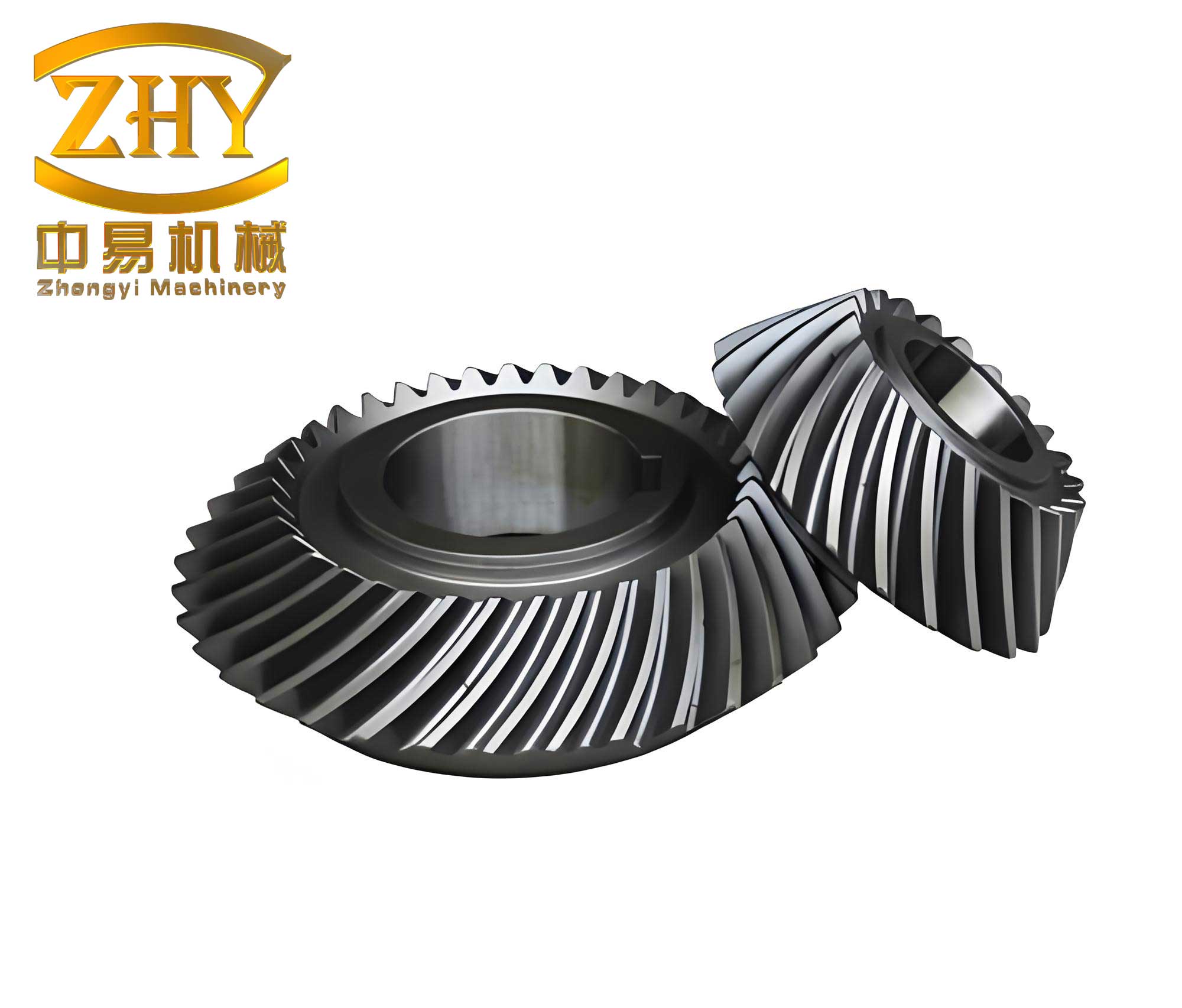
Next, we performed a macro-fractographic analysis on the failed spiral gear pair. The main spiral gear exhibited severe wear across most teeth, with tooth breakage at the larger end. The secondary spiral gear showed wear on the tooth tips, especially at the smaller end, and two teeth had fractured completely from the concave side (non-drive side), displaying brittle fracture characteristics. The fracture origins on the secondary spiral gear were traced to the concave surface, suggesting that the main spiral gear failed first, likely during reverse motion, which aligned with the driver’s account. This indicated that the spiral gear pair experienced excessive stress concentrations, possibly due to misalignment or material weaknesses.
To delve deeper, we conducted metallurgical tests on the spiral gear pair. The material specified by the supplier was 20CrMnTi. Chemical composition analysis using a direct-reading spectrometer yielded the following results:
| Element | Standard Range for 20CrMnTi (%) | Measured Value – Main Spiral Gear (%) | Measured Value – Secondary Spiral Gear (%) |
|---|---|---|---|
| C | 0.17–0.23 | 0.22 | 0.21 |
| Si | 0.17–0.37 | 0.28 | 0.29 |
| Mn | 0.80–1.10 | 0.86 | 0.84 |
| Cr | 1.00–1.30 | 1.11 | 1.06 |
| Ti | 0.04–0.10 | 0.071 | 0.069 |
| S | ≤0.035 | 0.003 | 0.006 |
| P | ≤0.035 | 0.017 | 0.017 |
The composition met GB/T3077-1999 standards for 20CrMnTi, so the issue lay elsewhere. We then performed metallographic examination and hardness testing on the spiral gear pair. For the main spiral gear, the results were concerning:
| Test Item | Standard Requirement | Detection Result |
|---|---|---|
| Carbides | Grade 1–4 | Grade 7 (excessive, networked) |
| Martensite + Retained Austenite | Grade 1–4 | Grade 3, but with bainite and troostite |
| Core Ferrite | Grade 1–5 | Grade 3 |
| Effective Case Depth | 1.10–1.50 mm | 0.57 mm (insufficient) |
| Non-Martensite Layer | ≤0.02 mm | 0.04 mm at tooth face, 0.06 mm at root |
| Core Hardness | 29–46 HRC | 26 HRC (below specification) |
| Surface Hardness | 58–64 HRC | Unmeasurable due to wear |
The hardness gradient of the main spiral gear’s carburized layer was steep, with variations exceeding acceptable limits. The hardness values at different depths from the surface are summarized below, illustrating the rapid decline:
| Distance from Surface (mm) | Hardness (HV1) |
|---|---|
| 0.10 | 738 |
| 0.20 | 702 |
| 0.40 | 627 |
| 0.50 | 612 |
| 0.60 | 526 |
The effective case depth, where hardness drops to 550 HV1, was only 0.57 mm, far below the required 1.10–1.50 mm. This insufficient hardening compromised the spiral gear’s load-bearing capacity. For the secondary spiral gear, the findings were slightly better but still problematic:
| Test Item | Standard Requirement | Detection Result |
|---|---|---|
| Carbides | Grade 1–4 | Unmeasurable due to wear |
| Martensite + Retained Austenite | Grade 1–4 | Grade 2 |
| Core Ferrite | Grade 1–5 | Grade 6 (excessive) |
| Effective Case Depth | 1.10–1.50 mm | 1.2 mm |
| Non-Martensite Layer | ≤0.02 mm | 0.02 mm at tooth face, 0.03 mm at root |
| Core Hardness | 29–46 HRC | 29 HRC (at lower limit) |
| Surface Hardness | 58–64 HRC | Unmeasurable due to wear |
The hardness gradient for the secondary spiral gear was more gradual, as shown below:
| Distance from Surface (mm) | Hardness (HV1) |
|---|---|
| 0.10 | 783 |
| 0.20 | 776 |
| 0.40 | 740 |
| 0.60 | 682 |
| 0.80 | 638 |
| 1.00 | 595 |
| 1.20 | 550 |
| 1.30 | 510 |
However, the core hardness was at the lower specification limit, and excessive ferrite in the core indicated inadequate quenching cooling rates. The spiral gear’s tooth tips showed severe wear and phase transformation, suggesting localized overheating during service. The fracture origins in the secondary spiral gear were at the tooth roots, propagating rapidly inward, consistent with brittle failure due to material embrittlement.
We also inspected other components. The differential housing exhibited a hardness of 207 HB, with a microstructure of pearlite and networked ferrite, indicating normalizing treatment. However, the bolt holes had deformed, with an average shrinkage of 0.21 mm and indentations up to 0.34 mm deep, likely from excessive bolt hardness. The bolts used to secure the secondary spiral gear were M12×1.25×25-10.9 grade, with a hardness of 37 HRC (approx. 341 HB). The effective thread engagement length was only 10 mm, which is suboptimal for such applications; a minimum of 15 mm is recommended based on engineering practice. The bolt hardness was significantly higher than the differential housing’s hardness (207 HB), creating a mismatch that promoted deformation and wear under load. The bolt microstructure consisted of tempered troostite, which is normal, but the hardness disparity exacerbated stress concentrations in the spiral gear assembly.
Synthesizing the data, the root cause of the spiral gear pair failure was multi-faceted. Primarily, the actual maximum input torque capacity of the axle’s main reduction unit fell short of the design value due to material and heat treatment flaws. The spiral gear pair, especially the main spiral gear, suffered from inadequate carburizing and quenching processes, leading to insufficient case depth, excessive carbides, and low core hardness. This compromised the spiral gear’s ability to withstand transient overloads, such as those encountered on muddy terrain. The differential housing’s low hardness and bolt mismatches further exacerbated the issue by allowing component movement and偏载 (eccentric loading), concentrating stresses on the spiral gear teeth. The calculated engine-derived torque (11371.5 N·m) approached the axle’s limit, but with material weaknesses, the spiral gear pair failed at lower actual torques. Essentially, the spiral gear’s metallurgical properties did not align with the operational demands, causing premature brittle fracture and tooth breakage.
To address these issues, we implemented several corrective measures in collaboration with the axle supplier. First, we changed the spiral gear material from 20CrMnTi to 20CrMnMoH. The latter offers better toughness and lower temper brittleness sensitivity, enhancing impact resistance for the spiral gear pair. Second, we revised the technical specifications: core hardness was raised to a minimum of 37 HRC, and surface hardness was controlled around 60 HRC. This adjustment increases the spiral gear’s torque capacity theoretically to approximately 12800 N·m, providing a safety margin. The relationship between hardness and torque capacity can be expressed empirically as:
$$T_{\text{max}} \propto H_v \times \sqrt{b}$$
where \(T_{\text{max}}\) is the maximum tolerable torque, \(H_v\) is the Vickers hardness, and \(b\) is the case depth. By improving both parameters, the spiral gear’s performance is enhanced. Third, we enforced stricter heat treatment controls, requiring third-party inspection reports for each batch of spiral gears, with periodic in-house metallurgical checks. Fourth, we increased the bolt length to ensure adequate thread engagement, reducing the risk of loosening. Fifth, we re-evaluated bolt selection to match hardness with surrounding components, minimizing deformation risks. Sixth, we added cone bearing clearance inspections during incoming quality control to prevent axial movement of the spiral gear pair. Seventh, we recalibrated design inputs to incorporate safety factors; based on experience, the calculated engine-derived torque should be at least 10% below the axle’s rated capacity to account for冲击 loads (shock loads) in off-road conditions. These modifications aim to fortify the spiral gear assembly against similar failures.
Since implementing these changes over a year ago, no further failures of this nature have been reported, validating the effectiveness of our analysis and corrective actions. The spiral gear pair, as a pivotal element in drive axles, requires meticulous attention to material selection, heat treatment, and system integration. This case underscores the importance of holistic vehicle matching, where components like the spiral gear must be optimized not just individually but within the entire powertrain context. Continuous monitoring and refinement of manufacturing processes are essential to ensure reliability in demanding applications. Through this detailed failure analysis, we have reinforced that the spiral gear’s integrity is paramount for vehicle performance, and proactive measures can prevent recurrence, ultimately enhancing product longevity and customer satisfaction.
In conclusion, the failure of the spiral gear pair in the tandem drive axle was primarily due to metallurgical deficiencies exacerbated by component mismatches. By addressing these through material upgrades,工艺优化 (process optimization), and design tweaks, we have improved the spiral gear’s durability. This experience highlights the critical role of spiral gears in automotive systems and the need for rigorous testing and validation. Future developments will focus on advancing spiral gear technologies, such as exploring advanced coatings or alloy modifications, to push the boundaries of performance in specialized vehicles. The lessons learned here serve as a benchmark for similar analyses, ensuring that spiral gear pairs continue to deliver reliable power transmission under diverse operating conditions.