
In industrial applications, gear shafts in reducers are critical components that transmit torque and motion, often under high loads and cyclic conditions. Prolonged operation in such environments leads to stress concentration, material degradation, and eventual fatigue failure. Understanding the fatigue mechanisms of gear shaft fractures and implementing effective prevention strategies are essential for enhancing operational safety and extending service life. This article delves into the fatigue behavior of gear shafts, covering material properties, stress analysis, crack propagation, detection methods, and preventive measures, with a focus on practical solutions supported by data, formulas, and tables.
Fatigue in gear shafts typically initiates from microscopic defects under alternating stresses, progressing to macroscopic cracks and final fracture. The gear shaft’s performance is influenced by material selection, design geometry, and operational conditions. For instance, common materials like 42CrMo alloy steel, 20CrMnTi carburized steel, and 40Cr quenched and tempered steel exhibit varying fatigue limits and resistance to crack initiation. In this analysis, we explore how optimizing these factors can mitigate fatigue risks. Additionally, we incorporate dynamic monitoring and maintenance protocols to proactively address potential failures. Throughout this discussion, the term ‘gear shaft’ will be emphasized to underscore its centrality in reducer systems.
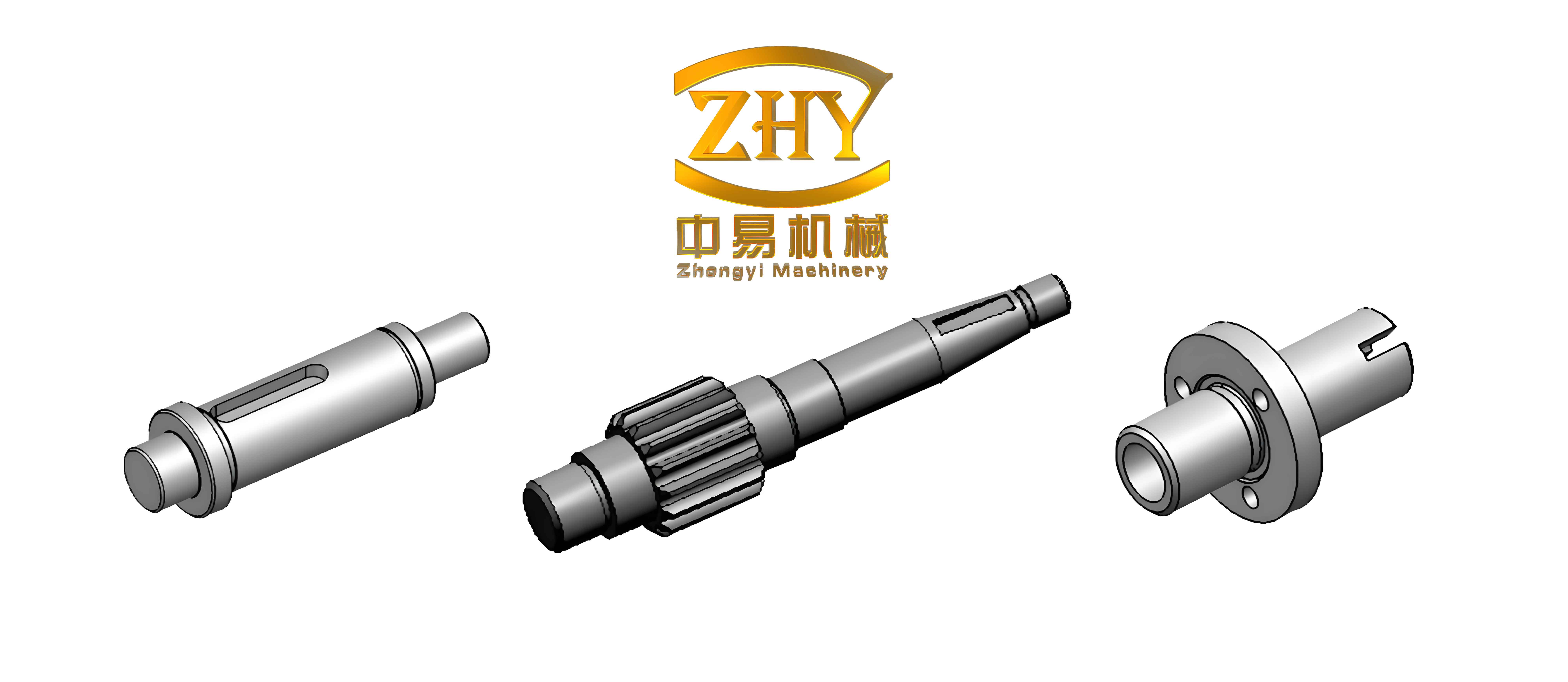
The fatigue life of a gear shaft is governed by the relationship between applied loads and material endurance. Under cyclic loading, stress concentrations at geometric discontinuities such as shoulders, keyways, and fillets accelerate fatigue damage. The stress intensity factor, denoted as \( K \), plays a crucial role in crack growth. For a gear shaft subjected to bending and torsion, the equivalent stress can be calculated using the von Mises criterion:
$$ \sigma_{eq} = \sqrt{ \left( \frac{\sigma_x + \sigma_y}{2} \right)^2 + 3\tau_{xy}^2 } $$
where \( \sigma_x \) and \( \sigma_y \) are normal stresses, and \( \tau_{xy} \) is the shear stress. In fatigue analysis, the stress amplitude \( \sigma_a \) and mean stress \( \sigma_m \) determine the fatigue limit. The Goodman relation is often applied to account for mean stress effects:
$$ \frac{\sigma_a}{\sigma_e} + \frac{\sigma_m}{\sigma_u} = 1 $$
Here, \( \sigma_e \) is the endurance limit, and \( \sigma_u \) is the ultimate tensile strength. For a gear shaft made of 42CrMo steel, with \( \sigma_u \approx 850 \, \text{MPa} \) and \( \sigma_e \approx 400 \, \text{MPa} \), the allowable stress amplitude decreases as mean stress increases, highlighting the importance of load management.
Material fatigue characteristics vary significantly among common gear shaft materials. The following table summarizes key properties and their impact on fatigue performance:
| Material | Fatigue Limit (MPa) | Hardness (HRC) | Typical Applications | Fatigue Life Improvement with Treatment |
|---|---|---|---|---|
| 42CrMo Alloy Steel | 400 | 30-35 (base), 60 (after carburizing) | High-load, high-strength gear shafts | Up to 30% with carburizing and shot peening |
| 20CrMnTi Carburized Steel | 350 | 58-62 (surface) | High-speed, low-impact gear shafts | 20-25% with proper heat treatment |
| 40Cr Quenched and Tempered Steel | 380 | 28-32 | Medium-load gear shafts | 15-20% with shot peening |
As shown, 42CrMo offers superior fatigue resistance, especially after surface treatments like carburizing, which increases surface hardness to approximately 60 HRC. This enhancement is critical for gear shafts operating under repetitive stresses, as it delays crack initiation. The fatigue crack growth rate in a gear shaft can be modeled using Paris’ law:
$$ \frac{da}{dN} = C (\Delta K)^m $$
where \( da/dN \) is the crack growth per cycle, \( \Delta K \) is the stress intensity factor range, and \( C \) and \( m \) are material constants. For 42CrMo steel, typical values are \( C = 6.5 \times 10^{-12} \) and \( m = 3.0 \) for stress in MPa√m. This equation helps predict the remaining life of a gear shaft once a crack is detected, enabling timely maintenance.
Workload and fatigue stress are intimately linked in gear shaft performance. Torque transmission induces shear stresses, while radial and axial forces contribute to bending stresses. The combined effect can be expressed as:
$$ \tau_{max} = \frac{16T}{\pi d^3} $$
for torsion in a solid gear shaft of diameter \( d \) under torque \( T \), and bending stress \( \sigma_b = \frac{32M}{\pi d^3} \) for bending moment \( M \). In practice, dynamic loads cause stress fluctuations that accelerate fatigue. For example, in a gear shaft experiencing variable loads, the cumulative damage can be estimated using Miner’s rule:
$$ \sum \frac{n_i}{N_i} = 1 $$
where \( n_i \) is the number of cycles at stress level \( i \), and \( N_i \) is the fatigue life at that level. Monitoring these parameters through sensors like strain gauges allows for real-time assessment of gear shaft integrity.
Fatigue crack formation in a gear shaft begins at stress concentration zones, such as fillets or keyways, where microscopic slip leads to dislocation accumulation. Initially, cracks propagate slowly in a stable manner, but as \( \Delta K \) increases, the growth accelerates. The transition to unstable fracture occurs when \( K_{max} \) approaches the fracture toughness \( K_{IC} \) of the material. For 42CrMo, \( K_{IC} \approx 60 \, \text{MPa√m} \). Environmental factors like corrosion can exacerbate this process, reducing the fatigue limit by up to 50% in aggressive conditions. Thus, protective coatings and controlled environments are vital for gear shaft durability.
Detection of fatigue damage in gear shafts relies on non-destructive testing (NDT) methods. Magnetic particle testing is effective for surface cracks in ferromagnetic materials, while ultrasonic testing penetrates deeper to identify internal flaws. Acoustic emission monitoring captures elastic waves from active cracks, providing early warning. For instance, in a gear shaft under load, acoustic signals with frequencies above 100 kHz indicate crack propagation. Additionally, eddy current testing detects surface defects without contact. These techniques are complemented by microscopic analysis using scanning electron microscopy (SEM), which reveals fatigue striations and crack origins. In one case, SEM of a fractured gear shaft showed striation spacing of 2 μm, corresponding to a crack growth rate of 1 μm per cycle at 30 Hz loading.
To prevent gear shaft fatigue fractures, multiple strategies are employed. Material optimization involves selecting high-strength steels and applying surface treatments. Carburizing, for example, diffuses carbon into the gear shaft surface, creating a hard case while maintaining a tough core. The resulting hardness gradient improves resistance to wear and fatigue. Shot peening introduces compressive residual stresses, which counteract tensile stresses from loads. The magnitude of these stresses can be quantified as:
$$ \sigma_{res} = -K_p \cdot \sigma_{applied} $$
where \( K_p \) is a peening factor, typically ranging from 0.5 to 0.8. This treatment can increase the fatigue life of a gear shaft by over 30%, as demonstrated in experimental data.
Design improvements focus on reducing stress concentrations. Increasing fillet radii at gear shaft shoulders smooths stress transitions, lowering the stress concentration factor \( K_t \). For example, enlarging a radius from 1 mm to 3 mm reduces \( K_t \) from 2.5 to 1.8, boosting fatigue life by 35%. Similarly, using rounded keyways instead of sharp ones minimizes stress risers. Finite element analysis (FEA) can simulate stress distributions in a gear shaft, guiding optimal geometry changes. The table below compares design modifications and their impact:
| Design Feature | Modification | Stress Concentration Factor Reduction | Fatigue Life Improvement |
|---|---|---|---|
| Shaft Shoulder | Increase fillet radius | 2.5 to 1.8 | 35% |
| Keyway | Use rounded design | 2.2 to 1.7 | 20% |
| Bearing Fit | Optimize interference fit | 1.9 to 1.5 | 15% |
Dynamic load monitoring and operational optimization are crucial for extending gear shaft life. Sensors such as accelerometers and strain gauges collect real-time data on load variations. By analyzing stress spectra, operators can adjust parameters like speed or load to minimize peaks. For instance, reducing rotational speed by 10% in a gear shaft system can decrease stress amplitude by 15%, significantly prolonging fatigue life. Environmental controls, such as maintaining low humidity and applying anti-corrosion coatings, further protect the gear shaft from accelerated degradation.
Maintenance strategies include preventive inspections and lifetime management. Regular NDT checks, such as ultrasonic testing every 6 months, can detect cracks early, reducing failure rates by 15%. Online monitoring with acoustic emission sensors enables real-time interventions, cutting downtime and extending service life by up to 35%. Lifetime prediction models, based on fatigue accumulation, help schedule replacements before critical failure. For example, replacing a gear shaft at 90% of its predicted life prevents unexpected breakdowns. The effectiveness of different maintenance approaches is summarized in the following table:
| Maintenance Strategy | Failure Rate Reduction (%) | Service Life Extension (%) |
|---|---|---|
| Regular Inspection and Maintenance | 15 | 20 |
| Online Monitoring and Real-Time Maintenance | 30 | 35 |
| Lifetime Management | 25 | 28 |
In conclusion, addressing gear shaft fatigue requires a holistic approach combining material science, mechanical design, and proactive maintenance. By optimizing materials like 42CrMo with surface treatments, improving geometric details to lower stress concentrations, monitoring dynamic loads, and implementing robust maintenance plans, the fatigue resistance of gear shafts can be significantly enhanced. This not only improves reliability but also reduces operational costs. Future work could focus on advanced modeling techniques, such as machine learning for predictive analytics, to further refine gear shaft performance in demanding applications.
The integration of these measures ensures that gear shafts operate safely under high-cycle fatigue conditions, ultimately contributing to the longevity and efficiency of reducer systems. Continuous research and development in this field will lead to even more resilient gear shaft designs, capable of withstanding increasingly harsh environments.