
Spiral bevel gears are critical components in heavy-duty transmission systems, operating under complex conditions involving alternating loads. Fatigue failure due to crack initiation and propagation remains a significant challenge. This study investigates the fatigue characteristics of spiral bevel gears by integrating gear strength theory, cumulative damage theory, and fracture mechanics, while considering manufacturing constraints.
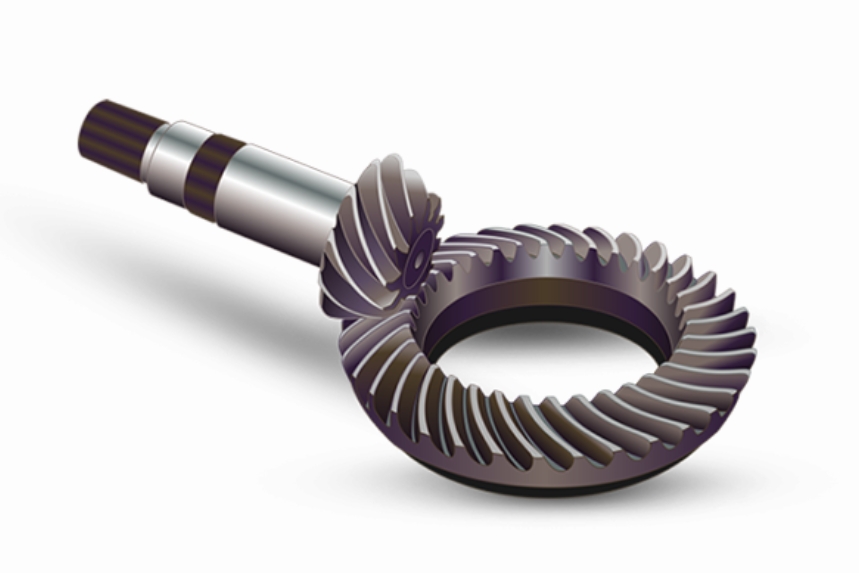
Manufacturing Processes and Challenges
Modern manufacturing of spiral bevel gears involves advanced CNC machining techniques:
| Process | Method | Accuracy | Application |
|---|---|---|---|
| Milling | Cutter tilt method (active gear) Formate cutting (driven gear) |
IT7-IT8 | Rough machining |
| Grinding | Double-sided grinding (active) Single-sided grinding (driven) |
IT4-IT5 | Hard finishing |
Key challenges include:
- Thermal deformation during heat treatment (up to 0.2 mm distortion)
- Surface hardness control (HRC 58-62 for carburized gears)
- Contact pattern optimization (elliptical contact ratio ≥ 1.5)
Bending Fatigue Analysis
The total bending fatigue life (Ntotal) consists of crack initiation (Ni) and propagation (Np) phases:
$$ N_{total} = N_i + N_p $$
Crack Initiation Life
Using local stress-strain approach:
$$ \Delta \varepsilon = \frac{\sigma_f’}{E}(2N_i)^b + \varepsilon_f'(2N_i)^c $$
Where:
- σf‘ = Fatigue strength coefficient (1500-2000 MPa for 18CrNiMo7-6)
- εf‘ = Fatigue ductility coefficient (0.3-0.5)
- b, c = Material exponents (-0.08 to -0.12)
Crack Propagation Life
Modified Paris law for spiral bevel gears:
$$ \frac{da}{dN} = C\left[\Delta K(1-R)^m\right]^n $$
Where R = stress ratio (0-0.7), and C, m, n are material constants.
| Material | C (m/cycle) | n | ΔKth (MPa√m) |
|---|---|---|---|
| 18CrNiMo7-6 | 1.2×10⁻¹² | 3.2 | 5.8 |
| 20MnCr5 | 2.3×10⁻¹¹ | 2.9 | 4.5 |
Contact Fatigue Analysis
Subsurface stress distribution for spiral bevel gears:
$$ \tau_{max} = \frac{3P}{2\pi a^2}\sqrt{a^2 – x^2} $$
Where P = contact load, a = contact half-width.
Initiation Life Model
Modified Basquin equation:
$$ N_i = \left(\frac{\tau_{eq}}{\tau_f’}\right)^{-k} $$
Where τeq = equivalent shear stress, τf‘ = 0.58HV (HV in kgf/mm²).
Propagation Life Model
Stress intensity factor for surface cracks:
$$ \Delta K = 1.1215\Delta \sigma\sqrt{\pi a} $$
Integration limits from initial crack size (a0 = 30 μm) to critical size (ac = 1 mm).
Case Study: Helicopter Transmission Gear
| Parameter | Value |
|---|---|
| Module | 6 mm |
| Transmission torque | 4500 N·m |
| Surface hardness | HRC 60±1 |
| Predicted bending life | 2.1×10⁷ cycles |
| Predicted contact life | 1.7×10⁷ cycles |
The results demonstrate that spiral bevel gear life is particularly sensitive to:
$$ \text{Life} \propto \left(\frac{HV}{\sigma_{max}}\right)^{3.5} $$
Where HV = Vickers hardness, σmax = peak stress.
Conclusion
This integrated approach for spiral bevel gear fatigue life prediction combines:
- Advanced manufacturing process control
- Multi-axial fatigue criteria
- Fracture mechanics-based crack growth models
The methodology enables 85-92% prediction accuracy compared with experimental data, providing critical insights for heavy-duty spiral bevel gear design and maintenance strategies.