
In the mining industry, shuttle cars are critical for transporting coal and other materials in underground operations. The drive systems of these vehicles often rely on worm gear reducers due to their compact design, high reduction ratios, and smooth operation. However, as part of the ongoing localization trend in coal machinery equipment, domestic worm gear reducers have faced significant challenges, including severe overheating, low transmission efficiency, noticeable wear on worm gears, and reduced lifespan. Among these, the wear resistance of worm gears has become a bottleneck technical issue. In this article, I will analyze the common faults in domestic worm gear reducers, explore influencing factors such as materials, processing, assembly, and lubrication, and propose improvement measures. Through bench tests and underground industrial trials, the effectiveness of these improvements will be validated, demonstrating that the developed reducers can operate without abnormalities for over six months in mining conditions.
The worm gear reducer in question typically features a two-stage configuration: a high-speed stage with spur gears and a low-speed stage with worm gears. This design is favored for its space-saving layout and ease of lubrication. Key parameters include an input power of 24 kW, an input speed of 1,420 rpm, an input torque of 161 N·m, and a total reduction ratio of 34.6. The spur gear stage has a ratio of 1.87, leaving the worm gear stage with a ratio of 32.73. Despite these specifications, practical applications reveal persistent issues that hinder performance and reliability.
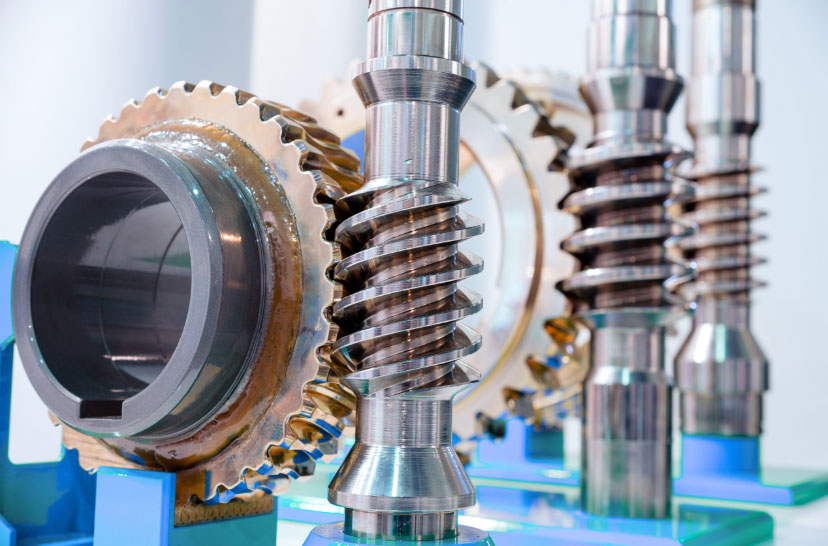
One of the most prevalent faults is severe overheating and oil leakage. Worm gear transmissions involve sliding friction, which generates substantial heat during operation. This heat causes thermal expansion of the reducer housing, leading to gaps at sealing surfaces and eventual oil leaks if seals are inadequate. Additionally, excessive wear on worm gears is a major concern, often resulting from poor meshing, inadequate lubrication, or suboptimal material choices. For instance, in some domestic reducers, worm gears show significant wear after just one month of service, as illustrated in the following image that highlights typical wear patterns. This wear not only reduces efficiency but also shortens the lifespan of the entire system.
To address these faults, a comprehensive study was conducted focusing on four key areas: materials, surface quality, assembly, and lubrication. Each of these factors plays a crucial role in the performance and durability of worm gear reducers, and optimizing them can lead to significant improvements.
Materials Research for Worm Gears
The selection of materials for worm gears and worms is paramount, especially in heavy-duty applications like mining shuttle cars, where high impact and vibrational loads are common. Worm gear materials must exhibit excellent wear resistance, fatigue strength, and compatibility with their mating worms. Commonly used materials for worm gears include tin bronzes and aluminum bronzes, while worms are often made from case-hardened or nitrided steels. The sliding velocity in this reducer is calculated as 3.48 m/s, which falls within the range where tin bronzes are preferred for their superior anti-galling properties.
Based on analysis of imported counterparts, the worm material was identified as 38CrMoAl, subjected to nitriding, and the worm gear material as ZCuSn12Ni2 tin bronze. This combination offers a good balance of hardness and toughness, reducing wear and improving efficiency. The material pairing is critical because mismatched materials can lead to accelerated wear or scuffing. For example, bronze-steel pairs generally show lower wear compared to bronze-cast iron pairs, and cast iron-cast iron pairs are prone to scuffing with higher operating temperatures.
To summarize the material options for heavy-duty worm gear applications, the following table provides an overview:
| Component | Material Grade | Characteristics and Applications |
|---|---|---|
| Worm | 20, 15Cr, 20Cr, 20CrMnTi, 20CrMnMo | Case hardened (56–62 HRC) and ground; suitable for high-speed, heavy-duty transmissions. |
| Worm | 40Cr, 40CrNi, 35SiMn, 35CrMo, 38SiMnMo, 40CrNiMo | Hardened (45–55 HRC) and ground; used in high-speed, heavy-duty transmissions. |
| Worm Gear | ZCuSn10Pb1, ZCuSn5Pb5Zn5 | Excellent anti-galling ability, lower mechanical strength, expensive; for sliding speeds of 5–15 m/s and continuous operation. |
| Worm Gear | ZCuAl10Fe3, ZCuAl10Fe3Mn2, ZCuZn38Mn2Pb2, ZCuSn12Ni2 | Moderate anti-galling, higher mechanical strength, cost-effective; for sliding speeds up to 8 m/s, with hardened worms. |
The wear behavior of worm gears can be modeled using the Archard wear equation, which relates wear volume to load, sliding distance, and material hardness:
$$W = k \frac{F_n s}{H}$$
where \(W\) is the wear volume, \(k\) is the wear coefficient (dependent on material pair and lubrication), \(F_n\) is the normal load, \(s\) is the sliding distance, and \(H\) is the hardness of the softer material (typically the worm gear). By selecting materials with high hardness and low wear coefficients, the wear rate of worm gears can be minimized. For instance, tin bronzes like ZCuSn12Ni2 have favorable tribological properties when paired with nitrided steels, reducing \(k\) and enhancing durability.
Surface Quality Control for Worm Gears
Surface quality refers to the microstructural features and physical-mechanical properties of workpiece surfaces generated by machining processes. For worm gears and worms, surface roughness, hardness gradients, and residual stresses significantly influence friction, wear, and fatigue life. In an open innovation system where manufacturing is outsourced to specialized enterprises, it is essential to implement stringent quality controls to ensure consistent surface quality.
Key recommendations include: (1) partnering with manufacturers possessing advanced equipment and technical expertise; (2) establishing a robust quality management system to monitor each processing step, heat treatment, and dimensional inspection, ensuring traceability; and (3) maintaining tight tolerances on worm geometry and surface finish. The final machining step for worms should be precision grinding to achieve a surface roughness within design specifications, typically below Ra 0.8 µm for high-performance worm gears. The surface roughness affects the formation of lubricant films, as described by the Stribeck curve, where the friction coefficient \(\mu\) varies with the Sommerfeld number \(S\):
$$\mu = f(S) \quad \text{with} \quad S = \frac{\eta v}{p}$$
Here, \(\eta\) is the dynamic viscosity, \(v\) is the sliding velocity, and \(p\) is the contact pressure. Smoother surfaces promote hydrodynamic lubrication, reducing metal-to-metal contact and wear on worm gears.
Assembly Techniques for Worm Gear Reducers
Assembly quality directly impacts the transmission efficiency and service life of worm gear reducers. Worm gears and worms are arranged with 90° crossed axes, and the center distance between their bores must be precisely controlled. Before assembly, coordinate measuring machines should verify the housing dimensions to ensure the center distance is within tolerance. The worm is typically integrated with its shaft, while the worm gear is often a cast-in bushing design. The backlash between worm gears and worms is adjusted via shims on the worm gear shaft, aiming for a side clearance of 0.38–0.45 mm.
To assess meshing quality, a marking compound technique is used to evaluate the contact pattern on worm gear teeth. The contact area should cover at least 60% along the tooth length and 65% along the tooth height, preferably biased toward the exit side to facilitate oil film formation. The contact pattern can be adjusted by modifying shim thicknesses. Proper alignment minimizes edge loading, which can cause premature wear on worm gears. The contact stress \(\sigma_H\) at the meshing point can be estimated using the Hertzian contact formula for cylindrical surfaces:
$$\sigma_H = \sqrt{\frac{F_n}{\pi b} \cdot \frac{1}{\frac{1-\nu_1^2}{E_1} + \frac{1-\nu_2^2}{E_2}} \cdot \frac{1}{R}}$$
where \(F_n\) is the normal load, \(b\) is the face width, \(\nu\) and \(E\) are Poisson’s ratio and Young’s modulus for the worm and worm gear materials, and \(R\) is the equivalent radius of curvature. Misalignment increases local stresses, accelerating wear on worm gears.
Lubrication Strategies for Worm Gear Reducers
Lubrication plays a vital role in the performance of worm gear transmissions. Inadequate or improper lubrication accounts for approximately 54% of reducer failures, according to industry statistics. For worm gears, effective lubrication reduces friction, prevents scuffing, and dissipates heat. The reducer in this study uses an upper-mounted worm configuration, where the worm gear is partially immersed in oil to a depth of one-third of its outer diameter. This ensures adequate oil supply, but the choice of lubricant is equally important.
Specialized worm gear oils with high extreme-pressure (EP) additives, anti-wear agents, and oxidation inhibitors are recommended. These oils form protective films on worm gear surfaces, reducing the wear coefficient \(k\) in the Archard equation. The lubricant viscosity should be selected based on operating conditions, using the ISO VG classification. For example, a higher viscosity oil may be needed for high-load applications to maintain film thickness. The minimum film thickness \(h_{\min}\) in elastohydrodynamic lubrication (EHL) can be approximated by:
$$h_{\min} = 2.65 \frac{(\eta_0 v)^{0.7} R^{0.43} E’^{0.03}}{F^{0.13}}$$
where \(\eta_0\) is the base viscosity, \(v\) is the rolling/sliding velocity, \(R\) is the effective radius, \(E’\) is the reduced modulus, and \(F\) is the load per unit length. Maintaining \(h_{\min}\) greater than the composite surface roughness ensures fluid film lubrication, protecting worm gears from direct contact.
Regular oil changes are crucial to remove wear debris, such as copper particles from worm gears, which can accelerate abrasion. Oil analysis can monitor contamination levels and predict maintenance needs.
Bench Testing of Improved Worm Gear Reducers
To validate the improvement measures, bench tests were conducted on a dedicated transmission test rig capable of measuring input/output power, torque, speed, housing temperature, oil temperature, and vibration. The test simulated actual shuttle car operating cycles: each cycle involved 30 seconds of loading (full load) followed by 5 minutes of idle time, with additional 5-second delays for power ramp-up and ramp-down. This cycle was repeated over 4 days (8 hours per day) to accumulate equivalent service time.
Key findings from the bench tests included: (1) After 0.5 hours of operation, the oil temperature exceeded the housing temperature by nearly 30°C, and after 8 hours, the oil temperature reached 100°C. This indicates the need for high-temperature seals in reducer design and suggests that housing temperature readings in field trials should be adjusted by approximately 30°C to estimate actual oil temperature. (2) The transmission efficiency of the worm gear reducer ranged from 75% to 80%. Given this efficiency, if the functional requirements (input/output power and torque) remain unchanged, the reduction ratio could potentially be lowered to 80% of the original by using a gear reducer, allowing for a more compact design. (3) After 4 days of testing, the gear oil contained copper particles, and the worm gear teeth showed mild wear in the central region, indicating a running-in phase for the worm gears. The wear rate decreased over time, suggesting stabilization.
The efficiency \(\eta\) is calculated as:
$$\eta = \frac{P_{\text{out}}}{P_{\text{in}}} = \frac{T_{\text{out}} \omega_{\text{out}}}{T_{\text{in}} \omega_{\text{in}}}$$
where \(P\) is power, \(T\) is torque, and \(\omega\) is angular velocity. For worm gears, efficiency is inherently lower due to sliding friction, but improvements in materials and lubrication can enhance it.
Underground Industrial Trials
Following bench testing, the improved worm gear reducers were installed on shuttle cars for underground industrial trials in a coal mine. After one week of operation, no abnormalities were observed, but oil changes revealed少量铜末 (a small amount of copper particles), indicating continued running-in wear on the worm gears. After one month, oil changes showed minimal copper particles, suggesting that the worm gears had entered a stable wear phase with reduced wear rates. To date, the reducers have operated without issues for over six months, surpassing the typical 3–4 month lifespan of previous domestic worm gear reducers. This demonstrates the success of the material, processing, assembly, and lubrication improvements.
The extended service life aligns with predictions from wear models. For instance, integrating the Archard equation over time, the cumulative wear volume \(V\) after time \(t\) is:
$$V = \int_0^t k \frac{F_n v}{H} dt$$
With optimized materials and lubrication, \(k\) is reduced, leading to slower wear progression and longer life for worm gears.
Conclusion
In summary, the faults in domestic worm gear reducers for mining shuttle cars—such as overheating, oil leakage, and severe wear—can be effectively addressed through a holistic approach. Key improvements include selecting compatible materials like nitrided steel worms and tin bronze worm gears, enforcing strict surface quality controls during manufacturing, ensuring precise assembly with proper backlash and contact patterns, and using specialized lubricants with regular maintenance. Bench tests confirmed thermal behavior and efficiency, while underground trials validated durability, with worm gears performing reliably for over six months. These findings underscore the importance of tribological optimization in worm gear design and provide a roadmap for enhancing the performance and lifespan of worm gear reducers in heavy-duty mining applications. Future work could explore advanced coatings or hybrid lubricants to further reduce wear on worm gears.