
In the field of aerospace engine accessory transmission, the demand for higher speeds and load capacities has driven the development of advanced testing equipment. As a key component, multi-stage transmission gearboxes, particularly those incorporating bevel gears for directional changes, are critical for simulating real-world conditions. However, these systems often face challenges related to the reliability of high-speed shafts, especially when equipped with rolling bearings. In this article, I will share my experience in diagnosing and improving a high-speed shaft failure in a multi-stage bevel gear transmission system, focusing on the impact of axial forces and shaft deformations on bearing life. By employing exhaustive methods and analytical calculations, I aim to provide a comprehensive approach to enhancing the durability of such systems, with an emphasis on the role of bevel gears in transmission dynamics.
The multi-stage bevel gearbox in question was designed for testing a new engine accessory gearbox, requiring high-speed operation under varying loads. Its configuration includes three stages: the first stage uses spiral bevel gears to increase speed and change transmission direction, while the second and third stages employ single helical gears for further speed augmentation. The output shaft is vertically oriented, with a horizontal input shaft at a 90-degree angle, making it suitable for high-speed applications. The use of bevel gears in the initial stage is crucial for efficient power transmission and directional change, but it also introduces complex forces that can affect downstream components. Below is a table summarizing the major parameters of this bevel gear transmission system.
| Parameter | Value |
|---|---|
| Rated Power (kW) | 780 |
| Maximum Power (kW) | 1,150 |
| Rated Input Speed (rpm) | 1,200 |
| Rated Output Speed (rpm) | 19,800 |
| Maximum Output Speed (rpm) | 24,700 |
| Design Life (hours) | ≥ 2,000 |
The output shaft, which is vertically arranged, is supported by paired spindle bearings at both ends. Specifically, angular contact ball bearings are used, with one end fixed to handle axial loads and the other end floating to accommodate thermal expansion. The bearings are numbered from top to bottom as 1, 2, 3, and 4, where bearings 3 and 4 form the fixed end, and bearings 1 and 2 are the floating end. This arrangement is common in high-speed bevel gear systems, but as I will discuss, it can lead to uneven load distribution and premature failure if not properly analyzed.
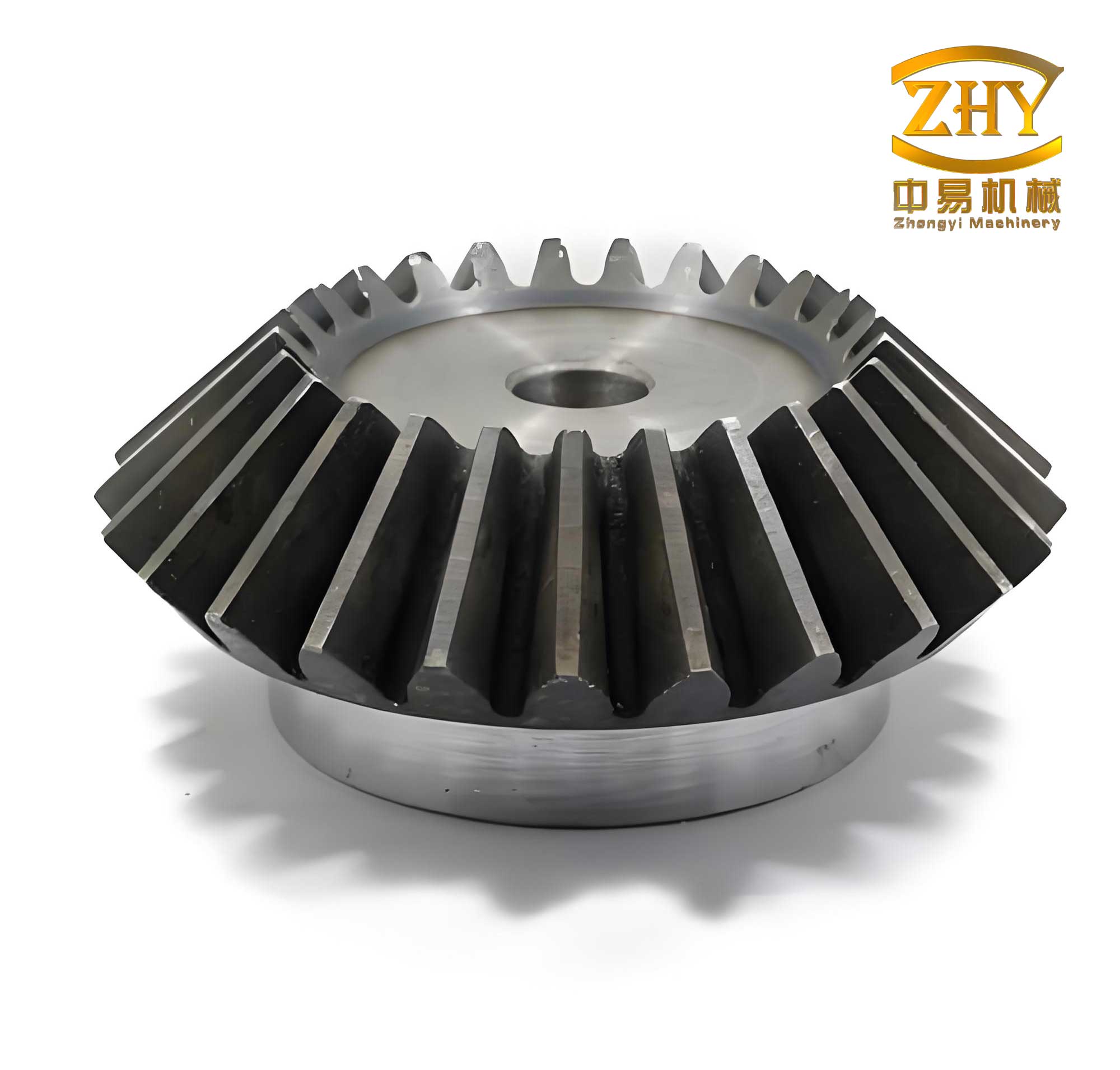
During operation, the gearbox exhibited severe vibration, increased bearing temperature, audible noise, and visible sparks after approximately 200 hours of full-load operation. Upon disassembly, it was found that bearing 3 had catastrophic failure, with its inner ring碎裂 and balls ejected, while bearing 4 showed significant damage. Adjacent components also displayed wear, indicating a systemic issue. This failure recurred after a repair, with similar symptoms, prompting a deeper investigation into the root cause. The involvement of bevel gears in the transmission chain meant that axial forces generated during operation could not be ignored, as they directly influenced the bearing loads.
To diagnose the fault, I first considered the standard bearing life calculation, which often overlooks axial forces and shaft deformations. For angular contact ball bearings, the basic rating life is given by the formula:
$$L_{h10} = \frac{10^6}{n \times 60} \left( \frac{C}{P} \right)^\epsilon$$
where \(L_{h10}\) is the basic rating life in hours, \(C\) is the basic dynamic load rating in kN, \(P\) is the equivalent dynamic load in kN, \(n\) is the rotational speed in rpm, and \(\epsilon\) is the life exponent (3 for ball bearings). In the initial design, the equivalent load was calculated based on radial forces only, assuming that the axial force ratio was below a threshold. For bearing 3, the radial load \(F_{r3}\) was determined from the gear forces, and the axial load \(F_{a3}\) was considered minimal. However, this approach proved inadequate, as the actual operating conditions involved significant axial components from the bevel gears.
I developed a more comprehensive mechanical model of the output shaft, incorporating the effects of axial forces and shaft deformations. The gear forces include tangential \(F_t\), radial \(F_r\), and axial \(F_a\) components, which are inherent in bevel gear interactions. Using static equilibrium, the loads on bearing 3 were recalculated as:
$$F_{r3} = \frac{F_r \cdot a + M}{a + b}$$
$$F_{a3} = F_a$$
where \(a\) and \(b\) are distances from the gear to the bearing pairs, and \(M\) is the moment induced by the axial force. For the specific configuration, with \(F_r = 5.2 \, \text{kN}\) and \(F_a = 1.4 \, \text{kN}\), the ratio \(F_{a3}/F_{r3} = 0.27\), which is less than 1.09, leading to the initial assumption that axial effects were negligible. However, when shaft deformation due to bending and thermal expansion was factored in, the actual radial load on bearing 3 increased substantially.
To quantify this, I used MASTA software to create a finite element model of the output shaft, simulating the stress distribution under maximum load conditions. The results showed that bearing 3 experienced the highest stress, with a calculated basic rating life of only 183.7 hours, far below the design requirement of 2,000 hours. This aligned with the observed failure timeline. The table below summarizes the calculated lives for all bearings under the original configuration, considering ISO 281:2007 standards.
| Bearing Number | Basic Rating Life (hours) | Modified Rating Life (hours) |
|---|---|---|
| 1 | 25,458 | 127,2927 |
| 2 | 5,533 | 276,656 |
| 3 | 183.7 | 9,185 |
| 4 | 5,729 | 286,467 |
The drastic reduction in life for bearing 3 highlighted the need to account for axial forces and deformations in bevel gear systems. The axial load from the bevel gears, combined with shaft deflection, caused a misalignment that increased the radial load on the fixed-end bearing. This is a common issue in multi-stage transmissions where bevel gears are used, as they introduce non-symmetric forces that can destabilize the shaft alignment.
To address this, I proposed an improvement scheme based on an exhaustive enumeration of bearing arrangement forms. The goal was to find a configuration that would evenly distribute loads and extend bearing life. I considered six different arrangements, varying the orientation (O-type or X-type) and fixed/floating ends. The O-type arrangement refers to bearings mounted in a back-to-back configuration, while X-type is face-to-face; each has different stiffness and load-carrying characteristics. Below is a table comparing the basic rating lives for each arrangement, calculated using the same software and standards.
| Arrangement Form | Bearing 1 Life (hours) | Bearing 2 Life (hours) | Bearing 3 Life (hours) | Bearing 4 Life (hours) |
|---|---|---|---|---|
| Original (O-type, fixed at bottom) | 25,458 | 5,533 | 183.7 | 5,729 |
| Arrangement 1 (O-type, both ends fixed) | 98,614 | 3,981 | 157.9 | 8,632 |
| Arrangement 2 (X-type, both ends fixed) | 1,210,640 | 1,832,897 | 598 | 1,489 |
| Arrangement 3 (O-type top, X-type bottom fixed) | 10,450 | 4,254.7 | 1,663 | 389.3 |
| Arrangement 4 (O-type top fixed, X-type bottom floating) | 1,489,944 | 9,449,509.7 | 1,000 | 1,210 |
| Arrangement 5 (O-type top floating, X-type bottom fixed) | 18,011 | 3,636 | 2,120 | 344 |
| Arrangement 6 (O-type, fixed at top) | 368 | 3,773 | 1,969 | 1,243 |
From this analysis, Arrangement 4 emerged as the optimal choice, offering balanced life across all bearings and a significant improvement for bearing 3. In this configuration, bearings 1 and 2 are O-type and fixed at the top, while bearings 3 and 4 are X-type and floating at the bottom. This setup better accommodates the axial forces from the bevel gears and reduces shaft deformation effects. The modified rating life for bearing 3 in Arrangement 4 exceeded 1,000 hours, and when adjusted for the load spectrum, it could reach over 5,000 hours, meeting the design requirement.
The improvement was implemented by modifying the output shaft structure accordingly. After repair, the gearbox has been operating safely for two years, accumulating over 4,000 hours of runtime under various conditions without recurrence of the bearing failure. This success underscores the importance of considering axial forces and deformations in the design of multi-stage bevel gear transmission systems. The bevel gears, while efficient for directional changes, impose unique loads that must be carefully managed through appropriate bearing selection and arrangement.
To further elaborate on the theoretical aspects, the axial force generated by bevel gears can be derived from the gear geometry. For a spiral bevel gear, the axial force component \(F_a\) is related to the tangential force \(F_t\) and the gear pressure angle \(\alpha\) and spiral angle \(\beta\):
$$F_a = F_t \cdot \tan(\alpha) \cdot \sin(\beta)$$
This force contributes to the moment \(M\) on the shaft, which in turn affects the bearing loads. In high-speed applications, such as those involving bevel gears, dynamic effects like centrifugal forces and thermal expansion also play a role. The shaft deformation \(\delta\) due to bending can be estimated using beam theory:
$$\delta = \frac{F \cdot L^3}{3 \cdot E \cdot I}$$
where \(F\) is the applied force, \(L\) is the shaft length, \(E\) is the modulus of elasticity, and \(I\) is the area moment of inertia. When combined with axial forces from bevel gears, this deformation alters the bearing contact angles, increasing stress on specific bearings.
In practice, for multi-stage transmissions with bevel gears, I recommend using software tools like MASTA or ANSYS for comprehensive analysis. Additionally, regular monitoring of vibration and temperature can help detect early signs of bearing wear. The table below provides a checklist for diagnosing bearing failures in bevel gear systems, based on my experience.
| Symptom | Possible Cause | Recommended Action |
|---|---|---|
| High vibration | Unbalanced loads from bevel gears, bearing misalignment | Check gear mesh and bearing alignment; consider axial force analysis |
| Increased temperature | Excessive friction due to overloading or poor lubrication | Verify load distribution and lubricant flow; inspect bevel gear wear |
| Noise or sparking | Bearing fracture or gear tooth interference | Immediate shutdown and disassembly; review bearing life calculations |
| Short bearing life | Inadequate consideration of axial forces and shaft deformations | Re-evaluate bearing arrangement using exhaustive enumeration methods |
In conclusion, the fault diagnosis and improvement process for the high-speed shaft in this multi-stage bevel gear transmission system highlights the critical role of axial forces and shaft deformations in bearing life. By moving beyond standard calculations and employing an exhaustive approach to bearing arrangement, I was able to identify a configuration that ensures reliable operation. The integration of bevel gears in such systems offers advantages in compactness and efficiency, but it demands careful engineering to mitigate associated risks. This case study serves as a reference for similar applications, emphasizing the need for holistic analysis in the design of high-speed transmission systems.