
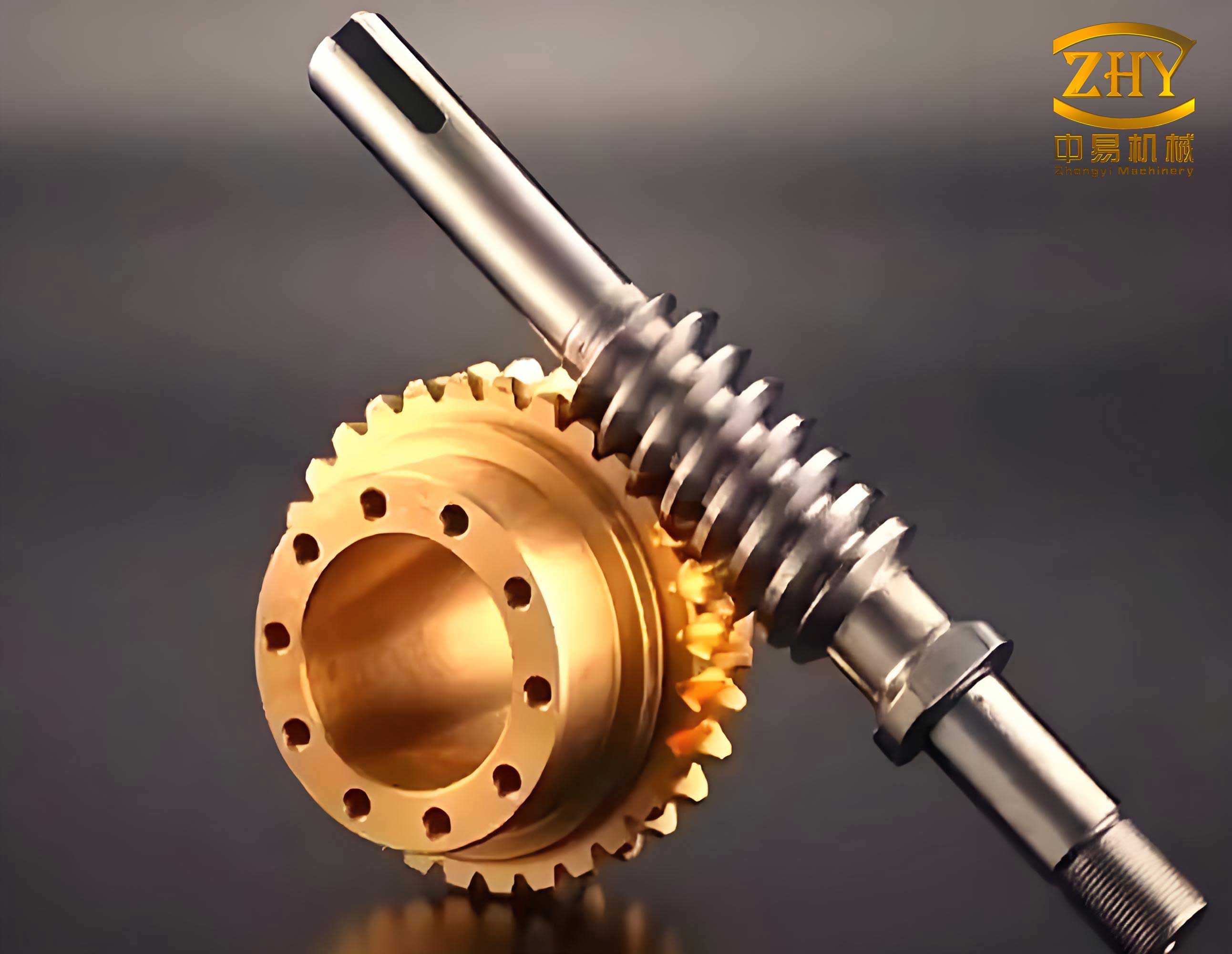
In modern mechanical systems, screw gears, commonly referred to as worm gears, play a critical role in power transmission due to their high reduction ratios and compact design. However, during operation, these screw gears are subjected to severe friction, elevated temperatures, and high-cycle fatigue, leading to failures such as pitting, spalling, and tooth breakage. Such faults can result in unpredictable economic losses and safety hazards. Therefore, condition monitoring and timely fault diagnosis of screw gear reducers are essential to extend service life, reduce maintenance downtime, and prevent catastrophic incidents. In recent years, intelligent algorithms like artificial neural networks (ANN) have been applied to fault identification of screw gears with promising results. Nonetheless, research on using fish swarm algorithm (FSA) and ant colony optimization (ACO) for screw gear fault diagnosis remains limited. To address this gap, we propose a hybrid improved FSA-ACO algorithm for fault identification of screw gears. This method combines the strengths of both algorithms, optimizing parameters for complementary advantages, and integrates it with fault recognition through a neighbor function criterion, establishing a novel diagnostic approach. We validate the feasibility and effectiveness of this method using a WPA40 model screw gear as a test case, demonstrating its potential for practical applications.
The core of our approach lies in the hybrid improvement of FSA and ACO algorithms. Initially, the fish swarm algorithm is employed for its rapid convergence properties, which help avoid premature convergence to locally optimal paths during the early stages. As shown in the optimization process, FSA efficiently explores the search space through behaviors such as foraging and swarming, guided by crowding degree concentrations. Subsequently, the ant colony algorithm is introduced to enhance global optimization and neighborhood search capabilities, preventing stagnation in local optima. This hybrid strategy leverages the similarity between the movement patterns of artificial fish and ants: both tend to move toward areas with higher concentrations (crowding degree for fish and pheromone for ants), and their collective behaviors—such as swarming in FSA and pheromone updating in ACO—depend on optimal states from partner centers or individuals. By integrating these algorithms, we achieve a synergistic effect where FSA narrows the global search scope, and ACO refines the solution with distributed parallel computing and heuristic search, ultimately improving convergence speed and accuracy while mitigating local extremum issues.
To apply the improved FSA-ACO algorithm to screw gear fault identification, we frame the problem as a pattern recognition task. Vibration signals from screw gear reducers are acquired via sensors, processed, and analyzed to extract feature vectors indicative of fault types. These features serve as samples for training and classification, mapping measurement sets to fault sets. In our methodology, we introduce a neighbor function criterion to handle the complex, non-proportional relationships between symptom sets \( F = \{F_1, F_2, \ldots, F_M\} \) and fault sets \( D = \{D_1, D_2, \ldots, D_N\} \). For any two samples \( y_i \) and \( y_j \) in the dataset, if \( y_j \) is the \( N \)-th neighbor of \( y_i \), and \( y_i \) is the \( M \)-th neighbor of \( y_j \), the neighbor function value \( \tau_{ij} \) is defined as:
$$ \tau_{ij} = N + M – 2 $$
During clustering, connections between samples within the same class incur a loss equal to their neighbor function value. The total intra-class loss \( L_{IA} \) and inter-class loss \( L_{IR} \) are given by:
$$ L_{IA} = \sum_{i=1}^{N} \sum_{j=1}^{N} \tau_{ij} $$
$$ L_{IR} = \sum_{i=1}^{C} \tau^t_{ij} $$
where \( C \) is a constant, and \( \tau^t_{ij} \) represents the inter-class loss for class \( i \). The clustering criterion function \( J_{NN} \) is then:
$$ J_{NN} = L_{IA} + L_{IR} = \sum_{i=1}^{N} \sum_{j=1}^{N} \tau_{ij} + \sum_{i=1}^{C} \tau^t_{ij} $$
Thus, screw gear fault identification reduces to minimizing \( J_{NN} \), transforming the diagnostic issue into an optimization problem solvable by our hybrid algorithm.
We construct a fault diagnosis model based on the improved FSA-ACO algorithm. Each screw gear fault sample, derived from vibration signal features, is treated as a location to be visited by artificial ants. The ants select visitation paths based on pheromone concentrations and neighbor function values, building ordered sequences that represent preliminary fault classifications. The algorithm proceeds as follows: First, we initialize parameters such as population size, perceptual distance, initial positions, maximum iterations, and crowding degree. Next, we establish a weighted Euclidean distance matrix \( A \) and a neighbor matrix \( M \) from the fault sample data, where the weighted distance between samples \( y_i \) and \( y_j \) is:
$$ A_{ij} = |A(y_i, y_j)| = \sqrt{\sum_{k=1}^{m} P_k (x_{ki} – x_{jk})^2} $$
Here, \( P_k \) is the weighting factor for different features, and \( M_{ij} \) is the neighbor function value of sample \( y_i \) to \( y_j \). We then construct a neighbor function matrix \( L \) with elements \( L_{ij} = M_{ij} + M_{ji} – 2 \), and initialize pheromone concentrations \( \tau_{ij}(0) = C \), where \( C \) is the crowding degree, facilitating the transition from FSA to ACO. The fish swarm algorithm is applied to prune the search space by eliminating fault samples with large weighted distance indicators, after which the ant colony algorithm takes over. Ants visit each fault sample location based on the neighbor function matrix and pheromone levels, with pheromone updates incorporating an elite strategy:
$$ \tau_{ij}(t+1) = \rho \tau_{ij}(t) + \Delta \tau_{ij} + \Delta \tau^*_{ij} $$
where \( \Delta \tau_{ij} = \sum_{k=1}^{m} \Delta \tau^k_{ij} \), \( \Delta \tau^k_{ij} = \frac{Q}{L_K} \) if edge \( (i,j) \) is part of ant \( k \)’s path, and 0 otherwise; \( \Delta \tau^*_{ij} = \frac{\sigma \cdot Q}{L^*} \) if edge \( (i,j) \) belongs to the best-found solution, and 0 otherwise. Here, \( \sigma \) is the number of elite ants, and \( L^* \) is the length of the optimal path. Ants choose paths probabilistically using:
$$ P^K_{ij} = \frac{[\tau_{ij}(t)]^\alpha \cdot [\eta_{ij}(t)]^\beta}{\sum_{s \in \text{allow}_K} [\tau_{ij}]^\alpha \cdot [\eta_{ij}(t)]^\beta}, \quad \text{if } j \in \text{allow}_K $$
with \( \eta_{ij}(t) \) as the heuristic function, \( \text{allow}_K \) as the set of unvisited cities for ant \( K \), and \( \alpha \) and \( \beta \) as factors controlling pheromone and heuristic importance. After all ants complete visits, connections with high neighbor function values are broken to form initial fault classifications, and the process iterates until \( J_{NN}(k) \) is minimized for all ants, yielding the final fault identification result.
To validate our approach, we conducted experiments on a vibration test system for screw gears, specifically using a WPA40 model worm gear reducer. The test bench comprised a servo drive motor, screw gear reducer, magnetic powder brake, vibration sensors, torque sensors, temperature sensors, couplings, an NI acquisition card, and a computer. The servo motor provided an input torque of 6 N·m at 1,000 rpm, driving the worm shaft, while the magnetic brake served as the load. Vibration signals were captured along the worm axis under different fault conditions, including normal state, pitting, spalling, and tooth breakage. Time-domain features such as mean value, standard deviation, peak indicator, waveform factor, kurtosis indicator, margin indicator, and impulse indicator were extracted from these signals, as summarized in the table below.
| Fault Symptom Indicator | Normal State | Pitting Fault | Spalling Fault | Tooth Breakage Fault |
|---|---|---|---|---|
| Mean Value | 7.04e-04 | 9.02e-04 | 2.71e-04 | 4.65e-04 |
| Standard Deviation | 5.99e-02 | 4.08e-02 | 9.97e-02 | 1.24e-01 |
| Peak Indicator | 8.0062 | 6.0155 | 8.9265 | 7.7691 |
| Waveform Factor | 1.2898 | 1.2877 | 1.3162 | 1.3282 |
| Kurtosis Indicator | 4.1699 | 3.8300 | 5.3840 | 5.6190 |
| Margin Indicator | 12.341 | 9.269 | 14.154 | 12.457 |
| Impulse Indicator | 19.190 | 13.456 | 21.302 | 19.732 |
These features were used as sample data for our hybrid algorithm. We defined weighted distance indicators, such as \( (X_{1k}, X_{2k}) \), \( (X_{2k}, X_{4k}) \), \( (X_{3k}, X_{6k}, X_{7k}) \), \( (X_{3k}, X_{4k}, X_{5k}) \), and \( (X_{3k}, X_{5k}, X_{6k}, X_{7k}) \), where \( X_{1k} \) to \( X_{7k} \) represent the seven time-domain parameters for ant \( K \). The algorithm was simulated with these inputs, and the diagnostic correctness rates for different fault symptoms were calculated, as shown in the following table.
| Weighted Distance Indicator | Normal State | Pitting Fault | Spalling Fault | Tooth Breakage Fault |
|---|---|---|---|---|
| \( (X_{1k}, X_{2k}) \) | 0.91 | 0.84 | 0.87 | 0.86 |
| \( (X_{2k}, X_{4k}) \) | 1 | 0.91 | 0.94 | 0.95 |
| \( (X_{3k}, X_{6k}, X_{7k}) \) | 1 | 0.86 | 0.90 | 0.89 |
| \( (X_{3k}, X_{4k}, X_{5k}) \) | 1 | 0.87 | 0.89 | 0.97 |
| \( (X_{3k}, X_{5k}, X_{6k}, X_{7k}) \) | 1 | 0.92 | 0.93 | 0.98 |
The simulation results indicate that our improved FSA-ACO algorithm achieved diagnostic correctness rates above 84% for all fault types, with errors within acceptable limits. These minor discrepancies may stem from factors such as alignment inconsistencies during screw gear assembly, variations in lubricant temperature, and inherent noise in feature extraction. Nevertheless, the outcomes confirm the method’s effectiveness and feasibility for screw gear fault identification. This approach not only enhances the accuracy of fault diagnosis but also reduces reliance on physical disassembly, paving the way for predictive maintenance and extended service life of screw gear systems.
In conclusion, we have developed a hybrid improved FSA-ACO algorithm for fault identification of screw gears, integrating the neighbor function criterion to bridge algorithmic optimization with practical diagnostic needs. The method demonstrates robust performance in classifying faults such as pitting, spalling, and tooth breakage, leveraging vibration signal analysis and intelligent optimization. Future work could explore additional feature domains, such as frequency-domain analysis, to further improve diagnostic rates and support fatigue life studies for screw gears. By minimizing invasive inspections and ensuring precision, this research contributes to safer and more efficient operation of mechanical transmission systems involving screw gears.