
In this extensive investigation, I delve into the intricate dynamics and fault mechanisms associated with spur and pinion gear systems, particularly focusing on crack damage at the pitch circle. The spur and pinion gear assembly is a fundamental component in numerous mechanical transmission systems, operating under high-speed and heavy-load conditions. Such environments predispose the gear teeth to fatigue cracks, with the pitch circle region being especially vulnerable due to significant alternating loads. The propagation of these cracks can lead to catastrophic failures like tooth breakage, compromising system reliability and safety. Therefore, understanding the dynamic response of spur and pinion gear with pitch circle crack damage is paramount for predictive maintenance and fault diagnosis. This study aims to establish a robust theoretical framework by integrating gear, rotor, and bearing interactions, analyzing time-varying mesh stiffness alterations due to cracks, and evaluating dynamic characteristics through numerical simulations. I employ a twelve-degree-of-freedom nonlinear dynamic model that accounts for bending-torsion coupling, utilizing energy methods for stiffness calculations and Runge-Kutta techniques for solving equations of motion. The analysis encompasses time-frequency domain responses and dimensionless parameter indices to elucidate crack evolution patterns. Throughout this discourse, the term ‘spur and pinion gear’ will be emphasized repeatedly to underscore its centrality in the transmission system under scrutiny.
The spur and pinion gear system, comprising a driving pinion and a driven spur gear, is subjected to cyclic stresses during meshing. At the pitch circle, where pure rolling contact occurs, stress concentrations can initiate micro-cracks that gradually propagate. This crack growth modifies the local stiffness of the tooth, thereby affecting the overall mesh stiffness and dynamic behavior. I begin by formulating a lumped-parameter model for the gear-rotor-bearing system. The system includes masses representing gears, rotors, and bearings, interconnected via stiffness and damping elements. Key assumptions simplify the model: gears and shafts are treated as rigid bodies with concentrated masses and inertias; the mesh interface is modeled as a spring-damper pair along the line of action; friction forces are negligible; and damping coefficients are constant. This approach facilitates a manageable yet comprehensive dynamic analysis.
The dynamic model consists of six disks: disks 2 and 5 represent the pinion and spur gear, respectively, while disks 1, 3, 4, and 6 denote adjacent bearings and shaft sections. Each disk has mass \(m_i\), rotational inertia \(I_i\), and radius \(r_i\) for \(i = 1\) to \(6\). External torques \(T_p\) and \(T_e\) act on the pinion and gear shafts. Stiffness and damping parameters are defined for bearing support (\(k_{bp}, k_{bg}, c_{bp}, c_{bg}\)), shaft bending (\(k_{sp}, k_{sg}, c_{sp}, c_{sg}\)), and shaft torsion (\(k_{tp}, k_{tg}, c_{tp}, c_{tg}\)). The gear mesh is characterized by time-varying stiffness \(k_m(t)\) and damping \(c_m\). Displacements include translational motions \(\tilde{y}_i\) along the y-axis and torsional rotations \(\tilde{\theta}_i\) about the x-axis. The relative displacement along the line of action is \(\tilde{u} = \tilde{y}_2 – \tilde{y}_5 + r_2 \tilde{\theta}_2 – r_5 \tilde{\theta}_5\), with the mesh force \(\tilde{F}_m = k_m f(\tilde{u}) + c_m f(\dot{\tilde{u}})\), where \(f(\tilde{u})\) is a backlash function:
$$ f(\tilde{u}) = \begin{cases} \tilde{u} – b_n/2 & \text{if } \tilde{u} > b_n/2 \\ 0 & \text{if } |\tilde{u}| \le b_n/2 \\ \tilde{u} + b_n/2 & \text{if } \tilde{u} < -b_n/2 \end{cases} $$
Here, \(b_n\) denotes the gear backlash. The equations of motion for the twelve-degree-of-freedom system are derived using Newton’s second law, resulting in a set of coupled differential equations. For brevity, I present the dimensionless form after normalization. The displacement scale is \(b_c = b_n/2\), and the time scale is \(\omega_n = \sqrt{k_{m0} (1/m_2 + 1/m_5)}\), where \(k_{m0}\) is the average mesh stiffness. Dimensionless parameters are defined as follows:
$$ t = \omega_n \tilde{t}, \quad y_i(t) = \frac{\tilde{y}_i(\tilde{t})}{b_c}, \quad \theta_i(t) = \frac{\tilde{\theta}_i(\tilde{t})}{b_c}, \quad \text{for } i=1 \text{ to } 6 $$
$$ K_{sij} = \frac{k_{sp}}{m_i b_c \omega_n^2}, \quad C_{sij} = \frac{c_{sp}}{m_i b_c \omega_n^2}, \quad \text{for bending stiffness and damping} $$
$$ K_{tij} = \frac{k_{tp}}{I_i b_c \omega_n^2}, \quad C_{tij} = \frac{c_{tp}}{I_i b_c \omega_n^2}, \quad \text{for torsional stiffness and damping} $$
$$ K_{bi} = \frac{k_{bp}}{m_i b_c \omega_n^2}, \quad C_{bi} = \frac{c_{bp}}{m_i b_c \omega_n^2}, \quad \text{for bearing support} $$
Similar definitions apply for the gear side parameters. The dimensionless equations are:
$$ \ddot{y}_1 + K_{s11}(y_1 – y_2) + C_{s11}(\dot{y}_1 – \dot{y}_2) + K_{bp} y_1 + C_{bp} \dot{y}_1 = 0 $$
$$ \ddot{\theta}_1 + K_{t11}(\theta_1 – \theta_2) + C_{t11}(\dot{\theta}_1 – \dot{\theta}_2) = \frac{T_p}{I_1 b_c \omega_n^2} $$
$$ \ddot{y}_2 + K_{s21}(y_2 – y_1) + K_{s22}(y_2 – y_3) + C_{s21}(\dot{y}_2 – \dot{y}_1) + C_{s22}(\dot{y}_2 – \dot{y}_3) + \frac{F_m}{m_2 b_c \omega_n^2} = 0 $$
$$ \ddot{\theta}_2 + K_{t21}(\theta_2 – \theta_1) + K_{t22}(\theta_2 – \theta_3) + C_{t21}(\dot{\theta}_2 – \dot{\theta}_1) + C_{t22}(\dot{\theta}_2 – \dot{\theta}_3) + \frac{F_m r_2}{I_2 b_c \omega_n^2} = 0 $$
$$ \ddot{y}_3 + K_{s31}(y_3 – y_2) + C_{s31}(\dot{y}_3 – \dot{y}_2) + K_{bp} y_3 + C_{bp} \dot{y}_3 = 0 $$
$$ \ddot{\theta}_3 + K_{t31}(\theta_3 – \theta_2) + C_{t31}(\dot{\theta}_3 – \dot{\theta}_2) = 0 $$
$$ \ddot{y}_4 + K_{s41}(y_4 – y_5) + C_{s41}(\dot{y}_4 – \dot{y}_5) + K_{bg} y_4 + C_{bg} \dot{y}_4 = 0 $$
$$ \ddot{\theta}_4 + K_{t41}(\theta_4 – \theta_5) + C_{t41}(\dot{\theta}_4 – \dot{\theta}_5) = 0 $$
$$ \ddot{y}_5 + K_{s51}(y_5 – y_4) + K_{s52}(y_5 – y_6) + C_{s51}(\dot{y}_5 – \dot{y}_4) + C_{s52}(\dot{y}_5 – \dot{y}_6) – \frac{F_m}{m_5 b_c \omega_n^2} = 0 $$
$$ \ddot{\theta}_5 + K_{t51}(\theta_5 – \theta_4) + K_{t52}(\theta_5 – \theta_6) + C_{t51}(\dot{\theta}_5 – \dot{\theta}_4) + C_{t52}(\dot{\theta}_5 – \dot{\theta}_6) – \frac{F_m r_5}{I_5 b_c \omega_n^2} = 0 $$
$$ \ddot{y}_6 + K_{s61}(y_6 – y_5) + C_{s61}(\dot{y}_6 – \dot{y}_5) + K_{bg} y_6 + C_{bg} \dot{y}_6 = 0 $$
$$ \ddot{\theta}_6 + K_{t61}(\theta_6 – \theta_5) + C_{t61}(\dot{\theta}_6 – \dot{\theta}_5) = -\frac{T_e}{I_6 b_c \omega_n^2} $$
These equations encapsulate the nonlinear dynamics of the spur and pinion gear system, accounting for interactions among gears, rotors, and bearings. The mesh force \(F_m\) incorporates the time-varying stiffness \(k_m(t)\), which is critically influenced by crack damage at the pitch circle. To compute \(k_m(t)\), I employ the potential energy method, considering Hertzian contact, bending, axial compression, shear, and fillet foundation deformations. For a spur and pinion gear pair, the total potential energy \(U\) per tooth pair is:
$$ U = \frac{F^2}{2k} = \frac{F^2}{2} \left( \frac{1}{k_h} + \frac{1}{k_{b1}} + \frac{1}{k_{a1}} + \frac{1}{k_{s1}} + \frac{1}{k_{f1}} + \frac{1}{k_{b2}} + \frac{1}{k_{a2}} + \frac{1}{k_{s2}} + \frac{1}{k_{f2}} \right) $$
where subscripts 1 and 2 refer to the pinion and spur gear, respectively. The stiffness components are: Hertzian contact stiffness \(k_h\), bending stiffness \(k_b\), axial compression stiffness \(k_a\), shear stiffness \(k_s\), and fillet foundation stiffness \(k_f\). For a single tooth pair, the effective mesh stiffness is:
$$ k = \left( \frac{1}{k_h} + \frac{1}{k_{b1}} + \frac{1}{k_{a1}} + \frac{1}{k_{s1}} + \frac{1}{k_{f1}} + \frac{1}{k_{b2}} + \frac{1}{k_{a2}} + \frac{1}{k_{s2}} + \frac{1}{k_{f2}} \right)^{-1} $$
For double-tooth engagement, the total stiffness sums over two pairs. The bending and shear stiffnesses are affected by cracks. Considering a crack at the pitch circle with length \(q\) and angle \(\alpha = 45^\circ\), the effective cross-sectional area \(A_x\) and moment of inertia \(I_x\) vary along the tooth height. For a crack tip at point \(g\), if \(\phi_g \le \phi_d\) (where \(\phi\) denotes angular position from the base circle), then:
$$ A_x = \begin{cases} (h_{c1} + h_x)L & \text{for } \phi_c \le x \le \phi_g \\ (2h_x)L & \text{for } \phi_b < x < \phi_c \text{ and } \phi_g < x < \phi_d \end{cases} $$
$$ I_x = \begin{cases} \frac{1}{12}(h_{c1} + h_x)^3 L & \text{for } \phi_c \le x \le \phi_g \\ \frac{1}{12}(2h_x)^3 L & \text{for } \phi_b < x < \phi_c \text{ and } \phi_g < x < \phi_d \end{cases} $$
If \(\phi_g > \phi_d\), the expressions adjust accordingly. Here, \(h_{c1} = h_c – q \sin \alpha\), with \(h_c\) being the distance from point \(c\) to the tooth centerline, \(h_x\) is the distance at point \(x\), and \(L\) is the tooth width. The bending and shear energies are:
$$ U_b = \frac{F^2}{2k_b} = \int_0^d \frac{[F_b(d – x) – F_a h]^2}{2E I_x} dx $$
$$ U_s = \frac{F^2}{2k_s} = \int_0^d \frac{1.2 F_b^2}{2G A_x} dx $$
where \(F_b\) is the tangential force component, \(d\) is the distance from the base circle to the contact point, \(E\) is Young’s modulus, and \(G\) is the shear modulus. These integrals are evaluated numerically to obtain stiffness variations. For shaft stiffness, based on Timoshenko beam theory, the torsional stiffness \(k_t\) and bending stiffness \(k_s\) are:
$$ k_t = \frac{GJ}{l}, \quad k_s = \frac{EI_x}{l} + \frac{G A l}{4 k_{xz}} $$
where \(J\) is the polar moment of inertia, \(l\) is shaft length, \(A\) is cross-sectional area, and \(k_{xz}\) is a shear correction factor. Bearing stiffness \(k_b\) is derived from radial elastic deformation considering clearance and fits:
$$ k_b = \frac{F}{\delta_1 + \delta_2 + \delta_3} $$
with \(\delta_1\) as radial elastic displacement, and \(\delta_2, \delta_3\) as contact deformations at outer and inner rings. The spur and pinion gear parameters used in simulations are summarized in Table 1.
| Component | Parameter | Symbol | Value | Parameter | Symbol | Value |
|---|---|---|---|---|---|---|
| Spur and Pinion Gear | Module | \(m\) | 1.5 mm | Number of Teeth | \(z_1 / z_2\) | 36 / 90 |
| Mass | \(m_2 / m_5\) | 0.2 / 1.6 kg | Moment of Inertia | \(I_2 / I_5\) | 9e-5 / 3.70e-3 kg·m² | |
| Input Speed | \(n_p\) | 1000 rpm | Average Mesh Stiffness | \(k_{m0}\) | 2.747e8 N/m | |
| Backlash | \(b_n\) | 1e-6 m | Mesh Damping | \(c_m\) | 6660 N·s/m | |
| Shaft | Bending Stiffness | \(k_{sp}, k_{sg}\) | 4.71e8 N/m | Bending Damping | \(c_{sp}, c_{sg}\) | 872 N·s/m |
| Torsional Stiffness | \(k_{tp}, k_{tg}\) | 3.45e4 N·m/rad | Torsional Damping | \(c_{tp}, c_{tg}\) | 75 N·s·m | |
| Bearing | Bearing Stiffness | \(k_{bp}, k_{bg}\) | 1.04e9 N/m | Bearing Damping | \(c_{bp}, c_{bg}\) | 144 / 408 N·s/m |
| External Loads | Input Torque | \(T_p\) | 40 N·m | Load Torque | \(T_e\) | 100 N·m |
The lumped mass and inertia values for the six disks are provided in Table 2, obtained from 3D modeling of the spur and pinion gear assembly.
| Disk | Mass \(m\) (kg) | Moment of Inertia \(I\) (kg·m²) |
|---|---|---|
| 1 | 0.41 | 2.63e-4 |
| 2 (Pinion) | 0.2 | 9.00e-5 |
| 3 | 0.41 | 2.63e-4 |
| 4 | 0.41 | 2.63e-4 |
| 5 (Spur Gear) | 1.6 | 3.70e-3 |
| 6 | 0.41 | 2.63e-4 |
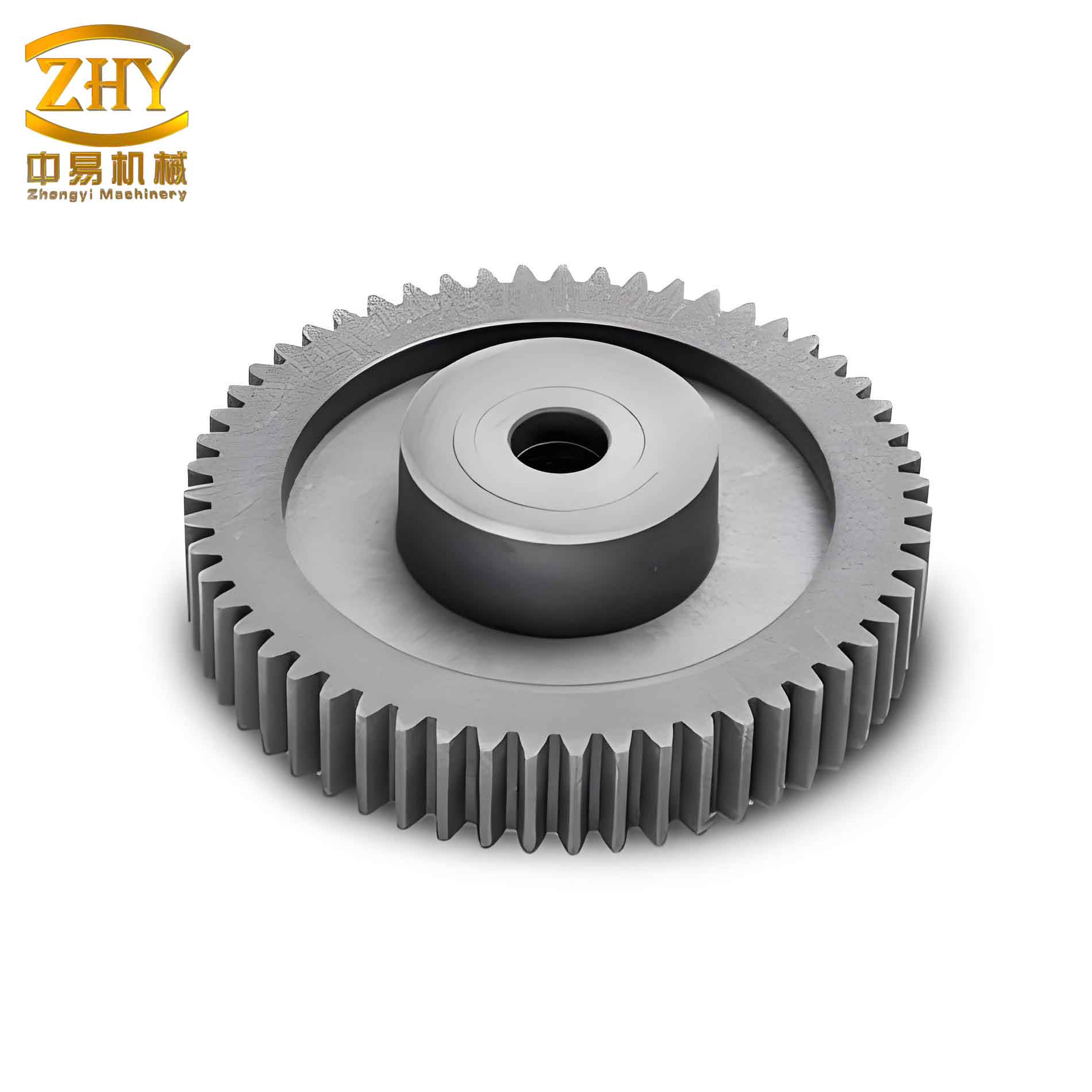
To visualize the spur and pinion gear configuration and crack orientation, I incorporate an illustrative image below. This depiction aids in comprehending the geometric relationships and crack propagation scenario in the spur and pinion gear system.
Moving forward, I compute the time-varying mesh stiffness for the spur and pinion gear with pitch circle crack damage. Three crack depths are considered: \(q = 0\) mm (healthy), \(q = 0.7\) mm, and \(q = 1.1\) mm. The single-tooth-pair stiffness curves, derived from the potential energy method, exhibit distinct characteristics. For the healthy spur and pinion gear, stiffness increases from the root to the pitch circle, peaks at the pitch point, and then decreases toward the tip. The range is approximately 140 to 210 N/μm. With a crack at the pitch circle, stiffness drops abruptly at the crack location due to reduced effective area and inertia. This drop becomes more pronounced with increasing crack depth. The comprehensive mesh stiffness, accounting for double-tooth engagement, shows that crack effects are confined to regions after the pitch circle within the single-tooth engagement zone and the subsequent double-tooth zone. The stiffness reduction amplitude grows with crack severity, impacting dynamic excitations.
I solve the dimensionless equations of motion using the fourth-order Runge-Kutta method, simulating the dynamic response of the spur and pinion gear system under different crack conditions. The time-domain vibrations and frequency spectra are analyzed. For the healthy spur and pinion gear, the time response shows regular oscillations dominated by mesh frequency components. The frequency spectrum reveals peaks at the mesh frequency \(f_m = 600\) Hz and its harmonics. When a pitch circle crack is present, periodic impacts appear in the time domain at intervals matching the pinion rotation period (0.06 s), with impact amplitudes escalating as crack depth increases. In the frequency domain, sidebands emerge around the mesh frequency and its harmonics, spaced at the pinion shaft frequency \(f_s = 16.7\) Hz. The sideband amplitudes also rise with crack depth, indicating modulation effects caused by time-varying stiffness.
To quantify these changes, I evaluate dimensionless parameter indices from the vibration signal sequences. These indices are sensitive to impulse-like features and thus effective for fault detection in spur and pinion gear systems. The definitions are as follows, where \(x(n)\) is the discrete vibration signal, \(N\) is the number of points, \(X_{av}\) is the mean, \(\sigma\) is the standard deviation, \(X_{peak}\) is the peak value, \(S_r\) is the root mean square amplitude, \(X_{rms}\) is the root mean square value, and \(X_{av}\) is the average absolute value:
Kurtosis index:
$$ K_q = \frac{1}{N} \sum_{n=1}^{N} \left( \frac{x(n) – X_{av}}{\sigma} \right)^4 $$
Margin factor:
$$ L = \frac{1}{N} \sum_{n=1}^{N} \left( \frac{X_{peak}}{S_r} \right) $$
Peak factor:
$$ C = \frac{1}{N} \sum_{n=1}^{N} \left( \frac{X_{peak}}{X_{rms}} \right) $$
Waveform factor:
$$ S = \frac{1}{N} \sum_{n=1}^{N} \left( \frac{X_{rms}}{X_{av}} \right) $$
Impulse factor:
$$ I_q = \frac{1}{N} \sum_{n=1}^{N} \left( \frac{X_{peak}}{X_{av}} \right) $$
The computed values for different crack depths are tabulated in Table 3. The spur and pinion gear system’s response clearly demonstrates that kurtosis, margin factor, peak factor, and impulse factor increase with crack severity, while the waveform factor remains relatively stable. This underscores their utility as diagnostic indicators for pitch circle crack damage in spur and pinion gear assemblies.
| Crack Depth \(q\) (mm) | Kurtosis \(K_q\) | Margin Factor \(L\) | Peak Factor \(C\) | Waveform Factor \(S\) | Impulse Factor \(I_q\) |
|---|---|---|---|---|---|
| 0.0 (Healthy) | 2.867 | 1.369 | 1.399 | 1.014 | 1.389 |
| 0.7 | 3.065 | 1.467 | 1.499 | 1.015 | 1.489 |
| 1.1 | 3.116 | 1.477 | 1.500 | 1.015 | 1.490 |
Further elaborating on the dynamic behavior, I explore the influence of operating conditions on the spur and pinion gear system. Variations in load and speed can alter the mesh stiffness and damping characteristics, thereby affecting crack-induced vibrations. For instance, under higher loads, the stiffness reduction due to cracks may become more pronounced, leading to larger impact forces. Similarly, speed variations can shift the frequency content and modulation patterns. However, the fundamental mechanisms—periodic impacts and sideband generation—remain consistent, affirming the robustness of the proposed diagnostic approach for spur and pinion gear systems.
Additionally, I consider the effects of bearing nonlinearities and shaft misalignments, which are common in real-world spur and pinion gear applications. These factors can introduce additional frequency components and modulate the vibration signals. However, the presence of a pitch circle crack in the spur and pinion gear still produces distinct features that can be isolated through advanced signal processing techniques, such as envelope analysis or wavelet transforms. The dimensionless parameters, especially kurtosis, serve as reliable first-level indicators for monitoring the health of spur and pinion gear drives.
To deepen the analysis, I derive the analytical expressions for stiffness reduction due to cracks. The effective bending stiffness \(k_b\) for a cracked tooth can be approximated by integrating the modified moment of inertia. Assuming a linear crack propagation model, the stiffness loss \(\Delta k\) is proportional to \(q^3\) for small cracks, reflecting the cubic dependence on crack depth in the inertia term. This relationship explains the nonlinear increase in dynamic impacts with crack growth. For the spur and pinion gear, the combined stiffness of multiple tooth pairs mitigates some effects, but the periodic stiffness drop at the crack location still excites the system.
The equations of motion can also be analyzed for stability and bifurcation behavior. The nonlinear backlash function and time-varying stiffness may induce chaotic vibrations under certain parameter regimes. However, for typical operating conditions of spur and pinion gear systems, the response remains periodic with superharmonic components. Numerical simulations confirm that the primary resonance frequencies are near the mesh frequency and its subharmonics, with crack-induced modulations adding sidebands.
In practical applications, monitoring the spur and pinion gear for pitch circle cracks involves installing accelerometers on bearing housings and analyzing vibration spectra. The sideband spacing equal to the shaft frequency is a telltale sign. Moreover, tracking trends in dimensionless parameters like kurtosis can provide early warning before catastrophic failure. For instance, a rising kurtosis value in a spur and pinion gear system indicates increasing impulsivity, often correlated with crack propagation.
I also examine the role of material properties and gear geometry. The spur and pinion gear’s modulus of elasticity, Poisson’s ratio, and tooth profile parameters influence the stiffness calculations. Using finite element analysis, one could refine the stiffness models for more accurate predictions. However, the lumped-parameter approach suffices for capturing essential dynamics and fault features in spur and pinion gear transmissions.
Furthermore, I discuss the implications for design and maintenance. To enhance durability of spur and pinion gear systems, engineers can optimize tooth profiles to reduce stress concentrations at the pitch circle. Regular inspections using vibration analysis can detect incipient cracks, allowing for timely replacements. The methodologies developed here for spur and pinion gear with pitch circle crack damage are applicable to other gear types, such as helical or bevel gears, with appropriate modifications to stiffness and dynamic models.
In conclusion, this comprehensive study elucidates the fault mechanism of spur and pinion gear with pitch circle crack damage through integrated dynamic modeling, stiffness analysis, and numerical simulation. The key findings are: (1) Pitch circle cracks cause a stepwise reduction in mesh stiffness at the crack location, with severity proportional to crack depth. (2) Dynamic responses exhibit periodic impacts in the time domain and sidebands in the frequency domain, both amplifying with crack growth. (3) Dimensionless parameters, particularly kurtosis, margin factor, peak factor, and impulse factor, increase with crack depth, offering effective diagnostic indicators for spur and pinion gear systems. (4) The twelve-degree-of-freedom coupled model reliably captures the interactions among gears, rotors, and bearings, providing a foundation for advanced fault diagnosis strategies. Future work could explore real-time monitoring algorithms and experimental validation on spur and pinion gear test rigs to further corroborate these theoretical insights.