
Automotive cemented gears manufactured from alloy carburizing steels undergo multiple processing stages: forging, pre-heat treatment, machining, carburizing, quenching, and finishing. Conventional normalizing—commonly used for forged gear blanks—frequently results in inconsistent cooling rates due to stacking during air cooling. This variability causes heterogeneous microstructures, unpredictable hardness (160-230 HBW), and substantial distortion during subsequent carburizing and quenching. Our research demonstrates that isothermal normalizing utilizing residual forging heat effectively addresses these limitations.
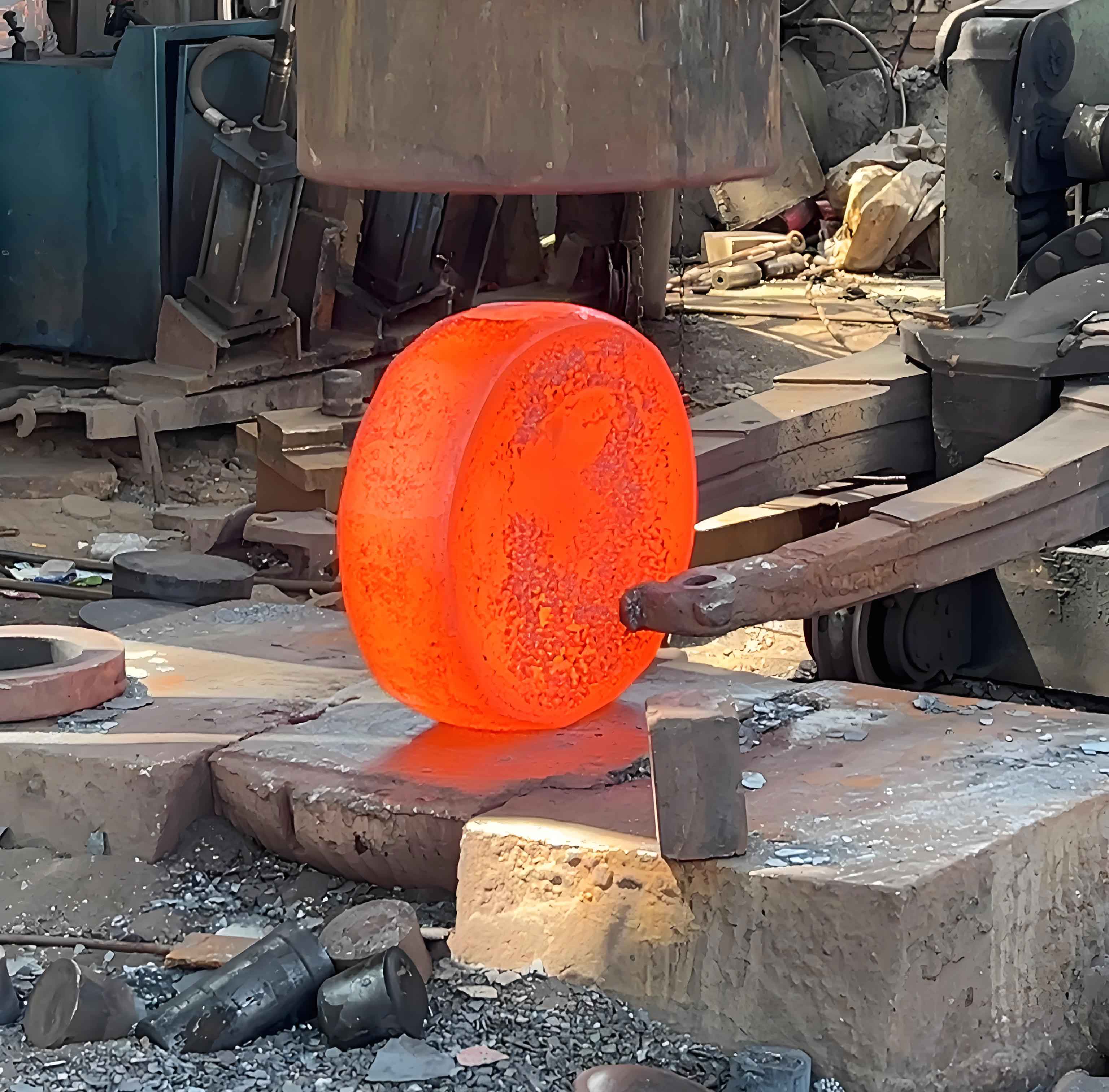
Using 20CrMnTi forged gear blanks (chemical composition: 0.17-0.23% C, 1.20-1.60% Mn, 1.00-1.30% Cr, 0.04-0.10% Ti), we compared conventional normalizing against residual-heat isothermal normalizing. Key technical requirements included:
- Grain size: 5-8 (ASTM scale)
- Hardness: 160-190 HBW
- Band structure ≤ Grade 2, no bainite, Widmanstätten structure ≤ Grade 1
Phase Transformation Kinetics
The continuous cooling transformation (CCT) behavior of 20CrMnTi governs microstructure evolution. Cooling rate \( \dot{T} \) determines phase formation:
$$ \dot{T} = \frac{dT}{dt} = f(\Delta t_{800^\circ C \to 500^\circ C}) $$
where slow cooling promotes granular bainite (\(B_g\)), degrading machinability. Conventional normalizing yields mixed microstructures:
| Process | Microstructure | Grain Size (ASTM) | Hardness (HBW) | Hardness Variation |
|---|---|---|---|---|
| As-forged (air-cooled) | Widmanstätten ferrite + pearlite + bainite | 2-3 | 220-280 | 60 HBW |
| Conventional normalizing (930°C/1h + air) | \( B_g + F + P \) | 3-4 | 168-230 | 62 HBW |
Residual-Heat Isothermal Normalizing Protocol
Optimized parameters for forged gear blanks:
- Terminate forging at 1050-1000°C (austenitic state)
- Air-cool to 800°C within 3.5 min (\( \dot{T} \approx 71^\circ C/min \))
- Isothermal hold at 650°C for ≥65 min
The isothermal transformation follows Avrami kinetics:
$$ f = 1 – \exp(-kt^n) $$
where \( f \) = transformed fraction, \( k \) and \( n \) = material constants. This ensures complete \( \gamma \to F + P \) transformation.
| Soaking Temp (°C) | Time (min) | Microstructure | Grain Size | Hardness (HBW) |
|---|---|---|---|---|
| 800 | 65 | Equiaxed \( F + P \) | 7-8 | 160 |
| 750 | 65 | \( F + S + Widmanstätten \) | 4-6 (mixed) | 179 |
| 700 | 45 | Partial transformation | 2-3 / 7-8 (mixed) | 184 |
Carburizing Distortion Analysis
Distortion metrics after gas carburizing (930°C) and quenching:
| Pre-treatment | Hub Bore Diameter Δ (μm) | Web Bore Diameter Δ (μm) | Base Tangent Length Δ (μm) |
|---|---|---|---|
| Conventional normalizing | -48.8 ± 29.0 | -44.0 ± 42.0 | +32.0 ± 26.0 |
| Residual-heat isothermal | -34.4 ± 14.0 | -34.0 ± 19.0 | +15.0 ± 9.0 |
Distortion reduction exceeds 50% due to homogeneous prior microstructure in the forged gear blank.
Mechanism of Microstructure Refinement
Rapid cooling (800°C in ≤3.5 min) suppresses \( B_s \) (bainite start) and \( W_\alpha \) formation:
$$ \dot{T}_{critical} > \frac{B_s – T_{\text{iso}}}{\Delta t} \approx 30^\circ C/s $$
Isothermal holding at 650°C maximizes nucleation density \( N_v \):
$$ N_v = N_0 \exp\left(-\frac{Q}{\text{R}T}\right) $$
where \( Q \) = activation energy, R = gas constant. This produces uniform 7-8 ASTM grain size.
Industrial Implementation
Residual-heat isothermal normalizing for forged gear blanks achieves:
- Energy savings: Eliminates 930°C re-heating cycle
- Cycle time reduction: 65 min vs. 120 min (conventional)
- Hardness consistency: ΔHBW ≤ 5 vs. ≥62 in conventional
Process robustness requires ±10°C temperature control and ≤30 sec transfer time from forge to isothermal chamber.
Conclusions
- Conventional normalizing generates non-equilibrium \( B_g \) in forged gear blanks, increasing carburizing distortion by >50%.
- Residual-heat isothermal normalizing (800°C transfer + 650°C/65 min) produces homogeneous equiaxed \( F + P \) (7-8 ASTM grain).
- Hardness consistency (160-190 HBW, Δ≤5 HBW) enhances machinability of forged gear blanks.
- Distortion variability decreases by 52-65% versus conventional processes.
- The technology eliminates reheating energy and reduces total cycle time by 46%.