
As a researcher focusing on tribology and gear systems, I have been deeply interested in the challenges of lubrication under severe operating conditions. In practical applications, gearboxes often operate in a non-steady state elastohydrodynamic lubrication (EHL) regime, characterized by significant impact loads, high contact stresses, and elevated temperatures. Parameters such as load, speed, and the radii of curvature of the contacting surfaces are all transient. These dynamic effects cause the characteristics of the EHL film, such as its thickness and pressure, to differ substantially from those under steady-state conditions. Therefore, the lubricant must maintain an adequate film thickness during operation, minimize boundary lubrication, and prevent dry friction to ensure the longevity and reliability of the components. My investigation centers on a novel intelligent lubricant: ferrofluid. This stable colloidal liquid, composed of magnetic nanoparticles, a carrier liquid, and surfactants, combines the magnetic properties of solids with the flow characteristics of liquids. In the absence of a magnetic field, it exhibits excellent Newtonian lubrication behavior. Under an applied magnetic field, it can precisely fill the lubricating surfaces, enabling continuous lubrication and near-zero leakage. This unique property can significantly extend the service life of both the gears and the lubricant itself, while also offering good thermal conductivity to improve overall lubrication conditions. In this analysis, I will explore the EHL performance of different carrier fluid-based ferrofluids in spur and pinion gear contacts subjected to impact loading.
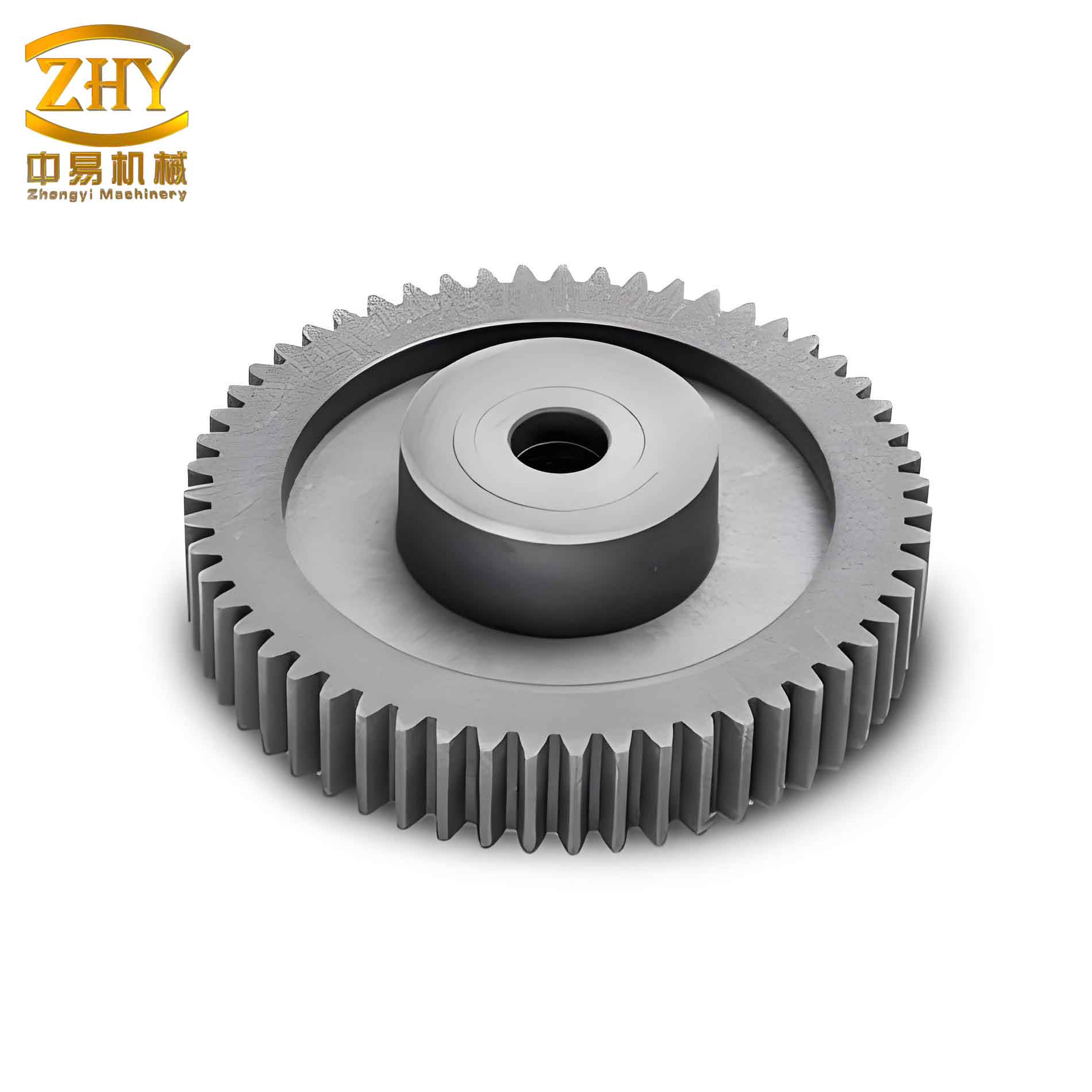
Theoretical Model and Governing Equations for Spur and Pinion Gear Contact
To analyze the transient EHL problem in meshing spur and pinion gear teeth, a precise geometrical and mathematical model must be established. The contact between two gear teeth is analogous to two cylinders with time-varying radii rolling and sliding against each other. The fundamental equations governing this lubricated contact are derived below.
1. Geometrical and Kinematical Model
The contact between two involute teeth of a spur and pinion gear pair can be modeled along the line of action. A fixed coordinate system XPY is used to define positions, while a moving coordinate system xKy has its origin fixed at the instantaneous contact point. This contact point moves along the line of action with a velocity \( v_s(t) \). The key time-varying parameters are:
- Radii of Curvature: \( R_1(t) = R_{b1}\tan\phi – s(t) \) and \( R_2(t) = R_{b2}\tan\phi + s(t) \), where \( R_{b1}, R_{b2} \) are base circle radii, \( \phi \) is the pressure angle, and \( s(t) \) is the distance from the pitch point.
- Effective Radius: \( R(t) = \frac{R_1(t) R_2(t)}{R_1(t) + R_2(t)} \).
- Surface Velocities: \( u_1(t) = \omega_1 (R_{b1}\tan\phi + s) \), \( u_2(t) = \omega_2 (R_{b2}\tan\phi – s) \).
- Entrainment Velocity: \( u(t) = \frac{u_1(t) + u_2(t)}{2} \).
The load on a single tooth pair also varies during the meshing cycle due to the transition between single and double tooth contact, as shown in the conceptual load graph.
2. Governing Equations for Transient EHL
The core physics of the lubricated contact is captured by the following set of equations, rendered here in their dimensionless forms for numerical solution.
Reynolds Equation:
The transient Reynolds equation governing the pressure distribution in the contact is:
$$ \frac{\partial}{\partial X}\left( \bar{\rho} \frac{\bar{h}^3}{\bar{\eta}} \frac{\partial \bar{P}}{\partial X} \right) = 12 \frac{\partial (\bar{\rho} \bar{h})}{\partial X} + 12 \frac{\partial (\bar{\rho} \bar{h})}{\partial \bar{t}} $$
where \( \bar{P} \) is the dimensionless pressure, \( \bar{h} \) is the dimensionless film thickness, \( \bar{\eta} \) is the dimensionless viscosity, \( \bar{\rho} \) is the dimensionless density, \( X \) is the dimensionless coordinate, and \( \bar{t} \) is the dimensionless time. The boundary conditions are \( \bar{P}(X_{in}) = \bar{P}(X_{out}) = 0 \) and \( \bar{P}(X) \geq 0 \).
Film Thickness Equation:
The equation accounting for both the geometry and the elastic deformation of the spur and pinion gear teeth is:
$$ \bar{h}(X,\bar{t}) = \bar{h}_0(\bar{t}) + \frac{X^2}{2} – \frac{1}{2\pi} \int_{X_{in}}^{X_{out}} \bar{P}(\xi, \bar{t}) \ln|X – \xi| \, d\xi $$
Here, \( \bar{h}_0 \) is the dimensionless rigid central film thickness.
Viscosity-Pressure Relation (Roelands):
The lubricant’s viscosity increases dramatically with pressure, modeled as:
$$ \bar{\eta} = \exp\left\{ (\ln \eta_0 + 9.67) \left[ (1 + 5.1 \times 10^{-9} p_H \bar{P})^{z_0} – 1 \right] \right\} $$
where \( \eta_0 \) is the ambient viscosity and \( z_0 \) is the pressure-viscosity index.
Density-Pressure Relation (Dowson-Higginson):
The lubricant’s compressibility is given by:
$$ \bar{\rho} = \frac{1 + \frac{0.6 \times 10^{-9} p_H \bar{P}}{1.7 \times 10^{-9}}}{1 + \frac{1.7 \times 10^{-9} p_H \bar{P}}{1.7 \times 10^{-9}}} $$
where \( \rho_0 \) is the ambient density.
Load Balance Equation (Including Impact):
The total load carried by the lubricant film must equal the applied external load at every instant. The impact load is modeled as a function of time:
$$ w_i = w_0 e^{-0.2t} \sin\left(\frac{\pi t}{4}\right) $$
where \( w_0 \) is the amplitude of the impact load. The dimensionless form is integrated over the pressure field:
$$ \int_{X_{in}}^{X_{out}} \bar{P}(X, \bar{t}) \, dX = \frac{2\pi}{3} C_{wtt}(\bar{t}) $$
Here, \( C_{wtt}(\bar{t}) \) represents the time-varying component of the load, combining the regular gear meshing load and the impact load.
3. Numerical Solution Method
Solving this strongly coupled, non-linear system of integro-differential equations requires robust numerical techniques. The approach I employ is as follows:
- Discretization: The dimensionless Reynolds equation is discretized using the finite difference method.
- Pressure Solution: The resulting algebraic equations are solved using the Multigrid Method, which accelerates convergence by obtaining solutions on a hierarchy of grid levels. A W-cycle is typically used.
- Elastic Deformation Integral: The computationally expensive convolution integral in the film thickness equation is calculated efficiently using the Multigrid Integration Method.
- Time Marching: The simulation marches through a full meshing cycle, divided into 120 time steps. The pressure and film thickness from the previous time step serve as the initial guess for the next.
- Convergence Criteria: Iterations at each time step continue until the relative error between successive pressure iterations is less than \( 10^{-3} \).
Analysis of Ferrofluid Performance Under Impact Load
The following analysis is based on simulations of a standard spur and pinion gear pair. The base parameters for the gear and the ambient lubricant conditions are listed in the table below.
| Parameter | Symbol | Value |
|---|---|---|
| Ambient Viscosity | \(\eta_0\) | 0.075 Pa·s |
| Pressure-Viscosity Coefficient | \(\alpha\) | \(2.19 \times 10^{-8}\) Pa⁻¹ |
| Ambient Density | \(\rho_0\) | 870 kg/m³ |
| Gear Young’s Modulus | \(E_{1,2}\) | \(2.06 \times 10^{11}\) Pa |
| Gear Poisson’s Ratio | \(\nu_{1,2}\) | 0.3 |
| Pinion Teeth | \(z_1\) | 35 |
| Gear Teeth | \(z_2\) | 140 |
| Module | \(m\) | 2.5 mm |
| Pinion Speed | \(n_1\) | 600 rpm |
| Pressure Angle | \(\phi\) | 20° |
| Transmitted Power | \(P\) | 20 kW |
The focus is on comparing ferrofluids with different carrier liquids. Their primary distinguishing property at this stage (without an applied magnetic field) is their ambient viscosity, a critical parameter in isothermal EHL.
| Carrier Fluid | Material Code | Dynamic Viscosity, \(\eta\) (Pa·s) | Density, \(\rho\) (kg/m³) |
|---|---|---|---|
| Ester-based | H02 | 0.006 | 1250 |
| Hydrocarbon-based | E02 | 0.030 | 1300 |
| Diester-based | D01 | 0.075 | 1185 |
1. Effect of Carrier Fluid on Pressure and Film Thickness
Under the simulated impact load condition, the pressure and film thickness profiles at the gear pitch point (point of pure rolling) reveal significant differences between the ferrofluids. The results clearly demonstrate that in isothermal EHL, the ambient viscosity is a dominant factor.
The diester-based D01 ferrofluid, with the highest viscosity (0.075 Pa·s), generates the thickest lubricating film. A thicker film is highly desirable as it provides a greater safety margin against surface contact and wear. Concurrently, this fluid exhibits the lowest peak and central contact pressures. The higher viscosity resists flow, leading to a more distributed pressure profile.
Conversely, the ester-based H02 ferrofluid, with the lowest viscosity (0.006 Pa·s), produces the thinnest film and the highest contact pressures. The lower viscosity allows the fluid to be squeezed out of the contact zone more easily under the impact load, resulting in a thinner film and more concentrated, higher pressures, which increase the risk of surface fatigue.
All profiles show the characteristic features of EHL: a Hertzian-like pressure plateau in the center, a sharp pressure spike at the outlet, and a corresponding constriction (necking) in the film thickness at the same location. For the lower viscosity fluids, the pressure spike is more pronounced and shifts slightly towards the inlet region due to the different flow dynamics.
2. Influence of Gear Ratio on Diester-based D01 Ferrofluid Performance
Using the best-performing diester-based D01 ferrofluid, I investigated the effect of changing the gear ratio (\(i = z_2/z_1\)) of the spur and pinion gear pair under impact load. The gear ratio directly affects the effective radius of curvature \(R(t)\) and the entrainment velocity \(u(t)\) at the contact.
The simulation shows a clear trend: a larger gear ratio leads to a larger film thickness and lower contact pressure. This is a direct consequence of the increased effective radius of curvature, which geometrically favors the formation of a thicker lubricant film (larger \(R\) in the \(X^2/2R\) term of the film shape). The increased entrainment velocity associated with certain ratios also enhances film generation. This finding implies that, within design constraints, opting for a higher gear ratio can be a beneficial strategy for improving the lubrication performance and reducing friction and wear in spur and pinion gear transmissions operating under dynamic loads.
3. Influence of Transmitted Power on Diester-based D01 Ferrofluid Performance
Finally, I analyzed the effect of varying the transmitted power through the spur and pinion gear set. An increase in transmitted power directly translates to a higher load carried by the meshing teeth.
The results are intuitive from a tribological standpoint: higher transmitted power (and thus higher load) leads to increased contact pressure and a reduction in film thickness. The increased load flattens the contact ellipse, squeezing the lubricant out more effectively. While the diester-based D01 fluid continues to perform well relative to other carriers, the overall system operates under more severe conditions. This underscores the importance of selecting a lubricant with sufficiently high pressure-viscosity response and potentially activating its magnetic properties to enhance load-carrying capacity when operating at high power levels.
Summary of Key Findings
Based on the comprehensive non-steady state EHL numerical analysis of spur and pinion gear contacts lubricated with ferrofluids under impact load, the following conclusions can be drawn:
- Carrier Fluid Viscosity is Critical: Under impact loading and in the absence of an applied magnetic field, the ambient viscosity of the ferrofluid’s carrier liquid is the primary differentiator. The diester-based D01 ferrofluid (highest viscosity) generated the most favorable lubrication conditions with the thickest film and lowest pressure. The ester-based H02 ferrofluid (lowest viscosity) resulted in the least favorable conditions with the thinnest film and highest pressure.
- Gear Ratio as a Design Parameter for Lubrication: For a given lubricant like the diester-based D01 ferrofluid, increasing the gear ratio of the spur and pinion gear pair improves lubrication performance under impact load by increasing the film thickness and reducing contact pressure.
- Load-Power Relationship: Increasing the transmitted power, and consequently the tooth load, negatively impacts the lubrication regime by increasing pressure and decreasing film thickness, even with a high-performance lubricant like the diester-based D01 ferrofluid.
This analysis provides a solid theoretical foundation for the selection and application of ferrofluids in gear lubrication. The logical next step in this research is to incorporate the effects of an external magnetic field into the model. The applied magnetic field can induce a magnetization-dependent viscosity and yield stress in the ferrofluid, which is anticipated to significantly enhance its load-carrying capacity, particularly under severe impact loads and for the lower-viscosity carrier fluids, potentially altering the performance hierarchy established in this isothermal, non-magnetic analysis. Furthermore, coupling this with thermal effects would yield a complete picture of the transient thermo-magneto-elastohydrodynamic lubrication (TMEHL) in spur and pinion gear contacts.