
In the modern cement industry, the trend toward large-scale production equipment has necessitated the use of robust and compact drive systems. Material lifting equipment, such as bucket elevators, often relies on right-angle cylindrical gear reducers to ensure reliability and save space. Among these, reducers utilizing spiral bevel gears for the primary stage are prevalent, especially in critical applications like raw meal feeding to kilns. These spiral bevel gear units, often high-end imports, are costly and, in the event of failure, typically require complete disassembly and factory return for repair, leading to extended downtime of 15 to 20 days. During peak production seasons, such a failure can severely impact operational continuity and profitability. This narrative details our first-person experience in successfully executing an on-site repair of a failed spiral bevel gear reducer during a crucial production period, averting significant financial loss and enhancing our in-house maintenance capabilities.
The incident involved an NSE1000-28m bucket elevator responsible for conveying raw meal. The reducer, a FLENDER model B3HH14D-90 with an integral auxiliary drive, featured a primary stage composed of a spiral bevel gear pair. During routine operation, abnormal acoustics emerged—a rhythmic, low-pitched whining or howling sound. Concurrently, the reducer housing exhibited elevated temperatures, measured via infrared thermometer at 58–65°C. Initial inspection through the access port revealed abnormal meshing in the primary spiral bevel gear set. The pinion (small spiral bevel gear) showed visible indentation and minor pitting on the working flanks. Despite being a critical component, the decision was made to continue operation under close monitoring due to production demands. Merely 12 days later, a follow-up inspection revealed catastrophic progression: severe spalling and tooth breakage on the spiral bevel gear faces. The secondary and third-stage helical gear pairs, however, remained intact. The spiral bevel gear was clearly the epicenter of the failure.
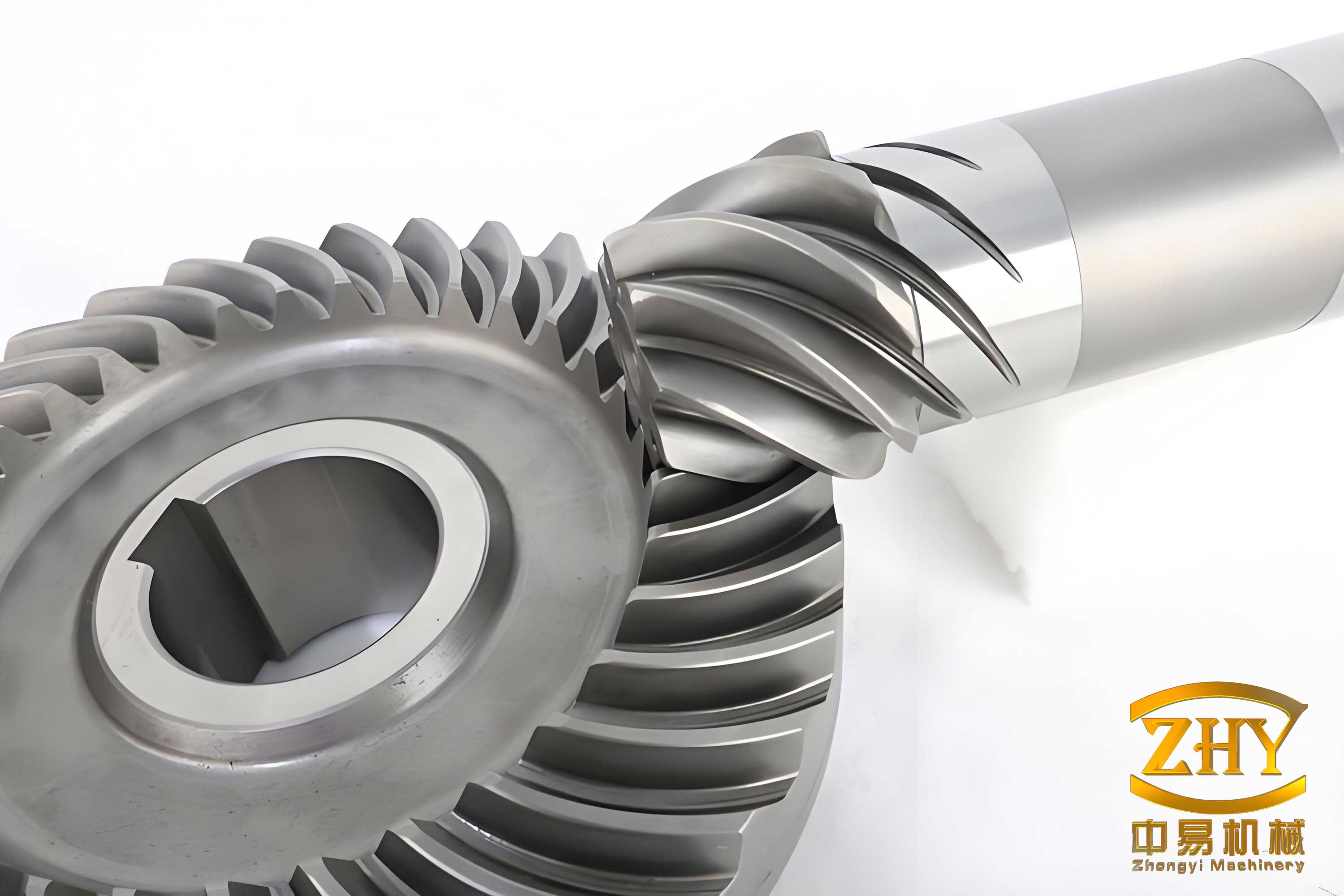
Our preliminary fault analysis pointed towards a failure in the primary spiral bevel gear pair or its supporting bearings. Given the reducer’s reliable service since 2011, the sudden degradation suggested an acute issue, possibly stemming from improper lubrication, bearing wear altering gear alignment, or latent material defects. The manufacturer insisted on factory overhaul, guaranteeing quality but entailing a minimum 12-day shutdown. Considering the peak season’s pressures and our team’s prior experience with domestic reducer maintenance, we embarked on the ambitious task of an on-site repair. The core challenge was the precise readjustment of the Gleason-system spiral bevel gear pair, a task notorious for its sensitivity. Incorrect adjustment could lead to rapid renewed failure, as evidenced by a competitor’s experience where a similar repair lasted only 20 days. Thus, the correct meshing of the spiral bevel gear became our paramount focus.
The reducer’s design was a three-stage, right-angle configuration. The critical first stage consisted of the spiral bevel gear set, converting the horizontal motor input to a vertical intermediate shaft. The output was via a hollow shaft mounted directly onto the elevator head pulley shaft. The housing was horizontally split, allowing removal of the upper casing. Two primary repair difficulties were identified. First, achieving the precise meshing geometry for the spiral bevel gear pair. Second, verifying smooth rotation post-repair, as the connected elevator chain and bucket weight made manual turning nearly impossible. We evaluated two schemes. Scheme One involved complete dismounting of the reducer from the main shaft, solving the rotation check but drastically extending downtime. Scheme Two proposed in-situ repair: after opening the housing, temporarily removing the third-stage pinion shaft assembly. This would allow independent adjustment of the first (spiral bevel gear) and second stages, followed by reinstallation and final adjustment of the third-stage helical gears. We opted for Scheme Two to minimize production impact.
Preparation was meticulous. In consultation with technical experts, we procured replacement parts: the entire pinion shaft assembly (including the small spiral bevel gear), bearing sets, seals, and an assortment of shims (0.02mm, 0.05mm, 0.10mm thick) for axial adjustments. Tools included dial indicators, Prussian blue (for contact pattern checking), hydraulic jacks, and chain blocks. The target adjustment parameters for the spiral bevel gear pair, derived from technical literature and expert consultation, were defined as follows:
| Parameter | Specification | Rationale |
|---|---|---|
| Pinion Axial Endplay | 0.01 – 0.035 mm | Ensures proper bearing preload and thermal expansion clearance. |
| Gear Backlash (Circumferential) | 0.03 – 0.05 mm | Prevents binding under load and allows for lubrication film. |
| Contact Pattern Length | ≈50% of face width | Indicates correct load distribution across the tooth flank. |
| Contact Pattern Location | Centered, slightly towards toe (small end) on gear | Compensates for deflection under load to centralize contact. |
| Pattern on Pinion | Slightly towards tip | For the driving spiral bevel gear, this optimizes torque transmission. |
| Pattern on Gear (Bull) | Slightly towards root | For the driven spiral bevel gear, this strengthens the tooth section. |
The repair was scheduled during a 20-hour raw mill stop, with the homogenization silo kept full. Upon disassembly, the root cause was identified: severe wear of the rollers and raceways in the tapered roller bearings supporting the second-stage shaft (which housed the large spiral bevel gear). This bearing failure had allowed axial and radial displacement, disrupting the precise meshing alignment of the spiral bevel gear pair and leading to concentrated stress and rapid surface failure.
The adjustment process for the spiral bevel gear pair was methodical. First, the new high-speed pinion shaft (with its small spiral bevel gear) was installed. Its axial endplay was set to 0.03 mm by adjusting the locking nut and shims, using a dial indicator for measurement. The relationship between shim thickness (S), nut torque (T), and resulting endplay (δ) can be approximated for bearing preload calculation:
$$ \delta \propto \frac{S}{E \cdot A} $$
where \( E \) is the modulus of elasticity and \( A \) is the effective bearing contact area. In practice, we relied on direct measurement.
Next, the second-stage shaft assembly, with the new large spiral bevel gear, was positioned. The meshing adjustment involved manipulating the shim packs on either side of the tapered roller bearings to control the axial position of the large gear relative to the pinion. Backlash was checked by fixing the pinion and using a dial indicator on the gear tooth. After achieving a preliminary backlash of 0.05 mm, the contact pattern was verified. Prussian blue was applied to the pinion teeth, and the assembly was rotated. The initial pattern was off-center. The adjustment requires understanding the spiral bevel gear’s geometry. The effective circular pitch and backlash relationship is given by:
$$ j_t = p_t – (s_{gear} + s_{pinion}) $$
where \( j_t \) is the transverse backlash, \( p_t \) is the transverse circular pitch, and \( s \) is the tooth thickness. Our goal was a uniform \( j_t \) around 0.05 mm.
Through iterative shim adjustments—adding to one side and removing from the other—we manipulated the contact pattern. The desired pattern for a Gleason spiral bevel gear under no-load conditions should be slightly towards the toe (small end) to compensate for shaft deflection under load, which shifts contact towards the heel. The contact area length (L) as a function of misalignment (ΔΓ) can be conceptually modeled:
$$ L \approx b \cdot \left(1 – \frac{|\Delta \Gamma|}{\Gamma_{max}}\right) $$
where \( b \) is the face width and \( \Gamma \) represents the misalignment angle. After several iterations, we achieved a pattern covering approximately 70% of the face width, centered slightly towards the toe. The final measured parameters were: pinion axial endplay: 0.02 mm, spiral bevel gear backlash: 0.05 mm. With the third-stage shaft removed, the housing upper half was temporarily installed, and the spiral bevel gear pair was manually rotated, confirming smooth, frictionless motion in both directions.
The third-stage helical gear shaft was then reinstalled. Its mesh was adjusted following standard helical gear practice, ensuring tooth contact across the full face width. The final assembly was completed, including all seals and bearings. Total active repair time was 16 hours. Post-repair, the reducer was filled with the specified lubricant. A critical run-in procedure was implemented. The elevator was run empty for one hour; vibration, noise, and temperature rise were normal. Upon loading, to facilitate controlled run-in of the new spiral bevel gear pair, the raw meal feed rate was reduced from the normal 290 t/h to 260 t/h. The previously heard whining noise disappeared, and housing temperature stabilized at 48–50°C. After 8 days of operation, an inspection showed excellent meshing with no abnormalities, allowing a return to full feed rate. A subsequent inspection 30 days later confirmed a healthy, stabilized contact pattern on the spiral bevel gear teeth, indicating successful wear-in.
The long-term outcome was highly positive. The reducer operated continuously and reliably for nearly a year until a planned preventive maintenance shutdown, during which it was sent to the manufacturer for a thorough inspection and保养. The success of this on-site spiral bevel gear repair provided invaluable insights, which we have formalized into a procedural guide. Key factors for successful spiral bevel gear adjustment are summarized below:
| Factor | Description | Technical Consideration |
|---|---|---|
| Bearing Condition | Support bearings must be in perfect condition. | Worn bearings introduce unpredictable displacements, ruining spiral bevel gear mesh alignment. |
| Precision Measurement | Use of dial indicators for backlash and endplay. | Accuracy within 0.01 mm is crucial for spiral bevel gear longevity. |
| Contact Pattern Analysis | Use of quality marking compounds (e.g., Prussian blue). | The pattern is the definitive indicator of spiral bevel gear alignment. It must be centered and of adequate length. |
| Iterative Adjustment | Patient, small changes to shim packs. | Axial movement (Δa) of the gear affects both backlash and pattern. The relationship is non-linear for spiral bevel gears. |
| Controlled Run-in | Reduced load initial operation. | Allows micro-asperities on the new spiral bevel gear teeth to wear smoothly, establishing an optimal contact surface. |
| Thermal Management | Monitoring operational temperature. | Temperature rise (ΔT) affects clearances. The coefficient of thermal expansion (α) for steel is ~11 x 10⁻⁶ /°C. Growth ΔL = α * L * ΔT. |
From a broader engineering perspective, the health of a spiral bevel gear mesh can be monitored through vibration analysis. Specific frequency components, such as the Gear Mesh Frequency (GMF) and its sidebands, are indicators. For a spiral bevel gear, the GMF is:
$$ GMF = \frac{N_{pinion} \times RPM_{pinion}}{60} = \frac{N_{gear} \times RPM_{gear}}{60} $$
where \( N \) is the number of teeth. Increasing sideband amplitude around the GMF often indicates misalignment or uneven wear in the spiral bevel gear set.
Furthermore, the bending stress at the root of a spiral bevel gear tooth can be estimated using the Lewis formula modified for bevel gears:
$$ \sigma_b = \frac{F_t}{b m_n} \cdot \frac{1}{Y} \cdot K_a K_m K_v $$
where \( F_t \) is the tangential force, \( b \) is the face width, \( m_n \) is the normal module, \( Y \) is the Lewis form factor (specific to spiral bevel gear geometry), and \( K_a, K_m, K_v \) are application, load distribution, and dynamic factors, respectively. Proper alignment minimizes the load distribution factor \( K_m \), directly reducing stress and preventing the spalling we observed.
This field repair of a critical spiral bevel gear reducer was a testament to systematic problem-solving and technical courage. It underscored that with proper preparation, understanding of spiral bevel gear adjustment principles, and meticulous execution, even complex, precision gearboxes can be successfully repaired in-situ. The financial savings from avoided production loss were substantial. More importantly, it significantly enhanced our internal engineering confidence and created a valuable knowledge base for maintaining other spiral bevel gear-driven equipment within the plant. The spiral bevel gear, while a delicate and precision component, need not be a source of prolonged downtime if its maintenance logic is thoroughly understood and applied.