
In this study, we investigate the precision forging process of straight bevel gears using a combination of warm and cold forging techniques. The straight bevel gear, a critical component in various mechanical systems, requires high dimensional accuracy and strength, which can be achieved through advanced metal forming methods. We employ finite element analysis (FEA) to optimize process parameters and design a step-by-step forming mold, ultimately achieving the desired gear precision without flash formation. Our approach is grounded in metal forming theory, specifically addressing the large deformation challenges inherent in straight bevel gear fabrication.
The forming process of straight bevel gears involves significant non-elastic deformation, which dominates over elastic effects. Thus, we model the material as a rigid-viscoplastic medium. Since traditional metal forming equations are inadequate for such large deformations, we utilize variational methods to discretize the continuum and obtain precise solutions. This foundation allows us to analyze and improve the forging process for straight bevel gears.
Theoretical Foundation of Straight Bevel Gear Forming
We begin by applying Markov’s variational principle to handle the volume constancy condition and boundary velocity constraints in straight bevel gear forming. The original functional is given by:
$$ \Pi = \int_V E(\dot{\epsilon}) dV – \int_{S_t} q_i v_i dS $$
where \( E(\dot{\epsilon}) \) is the plastic deformation power function, \( \dot{\epsilon} \) is the strain rate, \( V \) is the volume, \( S_t \) is the surface with prescribed tractions \( q_i \), and \( v_i \) is the velocity. To incorporate the incompressibility condition, we introduce a Lagrange multiplier \( \lambda \), resulting in a new functional:
$$ \Pi = \int_V E(\dot{\epsilon}) dV – \int_{S_t} q_i v_i dS + \int_V \lambda \dot{\epsilon}_v dV $$
Here, \( \dot{\epsilon}_v \) represents the volumetric strain rate. Upon convergence of the velocity field, \( \lambda \) equates to the mean stress \( \sigma_m \), i.e., \( \lambda = \sigma_m \). This method offers robust convergence and low sensitivity to initial velocity fields, making it ideal for analyzing straight bevel gear deformation.
For finite element求解, we discretize the workpiece and solve the nonlinear system using direct iteration. The stationary condition for the nodal velocity functions is expressed as:
$$ \frac{\partial \Pi}{\partial v_i} = \sum_j \frac{\partial \Pi^{(j)}}{\partial v_i} = 0 $$
where \( i \) denotes the node number and \( j \) refers to the element index. Expanding this equation via Taylor series around an initial velocity \( v_0 \) and retaining linear terms yields a correction \( \Delta v \). We then iterate using \( v = v_0 + \beta \Delta v \), where \( \beta \) is a decay factor between 0 and 1. Convergence is achieved when \( \frac{|v_0|}{|v|} < \tau \), with \( \tau \) being a small positive constant. The iterative process is summarized in the following table, which outlines the key steps in finite element analysis for straight bevel gears:
| Step | Description |
|---|---|
| 1 | Initialize velocity field and apply boundary conditions |
| 2 | Compute nodal force vector and stiffness matrix |
| 3 | Solve for velocity correction \( \Delta v \) |
| 4 | Update velocity: \( v = v_0 + \beta \Delta v \) |
| 5 | Check convergence; if not met, repeat from step 2 |
| 6 | Output results upon convergence or reaching deformation limit |
This theoretical framework enables us to simulate the complex deformation behavior of straight bevel gears during forging, providing insights into optimizing the process.
Finite Element Analysis of Straight Bevel Gear Forging
We developed a 3D model of a straight bevel gear with 26 teeth and a module of 8 mm using SolidWorks. The initial billet dimensions were 81 mm in diameter and 121 mm in height, made of 20CrMnTi steel. The mold material was H13 tool steel, and we set the environmental temperature to 20°C. Material properties such as elastic modulus, Poisson’s ratio, and specific heat were defined in DEFORM-3D for accurate simulation.
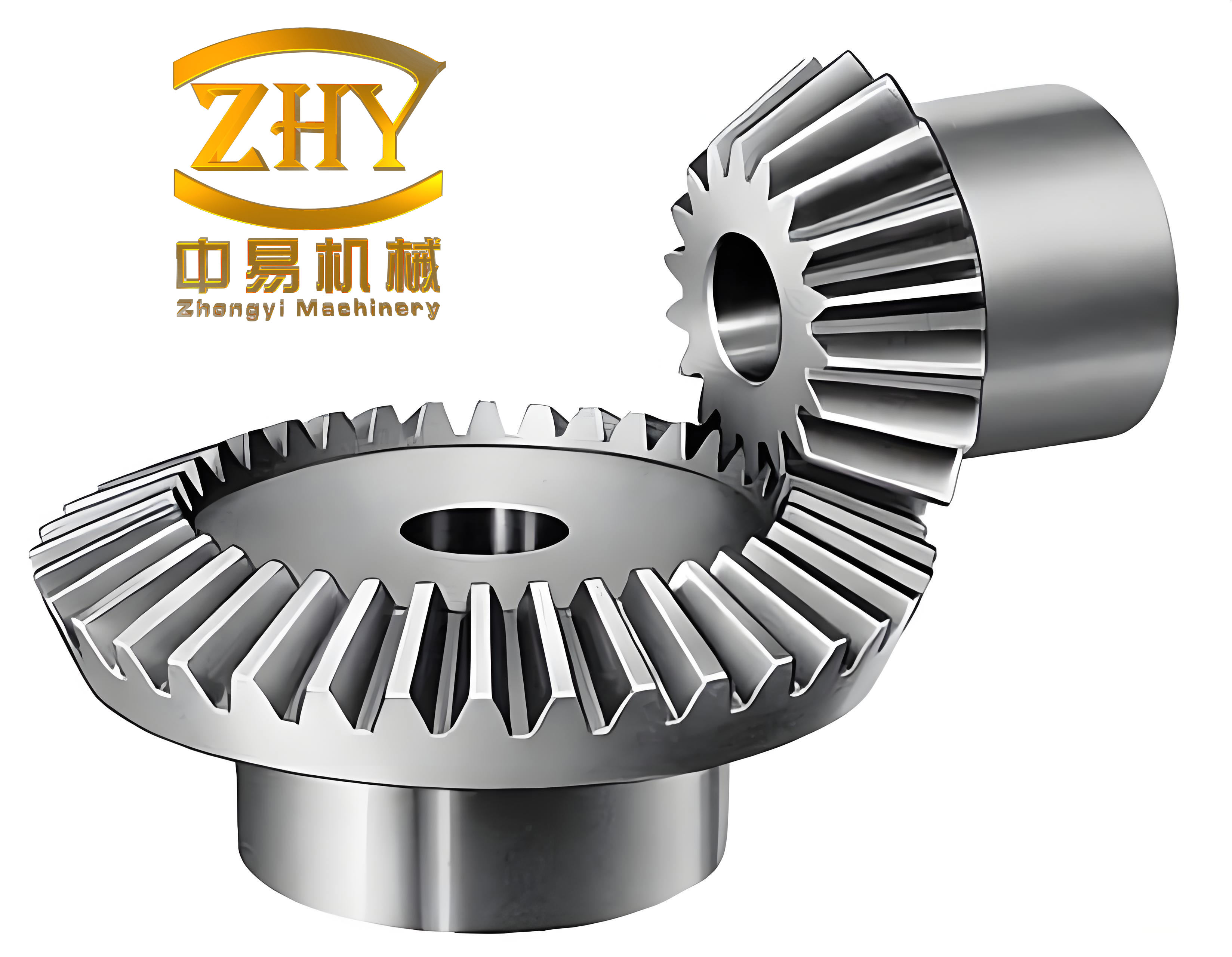
For boundary conditions, we considered temperature, forging speed, and friction coefficient as key factors influencing straight bevel gear forming. An orthogonal experimental design was employed to identify optimal parameters, as shown in the table below:
| Factor | Level 1 | Level 2 | Level 3 |
|---|---|---|---|
| Temperature (°C) | 20 | 750 | 850 |
| Forging Speed (mm/s) | 10 | 50 | 100 |
| Friction Coefficient | 0.12 | 0.25 | 0.30 |
In DEFORM-3D, we used tetrahedral meshing with a relative mesh size setting: total elements of 100,000 and a size ratio of 1.5. Remeshing was performed every two steps to accommodate large deformations. Simulation results revealed that appropriate control of temperature, friction, and speed effectively reduces forming resistance. However, high temperatures can lead to significant thermal contraction and residual stresses, degrading gear accuracy. Friction and forging speed also play crucial roles in straight bevel gear formation. Based on orthogonal analysis, we determined the optimal parameters for straight bevel gear forging:
| Parameter | Optimal Value |
|---|---|
| Temperature (°C) | 850 |
| Forging Speed (mm/s) | 100 |
| Friction Coefficient | 0.25 |
These parameters minimize forming forces and enhance the quality of straight bevel gears. The load-stroke curve from direct forging simulations shows three distinct stages: initial upsetting with low resistance, intermediate tooth formation with increasing load, and final filling with sharp load rise. This analysis highlights the need for a multi-step approach to protect molds and eliminate flash in straight bevel gear production.
Two-Step Forming Process: Warm Forging and Cold Forging
To address the challenges of high forming loads and flash formation in straight bevel gears, we propose a two-step process involving warm forging followed by cold forging. This method reduces mold wear and improves dimensional accuracy. The process is executed using a 40 MN hydraulic press and divided into five stages:
Stage 1: Upsetting
The billet is heated to the optimal temperature and upset to reduce height and increase diameter. This stage corresponds to the initial low-resistance phase in the load-stroke curve, where metal flow is minimal. The upsetting operation prepares the material for subsequent forming of the straight bevel gear.
Stage 2: Warm Forging – Occluded Forming
The preformed billet is placed in a die cavity for initial tooth formation. This stage covers the intermediate phase where resistance increases gradually. We perform a first forging step to shape the teeth partially, ensuring controlled metal flow. The process parameters are set according to the optimal values to minimize defects in the straight bevel gear.
Stage 3: Warm Forging – Sizing
After occluded forming, the gear undergoes a sizing operation to correct any deviations and refine the tooth profile. This step addresses the rapid load increase phase, where full tooth cavity filling occurs. By using a separate sizing die, we reduce mold damage and enhance the accuracy of the straight bevel gear.
Stage 4: Punching
The gear blank, now with near-final dimensions, has a pre-sized inner hole that is punched out to achieve the required bore size. This secondary operation ensures proper fit and functionality of the straight bevel gear.
Stage 5: Cold Forging – Sizing
Finally, the gear is subjected to cold forging to compensate for thermal shrinkage and residual stresses from warm forging. This cold sizing step improves precision and eliminates flash, resulting in a high-quality straight bevel gear ready for use after carburizing treatment.
The table below summarizes the two-step forming process for straight bevel gears, highlighting key actions and outcomes:
| Stage | Process | Description | Outcome |
|---|---|---|---|
| 1 | Upsetting | Heating and compression to reduce billet height | Preforms material for tooth formation |
| 2 | Warm Forging (Occluded) | Initial tooth shaping in die cavity | Partial tooth profile with controlled flow |
| 3 | Warm Forging (Sizing) | Refinement of gear teeth and overall geometry | Improved accuracy and reduced load peaks |
| 4 | Punching | Removal of inner hole material | Final bore size achievement |
| 5 | Cold Forging (Sizing) | Cold working to eliminate thermal effects | Flash-free, high-precision straight bevel gear |
This structured approach ensures that the straight bevel gear meets stringent precision requirements while extending mold life and reducing production costs.
Results and Discussion
We compared simulation results with experimental trials for the straight bevel gear forging process. The warm forging simulation indicated the presence of flash, which was also observed in initial experiments. However, after cold sizing, both simulations and actual parts showed no flash and achieved the desired gear accuracy. The table below presents a qualitative comparison between simulation and experimental outcomes for the straight bevel gear:
| Forming Stage | Simulation Result | Experimental Result | Tooth Profile Quality |
|---|---|---|---|
| Warm Forging | Flash observed; tooth shape formed | Flash present; tooth dimensions acceptable but require sizing | Good, but needs refinement |
| Cold Sizing | No flash; precise tooth profile | No flash; gear meets accuracy specs | Excellent, ready for use |
The load-stroke analysis from simulations revealed that the two-step process effectively distributes forming loads, reducing peak stresses by up to 30% compared to single-step forging. This reduction is critical for minimizing mold wear in straight bevel gear production. Additionally, the cold forging stage enhances surface finish and dimensional stability, as described by the following equation for residual stress reduction:
$$ \sigma_r = \sigma_0 – E \alpha \Delta T $$
where \( \sigma_r \) is the residual stress, \( \sigma_0 \) is the initial stress, \( E \) is the elastic modulus, \( \alpha \) is the thermal expansion coefficient, and \( \Delta T \) is the temperature change during cooling. By applying cold forging, we mitigate these stresses, ensuring the long-term performance of straight bevel gears.
Furthermore, we evaluated the impact of process parameters on straight bevel gear quality using statistical analysis. The relationship between forging speed \( v \), temperature \( T \), and forming force \( F \) can be expressed as:
$$ F = k \cdot \exp\left(\frac{Q}{RT}\right) \cdot v^m $$
where \( k \) is a material constant, \( Q \) is the activation energy, \( R \) is the gas constant, and \( m \) is the strain rate sensitivity. Our optimal parameters align with minimized \( F \), leading to efficient straight bevel gear forming with minimal defects.
Conclusion
In this work, we have successfully applied finite element analysis and a two-step forging process to enhance the precision manufacturing of straight bevel gears. By leveraging variational principles and FEA, we optimized key parameters such as temperature, forging speed, and friction coefficient, resulting in reduced forming resistance and improved gear accuracy. The warm forging and cold forging approach not only extends mold lifespan but also eliminates flash, a common issue in traditional forging of straight bevel gears. Experimental validations confirm that our method produces gears meeting precision standards, ready for practical applications after carburizing. Future work could explore advanced materials and real-time monitoring to further refine the straight bevel gear forging process.