
In the pursuit of automating and enhancing precision in modern agriculture, robotic systems have become indispensable. My focus lies on a critical component within these systems: the steering mechanism of agricultural manipulators. These manipulators operate in demanding environments, requiring compact, lightweight, yet highly precise and reliable actuation. For these reasons, the harmonic drive gear has emerged as a premier solution. Its unique operating principle, relying on the elastic deformation of a thin-walled component known as the flexspline, offers exceptional advantages. However, this very principle subjects the flexspline to complex, cyclic stress states, making fatigue life a primary design concern. In this detailed analysis, I will share my methodology and findings from a comprehensive finite element study of a flexspline, providing insights crucial for the design and optimization of robust harmonic drive gear units for agricultural robotics.
Fundamental Principles of Harmonic Drive Gear Transmission
The operation of a harmonic drive gear is elegantly simple yet mechanically sophisticated. The system comprises three primary components: the rigid Circular Spline, the flexible Flexspline, and the Wave Generator. The genius of the design lies in the mismatch: the flexspline typically has two fewer teeth than the circular spline. The wave generator, often an elliptical cam or a set of rotating bearings, is inserted into the flexspline, forcing it into a controlled elliptical deformation.
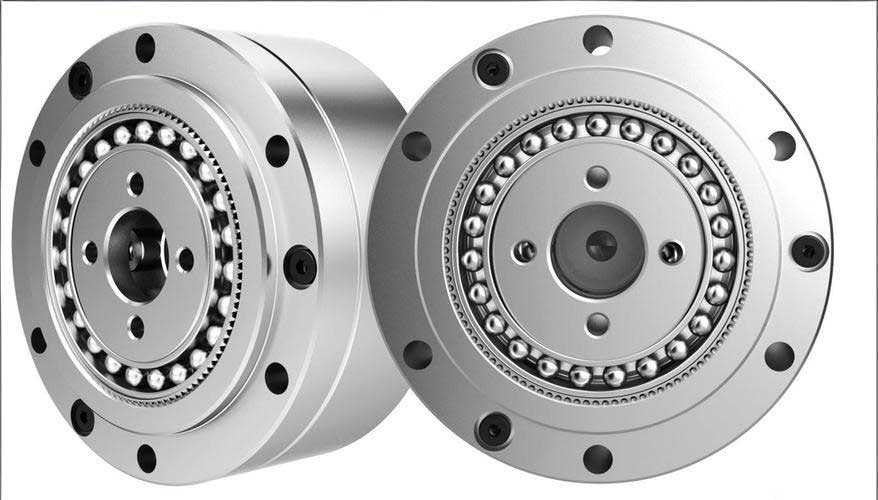
This deformation creates two diametrically opposed meshing zones along the major axis of the ellipse, where the teeth of the flexspline fully engage with those of the circular spline. At the minor axis, the teeth are completely disengaged. The regions in between are in varying states of engagement. As the wave generator rotates, the points of engagement move, causing a slow relative rotation between the flexspline and the circular spline. The high reduction ratio is a direct result of the tooth difference. This process subjects the flexspline to a continuous, traveling elastic deformation, making stress analysis paramount.
Wave Generator Configurations and Flexspline Response
The wave generator dictates the deformation profile of the flexspline. Common types include cam-based, planetary ball, and electro-mechanical actuators. For this study, I focused on a four-force cam-type wave generator, which applies a quasi-sinusoidal deformation. The radial displacement \( w \) of the flexspline’s neutral surface can be described as a function of the angular position \( \phi \) measured from the major axis:
$$ w(\phi) = \omega_0 \cos(2\phi) $$
where \( \omega_0 \) is the maximum radial deformation. This displacement induces corresponding circumferential displacements and internal stresses. The primary stress components in the thin-walled cup-type flexspline can be derived from shell theory. The bending stress in the longitudinal (z) direction and the circumferential (φ) direction are given by:
$$ \sigma_z = \frac{E s_1}{2 r_m^2} \left( \frac{\partial^2 w}{\partial \phi^2} + w \right) $$
$$ \sigma_\phi = \frac{E s_1}{2 r_m^2} \left( \frac{\partial^2 w}{\partial \phi^2} + \mu w \right) $$
where \( E \) is Young’s modulus, \( \mu \) is Poisson’s ratio, \( s_1 \) is the wall thickness at the toothed ring, and \( r_m \) is the mean radius of the undeformed flexspline. Shear stress due to torsion is also present. These theoretical equations provide a baseline but are limited for complex geometries and load cases, necessitating numerical methods like Finite Element Analysis (FEA).
| Wave Generator Type | Description | Advantages | Typical Applications |
|---|---|---|---|
| Cam-based | Elliptical cam with a thin bearing. | Simple, robust, high torque capacity. | Industrial robots, aerospace. |
| Planetary Ball (e.g., “Hat” type) | Elliptical raceway with rotating balls. | Low friction, smooth motion, zero backlash. | Precision instrumentation, medical devices. |
| Electro-Mechanical (Piezo/Acoustic) | Uses piezoelectric elements to generate traveling waves. | Extremely high precision, direct drive, no rotating generator. | Micro-positioning, semiconductor manufacturing. |
Finite Element Modeling Strategy for the Harmonic Drive Gear Flexspline
Moving from theory to practical analysis requires an accurate digital model. My approach leverages parametric CAD software for geometry creation and advanced FEA software for simulation, ensuring a workflow conducive to design iteration and optimization.
Geometric Modeling and Material Definition
I began by creating a precise 3D parametric model of a cup-type flexspline. The key dimensions for my analysis, representative of a unit for an agricultural manipulator steering joint, are as follows: number of teeth \( z = 204 \), module \( m = 0.8 \) mm, pressure angle \( \alpha = 20^\circ \). The material selected was a high-strength alloy steel, 35CrMnSiA, with the following properties crucial for the finite element analysis:
| Property | Symbol | Value | Unit |
|---|---|---|---|
| Young’s Modulus | \( E \) | 2.10 × 10⁵ | MPa |
| Poisson’s Ratio | \( \mu \) | 0.30 | – |
| Yield Strength | \( \sigma_y \) | ≥ 835 | MPa |
| Density | \( \rho \) | 7.85 × 10⁻⁹ | tonne/mm³ |
The parametric model included detailed tooth profiles, the main cup body, and the mounting flange. This model was then seamlessly imported into the FEA environment.
Mesh Generation and Element Selection
The quality of the finite element mesh directly impacts the accuracy of the results, especially in areas of high stress gradient like gear teeth. To address this, I partitioned the geometry into logical volumes: the toothed ring, the cup body, and the flange. A strategic meshing strategy was employed:
- Toothed Ring: I used a sweep meshing technique with SOLID186 elements. This 20-node quadratic hexahedral element is excellent for modeling irregular shapes and complex stress fields. Sweeping allowed me to generate a largely regular grid of hexahedral elements along the tooth profile and circumference, dramatically improving solution accuracy compared to tetrahedral elements.
- Cup Body and Flange: For these less critical, more uniform regions, I used SOLID187 elements (10-node quadratic tetrahedron) with a free-mesh algorithm, balancing accuracy and computational cost.
- Mesh Refinement: Critical stress concentration regions were finely meshed. These included:
- The fillet radius at the root of the teeth.
- The transition zone from the toothed ring to the cup wall.
- The bottom fillet of the cup.
The final high-fidelity model consisted of approximately 293,000 nodes and 120,000 elements. The superiority of a swept hex-dominant mesh in the tooth region cannot be overstated for a reliable stress analysis in a harmonic drive gear.
| Component | Element Type | Meshing Method | Key Purpose |
|---|---|---|---|
| Toothed Ring | SOLID186 (Hexahedral) | Sweep / Mapped | Accurate stress in teeth and root fillets. |
| Cup Body & Flange | SOLID187 (Tetrahedral) | Free / Patch Conforming | Efficient modeling of bulk deformation. |
| Transition Zones | SOLID186/187 | Local Refinement | Capture stress concentrations. |
Boundary Conditions and Load Application
To simulate the assembly and initial deformation state, I applied the following conditions, making necessary and justified simplifications:
- Constraints: The inner surface of the mounting flange and its front face were considered fixed (all degrees of freedom constrained). This represents a rigid bolted connection to the manipulator’s housing or output shaft, a standard configuration in many harmonic drive gear assemblies.
- Loads – Wave Generator Action: Simulating the exact contact between the wave generator bearing and the flexspline’s inner surface is non-linear and computationally intensive. For a preliminary static stress analysis of the initial deformation, a validated equivalent load approach is effective. The wave generator applies radial forces at specific contact zones. For a four-force cam with a contact angle \( \beta = 25^\circ \), the equivalent radial force \( P \) per unit length can be calculated. This force is applied as a pressure load to the inner surface of the toothed ring at the angular positions corresponding to the four contact points (\( \phi = \pm \beta, \phi = \pm(90^\circ – \beta) \)). This method effectively captures the dominant stress state without solving the full contact problem in this phase.
The static equilibrium equation solved by the FEA software is essentially:
$$ [K]\{u\} = \{F\} $$
where \( [K] \) is the global stiffness matrix (dependent on geometry and material), \( \{u\} \) is the nodal displacement vector, and \( \{F\} \) is the nodal force vector from the applied pressures and constraints.
Analysis Results and Critical Discussion
The linear static analysis yielded detailed contour plots of stress and displacement, revealing the complex behavior of the flexspline under the wave generator’s influence. My primary metric for assessing yielding risk was the von Mises equivalent stress, which combines all stress components into a single value comparable to the material’s yield strength.
Stress Distribution and Critical Locations
The global stress distribution confirmed theoretical predictions and highlighted critical zones. The highest stress concentrations were unequivocally located at the root fillet of the teeth in the regions where the wave generator applies force. The maximum von Mises stress value was found to be approximately 159 MPa. This is well below the yield strength of the material (835 MPa), indicating a high safety factor for static loading—a necessary condition for a component subjected to high-cycle fatigue.
The stress pattern shows a clear progression:
- Peak Stress at Tooth Roots: In the contact zones near \( \phi = \pm 25^\circ \) and \( \phi = \pm 65^\circ \).
- Attenuation Through the Cup Wall: Stress decreases rapidly moving axially from the toothed ring down the cup body.
- Stress Increase at the Cup Bottom: Due to the constraint (fixed flange), a secondary stress concentration appears at the fillet connecting the cup wall to the bottom. While lower than the tooth-root stress, this is another potential site for fatigue crack initiation.
| Region | Max von Mises Stress (MPa) | Cause | Fatigue Significance |
|---|---|---|---|
| Tooth Root Fillet (Contact Zone) | ~159 | Bending from meshing force & elliptical deformation. | Primary – Likely crack initiation site. |
| Cup Wall (near tooth ring transition) | ~80-100 | Continuation of bending stress from teeth. | Secondary. |
| Cup Bottom Fillet | ~70-90 | Boundary constraint and change in stiffness. | Secondary – Watch for manufacturing defects. |
| Flange | < 20 | Minimal deformation in fixed region. | Negligible. |
Deformation and Implications for Performance
The displacement results illustrated the classic elliptical deformation imposed by the wave generator. The maximum radial deformation \( \omega_0 \) was approximately 0.815 mm. Crucially, the deformation was not confined to the toothed ring; the entire cup body exhibited distortion. This global deformation has a direct consequence: it causes the cup’s generatrix (the line along its wall) to tilt relative to its central axis.
$$ \theta_{tilt} \approx \arctan\left(\frac{\delta_{axial}}{L_{cup}}\right) $$
where \( \delta_{axial} \) is the axial displacement component at the cup rim and \( L_{cup} \) is the cup length. This tilt leads to non-uniform load distribution along the tooth face. Teeth at one end of the flexspline will experience higher contact pressure than those at the other end, leading to accelerated wear in that localized high-stress zone and potentially reducing the overall lifespan and positioning accuracy of the harmonic drive gear. This is a critical insight for designers, suggesting that optimizing cup length and wall stiffness is as important as analyzing tooth stresses alone.
Towards Advanced Analysis and Design Optimization
This linear static analysis of initial deformation is a vital first step. However, to fully qualify a harmonic drive gear for the rigorous duty cycle of an agricultural manipulator, a more comprehensive analysis roadmap is required.
- Non-linear Contact Analysis: The next phase involves modeling the actual contact between the wave generator (with its bearing) and the flexspline, and between the flexspline and circular spline teeth. This is a highly non-linear problem involving surface-to-surface contact, friction, and potentially large deformations.
- Transmission Load Case: Applying a resisting output torque to the flexspline (or circular spline) will superpose torsional shear stresses and alter the tooth contact forces, potentially shifting the location of maximum stress.
- Fatigue Life Prediction: Using the stress results from a full load cycle analysis, a fatigue life calculation based on the material’s S-N curve and a damage accumulation model (like Miner’s rule) can predict the number of cycles to failure. The stress concentration factor (\( K_f \)) at the tooth root is a key input here.
- Parametric Optimization: Using the parametric CAD model linked to the FEA setup, a design-of-experiments (DOE) study can be performed. Key geometric variables can be systematically varied to minimize mass, maximize fatigue life, or minimize stress concentration. These variables include:
- Tooth profile parameters (pressure angle, root fillet radius).
- Cup wall thickness and taper.
- Cup bottom and transition fillet radii.
The objective function could be formulated as minimizing the peak von Mises stress or maximizing a fatigue safety factor:
$$ \text{Minimize: } \sigma_{vm}^{max}(\mathbf{x}) \quad \text{or} \quad \text{Maximize: } SF_{fatigue} = \frac{\sigma_{endurance}}{\sigma_{eq} \cdot K_f} $$
where \( \mathbf{x} \) is the vector of design variables.
| Analysis Step | Objective | Key Challenges | Output for Design |
|---|---|---|---|
| 1. Linear Static (Initial Deformation) | Identify stress concentrations from assembly. | Accurate geometric and boundary condition modeling. | Critical locations, initial stress state. |
| 2. Non-linear Static (Full Transmission Load) | Determine stress under working torque. | Managing contact non-linearity and convergence. | True maximum operating stress. |
| 3. Quasi-static Load Cycle | Map stress variation over one wave generator revolution. | Applying rotating boundary conditions/loads. | Stress range (\(\Delta \sigma\)) for fatigue. |
| 4. Dynamic / Modal Analysis | Identify natural frequencies to avoid resonance. | Accurate mass distribution and constraint modeling. | Campbell diagram, critical speeds. |
| 5. Parametric Optimization | Find geometry that minimizes mass/stress. | High computational cost, defining constraints. | Optimized flexspline dimensions. |
Conclusion
In this detailed exploration, I have demonstrated the application of advanced finite element analysis to understand the mechanical behavior of the core component in a harmonic drive gear—the flexspline. By constructing a high-fidelity parametric model and employing a disciplined meshing strategy, particularly using swept hexahedral elements in the critical toothed region, I was able to obtain a reliable and detailed stress and displacement field. The analysis conclusively identifies the tooth root fillets within the wave generator contact zones as the primary locus of maximum stress, with a secondary concentration at the constrained cup bottom. Furthermore, it reveals the non-uniform load distribution along the tooth face caused by the global cup deformation, a subtle but critical factor affecting wear and longevity.
This methodology and the insights derived form a powerful foundation. They provide not just validation for a specific design but a robust framework for the iterative improvement, optimization, and innovative design of flexsplines. For the challenging field of agricultural robotics, where reliability and precision are paramount in harsh conditions, such a deep, simulation-driven understanding of the harmonic drive gear’s inner workings is indispensable for developing manipulator steering systems that are both high-performing and durable.