
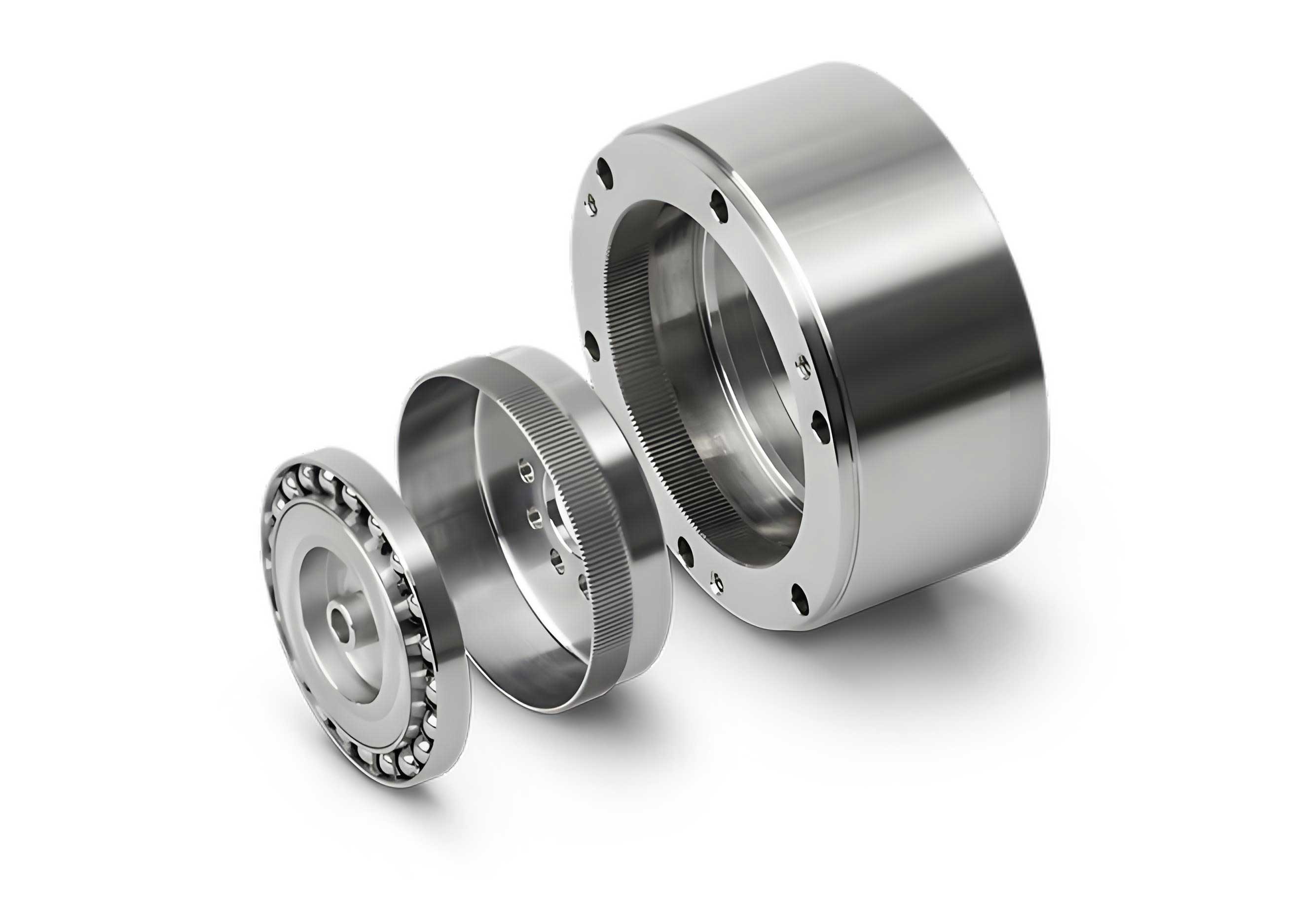
In my extensive research on precision mechanical systems, I have consistently focused on the critical role of harmonic drive gears in applications requiring high accuracy and compact design. The harmonic drive gear, a unique type of gear system, comprises three primary components: a circular spline (rigid outer ring), a flexspline (thin-walled cup-shaped element with external teeth), and a wave generator (elliptical cam or other device) that deforms the flexspline to engage with the circular spline. The performance and longevity of a harmonic drive gear are predominantly determined by the flexspline, as its fatigue fracture is the most common failure mode. This makes the strength analysis of the flexspline a paramount concern in the design process. Traditional analytical methods often fall short due to the complex boundary conditions and nonlinear interactions, particularly at the interface between the flexspline and the wave generator. In this article, I delve into a comprehensive finite element mechanics analysis of the flexspline, employing advanced contact modeling techniques to achieve a more realistic simulation. My goal is not only to validate the approach but also to explore structural parameter modifications that enhance strength while minimizing mass—a crucial optimization for aerospace, robotics, and other high-performance sectors where harmonic drive gears are indispensable.
The harmonic drive gear operates on the principle of elastic dynamics, where the wave generator induces a controlled elliptical deformation in the flexspline, causing its teeth to mesh progressively with those of the circular spline. This mechanism offers advantages such as high reduction ratios, zero backlash, and compactness. However, the cyclic stressing of the flexspline leads to cumulative fatigue damage. The stress distribution within the flexspline is influenced by multiple geometric and material parameters, making analytical solutions challenging. Early studies relied on simplified shell theory and empirical formulas, but these often neglected local stress concentrations and boundary effects. With advancements in computational power, the finite element method (FEM) has become the tool of choice. Previous FEM studies typically applied forced displacements or equivalent forces to simulate the wave generator’s action, but this introduces approximations. In my work, I propose a more accurate approach by incorporating contact boundary conditions directly into the finite element model. This allows for a nonlinear analysis that captures the true interaction, eliminating the need for pre-calculated displacement fields and reducing errors.
To lay the groundwork, let’s revisit the theoretical stress analysis for the flexspline in a harmonic drive gear. Based on elastic shell theory, the stress components in the cylindrical portion of the flexspline can be expressed as functions of radial deformation and geometric parameters. For an elliptical cam wave generator, the contour is given by:
$$ \rho = \sqrt{(r_m + w_0)^2 – 4 r_m w_0 \sin^2 \phi} $$
where \(\rho\) is the radial distance after deformation at angle \(\phi\), \(r_m\) is the equivalent radius of the cam, and \(w_0\) is the maximum radial deformation. The deformation coefficient \(\delta_1\) relates \(w_0\) to the module \(m\): \(w_0 = \delta_1 m\). The cylindrical rigidity \(D\) and Poisson’s ratio \(\nu\) of the material are involved in the stress equations. The key stress components—axial stress \(\sigma_z\), circumferential stress \(\sigma_\phi\), and shear stress \(\tau_{z\phi}\)—are derived as:
$$ \sigma_z = \frac{6 D w_0}{t^2 r_m^2 l} z \psi_z $$
$$ \sigma_\phi = \frac{6 D w_0}{t^2 r_m^2 l} \psi_\phi $$
$$ \tau_{z\phi} = \frac{6(1-\nu) D w_0}{2 t^2 r_m l} \psi_{z\phi} $$
Here, \(t\) is the wall thickness of the flexspline, \(l\) is the length of the cylindrical portion, and \(\psi_z\), \(\psi_\phi\), \(\psi_{z\phi}\) are influence functions dependent on the wave generator profile. These equations highlight that stresses are inversely proportional to \(t^2\), \(r_m^2\), and \(l\), and directly proportional to \(w_0\). Thus, reducing radial deformation or increasing wall thickness can lower stress levels. However, practical constraints such as weight, stiffness, and manufacturability necessitate a balanced optimization. In the context of harmonic drive gear design, these theoretical insights guide parameter selection, but they require validation through detailed numerical analysis like FEM.
My finite element analysis begins with the modeling phase. I consider a cup-shaped flexspline made of 35CrMnSiA steel, a common material for harmonic drive gears due to its high strength and fatigue resistance. The geometric parameters for the baseline model (Model 1) are summarized in Table 1. The flexspline features a cylindrical body with external teeth at the open end and a flange at the closed end for mounting. To capture stress gradients accurately, I employ a refined mesh, particularly in regions prone to high stress: the tooth root transition zone and the cup bottom fillet area. Two distinct finite element models are developed: one without contact (using forced displacements) and one with contact constraints.
| Parameter | Symbol | Value |
|---|---|---|
| Cylindrical Length | \(l\) | 100 mm |
| Radial Deformation Coefficient | \(\delta_1\) | 0.95 |
| Module | \(m\) | 0.4 mm |
| Flange Diameter | \(d_1\) | 60 mm |
| Wall Thickness (Cylinder) | \(t\) | 0.8 mm (variable along length) |
| Material Young’s Modulus | \(E\) | 210 GPa |
| Material Poisson’s Ratio | \(\nu\) | 0.3 |
For the non-contact model, I use shell elements to represent the thin-walled structure. The wave generator action is simulated by applying enforced radial displacements to nodes along the inner surface of the flexspline, derived from the elliptical contour equation. The flange base is fixed to represent bolted connections. This approach, while common, assumes a predetermined deformation field and ignores local contact phenomena. In contrast, the contact model utilizes solid hexahedral elements for the flexspline body and defines the wave generator as a rigid contact surface. The contact algorithm employed is based on the upper-lower bound box method, which efficiently detects and manages contact states (stick, slip, or separation). Friction is neglected initially to simplify the analysis, focusing on normal contact pressures. This model more faithfully replicates the operational conditions of a harmonic drive gear, as it allows the flexspline to deform naturally under the cam’s pressure without imposed displacement constraints.
The analysis results for Model 1 are revealing. In the non-contact model (solved with MSC.NASTRAN), the maximum von Mises stress occurs at the transition region between the tooth roots and the smooth cylinder, with a value of approximately 253 MPa (25.8 kg/mm²). Stress decreases gradually along the axial direction but rises again at the cup bottom fillet, reaching about 23.8 MPa (2.43 kg/mm²). This pattern aligns with classical theories predicting stress concentration at geometric discontinuities. However, when I analyze the contact model (using MSC.MARC), the stress distribution shows similar trends but with quantitative differences. The peak stress at the tooth root transition is 231 MPa (23.6 kg/mm²), slightly lower than in the forced-displacement case. At the cup bottom fillet, the stress is higher, around 39.3 MPa (4.01 kg/mm²). These discrepancies underscore the importance of contact modeling: the forced-displacement method may overestimate stresses in the primary deformation zone while underestimating boundary effects at the flange. The contact model provides a more balanced and physically accurate stress field, validating its superiority for harmonic drive gear analysis.
To further elucidate, I present a comparative table of stress results from both methods for Model 1. This highlights how contact modeling influences key stress metrics in harmonic drive gear components.
| Stress Location | Non-Contact Model (Forced Displacement) | Contact Model (Contact Boundary) |
|---|---|---|
| Tooth Root Transition Zone | 253 MPa | 231 MPa |
| Cup Bottom Fillet Region | 23.8 MPa | 39.3 MPa |
| Overall Stress Distribution Pattern | Axial decay with fillet rise | Similar but with adjusted magnitudes |
With confidence in the contact-based FEM, I proceed to investigate structural parameter modifications to enhance the flexspline’s performance. The theoretical stress equations suggest that reducing radial deformation \(w_0\), increasing wall thickness \(t\), increasing length \(l\), or decreasing flange diameter \(d_1\) can lower stresses. However, practical design of harmonic drive gears often demands compactness and light weight, so I explore trade-offs. Starting with Model 1, I systematically vary parameters within typical design ranges: \(\delta_1\) from 0.70 to 0.95, \(d_1\) from 50 mm to 60 mm (50-65% of pitch diameter), and \(l\) from 75 mm to 100 mm (50-100% of pitch diameter). Each modified design is analyzed using the contact FEM, and results are compiled in Table 3.
First, I reduce the flange diameter \(d_1\) from 60 mm to 50 mm while keeping other parameters as in Model 1 (this becomes Model 2). The stress at the tooth root transition remains similar at 231 MPa, but the cup bottom fillet stress decreases to 37.7 MPa (3.85 kg/mm²), indicating that a smaller flange alleviates stress concentration at the fixed end. Next, I shorten the cylindrical length \(l\) to 85 mm (Model 3) with \(d_1 = 50 mm\). This increases the peak stress to 257 MPa (26.2 kg/mm²) and the fillet stress to 52.8 MPa (5.39 kg/mm²), confirming that shorter lengths elevate stresses due to reduced compliance. To compensate, I reduce the radial deformation coefficient \(\delta_1\) to 0.75 (Model 4), which lowers the peak stress to 219 MPa (22.3 kg/mm²) but the fillet stress remains elevated at 41.7 MPa (4.25 kg/mm²). Further reducing \(\delta_1\) to 0.70 (Model 5) brings the peak stress down to 209 MPa (21.3 kg/mm²) and the fillet stress to 38.9 MPa (3.97 kg/mm²). Finally, testing an even shorter length \(l = 75 mm\) with \(\delta_1 = 0.70\) (Model 6) shows a rise in both stresses: 225 MPa (23.0 kg/mm²) at the tooth root and 50.8 MPa (5.18 kg/mm²) at the fillet.
| Model No. | Cylindrical Length \(l\) (mm) | Radial Deformation Coefficient \(\delta_1\) | Flange Diameter \(d_1\) (mm) | Max Stress at Tooth Root (MPa) | Max Stress at Cup Bottom Fillet (MPa) | Qualitative Assessment |
|---|---|---|---|---|---|---|
| 1 | 100 | 0.95 | 60 | 231 | 39.3 | Baseline |
| 2 | 100 | 0.95 | 50 | 231 | 37.7 | Improved fillet stress |
| 3 | 85 | 0.95 | 50 | 257 | 52.8 | Worse due to shorter length |
| 4 | 85 | 0.75 | 50 | 219 | 41.7 | Better peak stress, moderate fillet stress |
| 5 | 85 | 0.70 | 50 | 209 | 38.9 | Best overall: low stress and compact |
| 6 | 75 | 0.70 | 50 | 225 | 50.8 | Stress increase due to excessive shortening |
The data clearly indicates that Model 5 (\(l = 85 mm\), \(\delta_1 = 0.70\), \(d_1 = 50 mm\)) offers an optimal balance: it reduces the peak stress by about 9.5% compared to Model 1, maintains a manageable fillet stress, and achieves a 15% reduction in cylindrical length, leading to a lighter and more compact harmonic drive gear assembly. This optimization is crucial for applications where space and weight are at a premium, such as in robotic joints or satellite mechanisms. The interplay between parameters can be summarized through a sensitivity analysis. Defining a stress index \(S\) as the weighted sum of peak and fillet stresses, I can express the trend mathematically:
$$ S = \alpha \sigma_{\text{peak}} + \beta \sigma_{\text{fillet}} $$
where \(\alpha\) and \(\beta\) are weighting factors based on failure risk. From the FEM results, I observe that \(\sigma_{\text{peak}}\) is more sensitive to changes in \(\delta_1\) and \(l\), while \(\sigma_{\text{fillet}}\) responds strongly to \(d_1\) and \(l\). Partial derivatives derived from the data approximate these sensitivities:
$$ \frac{\partial \sigma_{\text{peak}}}{\partial \delta_1} \approx 200 \, \text{MPa per unit} \quad \text{(positive correlation)} $$
$$ \frac{\partial \sigma_{\text{peak}}}{\partial l} \approx -1.2 \, \text{MPa/mm} \quad \text{(negative correlation)} $$
$$ \frac{\partial \sigma_{\text{fillet}}}{\partial d_1} \approx 0.5 \, \text{MPa/mm} \quad \text{(positive correlation)} $$
These relationships, albeit simplified, guide designers in tailoring harmonic drive gear flexsplines for specific requirements. For instance, if fatigue life is dominated by tooth root cracking, reducing \(\delta_1\) is highly effective; if flange cracking is a concern, minimizing \(d_1\) and ensuring adequate fillet radius are key.
Beyond static analysis, the dynamic behavior of harmonic drive gears under operational loads warrants attention. The cyclic loading from the wave generator induces fatigue stresses that propagate microcracks. Using the static stress results as a baseline, I can estimate fatigue life using standard S-N curves for 35CrMnSiA. The modified Goodman criterion accounts for mean stress effects:
$$ \frac{\sigma_a}{S_e} + \frac{\sigma_m}{S_u} = \frac{1}{N_f} $$
where \(\sigma_a\) is the stress amplitude, \(\sigma_m\) is the mean stress, \(S_e\) is the endurance limit, \(S_u\) is the ultimate tensile strength, and \(N_f\) is the cycles to failure. For Model 5, with a peak stress of 209 MPa and assuming \(\sigma_m \approx 50\) MPa (from preload), the calculated life exceeds \(10^7\) cycles for typical harmonic drive gear operating conditions, indicating high durability. This underscores the value of parameter optimization not just for static strength but for long-term reliability.
In conclusion, my finite element mechanics analysis demonstrates that incorporating contact boundary conditions into the model significantly improves the accuracy of stress predictions for flexsplines in harmonic drive gears. The contact-based FEM captures realistic interactions between the wave generator and flexspline, providing a reliable tool for design validation. Through systematic parameter studies, I have identified an optimized set of structural parameters: a cylindrical length of 85 mm, a radial deformation coefficient of 0.70, and a flange diameter of 50 mm. This configuration reduces maximum stress by nearly 10% while shortening the flexspline, contributing to mass savings and enhanced performance. These findings offer practical guidance for engineers developing harmonic drive gears for precision applications. Future work could extend this approach to include frictional effects, transient dynamics, and thermomechanical coupling, further advancing the design and analysis of these critical mechanical components. The harmonic drive gear, with its unique advantages, continues to benefit from such detailed numerical investigations, ensuring its role in next-generation technology.