
The pursuit of enhanced performance and longevity in power transmission systems consistently places stringent demands on critical components such as gear shafts. Carburizing followed by quenching is the predominant heat treatment process employed to achieve a hard, wear-resistant case while maintaining a tough, ductile core in these components. However, the complex interplay of thermal gradients, phase transformations, and resulting stresses during this process often leads to significant and unpredictable distortion. This distortion is a primary defect affecting the final precision, meshing quality, and operational reliability of the gear shaft. For large-diameter, wide-face-width gear shafts, the challenge is magnified due to substantial sectional variations and disparate cooling rates along the tooth profile and width, leading to pronounced and complex distortion patterns like saddle-shaped (concave) bending. Traditional countermeasures, including iterative process adjustments and increasing post-heat-treatment machining allowances, are resource-intensive, imprecise, and can lead to non-uniform case depth and hardness after final grinding, ultimately increasing manufacturing costs. This article details an investigation, conducted from a first-person engineering perspective, into controlling distortion in a large gear shaft by leveraging Finite Element Analysis (FEA) to diagnose root causes and subsequently develop an optimized heat treatment strategy.
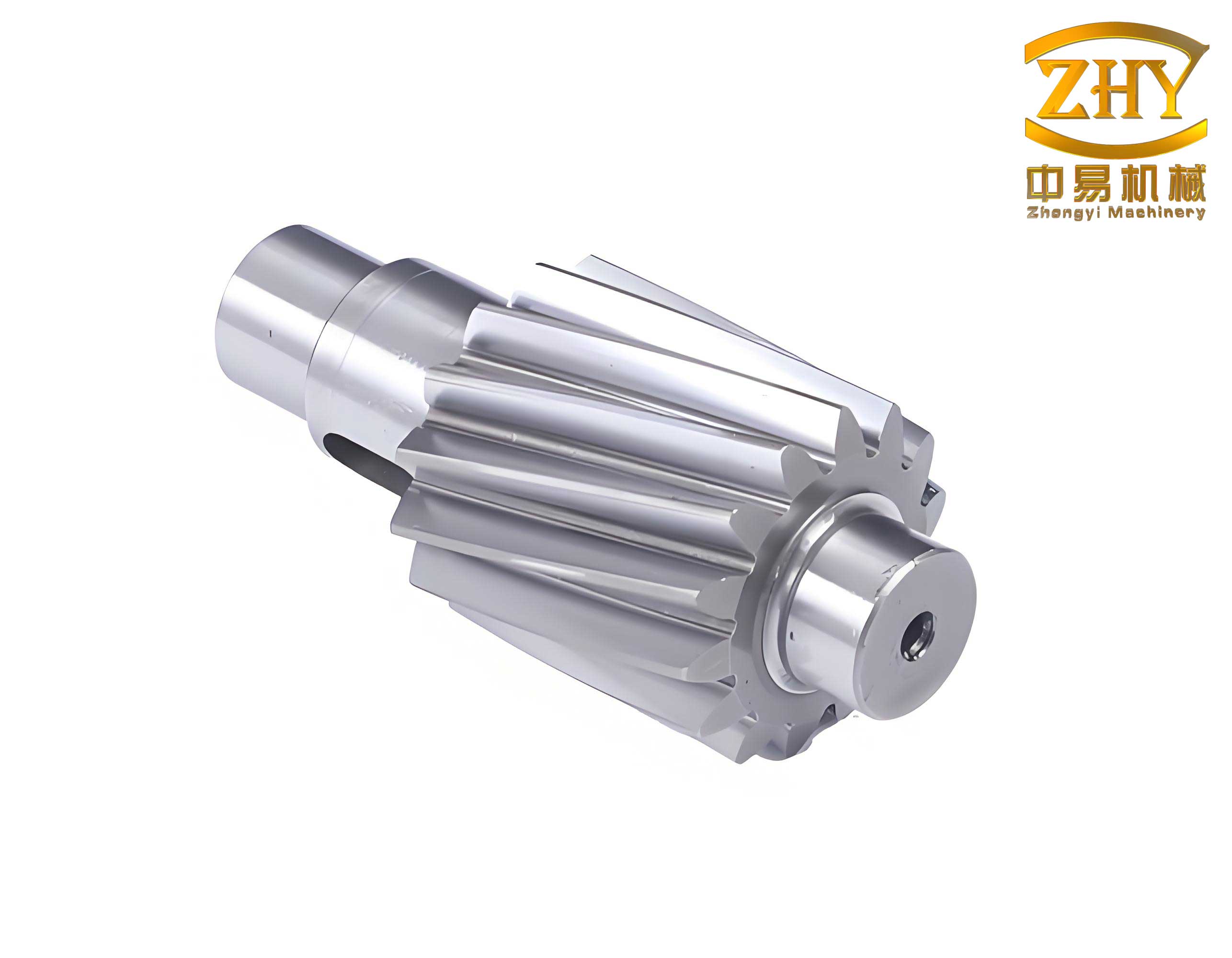
The subject of this study is a large gear shaft fabricated from the low-alloy steel 17CrNiMo6, a material chosen for its excellent hardenability and core properties. The key chemical composition of the gear shaft material is summarized in Table 1.
| C | Si | Mn | Cr | Mo | Ni |
|---|---|---|---|---|---|
| 0.17 | 0.27 | 0.65 | 1.61 | 0.29 | 1.57 |
The geometric specifications of the gear shaft are as follows: module M=22, number of teeth Z=23, tip diameter of approximately 550 mm, and a face width of 400 mm. The technical requirements post-carburizing and quenching specified a case depth of 5.0-5.5 mm, a maximum concavity (sinking) at the mid-face-width of the tooth tip of less than 1.5 mm, and a maximum warpage (deviation from flatness along the face width) of less than 1.5 mm. The initial manufacturing route involved gas carburizing in a pit furnace at 920°C, followed by a direct quench in agitated fast-quenching oil at 60°C. This traditional process consistently yielded distortion values exceeding the specified limits, necessitating a deeper analysis.
To diagnose the problem, a coupled thermo-metallurgical-mechanical finite element simulation was performed. Exploiting symmetry, a 3D model of a single tooth segment was created. The simulation sequentially modeled the carburizing process (including diffusion), cooling from carburizing temperature, reheating for quench, and finally, the quenching operation. The carbon diffusion during carburizing is governed by Fick’s second law, implemented in the simulation to predict case depth:
$$ \frac{\partial C}{\partial t} = \nabla \cdot (D \nabla C) $$
where \( C \) is the carbon concentration, \( t \) is time, and \( D \) is the temperature-dependent diffusion coefficient. The phase transformation kinetics during quenching were modeled using time-temperature-transformation (TTT) data and the Koistinen-Marburger relationship for martensite formation:
$$ V_m = 1 – \exp[-k(M_s – T)] $$
where \( V_m \) is the volume fraction of martensite, \( k \) is a material constant, \( M_s \) is the martensite start temperature (which is a function of carbon content), and \( T \) is the temperature.
The initial simulation of the oil-quenching process revealed the root cause of the excessive distortion. The carburizing cycle itself, comprising a boost stage at high carbon potential and a diffusion stage, successfully achieved the required case depth of approximately 5.2 mm, as confirmed by the simulated carbon profile. The core issue manifested during quenching. The fast-quenching oil, while providing the necessary cooling severity to harden the case, created extreme thermal gradients. The simulation output for the oil-quench process is critical for understanding the gear shaft distortion mechanism. The results showed a martensite content exceeding 90% throughout the case and a significant portion of the core, indicating full hardening. The associated volumetric expansion from the austenite-to-martensite transformation was substantial.
More importantly, the cooling was highly non-uniform. The ends of the gear shaft tooth cooled faster than the mid-section due to edge effects and the geometry of the gear shaft body. This differential cooling induced a complex stress state. The thermal contraction and phase transformation occurred asynchronously along the tooth face width. The simulated residual stress distribution on the tooth tip surface after oil quenching is presented in Table 2, showing the transition from high compressive stress in the middle to tensile stress towards the ends.
| Position from Mid-Face (mm) | Stress Type | Stress Magnitude (MPa) |
|---|---|---|
| 0 (Center) | Compressive | -116 |
| 75 | Compressive | -85 |
| 150 | ~0 / Transition | -10 |
| 185 (Near End) | Tensile | +22 |
| 200 (End) | Tensile | +29 |
This stress pattern—high compression in the center and tension at the ends—directly results in the observed saddle-shaped distortion. The central compressed zone wants to expand, pulling the ends inward, while the ends are in tension. The net effect is a concave bending of the tooth, with the mid-face-width showing the greatest reduction in tip diameter. The quantitative distortion results from the FEA for the oil-quench process are summarized in Table 3, confirming the failure to meet specifications.
| Distortion Parameter | Simulated Value | Specification Limit | Status |
|---|---|---|---|
| Max Concavity (Mid-Face) | 2.20 mm | 1.50 mm | FAIL |
| End Contraction | 0.80 mm | – | – |
| Warpage (Concavity Difference) | 1.40 mm | 1.50 mm | Marginal FAIL |
Armed with this understanding, the strategy for controlling gear shaft distortion focused on mitigating both thermal stress and transformation stress. The first improvement was modifying the heating cycle prior to quenching. Instead of a single-stage heating to the austenitizing temperature, a stepped heating approach was implemented: the gear shaft was first slowly heated to 560°C and held for 3 hours to reduce thermal gradients, then gradually heated to the final quenching temperature of 820°C over 9 hours. This lower quench temperature (compared to the typical 850-870°C) also reduces the thermal shock upon immersion.
The most significant change was the replacement of the quenching medium. Fast oil was substituted with a molten salt bath, specifically a mixture of 55% KNO3 and 45% NaNO2 with controlled water content. Salt baths offer a unique cooling characteristic: very high heat extraction rates in the high-temperature region (above ~500°C) and much slower cooling in the low-temperature martensite formation range. This characteristic is quantified by the heat transfer coefficient (h), a critical input for FEA. The cooling intensity can be modeled using a simplified Newtonian cooling approximation:
$$ q = h (T_s – T_m) $$
where \( q \) is the heat flux, \( h \) is the heat transfer coefficient, \( T_s \) is the surface temperature of the gear shaft, and \( T_m \) is the temperature of the quenching medium. The effective \( h \) value for the salt bath is significantly higher than oil in the high-temperature range but lower in the low-temperature range. This leads to more uniform cooling of the gear shaft cross-section initially, reducing thermal stress. Subsequently, the slow cooling through the martensite transformation range allows the stresses to relax and results in a more gradual, sequential transformation from the core to the case, minimizing transformation stress.
The proposed optimized process for the gear shaft was thus: Carburizing at 920°C -> Slow cooling -> Step heating to 820°C -> Quenching in a 180°C salt bath for 2 hours -> Air cooling to room temperature -> Tempering at 180°C for 12 hours. This is a marquenching (hot quenching) process. The FEA simulation was repeated with the updated heating cycle and the salt bath cooling characteristics. The results demonstrated a dramatic improvement. The modified stress evolution prevented the build-up of the extreme compressive stress in the tooth center. The final distortion values from the simulation of the optimized process are shown in Table 4.
| Distortion Parameter | Simulated Value | Specification Limit | Status |
|---|---|---|---|
| Max Concavity (Mid-Face) | 1.41 mm | 1.50 mm | PASS |
| End Contraction | 0.51 mm | – | – |
| Warpage (Concavity Difference) | 0.90 mm | 1.50 mm | PASS |
The quantitative comparison clearly shows the success of the FEA-driven optimization. The maximum concavity was reduced from 2.20 mm to 1.41 mm, and the warpage from 1.40 mm to 0.90 mm, both now well within the specified limits for the gear shaft. Furthermore, the distortion profile along the face width became more uniform, reducing the saddle shape effect. This predictability allowed for a precise setting of the final grinding allowance at 1.5 mm, which is both sufficient to clean up the distorted surface and minimal enough to prevent significant removal of the effective case depth, thereby eliminating the previously encountered issue of non-uniform surface hardness after finishing. The reduction in machining stock also translates directly to lower grinding time, reduced consumable costs, and extended tool life.
In conclusion, the application of Finite Element Analysis provided an indispensable virtual prototyping tool for diagnosing and solving a critical manufacturing problem for a large gear shaft. By accurately modeling the coupled physics of carburizing and quenching, the analysis pinpointed the non-uniform cooling and stress development during oil quenching as the primary driver of excessive saddle-shaped distortion. This insight directed the development of an optimized heat treatment protocol featuring controlled step heating and a switch to a salt bath marquenching process. The FEA predictions were confirmed in practice, resulting in a gear shaft that met all distortion specifications reliably. This approach underscores a modern paradigm in heat treatment of critical components like the gear shaft: moving from empirical trial-and-error to a simulation-informed, first-principles methodology for distortion control. This not only ensures quality and performance but also achieves significant reductions in manufacturing cost and lead time, proving essential for the production of high-performance, large-scale power transmission components.