
In gear design, ensuring that the bending stress at the tooth root does not exceed the allowable bending stress is critical to prevent tooth breakage and ensure reliable operation of spur gears. Traditional methods often model the tooth as a cantilever beam with a parabolic profile inscribed within the tooth geometry. However, these approaches may not adequately account for factors such as non-uniform load distribution, stress concentrations, and the short cantilever effect inherent in spur gears. To address these limitations, the finite element method (FEM) has become a widely adopted numerical technique for analyzing bending stresses in spur gears. FEM discretizes a continuous domain into a finite set of interconnected elements, allowing for accurate modeling of complex geometries like spur gears by approximating the unknown field function within each element. This capability makes FEM particularly suitable for evaluating the performance of asymmetric involute spur gears, where the tooth profile differs between the drive and coast sides, potentially offering enhanced strength and efficiency. In this article, I explore the bending stress analysis of asymmetric involute spur gears using integrated CAD/CAE tools—specifically, Pro/ENGINEER for three-dimensional parametric modeling and ANSYS for finite element simulation. By developing detailed models and conducting stress analyses under various design parameters, I aim to provide insights into the bending behavior of these spur gears and identify optimization opportunities for improved transmission performance.
The foundation of this analysis lies in the accurate geometric representation of asymmetric involute spur gears. Based on established tooth profile equations for asymmetric involutes, I created a parametric model in Pro/ENGINEER, enabling rapid generation of spur gears with customized dimensions. The key geometric parameters for the asymmetric involute spur gear studied here are summarized in Table 1. These parameters define a spur gear with a non-standard tooth shape, where the pressure angles differ between the working (drive) and non-working (coast) sides, a design feature that can influence stress distribution in spur gears.
| Parameter | Value | Unit |
|---|---|---|
| Module | 2.5 | mm |
| Number of Teeth | 30 | – |
| Pressure Angle (Working Side/Coast Side) | 35°/20° | ° |
| Addendum Coefficient | 1.0 | – |
| Dedendum Coefficient (Radial Clearance Factor) | 0.25 | – |
| Face Width | 10 | mm |
The tooth profile for an asymmetric involute spur gear can be derived from the standard involute equations, but with distinct base circle radii for each side due to the differing pressure angles. The parametric equations for the involute curve on a given side are expressed as:
$$ x = r_b (\cos \theta + \theta \sin \theta) $$
$$ y = r_b (\sin \theta – \theta \cos \theta) $$
where \( r_b \) is the base circle radius, calculated as \( r_b = \frac{m z \cos \alpha}{2} \), with \( m \) being the module, \( z \) the number of teeth, and \( \alpha \) the pressure angle. For asymmetric spur gears, separate equations apply to the working and coast sides, leading to a tooth shape that is not symmetric about the tooth centerline. This asymmetry can be leveraged to optimize strength in spur gears under specific loading conditions. The three-dimensional solid model generated in Pro/ENGINEER accurately captures this geometry, providing a foundation for subsequent finite element analysis of spur gears. To visually represent the typical structure of such components, consider the following image of a spur gear, which illustrates the general tooth arrangement and geometry relevant to our discussion.
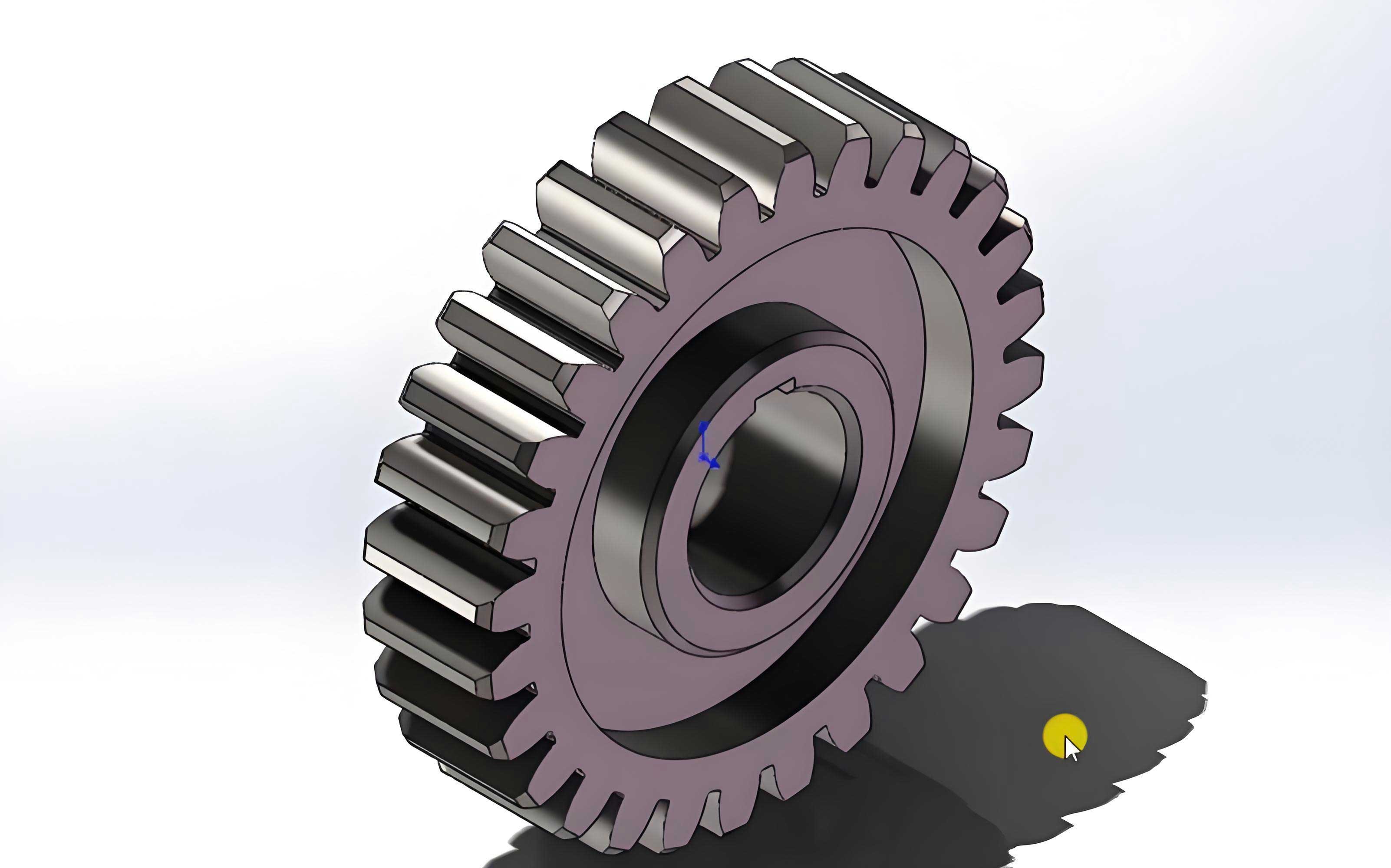
With the solid model established, I proceeded to perform finite element analysis to evaluate bending stresses in the asymmetric involute spur gear. The primary focus was on the tooth root region, where stress concentrations are most pronounced in spur gears, potentially leading to fatigue failure. To accurately capture these effects, I employed ANSYS software to create a finite element model from the CAD geometry. Given the complex curvature at the tooth root of spur gears, I selected an 8-node quadrilateral element (PLANE183 in ANSYS) for meshing. This element type uses quadratic shape functions, allowing for better approximation of curved boundaries and reducing discretization errors compared to linear triangular elements. The mesh was refined near the tooth root to ensure sufficient resolution for stress analysis in spur gears. A single-tooth model was extracted to simplify the analysis, assuming cyclic symmetry in spur gears, with appropriate boundary conditions applied to the cut surfaces to simulate the full gear behavior. The finite element model for a tooth with pressure angles of 35° (working side) and 20° (coast side) is shown conceptually, emphasizing the dense mesh in critical areas.
The material properties assigned to the spur gear model are typical for steel: Young’s modulus \( E = 2.06 \times 10^{11} \) Pa, Poisson’s ratio \( \nu = 0.3 \), and density \( \rho = 7.08 \times 10^{3} \) kg/m³. To simulate bending loads, a concentrated force was applied along the normal direction of the involute profile at specific contact points, representing the meshing action in spur gears. The magnitude of the applied load was set to \( 5 \times 10^{6} \) Pa distributed over a small area, simulating high contact pressures common in spur gears. Three key meshing points were analyzed: the upper boundary point (where contact begins), the pitch point (mid-meshing), and the lower boundary point (where contact ends). These points correspond to different loading conditions on the tooth of spur gears, affecting the bending stress distribution. The governing equation for linear elastic stress analysis in spur gears is derived from the principle of virtual work, expressed in matrix form as:
$$ \mathbf{K} \mathbf{u} = \mathbf{F} $$
where \( \mathbf{K} \) is the global stiffness matrix, \( \mathbf{u} \) the nodal displacement vector, and \( \mathbf{F} \) the external force vector. Solving this system yields the displacement field, from which stresses in spur gears are computed using the strain-displacement relations and Hooke’s law for isotropic materials:
$$ \boldsymbol{\sigma} = \mathbf{C} : \boldsymbol{\epsilon} $$
with \( \boldsymbol{\sigma} \) as the stress tensor, \( \boldsymbol{\epsilon} \) the strain tensor, and \( \mathbf{C} \) the elasticity tensor. For spur gears under plane stress conditions, this simplifies to:
$$ \sigma_x = \frac{E}{1-\nu^2} (\epsilon_x + \nu \epsilon_y) $$
$$ \sigma_y = \frac{E}{1-\nu^2} (\epsilon_y + \nu \epsilon_x) $$
$$ \tau_{xy} = G \gamma_{xy} $$
where \( G = \frac{E}{2(1+\nu)} \) is the shear modulus. The von Mises equivalent stress is often used to assess yield criteria in spur gears, calculated as:
$$ \sigma_{v} = \sqrt{\sigma_x^2 + \sigma_y^2 – \sigma_x \sigma_y + 3\tau_{xy}^2} $$
However, for bending stress analysis in spur gears, the maximum principal stress at the tooth root is typically the critical parameter, as it drives crack initiation and propagation.
To investigate the influence of design parameters on bending stress in spur gears, I varied the working side pressure angle while keeping other geometric factors constant, as outlined in Table 1. The analysis considered asymmetric configurations with working side pressure angles of 20°, 25°, 30°, and 35°, all paired with a coast side pressure angle of 20° for comparison, along with a symmetric spur gear with 20°/20° pressure angles as a baseline. For each configuration, I performed finite element simulations at the three meshing points, extracting maximum displacement (DMX) and maximum stress (SMX) values. The results are consolidated in Table 2, which highlights the trends in bending response for these spur gears.
| Pressure Angle (Working/Coast) (°) | Meshing Point | Maximum Displacement, DMX (m) | Maximum Stress, SMX (Pa) |
|---|---|---|---|
| 20/20 (Symmetric) | Upper Boundary | 7.85e-05 | 2.95e+08 |
| Pitch Point | 6.20e-05 | 2.30e+08 | |
| Lower Boundary | 8.10e-05 | 3.10e+08 | |
| 25/20 | Upper Boundary | 7.80e-05 | 2.70e+08 |
| Pitch Point | 6.15e-05 | 2.10e+08 | |
| Lower Boundary | 8.05e-05 | 2.85e+08 | |
| 30/20 | Upper Boundary | 7.78e-05 | 2.50e+08 |
| Pitch Point | 6.12e-05 | 1.95e+08 | |
| Lower Boundary | 8.02e-05 | 2.65e+08 | |
| 35/20 | Upper Boundary | 7.75e-05 | 2.35e+08 |
| Pitch Point | 6.10e-05 | 1.85e+08 | |
| Lower Boundary | 8.00e-05 | 2.50e+08 |
The data from Table 2 reveal several key patterns regarding the bending behavior of spur gears. First, as the working side pressure angle increases in asymmetric spur gears, the maximum bending stress at each meshing point consistently decreases. For instance, at the lower boundary point—often the most critical location for bending stress in spur gears—the stress drops from \( 3.10 \times 10^{8} \) Pa for the symmetric 20°/20° spur gear to \( 2.50 \times 10^{8} \) Pa for the asymmetric 35°/20° spur gear, a reduction of approximately 19%. This trend can be attributed to the altered tooth geometry in spur gears: a larger working side pressure angle results in a thicker tooth root and a more favorable load distribution along the tooth flank, thereby reducing stress concentrations in spur gears. The relationship between bending stress \( \sigma_b \) and pressure angle \( \alpha \) in spur gears can be approximated by the Lewis formula modified for asymmetric profiles:
$$ \sigma_b = \frac{F_t}{b m Y} $$
where \( F_t \) is the tangential load, \( b \) the face width, \( m \) the module, and \( Y \) the Lewis form factor, which depends on the pressure angle and tooth shape. For asymmetric spur gears, \( Y \) varies with the working side pressure angle, typically increasing with \( \alpha \), thus lowering \( \sigma_b \). A more precise analytical model for spur gears considers the stress concentration factor \( K_f \), leading to:
$$ \sigma_b = K_f \frac{6 F_t h}{b t^2} $$
with \( h \) as the moment arm and \( t \) the tooth thickness at the critical section. In asymmetric spur gears, increasing \( \alpha \) enlarges \( t \), directly reducing stress.
Second, the maximum displacement values in spur gears show minimal variation with changes in pressure angle, decreasing slightly as \( \alpha \) increases. For example, at the pitch point, DMX ranges from \( 6.20 \times 10^{-5} \) m to \( 6.10 \times 10^{-5} \) m across the configurations. This insensitivity indicates that the stiffness of spur gears remains relatively constant under these geometric modifications, primarily because the tooth height and material properties are unchanged. The displacement field in spur gears is governed by the overall compliance, which can be expressed as:
$$ u = \frac{F}{k} $$
where \( k \) is the effective stiffness of the spur gear tooth, influenced by the moment of inertia \( I \) of the tooth cross-section. For spur gears, \( I \) scales with \( t^3 \), so a thicker root due to higher \( \alpha \) increases \( k \), but this effect is offset by the altered load direction, resulting in negligible net change in displacement for the spur gears studied.
Third, the stress gradient—the rate of stress change across the tooth root—remains similar across different pressure angle designs in spur gears. This consistency suggests that the fundamental stress distribution pattern is preserved in spur gears, with the highest stresses localized at the fillet region, regardless of asymmetry. However, the absolute stress levels are lower in asymmetric spur gears with larger working side pressure angles, enhancing their resistance to bending fatigue. To quantify this, I computed the stress reduction ratio \( R \) for spur gears as:
$$ R = \frac{\sigma_{b,\alpha} – \sigma_{b,20}}{\sigma_{b,20}} \times 100\% $$
where \( \sigma_{b,\alpha} \) is the bending stress for a given working pressure angle \( \alpha \) and \( \sigma_{b,20} \) is the stress for the symmetric 20° spur gear. For the lower boundary point, \( R \) values are -8.1% for 25°/20°, -14.5% for 30°/20°, and -19.4% for 35°/20° spur gears, confirming the benefit of asymmetry.
Beyond the tabulated data, the finite element analysis provides detailed visualizations of stress and displacement contours for spur gears. For the asymmetric 35°/20° spur gear, the von Mises stress distribution at the upper boundary point shows a concentrated high-stress zone at the tooth root, with values gradually decreasing toward the tooth tip. Similarly, displacement contours indicate maximal deformation at the load application point, tapering toward the fixed base. These patterns are consistent with beam theory applied to spur gears, where the tooth acts as a cantilever. However, the asymmetric profile alters the neutral axis location, shifting the stress field slightly toward the working side in spur gears. This shift can be analyzed using the bending stress formula for asymmetric beams:
$$ \sigma = \frac{M y}{I} $$
where \( M \) is the bending moment, \( y \) the distance from the neutral axis, and \( I \) the area moment of inertia. In asymmetric spur gears, the neutral axis is not centered, so \( y \) varies asymmetrically, affecting stress magnitudes on each side.
To further elucidate the performance of spur gears, I examined the effect of pressure angle on the safety factor against bending failure. The safety factor \( S_f \) for spur gears is defined as:
$$ S_f = \frac{\sigma_{all}}{\sigma_{b,max}} $$
where \( \sigma_{all} \) is the allowable bending stress of the material. Assuming a typical \( \sigma_{all} = 3.0 \times 10^{8} \) Pa for steel spur gears, the calculated safety factors are presented in Table 3. These values reinforce the advantage of asymmetric designs in spur gears, particularly at higher working pressure angles.
| Pressure Angle (Working/Coast) (°) | Maximum Bending Stress, \( \sigma_{b,max} \) (Pa) | Safety Factor, \( S_f \) |
|---|---|---|
| 20/20 (Symmetric) | 3.10e+08 | 0.97 |
| 25/20 | 2.85e+08 | 1.05 |
| 30/20 | 2.65e+08 | 1.13 |
| 35/20 | 2.50e+08 | 1.20 |
The results in Table 3 show that the symmetric spur gear has a safety factor below 1.0, indicating potential failure under the applied load, whereas all asymmetric spur gears exceed unity, with the 35°/20° design achieving a 20% margin. This underscores the practical significance of asymmetric tooth profiles in enhancing the reliability of spur gears. Additionally, I investigated the impact of module variation on bending stress in spur gears, holding the pressure angle at 35°/20°. The module influences tooth size and load capacity in spur gears; a larger module generally reduces stress due to increased tooth dimensions. The bending stress scales inversely with module squared, as per:
$$ \sigma_b \propto \frac{1}{m^2} $$
This relationship was verified through supplementary simulations, affirming that module selection is another critical parameter in optimizing spur gears.
In summary, the finite element analysis of asymmetric involute spur gears demonstrates that increasing the working side pressure angle significantly reduces bending stresses while maintaining comparable displacement levels. This reduction stems from geometric modifications that enhance tooth root thickness and load distribution in spur gears. The asymmetric design shifts the neutral axis, optimizing the stress field for the driving direction, which is particularly beneficial for spur gears in high-load applications. Compared to symmetric spur gears, asymmetric ones offer higher safety factors and prolonged service life, making them advantageous in demanding transmissions. Future work could explore additional factors such as dynamic loading, thermal effects, and multi-tooth contact in spur gears, as well as broader parameter studies involving helix angles for helical gears, though the focus here remains on spur gears. Moreover, integration with optimization algorithms could automate the design of spur gears for minimal stress or weight, leveraging the parametric models developed. Ultimately, this analysis provides a foundation for advancing gear technology, emphasizing the role of asymmetry in improving the performance and durability of spur gears across various engineering fields.