
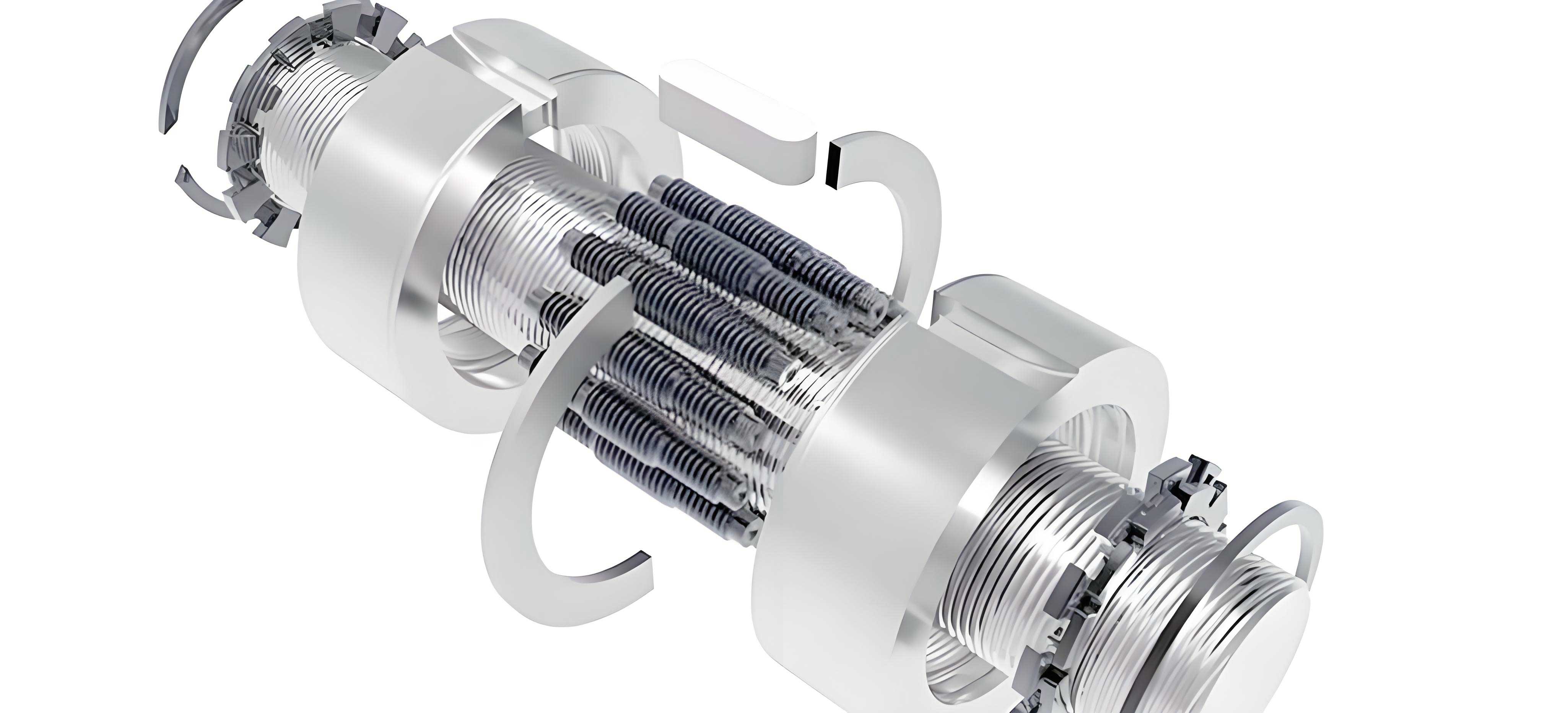
The planetary roller screw assembly is a highly efficient mechanical actuator that converts rotary motion into precise linear motion. Its superior load capacity, stiffness, and longevity compared to traditional ball screws make it indispensable in demanding applications such as aerospace systems, industrial robotics, and high-performance machine tools. The defining feature of a planetary roller screw assembly is the set of threaded rollers distributed around the central screw. A critical functional element of these rollers is their ends, which are machined as spur gears. These end gears mesh with internal ring gears fixed within the nut, ensuring proper phasing, load distribution, and preventing relative rotation of the rollers.
However, these end gears are not standard spur gears. To accommodate the central threaded portion of the roller and avoid interference with the screw threads, the gear teeth are intersected by the same helical groove that forms the roller thread. This results in a discontinuous tooth surface, where each nominal tooth face is segmented into a series of discrete “mini-teeth” or tooth segments separated by thread grooves. This unique geometry presents a significant challenge for contact stress analysis, which is fundamental to predicting fatigue life and reliability. The conventional Hertzian contact theory for standard gears becomes less accurate because the contact lines are no longer continuous along the face width. In this analysis, I investigate the static contact stress behavior of these threaded end gears using finite element analysis (FEA) to understand the implications of thread pitch on gear meshing performance within the planetary roller screw assembly.
1. Methodology and Model Development
The core of this investigation lies in comparing the contact mechanics of a standard, continuous-face-width spur gear pair against a pair where the planet gear features a threaded groove. The analysis is performed using a commercial FEA software suite (ANSYS Workbench), preceded by precise geometric modeling.
1.1 Geometric Parameters and Modeling
The gear parameters are derived from a commercial planetary roller screw assembly design. The internal gear pair consists of a planet gear (the roller end) and a fixed internal ring gear. The key geometric data is summarized below.
| Parameter | Planet (Roller) Gear | Internal Ring Gear |
|---|---|---|
| Module, \( m \) | 0.25 mm | 0.25 mm |
| Number of Teeth, \( z \) | 14 | 70 |
| Pressure Angle, \( \alpha \) | 20° | 20° |
| Addendum Coefficient, \( h_a^* \) | 0.8 | 0.8 |
| Dedendum Coefficient, \( c^* \) | 0.3 | 0.3 |
| Reference Diameter, \( d \) | \( d_p = m \cdot z_p = 3.5\ \text{mm} \) | \( d_i = m \cdot z_i = 17.5\ \text{mm} \) |
| Tip Diameter, \( d_a \) | \( d_{ap} = d_p + 2m \cdot h_a^* = 3.9\ \text{mm} \) | \( d_{ai} = d_i – 2m \cdot h_a^* = 17.1\ \text{mm} \) |
| Root Diameter, \( d_f \) | \( d_{fp} = d_p – 2m \cdot (h_a^* + c^*) = 2.95\ \text{mm} \) | \( d_{fi} = d_i + 2m \cdot (h_a^* + c^*) = 18.05\ \text{mm} \) |
The three-dimensional models for the standard (non-threaded) gear pair were generated using specialized gear design software (KissSoft) and a CAD platform. For the analysis of the planetary roller screw assembly’s end gear, the planet gear model was modified by sweeping a helical thread groove of square profile (90° thread angle) through the gear segment. A critical design constraint is that the tip diameter of the planet gear must be less than the crest diameter of the threaded portion of the roller. The crest diameter \( d_{ra} \) and root diameter \( d_{rf} \) of the roller’s threaded section depend on the screw and thread geometry. The nominal roller diameter \( d_r \) is a function of the screw parameters:
$$ d_r = d_s \cdot \frac{P_s}{P_r} – 2\Delta $$
$$ d_{ra} = d_r + 2 \times 0.35 H_r $$
$$ d_{rf} = d_r – 2 \times 0.475 H_r $$
where \( d_s \) is the screw nominal diameter, \( P_s \) is the screw lead, \( P_r \) is the roller lead (pitch), \( H_r \) is the roller thread depth, and \( \Delta \) is a radial clearance. Therefore, for a given screw size, the permissible tip diameter \( d_{ap} \) of the end gear decreases as the roller’s thread pitch increases. This relationship is captured in the following table for different thread pitches \( \tau \).
| Thread Pitch, \( \tau \) (mm) | Gear Tip Diameter, \( d_{ap} \) (mm) | Thread Groove Root Diameter, \( e \) (mm) |
|---|---|---|
| 2.0 | 3.64 | 3.31 |
| 3.0 | 3.71 | 3.215 |
| 4.0 | 3.78 | 3.12 |
| 5.0 | 3.85 | 3.025 |
The face width \( b \) was kept constant at 3 mm. Models for four different thread pitches (2, 3, 4, and 5 mm) were created, labeled RV2 to RV5. For computational efficiency, a sector model representing a single pair of teeth in contact within the region of highest load (single-tooth contact zone) was extracted for analysis.
1.2 Finite Element Analysis Setup
The material for all components was defined as stainless steel with standard properties: Young’s Modulus \( E = 200\ \text{GPa} \), Poisson’s ratio \( \mu = 0.3 \), and density \( \rho = 7850\ \text{kg/m}^3 \). A static structural analysis was performed.
Mesh Generation: The geometry was discretized using a high-quality tetrahedral mesh. To ensure accuracy in the contact region, a local mesh refinement with an element size of 0.005 mm was applied to the active tooth flanks and fillet regions of both gears. The mesh for the standard gear and an example threaded gear are shown conceptually below.
Contacts and Boundary Conditions: A frictional contact formulation was established between the mating tooth flanks. The planet gear was designated as the driving component. Boundary conditions were applied as follows:
- Planet Gear: A cylindrical joint was applied to its central axis. The rotational degree of freedom was released, and a driving torque of \( T = 10\ \text{mN·m} \) was applied.
- Internal Ring Gear: Its outer cylindrical surface was fixed using a joint connection, constraining all degrees of freedom.
This setup simulates a quasi-static loading condition at a specific meshing position, allowing for a detailed examination of the contact and bending stress fields induced by the unique geometry of the planetary roller screw assembly’s end gear.
2. Results and Analysis of Contact Stress
2.1 Baseline: Standard Spur Gear Meshing
First, I analyzed the standard spur gear pair (without thread grooves) to establish a baseline. The resulting contact stress distribution on the planet gear tooth flank is uniform along the entire face width. The maximum contact stress under the applied load was approximately 55 MPa. This serves as a reference point for evaluating the effect of the thread groove discontinuity inherent in the planetary roller screw assembly design.
2.2 Effect of Thread Groove on Contact Stress Distribution
The introduction of the thread groove fundamentally alters the stress state. For the threaded end gear (e.g., RV2 with 2 mm pitch), the contact is no longer a continuous line but is broken into discrete segments corresponding to the “mini-teeth.” The contact stress contour map reveals a significant increase in peak contact stress compared to the standard gear. Furthermore, a distinct pattern emerges on each mini-tooth: the contact stress is highest at the edges (adjacent to the thread groove) and lower in the center of the mini-tooth face.
This phenomenon can be attributed to two primary factors related to the design of the planetary roller screw assembly:
- Reduced Contact Line Length: The physical separation caused by the grooves drastically shortens the total instantaneous line of contact between the meshing gears. According to Hertzian contact theory, for a given load, contact stress is inversely related to the contact area. The reduced contact length leads to a higher stress concentration.
- Edge Stress Concentration: The sharp transitions at the boundaries between the mini-tooth face and the thread groove wall act as geometric discontinuities. Under load, these edges experience localized stress intensification, explaining the high-stress zones on the flanks of each mini-tooth.
2.3 Influence of Thread Pitch on Contact Stress
A systematic study of different thread pitches (RV2 to RV5) reveals a clear trend. As the thread pitch \( \tau \) increases, the number of mini-teeth across the face width decreases. Consequently, for a given face width, a larger pitch means each remaining mini-tooth segment is wider, but the total number of contact segments is smaller. The FEA results show that the maximum and average contact stresses on the tooth flank increase with increasing thread pitch.
The underlying mechanics can be summarized as follows: While individual mini-tooth width increases with pitch, the reduction in the number of load-sharing segments dominates. The load is distributed among fewer, albeit wider, contact patches, leading to an increase in the pressure over each patch. This is a critical design consideration for the planetary roller screw assembly, as higher contact stress directly correlates with reduced surface fatigue life (pitting resistance).
| Model (Pitch \(\tau\)) | Approx. Number of Mini-teeth | Trend in Max Contact Stress | Primary Cause |
|---|---|---|---|
| RV2 (2 mm) | Largest | Lowest among threaded gears | More load-sharing segments. |
| RV3 (3 mm) | Medium | Moderate Increase | Reduced number of contact segments. |
| RV4 (4 mm) | Medium | Significant Increase | Further reduction in load-sharing. |
| RV5 (5 mm) | Smallest | Highest | Least number of contact segments bearing the full load. |
3. Analysis of Bending Stress at the Tooth Root
Beyond contact stress, the bending stress at the tooth root is vital for preventing gear tooth fracture. The thread groove has a profound effect on the root stress distribution. In a standard gear, the bending stress along the root is relatively uniform. In contrast, for the threaded end gear of a planetary roller screw assembly, the root stress distribution exhibits a pronounced wavy pattern along the axis.
The peaks of this wave correspond to the root sections beneath the mini-teeth, which are subject to bending loads. The troughs correspond to the root sections aligned with the thread grooves, which are unloaded. The amplitude of this stress wave—the difference between peak (loaded) and trough (unloaded) stress—is a key indicator of stress concentration severity.
The analysis shows that the amplitude of the root stress wave increases with increasing thread pitch. For larger pitches (e.g., RV5), the thread groove root diameter \( e \) is smaller (closer to the gear’s root circle, as shown in Table 2). This means the material cross-section at the root beneath a mini-tooth is effectively more slender and has a smaller fillet radius transitioning into the deeper groove. This geometry creates a more severe stress riser. Therefore, while a larger pitch in a planetary roller screw assembly might be desirable for other kinematic or load-capacity reasons related to the threaded section, it can critically weaken the bending strength of the end gear. The maximum root bending stress must be carefully evaluated against the material’s endurance limit to prevent fatigue fracture.
The bending stress \( \sigma_b \) at the critical section can be approximated using the Lewis formula, modified for the reduced effective face width \( b_{eff} \):
$$ \sigma_b \approx \frac{F_t}{b_{eff} \cdot m \cdot Y} $$
where \( F_t \) is the tangential load, \( m \) is the module, \( Y \) is the Lewis form factor, and \( b_{eff} \) is less than the nominal face width \( b \) due to the groove. For a threaded gear, \( b_{eff} \) is not simply the mini-tooth width; the stress concentration effect of the groove must be accounted for via a stress concentration factor \( K_f \), leading to a localized stress:
$$ \sigma_{b, max} = K_f \cdot \sigma_b $$
where \( K_f \) increases as the groove becomes sharper and deeper relative to the root section.
4. Conclusions and Design Implications
This finite element investigation into the static contact and bending stresses of the threaded end gear in a planetary roller screw assembly yields several critical conclusions for design and analysis:
- Contact Stress Elevation: The presence of the thread groove significantly increases tooth flank contact stress compared to an equivalent standard spur gear. The stress distribution on each mini-tooth is non-uniform, with maxima at the edges adjacent to the groove walls.
- Pitch-Dependent Contact Behavior: Contrary to an initial assumption that wider mini-teeth might lower stress, the analysis demonstrates that increasing the thread pitch (leading to fewer load-bearing segments) results in higher contact stresses. This negatively impacts the surface durability (pitting resistance) of the planetary roller screw assembly’s gears.
- Root Stress Concentration and Pitch Effect: The thread groove induces a highly non-uniform, wavy bending stress distribution at the tooth root. The severity of this stress concentration, quantified by the wave amplitude, increases with thread pitch. Larger pitches create a weaker root geometry, making the gear more susceptible to bending fatigue failure.
- Design Trade-Off: There exists a fundamental trade-off in selecting the thread pitch for the planetary roller screw assembly. A smaller pitch improves gear meshing conditions (lower contact and bending stress concentrations) but may influence the lead and mechanical advantage of the threaded roller section. A larger pitch may be beneficial for the screw’s kinematic performance but compromises the strength and reliability of the end gear meshing.
Therefore, a comprehensive design optimization of the planetary roller screw assembly must integrate the analysis of both the threaded section and the end gear section. The gear geometry, particularly the thread pitch and groove profile, should not be determined by the screw mechanics alone. A dedicated stress analysis, as performed here, is essential. For designs utilizing larger pitches, a thorough verification of both the contact stress (for pitting) and, especially, the maximum root bending stress (for fracture) is mandatory to ensure the overall reliability and service life of the planetary roller screw assembly.