
Gear transmission stands as one of the most critical forms of mechanical drive, characterized by numerous configurations and widespread application. However, it is also among the components most prone to failure. Statistics indicate that gear failure constitutes the majority of malfunctions in mechanical equipment. A prevalent failure mode is tooth fatigue breakage. When a gear tooth is loaded, it behaves analogously to a cantilever beam. The maximum bending stress is generated at the tooth root, where the cross-sectional transition creates a stress concentration point. Under repeated loading, fatigue cracks initiate at the tooth root and propagate, ultimately leading to fatigue fracture of the tooth. This analysis focuses on helical gears, where the angled teeth introduce more complex contact conditions compared to spur gears. To effectively evaluate the structural integrity and predict the lifespan of helical gears, advanced simulation tools are essential.
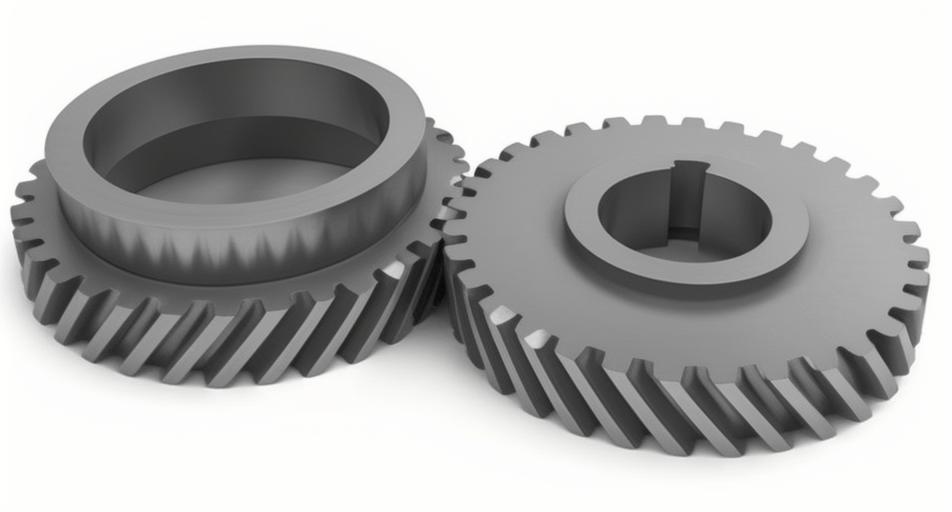
This study employs the ANSYS Workbench platform, leveraging the theory of finite element elastic analysis. A three-dimensional finite element model of a meshing helical gear pair is established. Through the calculation of contact surface stress and strain, this investigation aims to provide a valid basis for analyzing the contact stress of helical gears, performing strength checks, and assessing service life. The unique engagement characteristics of helical gears, where contact progresses gradually along the tooth face, necessitate such detailed computational analysis.
Theoretical Foundation of Gear Contact
The contact problem for a pair of meshing helical gears can be theoretically modeled by considering two elastic bodies, Gear A and Gear B. Their mating surfaces consist of a finite set of contact node pairs. Under the influence of external load vectors $\{\mathbf{F_A}\}$ and $\{\mathbf{F_B}\}$, displacement matrices $\{\mathbf{U_A}\}$ and $\{\mathbf{U_B}\}$ are produced at all nodes, including the contact interfaces. Based on finite element theory, the following equilibrium equations govern each body:
$$[\mathbf{K_A}]\{\mathbf{U_A}\} = \{\mathbf{F_A}\} + \{\mathbf{R_A}\}$$
$$[\mathbf{K_B}]\{\mathbf{U_B}\} = \{\mathbf{F_B}\} + \{\mathbf{R_B}\}$$
Here, $[\mathbf{K_A}]$ and $[\mathbf{K_B}]$ represent the global stiffness matrices of the helical gear bodies. The vectors $\{\mathbf{R_A}\}$ and $\{\mathbf{R_B}\}$ denote the contact reaction forces at the interface nodes. For a given set of helical gear parameters, the displacement matrices and the contact force vectors are the unknowns. With only two matrix equations available for the two-body system, the solution is indeterminate. To resolve this, compatibility equations specific to the contact interface must be introduced, reflecting the physical state of each contact node pair.
The contact state between any two candidate nodes can be classified into one of three conditions: bonded (sticking), separated, or sliding. Each state corresponds to a distinct set of compatibility (constraint) equations. Determining the correct state for all contact pairs leads to a unique solution for the system. For a contact pair where node 1 belongs to Gear A and node 2 belongs to Gear B, the equations are as follows:
1. Bonded/Sticking State:
In this state, the nodes are bonded together, allowing no relative motion.
$$R^{A}_{1n} + R^{B}_{2n} = 0, \quad U^{A}_{1n} = U^{B}_{2n}, \quad U^{A}_{1t} = U^{B}_{2t}$$
2. Separated State:
The surfaces are not in contact, and therefore transmit no forces.
$$R^{A}_{1n} = R^{B}_{2n} = 0, \quad R^{A}_{1t} = R^{B}_{2t} = 0$$
3. Sliding State:
The surfaces are in contact but sliding relative to each other, governed by Coulomb friction.
$$R^{A}_{1n} + R^{B}_{2n} = 0, \quad R^{A}_{1t} + R^{B}_{2t} = 0, \quad U^{A}_{1n} = U^{B}_{2n}, \quad |R^{A}_{1t}| = \mu |R^{A}_{1n}|$$
Where:
$R_{n}$ and $R_{t}$ are the normal and tangential (frictional) contact force components, respectively.
$U_{n}$ and $U_{t}$ are the normal and tangential displacement components.
$\mu$ is the coefficient of friction between the contacting surfaces of the helical gears.
The superscript denotes the gear body, and the subscript denotes the node number and component direction.
Finite Element Modeling of Helical Gears
The accurate creation of a geometric model is paramount for a reliable finite element analysis of helical gears. In this work, a parametric modeling approach was adopted using SolidWorks coupled with its GearTrax plugin. The necessary specifications for the helical gear pair, such as module, number of teeth, helix angle, face width, and pressure angle, were input into GearTrax, which automatically generated a pre-assembled, correctly meshed three-dimensional model of the helical gears. This method ensures geometric accuracy and proper initial contact alignment, which is crucial for the subsequent analysis.
Following the gear generation, supporting components like shafts and keys were modeled directly in SolidWorks using standard extrusion features based on dimensional drawings. Keyway dimensions adhered to national standards. A critical step in preparing the model for high-quality meshing involved partitioning the geometry. The native “Split” function in SolidWorks was utilized to divide the gear teeth and other complex regions into smaller, more regular volumes. This partitioning allows for controlled local mesh refinement in areas of high stress gradients, such as the tooth fillet and contact zones, leading to more accurate results without excessively increasing the total element count.
The assembled model was then imported into the ANSYS Workbench environment. The material properties for the helical gears, defined as 18CrNiMo7-6 alloy steel, were assigned as detailed in the table below. These properties form the basis for the linear elastic and, if needed, elastoplastic calculations within the solver.
| Property | Symbol | Value | Unit |
|---|---|---|---|
| Density | $\rho$ | 7.85E+03 | kg/m³ |
| Young’s Modulus | $E$ | 2.06E+11 | Pa (GPa) |
| Poisson’s Ratio | $\nu$ | 0.3 | – |
| Yield Strength | $\sigma_y$ | 9.05E+08 | Pa (MPa) |
| Ultimate Tensile Strength | $\sigma_u$ | 1.08E+09 | Pa (MPa) |
| Tangent Modulus | $E_t$ | 2.06E+11 | Pa (GPa) |
The next phase involved generating the computational mesh. A global element size of 10 mm was initially specified. Subsequently, targeted refinement was applied to the tooth surfaces and, most importantly, the potential contact regions of the helical gears. This was achieved by manually selecting the faces or using automated scripts to identify geometry by size. The contact regions received a significantly finer mesh to capture the steep stress gradients expected during gear meshing. The final discretized model, consisting primarily of tetrahedral elements, is represented conceptually by the following mesh parameters.
| Region | Element Type | Global Size | Local Refinement Size |
|---|---|---|---|
| Gear Bodies & Shafts | Quad/Tet Dominant | 10 mm | N/A |
| Tooth Flanks & Roots | Quad/Tet Dominant | N/A | 2 mm |
| Contact Zone (Patch) | Quad/Tet Dominant | N/A | 0.5 mm |
Following meshing, the boundary conditions and loads were applied to simulate a realistic static loading scenario for the helical gears. A “Cylindrical Support” was applied to both ends of the pinion shaft. This support type constrains radial and axial displacements but allows free rotation about the shaft axis (tangential direction), simulating the bearing support. The larger gear (gear wheel) was held fixed by applying a “Fixed Support” to its hub or shaft section, preventing all degrees of freedom. A pure torque of 1000 N·m was applied as a moment load on the cylindrical surface of the pinion shaft. This torque represents the input driving load that is transmitted through the meshing helical gears.
The most critical step in setting up the analysis for helical gears is defining the contact between the mating tooth surfaces. A “Frictional” contact type was defined between the tooth flanks of the pinion and the gear wheel. The coefficient of friction was set to $\mu = 0.02$, a typical value for well-lubricated steel surfaces. The “Asymmetric” formulation was chosen, designating the pinion tooth surface as the “Contact” body (higher priority for penetration checking) and the gear wheel tooth surface as the “Target” body. The “Augmented Lagrange” algorithm was selected for its robustness in solving frictional contact problems. The complete set of boundary and interaction conditions is summarized below.
| Component | Condition Type | Details / Value |
|---|---|---|
| Pinion Shaft Ends | Cylindrical Support | Fixed: Radial (X,Y) & Axial (Z). Free: Tangential (Rotation). |
| Gear Wheel Hub | Fixed Support | All DOFs constrained (UX, UY, UZ). |
| Pinion Shaft Surface | Moment / Torque | Magnitude = 1000 N·m, about shaft axis. |
| Gear Tooth Interfaces | Frictional Contact | Contact: Pinion teeth. Target: Gear wheel teeth. $\mu=0.02$. |
Analysis Results and Discussion
With the model fully defined, the static structural solver in Workbench was executed. The primary results of interest for the helical gear analysis are the equivalent (von Mises) stress distribution and the total deformation. The stress contours revealed a highly localized and complex pattern characteristic of the contact between helical gears. The maximum equivalent stress was found to be 15.1 MPa, a value significantly below the material’s yield strength of 905 MPa. This indicates that under the applied static torque, the helical gears operate well within the elastic region, and the design has a high safety factor against yielding.
The most insightful observation from the stress nephogram pertains to the shape and progression of the high-stress region. Unlike spur gears, where maximum contact stress typically occurs at a single point along the line of action, the helical gears exhibited a stress distribution that evolved along a diagonal band on the tooth face. This band represents the instantaneous contact line. The analysis visually confirmed the theoretical engagement behavior of helical gears: the contact line starts as a point, gradually elongates diagonally across the tooth face to a maximum length, then shortens again before the tooth pair disengages. The high-stress region in the simulation followed this exact pattern, validating the model’s ability to capture the fundamental mechanics of helical gear meshing.
Furthermore, significant stress concentration was observed at the tooth root fillet on the loaded side of both helical gears. This aligns perfectly with the cantilever beam theory of gear tooth bending, confirming that the root fillet is the critical location for bending fatigue failure. The stress at the root was also well below the yield limit for this static load case.
The deformation results showed that the maximum total displacement was approximately 0.019 mm (19 microns). This deformation occurred primarily on the pinion shaft due to the applied torque, with minimal distortion in the gear teeth themselves. Such a small deformation confirms that the overall stiffness of the gear-shaft system is sufficient, and the resulting slight misalignment would have a negligible impact on the contact pattern and operational performance of the helical gears under these conditions.
| Result Parameter | Maximum Value | Location | Comment |
|---|---|---|---|
| Equivalent (von Mises) Stress | 15.1 MPa | Tooth contact zone & root fillet | Well below yield (905 MPa). Pattern matches helical contact theory. |
| Total Deformation | 0.019 mm | Pinion shaft | Indicates sufficient system stiffness. |
| Safety Factor (Yield) | > 50 | – | Calculated as $\sigma_y / \sigma_{max}$. |
A deeper theoretical interpretation connects the FEA results to classical gear stress formulas. The maximum contact (Hertzian) stress for gears can be estimated using:
$$\sigma_{H} = \sqrt{ \frac{F}{ \pi b} \cdot \frac{1}{\frac{1-\nu_1^2}{E_1} + \frac{1-\nu_2^2}{E_2}} \cdot \frac{1}{\rho_{eff}} }$$
Where $F$ is the normal tooth load, $b$ is the face width, and $\rho_{eff}$ is the effective radius of curvature at the contact point. While this formula is simplified for spur gears, the FEA for helical gears accounts for the complex, varying line contact and load sharing across multiple teeth, providing a more accurate and detailed stress picture than the analytical formula alone.
Conclusion and Implications for Helical Gear Design
This finite element analysis successfully modeled and evaluated the static contact stress and deformation in a pair of 18CrNiMo7-6 steel helical gears. The parametric modeling process using SolidWorks and GearTrax, followed by detailed setup and solving in ANSYS Workbench, provided an effective workflow for gear analysis. The key findings are twofold. First, the stress distribution on the tooth surface of the helical gears uniquely illustrates the dynamic nature of their engagement, with the contact area progressing diagonally as a line that changes length throughout the mesh cycle. Second, for the specified load, the calculated maximum contact stress of 15.1 MPa and maximum deformation of 0.019 mm confirm that the gear design possesses substantial strength and stiffness reserves, operating entirely within the material’s elastic limit.
The results provide a solid theoretical foundation for several subsequent engineering activities. The stress contours at the tooth root can be directly used for precise bending fatigue life prediction using stress-life (S-N) or strain-life approaches. The detailed contact pressure distribution is invaluable for assessing surface durability and predicting pitting fatigue life. Perhaps most importantly, this validated FEA model serves as a virtual test bed for optimization. Design parameters of the helical gears—such as helix angle, face width, root fillet radius, and even micro-geometry modifications like tip and root relief—can be varied parametrically. Subsequent analyses can then quantify the impact of each change on peak stress, load distribution, and transmission error, guiding designers toward an optimal balance of strength, weight, noise, and efficiency. Thus, the methodology demonstrated here is not merely a verification tool but a powerful driver for the innovative and reliable design of advanced helical gear systems.