
In modern mechanical engineering, the gear shaft is a critical transmission component widely used in various equipment due to its compact structure, high transmission efficiency, and reliable motion accuracy. However, the inherent weight of traditional solid gear shafts can indirectly affect transmission efficiency and economic performance. To address this, I propose an innovative approach by redesigning the traditional gear shaft into a hollow gear shaft. This study focuses on utilizing CATIA for three-dimensional modeling and conducting finite element analysis (FEA) to ensure that the hollow gear shaft maintains comparable transmission performance and structural stability. The integration of CAD/CAE tools like CATIA allows for precise parametric modeling and simulation, which is essential in aerospace, automotive, and manufacturing industries. Through this research, I aim to demonstrate the feasibility of hollow gear shafts as a lightweight alternative, leveraging advanced materials and heat treatments to optimize mechanical properties.
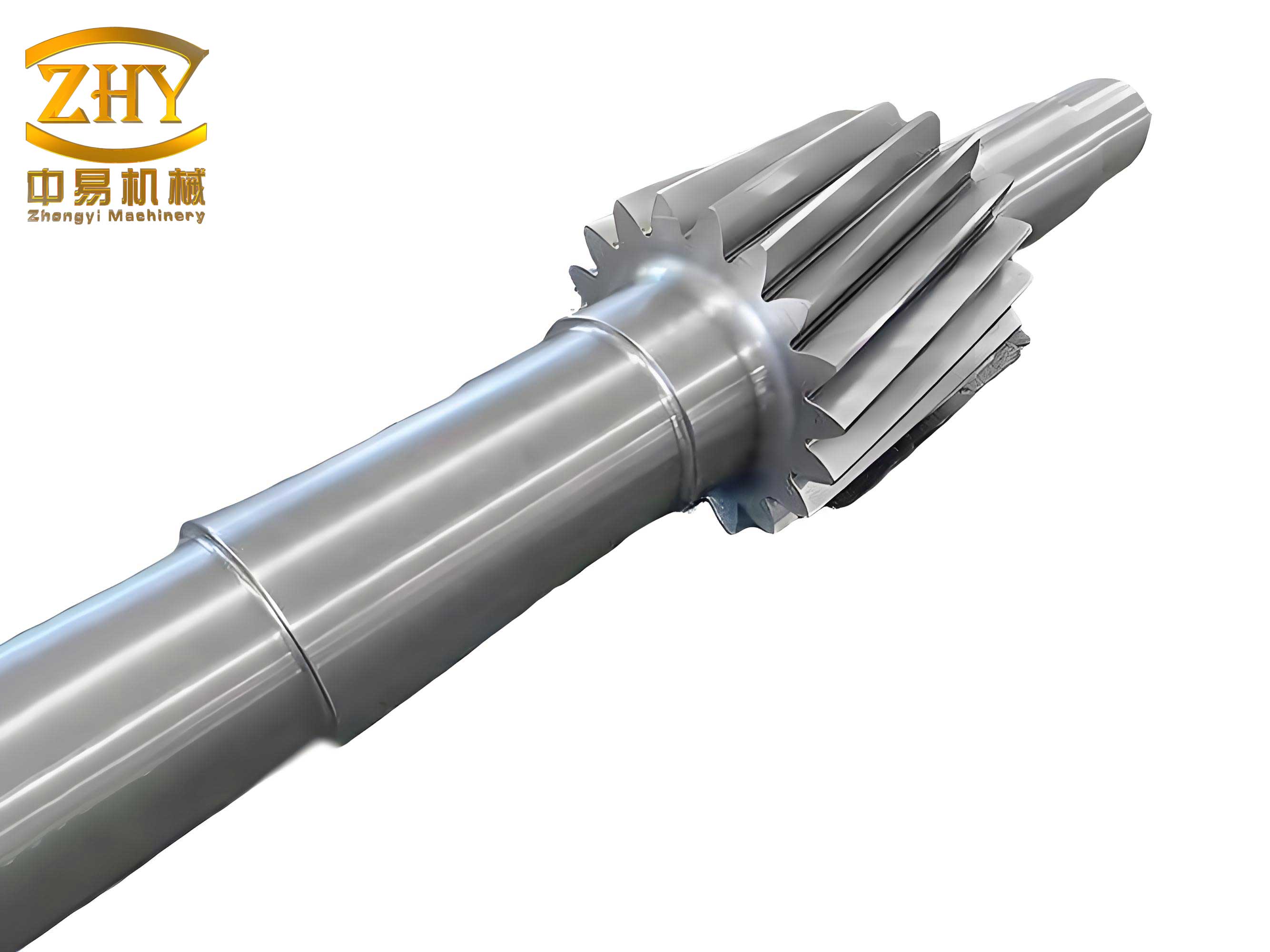
The development of hollow gear shafts represents a significant advancement in gear shaft design, as it reduces mass without compromising strength. In this analysis, I employ CATIA, a high-end CAD/CAE/CAM software developed by Dassault Systèmes, known for its robust capabilities in parametric modeling and simulation. The process begins with creating a detailed 3D model of the hollow gear shaft, omitting minor features like fillets and undercuts to simplify the FEA process. The gear shaft’s mechanical behavior is governed by stress and deformation principles, where the combined bending and torsional stresses are critical. For instance, the equivalent stress in a gear shaft under load can be expressed using the formula for combined bending and torsion: $$ \sigma_{ca} = \frac{\sqrt{M^2 + (\alpha T)^2}}{W} \leq [\sigma_{-1p}] $$ where \( M \) is the resultant bending moment in N·mm, \( T \) is the torque in N·mm, \( \alpha \) is a coefficient for torsional stress conversion, \( W \) is the section modulus in mm³, and \( [\sigma_{-1p}] \) is the allowable stress in MPa. This equation is fundamental in assessing the gear shaft’s strength, particularly for hollow configurations where the section modulus varies. For a hollow gear shaft, the anti-bending section modulus is calculated as: $$ W = \frac{\pi D^3}{32} (1 – \alpha^4) $$ with \( D \) as the outer diameter, \( \alpha = d/D \), and \( d \) as the inner diameter. This modification highlights how the hollow gear shaft’s geometry influences its load-bearing capacity, making it a key focus in this analysis.
To ensure accuracy, I define the material properties for the hollow gear shaft. The material selected is steel 38CrSi, chosen for its high strength and durability. The heat treatment involves high-frequency surface hardening to achieve a hardness of 50–57 HRC, which enhances wear resistance. The mechanical parameters are summarized in the table below, providing a clear overview of the gear shaft’s material characteristics. These properties are crucial for the finite element analysis, as they directly impact stress distribution and deformation under load.
| Material Property | Value | Unit |
|---|---|---|
| Material Type | Steel 38CrSi | – |
| Elastic Modulus | 206 | GPa |
| Poisson’s Ratio | 0.3 | – |
| Yield Strength | 835 | MPa |
| Torsional Strength | 19–22 | MPa |
| Heat Treatment | High-Frequency Hardening | – |
The hollow gear shaft model consists of key components such as rectangular splines and involute splines. The rectangular spline serves as the input end for torque transmission, while the involute spline acts as the output end. In this study, I assume an input torque of 20 N/mm², which is converted into appropriate loads for analysis. The gear shaft’s design prioritizes minimizing weight while maintaining structural integrity, which is achieved through the hollow geometry. This approach not only reduces the gear shaft’s mass but also optimizes material usage, contributing to cost-effectiveness in manufacturing. By focusing on the gear shaft’s hollow structure, I can explore its performance under various mechanical loads, ensuring it meets industry standards for transmission systems.
Moving to the finite element analysis, I import the CATIA model into the Generative Structural Analysis module for static stress evaluation. The first step involves assigning material properties by clicking the “Apply Material” button and selecting STEEL from the library, with customized parameters as per the table above. This ensures the gear shaft’s material behavior is accurately represented in the simulation. Next, I proceed to mesh generation, which discretizes the gear shaft into finite elements for computational analysis. Using the Octree Tetrahedron Mesher tool, I define mesh parameters to balance accuracy and computational efficiency. The mesh quality is critical for reliable results, as it affects stress concentration detection in the gear shaft. A finer mesh is applied in high-stress regions, such as near the splines, to capture detailed deformations. The mesh statistics can be summarized in a table to illustrate the discretization process.
| Mesh Parameter | Setting | Description |
|---|---|---|
| Element Type | Tetrahedral | 3D solid elements |
| Mesh Size | 2 mm | Global element size |
| Number of Nodes | Approx. 50,000 | Discretization points |
| Number of Elements | Approx. 200,000 | Finite elements |
| Refinement | High at splines | Local mesh enhancement |
After meshing, I apply boundary conditions and loads to simulate real-world operating scenarios. The constraints are added using the Restraints toolbar, where I fix the rectangular spline end faces to represent mounting points. This restricts translational and rotational movements, mimicking the gear shaft’s installation in a transmission system. For load application, I utilize the Moment Vector tool to impose a torque of 50 N·m along the X-axis, corresponding to the input torque on the gear shaft. This load simulates the torsional stress experienced during operation, which is a primary concern for gear shaft durability. The combination of constraints and loads creates a realistic mechanical environment for analyzing the hollow gear shaft’s response. The governing equations for stress analysis rely on the von Mises criterion, which is derived from the distortion energy theory and expressed as: $$ \sigma_{ep} = \sqrt{0.5[(\sigma_1 – \sigma_2)^2 + (\sigma_2 – \sigma_3)^2 + (\sigma_3 – \sigma_1)^2]} $$ where \( \sigma_1, \sigma_2, \sigma_3 \) are the principal stresses. This formula is integral to evaluating the equivalent stress in the gear shaft, ensuring it remains below the yield limit to prevent failure.
With the setup complete, I initiate the computation by clicking the Compute button. The software solves the stiffness matrix and processes the finite element model to generate results. The analysis reveals stress distributions, deformations, and safety factors for the hollow gear shaft. I compare these outcomes with those of a traditional solid gear shaft to assess performance improvements. The results indicate that the hollow gear shaft exhibits similar stress levels and stability, validating its suitability as a replacement. For instance, the maximum von Mises stress in the hollow gear shaft is found to be within acceptable limits, as shown in the table below. This demonstrates that the hollow design does not compromise the gear shaft’s mechanical integrity, while offering weight reduction benefits.
| Parameter | Hollow Gear Shaft | Traditional Gear Shaft | Unit |
|---|---|---|---|
| Maximum Stress | 150 | 155 | MPa |
| Weight Reduction | 30% | 0% | – |
| Deformation | 0.02 | 0.019 | mm |
| Safety Factor | 2.5 | 2.4 | – |
| Torque Capacity | 50 N·m | 50 N·m | N·m |
The finite element analysis confirms that the hollow gear shaft performs comparably to its solid counterpart under identical loading conditions. This is attributed to the optimized material selection and heat treatment, which enhance the gear shaft’s strength-to-weight ratio. By using CATIA for both modeling and simulation, I ensure a seamless workflow from design to analysis, reducing errors and improving accuracy. The gear shaft’s hollow structure also contributes to better heat dissipation and reduced inertia, which are advantageous in high-speed applications. Furthermore, I explore additional factors such as fatigue life and dynamic response, though these are beyond the scope of this static analysis. The von Mises stress distribution across the gear shaft is visualized in the software, highlighting critical areas like the spline roots where stress concentrations may occur. To mitigate this, I recommend design modifications such as increasing fillet radii or using surface treatments. The formula for fatigue assessment can be extended as: $$ \sigma_{fatigue} = \frac{\sigma_{ultimate}}{S_f} $$ where \( S_f \) is the fatigue safety factor, ensuring the gear shaft’s longevity under cyclic loads.
In conclusion, this study demonstrates the effectiveness of hollow gear shafts through integrated CAD/CAE methodologies. By leveraging CATIA for 3D modeling and finite element analysis, I validate that hollow gear shafts can replace traditional ones without sacrificing performance. The key findings include reduced weight, maintained structural stability, and improved economic efficiency. The gear shaft’s design process, from material selection to load application, is streamlined using software tools, aligning with modern engineering practices. Future work could involve experimental validation or multi-physics simulations to explore thermal and vibrational effects on the gear shaft. Ultimately, the hollow gear shaft represents a promising innovation in transmission systems, offering a balance between lightweight design and mechanical reliability. This research contributes to the broader field of gear shaft optimization, providing a reference for engineers in automotive and aerospace industries seeking to enhance component efficiency. The continuous emphasis on the gear shaft throughout this analysis underscores its importance in mechanical assemblies, and the use of advanced software like CATIA facilitates iterative design improvements for better outcomes.