
As a mechanical engineer specializing in thermal processing, I have always been fascinated by the critical role of heat treatment in enhancing the performance of mechanical components. Among these, bevel gears stand out due to their unique ability to transmit power between intersecting shafts, making them indispensable in various applications such as automotive differentials, industrial machinery, and aerospace systems. The reliability and longevity of bevel gears are paramount, and quenching is a pivotal heat treatment process that improves their strength and fatigue resistance. However, quenching-induced stresses and distortions can lead to failures like root cracking, necessitating a deep understanding of the thermal and mechanical behaviors during the process. In this article, I will delve into a comprehensive finite element analysis (FEA) of the quenching process for bevel gears using Ansys software, focusing on temperature and stress fields under different quenching conditions. By simulating real-world scenarios, this analysis aims to provide insights that can optimize quenching protocols for bevel gears, thereby reducing defects and enhancing service life.
The quenching of bevel gears involves rapid cooling from an austenitizing temperature, typically around 860°C for low-alloy steels like 20CrMoH, to induce a martensitic transformation that enhances hardness and strength. This process is governed by complex heat transfer phenomena and phase transformations, which can be modeled mathematically using the Fourier heat conduction equation. In my analysis, I consider a three-dimensional transient heat transfer problem, where the temperature distribution within the bevel gear is described by the following partial differential equation:
$$ \frac{\partial}{\partial x} \left( k \frac{\partial T}{\partial x} \right) + \frac{\partial}{\partial y} \left( k \frac{\partial T}{\partial y} \right) + \frac{\partial}{\partial z} \left( k \frac{\partial T}{\partial z} \right) + q = \rho c \frac{\partial T}{\partial t} $$
Here, \( T \) represents temperature (in °C), \( k \) is the thermal conductivity (in W·m⁻¹·°C⁻¹), \( \rho \) is density (in kg·m⁻³), \( c \) is specific heat capacity (in J·kg⁻¹·°C⁻¹), \( q \) denotes the latent heat generated during phase transformations (in W·m⁻³), and \( t \) is time (in seconds). For bevel gears, the boundary conditions are crucial, as they define the heat exchange with the quenching medium. I adopt a convection boundary condition, which is common in quenching simulations:
$$ – \lambda \frac{\partial T}{\partial n} \bigg|_s = H_k (T_w – T_c) $$
where \( \lambda \) is the thermal conductivity at the surface, \( H_k \) is the heat transfer coefficient (in W·m⁻²·°C⁻¹), \( T_w \) is the surface temperature of the bevel gear, and \( T_c \) is the temperature of the quenching medium (e.g., oil or water). The initial condition is set as \( T|_{t=0} = T_0 \), with \( T_0 = 860°C \) for the austenitized bevel gear. To account for thermal stresses, I couple the thermal analysis with a structural analysis using direct coupling in Ansys, employing coupled-field elements that solve for temperature and displacement simultaneously. This approach captures the interplay between temperature gradients and mechanical strains, which is essential for predicting distortions and residual stresses in bevel gears.
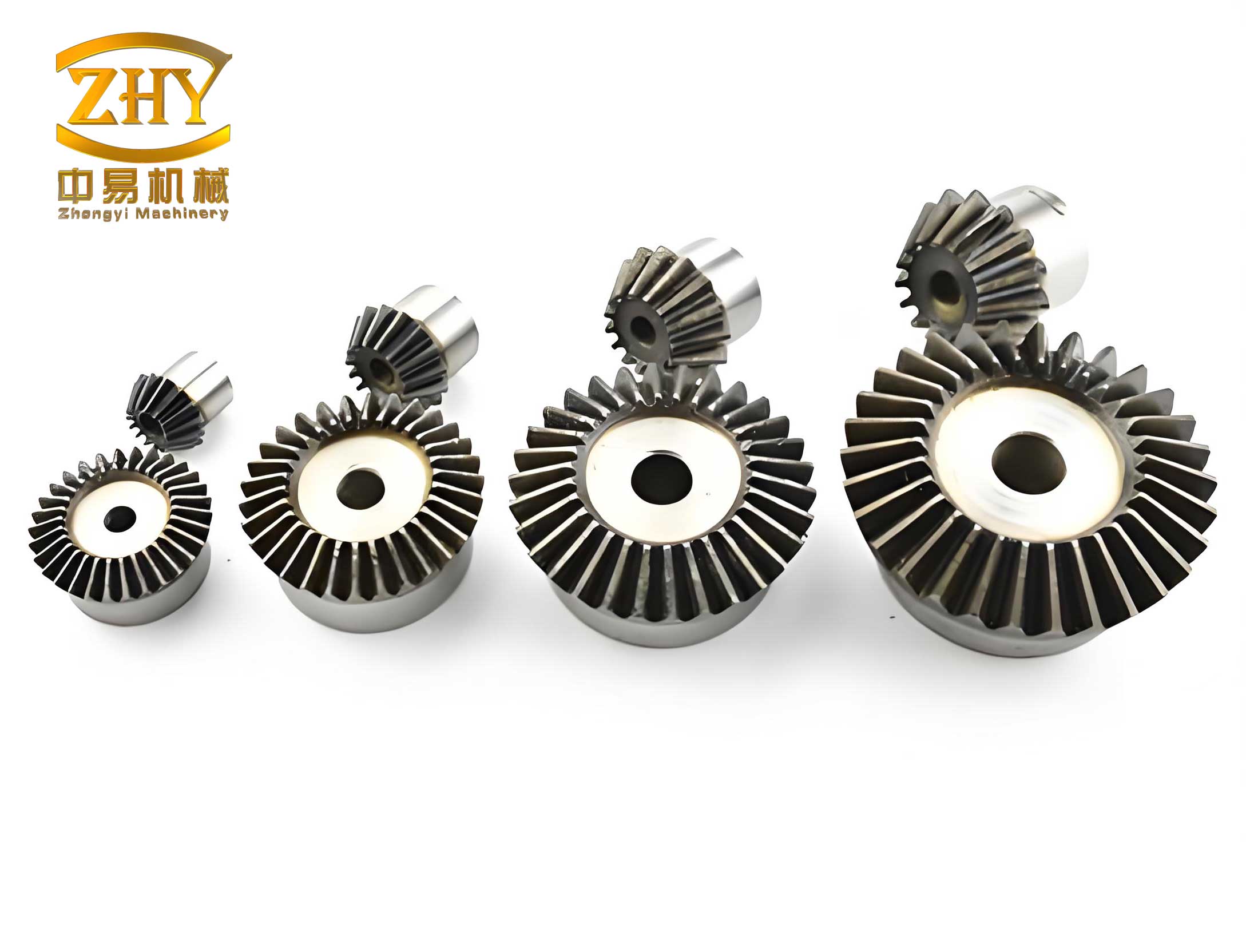
For the finite element model, I designed a bevel gear using Pro/E software, as shown in the image above, to represent a typical spiral bevel gear used in automotive transmissions. The geometry features a module of 5 mm, 20 teeth, and a pitch angle of 30°, ensuring realistic loading conditions. To simplify the computational domain while preserving accuracy, I exploit the symmetry of bevel gears by modeling a single tooth segment with appropriate symmetric boundary conditions. This reduction significantly decreases mesh complexity and solution time without compromising the validity of results for the entire gear. The mesh is generated using Ansys, with refined elements near the tooth root and tip where stress concentrations are expected. The material properties for 20CrMoH steel, which is commonly used for bevel gears due to its hardenability and toughness, are summarized in Table 1. These properties are temperature-dependent, but for simplicity in this initial analysis, I assume constant values over the quenching range, except for the heat transfer coefficient.
| Property | Symbol | Value | Units |
|---|---|---|---|
| Density | ρ | 7840 | kg·m⁻³ |
| Thermal Conductivity | k | 44 | W·m⁻¹·°C⁻¹ |
| Specific Heat Capacity | c | 460 | J·kg⁻¹·°C⁻¹ |
| Elastic Modulus | E | 210 × 10⁹ | Pa |
| Poisson’s Ratio | ν | 0.278 | – |
| Coefficient of Thermal Expansion | α | 1.27 × 10⁻⁵ | °C⁻¹ |
The quenching medium plays a pivotal role in determining the cooling rate and resultant microstructure of bevel gears. I investigate two common media: oil and water, each with distinct heat transfer characteristics. The heat transfer coefficients \( H_k \) for these media are nonlinear functions of temperature, derived from experimental data to ensure accuracy. Table 2 lists the values used in the simulation for oil quenching, while Table 3 provides those for water quenching. These coefficients influence the cooling curves and stress development in bevel gears, making them critical inputs for the FEA.
| Temperature (°C) | Heat Transfer Coefficient (W·m⁻²·°C⁻¹) |
|---|---|
| 50 | 224.5 |
| 100 | 250.4 |
| 200 | 270.6 |
| 300 | 459.5 |
| 400 | 1757.4 |
| 500 | 4358.6 |
| 600 | 3872.6 |
| 700 | 2189.9 |
| 860 | 947.0 |
| Temperature (°C) | Heat Transfer Coefficient (W·m⁻²·°C⁻¹) |
|---|---|
| 50 | 1000 |
| 100 | 3800 |
| 200 | 6000 |
| 300 | 13500 |
| 400 | 12500 |
| 500 | 7000 |
| 600 | 4200 |
| 755 | 1000 |
| 860 | 500 |
In the temperature field analysis, I simulate the cooling of the bevel gear from 860°C to an ambient temperature of 50°C. To capture local variations, I monitor three key points on the gear tooth: Point A at the tooth core (representing slow cooling regions), Point B at the mid-plane between two teeth (a high-stress area), and Point C at the tooth tip (where cooling is fastest). The cooling curves for oil and water quenching are plotted based on the FEA results. For oil quenching, the temperature evolution can be described by an exponential decay model:
$$ T(t) = T_c + (T_0 – T_c) e^{-bt} $$
where \( b \) is a cooling rate parameter dependent on \( H_k \) and geometry. For water quenching, the cooling is more rapid, and I observe a near-linear drop in temperature initially, followed by a slower phase. The time to reach ambient temperature is approximately 600 seconds for oil and 150 seconds for water, highlighting the milder nature of oil quenching for bevel gears. This slower cooling reduces thermal gradients, which is beneficial for minimizing distortions in bevel gears. The temperature distributions at various time steps, as shown in the simulation outputs, reveal that the tooth tip cools fastest, reaching 500°C within 5 seconds in oil, while the core remains above 800°C. Over time, these gradients diminish, but the non-uniform cooling can induce significant stresses.
To quantify the thermal stresses, I compute the von Mises stress field, which is a measure of distortion energy and is critical for assessing yield criteria. The stress development is governed by the coupled thermoelastic equations, where the total strain \( \epsilon_{ij} \) is composed of thermal and mechanical components:
$$ \epsilon_{ij} = \frac{1}{2} \left( \frac{\partial u_i}{\partial x_j} + \frac{\partial u_j}{\partial x_i} \right) + \alpha (T – T_{ref}) \delta_{ij} $$
Here, \( u_i \) are displacement components, \( \alpha \) is the coefficient of thermal expansion, \( T_{ref} \) is a reference temperature, and \( \delta_{ij} \) is the Kronecker delta. The von Mises stress \( \sigma_{vm} \) is calculated as:
$$ \sigma_{vm} = \sqrt{ \frac{3}{2} s_{ij} s_{ij} } $$
with \( s_{ij} = \sigma_{ij} – \frac{1}{3} \sigma_{kk} \delta_{ij} \) being the deviatoric stress tensor. In the simulation, the maximum von Mises stress occurs at Point B, the mid-plane between teeth, reaching values up to 35 MPa for oil quenching. This stress concentration is a common site for crack initiation in bevel gears during quenching. Point C at the tooth tip shows the fastest stress evolution, albeit at lower magnitudes, due to rapid thermal contraction. The stress-time curves illustrate that non-uniform cooling leads to disparate stress patterns across the gear, potentially causing warping or fracture if not controlled.
To mitigate these issues, I explore a stepped quenching strategy for bevel gears, where the gear is initially quenched in oil until it reaches an intermediate temperature (e.g., 300°C), followed by air cooling to ambient temperature. Air cooling has a lower heat transfer coefficient of 50 W·m⁻²·°C⁻¹, which slows down the cooling rate in the martensitic transformation range, reducing thermal stresses. In this analysis, I compare stepped quenching with conventional oil quenching. The cooling curve for Point A under stepped quenching shows a prolonged cooling period of about 2200 seconds, but the temperature drop is more gradual. The von Mises stress evolution becomes more synchronized between Points A and B, as seen in Table 4, which summarizes stress peaks for different quenching methods. This harmonization reduces the risk of distortion and cracking in bevel gears, making stepped quenching a viable process optimization.
| Quenching Method | Point A (Tooth Core) Stress (MPa) | Point B (Mid-Plane) Stress (MPa) | Point C (Tooth Tip) Stress (MPa) |
|---|---|---|---|
| Oil Quenching | 25 | 35 | 15 |
| Water Quenching | 30 | 40 | 20 |
| Stepped Quenching | 22 | 28 | 12 |
The thermal deformation of bevel gears is another critical aspect, quantified by the displacement at Point C. For conventional oil quenching, the deformation follows a sharp increase initially, settling at around 10 µm after 600 seconds. In contrast, stepped quenching results in a smoother deformation curve, reaching the same final displacement but with reduced transient peaks. This behavior can be modeled using a thermal strain equation:
$$ \epsilon_{th} = \alpha \Delta T $$
where \( \Delta T \) is the temperature change. By integrating this strain over the gear volume, the total deformation can be estimated. The smoother curve in stepped quenching indicates better control over dimensional accuracy, which is crucial for the precise meshing of bevel gears in传动 systems.
In conclusion, the finite element analysis of quenching for bevel gears using Ansys provides valuable insights into the thermal and mechanical responses during heat treatment. The simulation highlights that oil quenching offers a milder cooling profile compared to water quenching, reducing thermal shocks and potential defects in bevel gears. However, the stress concentrations at the mid-plane between teeth remain a concern, necessitating careful process design. Stepped quenching emerges as an effective strategy to homogenize stress development and minimize distortions, albeit with longer processing times. These findings underscore the importance of tailored quenching protocols for bevel gears, balancing cooling rates and stress management to enhance durability. Future work could incorporate phase transformation kinetics and more detailed material models to further refine the predictions for bevel gears in real-world applications.
Throughout this analysis, the focus on bevel gears has been paramount, as their unique geometry and loading conditions demand specialized heat treatment approaches. By leveraging FEA, engineers can optimize quenching parameters, reduce trial-and-error experiments, and improve the reliability of bevel gears in mechanical systems. As technology advances, such simulations will play an increasingly vital role in the manufacturing of high-performance bevel gears, ensuring they meet the stringent demands of modern industry.