
In the manufacturing of straight bevel gears, machining errors due to machine tool accuracy and heat treatment deformations lead to deviations between the actual tooth surface and the theoretical design. These discrepancies significantly impact the meshing performance, load distribution, and overall durability of straight bevel gears. Traditional analysis methods often rely on idealized theoretical tooth surfaces, which do not account for real-world manufacturing imperfections. To address this, we propose an approach that utilizes measured tooth surface data to construct a digital representation of the straight bevel gear, enabling precise finite element analysis (FEA) for evaluating static mechanical performance. This method integrates surface fitting techniques, curvature analysis, and advanced meshing strategies to model the actual gear geometry accurately.
The tooth surface of a straight bevel gear is a complex three-dimensional surface, where modifications and machining errors can alter contact patterns and stress distributions. Existing studies have focused on digital reconstruction of theoretical tooth surfaces using methods like NURBS-based fitting or parametric representations. However, these approaches neglect the inherent deviations in manufactured gears, leading to inaccuracies in performance predictions. Our work bridges this gap by directly incorporating measured coordinate points from a gear inspection center into the modeling process. This ensures that the analysis reflects the true geometry of the straight bevel gear, including effects of machining and thermal deformation.
We begin by measuring the tooth surface points of a straight bevel gear pair using a precision gear inspection system. The measured data points, denoted as (x_i, y_i, z_i) for i = 1, 2, …, n, are then fitted to a polynomial surface to reconstruct the digital tooth surface. The fitting process minimizes the sum of squared errors between the measured points and the fitted surface, ensuring high accuracy. For instance, a fifth-order polynomial is employed to achieve an error margin within acceptable limits for gear analysis. The general form of the polynomial surface is given by:
$$ z = f(x, y) = \sum_{j=1}^{m} a_j b_j(x, y) $$
where \( a_j \) are the coefficients to be determined, and \( b_j(x, y) \) represent the basis functions of the polynomial space. The error minimization function is defined as:
$$ E(f) = \sum_{i=1}^{n} [z_i – f(x_i, y_i)]^2 $$
To find the optimal coefficients, we solve the system of equations derived from setting the partial derivatives of \( E(f) \) with respect to each \( a_j \) to zero:
$$ \frac{\partial E(f)}{\partial a_j} = 0 \quad \text{for} \quad j = 1, 2, \dots, m $$
This results in a linear system that can be solved using methods like Gaussian elimination. The accuracy of the fit improves with higher polynomial orders, as shown in our experiments where a fifth-order polynomial reduced the maximum error to 0.3 μm, sufficient for detailed gear analysis.
To assess the geometric properties of the fitted tooth surface, we perform a second-order topological analysis. This involves calculating the principal curvatures, Gaussian curvature, and mean curvature at any point on the surface. The normal curvature \( k_n \) in a direction \( \mathbf{d} = (du, dv) \) is given by:
$$ k_n = \frac{L du^2 + 2M du dv + N dv^2}{E du^2 + 2F du dv + G dv^2} $$
where E, F, G are the first fundamental form coefficients, and L, M, N are the second fundamental form coefficients of the surface. The principal curvatures \( k_1 \) and \( k_2 \) (with \( k_1 \leq k_2 \)) are the roots of the equation:
$$ (EG – F^2) k^2 – (EN + GL – 2FM) k + (LN – M^2) = 0 $$
The Gaussian curvature K and mean curvature H are then derived as:
$$ K = k_1 k_2 = \frac{LN – M^2}{EG – F^2} $$
$$ H = \frac{k_1 + k_2}{2} = \frac{EN + GL – 2FM}{2(EG – F^2)} $$
These curvatures help characterize the local bending and twisting of the straight bevel gear tooth surface, which is crucial for understanding contact mechanics under load.
For our case study, we considered a straight bevel gear pair with parameters summarized in Table 1. The gears were measured using a high-precision gear inspection center, which captured 45 discrete points on the tooth surface. The fitting process was implemented using computational tools, and the coefficients for the fifth-order polynomial are listed in Table 2. The fitting errors for different polynomial orders are compared in Table 3, demonstrating the superiority of higher-order fits.
| Parameter | Pinion | Gear |
|---|---|---|
| Number of Teeth (Z) | 16 | 28 |
| Module (m) [mm] | 2.5 | 2.5 |
| Pressure Angle (α) [°] | 20 | 20 |
| Shaft Angle (Γ) [°] | 90 | 90 |
| Addendum (h_a) [mm] | 2.5 | 3 |
| Dedendum (h_f) [mm] | 3 | 2.5 |
| Face Width (B) [mm] | 12.09 | 12.09 |
| Coefficient | Value |
|---|---|
| a₀ | -79.1636 |
| a₁ | -3.2171 |
| a₂ | -1.8177 |
| a₃ | 0.0846 |
| a₄ | 0.0554 |
| a₅ | -0.0248 |
| a₆ | -0.0011 |
| a₇ | 0.0005 |
| a₈ | -0.0017 |
| a₉ | 0.0010 |
| a₁₀ | 0.000079 |
| a₁₁ | 0.00000049 |
| a₁₂ | -0.00001275 |
| a₁₃ | 0.00002023 |
| a₁₄ | -0.00001174 |
| a₁₅ | -0.00000002 |
| a₁₆ | -0.00000000 |
| a₁₇ | -0.00000001 |
| a₁₈ | 0.00000000 |
| a₁₉ | -0.00000008 |
| a₂₀ | 0.00000004 |
| Polynomial Order | Maximum Error [μm] |
|---|---|
| Third | 32.8 |
| Fourth | 3.361 |
| Fifth | 0.314 |
The digital tooth surface was then used to generate a finite element mesh. To control the tooth thickness, we rotated the fitted surface such that points on the pitch cone at the mid-face width aligned, ensuring accurate geometric representation. The mesh was created using hexahedral eight-node elements (SOLID45 in ANSYS), with material properties including an elastic modulus of 210 GPa, Poisson’s ratio of 0.3, and density of 7800 kg/m³. The finite element model consisted of three teeth to reduce computational cost while capturing the essential mechanics, as only a few teeth are in contact during meshing. The model was constrained by fixing all degrees of freedom on the gear back face and symmetry planes.
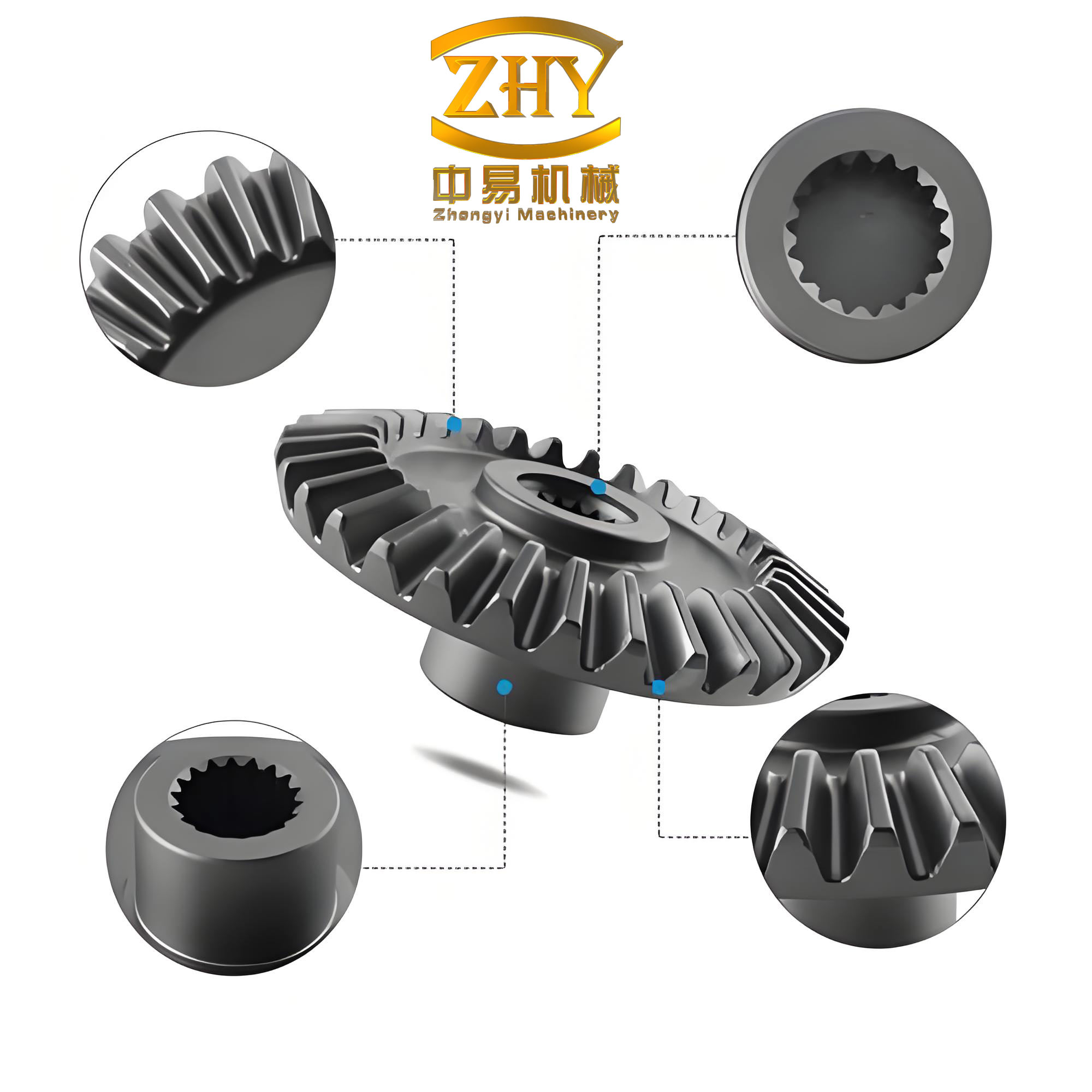
Loading was applied to simulate the worst-case scenario where a single tooth pair carries the full load at the highest point of single tooth contact. The force was directed along the normal pressure angle at the tooth tip, distributed over the contact area. The static analysis in ANSYS yielded stress and deformation results, showing maximum equivalent stress at the load application point and significant bending stress at the tooth root. This highlights the critical regions where fatigue failures might initiate in straight bevel gears.
In conclusion, our method demonstrates that higher-order polynomial fitting of measured tooth surfaces effectively captures the actual geometry of straight bevel gears, with fifth-order fits providing sufficient accuracy for engineering applications. The finite element analysis based on this digital model offers insights into the static mechanical behavior, accounting for real-world manufacturing variances. This approach is pivotal for optimizing the design and manufacturing processes of straight bevel gears, ensuring reliability and performance in practical applications. Future work could extend this to dynamic analysis or incorporate material nonlinearities for more comprehensive evaluations.