
In the manufacturing of straight bevel gears, deviations between the designed theoretical tooth surface and the actual machined surface arise due to machining errors from equipment limitations and heat treatment-induced deformations. These discrepancies significantly impact the meshing performance, load distribution, and overall durability of gear systems. To accurately evaluate the mechanical behavior of manufactured gears, this study employs a methodology that integrates coordinate measurement data, surface reconstruction techniques, and finite element analysis. By measuring actual tooth surface points using a gear measuring center, we reconstruct a digital representation of the gear surface through polynomial fitting. This digital model serves as the basis for generating a precise finite element mesh, enabling detailed static stress analysis under load. The approach provides a realistic assessment of gear performance, accounting for real-world manufacturing imperfections, and offers practical insights for optimizing straight bevel gear design and production.
The tooth surface of a straight bevel gear is a complex three-dimensional contour, where modifications and machining inaccuracies can alter contact patterns and stress distributions. Traditional analyses based solely on theoretical designs fail to capture these effects, leading to potential inefficiencies or failures in application. This research focuses on bridging this gap by utilizing measured data to create a high-fidelity model. The process involves parameterizing the measured points, fitting a surface using higher-order polynomials, and analyzing the surface’s curvature properties. Subsequently, a finite element model is constructed using mapping mesh techniques to ensure accuracy, followed by static load application to determine stress concentrations and deformation patterns. This method highlights the importance of considering actual manufacturing variances in straight bevel gear analysis.
Mathematical Foundation for Tooth Surface Fitting and Curvature Analysis
To represent the measured tooth surface of a straight bevel gear accurately, we adopt a parametric fitting approach based on polynomial functions. Assuming the surface is sufficiently smooth, a polynomial can approximate it, with the error diminishing as the polynomial order increases. Given a set of discrete points (x_i, y_i, z_i) for i = 1, 2, …, n obtained from coordinate measurements, the surface z = f(x, y) is modeled using a polynomial expansion. For instance, a third-order polynomial can be expressed as:
$$ z = a_0 + a_1 x + a_2 y + a_3 x^2 + a_4 xy + a_5 y^2 + a_6 x^3 + a_7 x^2 y + a_8 x y^2 + a_9 y^3 $$
In general, for a higher-order fit, the surface equation is represented as a linear combination of basis functions. Let l_i = (x_i, y_i) denote the coordinates of the measured points, and b_j(l) be a set of basis functions spanning the polynomial space. The fitted surface is given by:
$$ z = \sum_{j=1}^{m} a_j b_j(x, y) $$
where a_1, a_2, …, a_m are unknown coefficients determined by minimizing the sum of squared errors between the measured and fitted values. The error function E(f) is defined as:
$$ E(f) = \sum_{i=1}^{n} \left[ z_i – \sum_{j=1}^{m} a_j b_j(x_i, y_i) \right]^2 $$
To minimize E(f), the partial derivatives with respect to each coefficient a_k are set to zero:
$$ \frac{\partial E(f)}{\partial a_k} = 0 \quad \text{for} \quad k = 1, 2, \ldots, m $$
This results in a system of linear equations that can be solved using methods like Gaussian elimination to obtain the coefficients a_j. Once determined, the parametric equation provides a continuous representation of the tooth surface, facilitating further analysis.
To assess the geometric properties of the fitted surface, curvature analysis is essential. The normal curvature k_n at any point P on the surface in a direction defined by the ratio du:dv is calculated using the fundamental forms of the surface. Let E, F, G be the coefficients of the first fundamental form, and L, M, N be the coefficients of the second fundamental form. The normal curvature is given by:
$$ k_n = \frac{L du^2 + 2M du dv + N dv^2}{E du^2 + 2F du dv + G dv^2} $$
To find the principal curvatures, which are the maximum and minimum values of k_n, we solve the eigenvalue problem derived from the equation:
$$ \begin{vmatrix} L – k E & M – k F \\ M – k F & N – k G \end{vmatrix} = 0 $$
This simplifies to:
$$ (EG – F^2) k^2 – (EN + GL – 2FM) k + (LN – M^2) = 0 $$
The roots k_1 and k_2 (with k_1 ≤ k_2) of this quadratic equation are the principal curvatures. The Gaussian curvature K and mean curvature H are then computed as:
$$ K = k_1 k_2 $$
$$ H = \frac{k_1 + k_2}{2} $$
These metrics describe the local bending and twisting of the surface, which are critical for understanding the contact mechanics and stress distribution in straight bevel gears.
Case Study: Measurement, Fitting, and Finite Element Analysis
To demonstrate the methodology, we conducted an experimental analysis on a pair of straight bevel gears. The gear parameters are listed in Table 1, which includes key dimensions such as tooth numbers, module, pressure angle, and face width. These parameters define the theoretical geometry, but actual measurements are necessary to account for manufacturing variances.
| Parameter | Pinion | Gear |
|---|---|---|
| Number of Teeth (Z) | 16 | 28 |
| Module (m) [mm] | 2.5 | 2.5 |
| Pressure Angle (α) [°] | 20 | 20 |
| Shaft Angle (Γ) [°] | 90 | 90 |
| Addendum (h_a) [mm] | 2.5 | 3 |
| Dedendum (h_f) [mm] | 3 | 2.5 |
| Face Width (B) [mm] | 12.09 | 12.09 |
The tooth surfaces were measured using a precision gear measuring center, which captures coordinate points across the gear flank. This equipment ensures high accuracy in data acquisition, accounting for errors from machining and heat treatment. The measured points form the basis for reconstructing the actual tooth surface of the straight bevel gear.
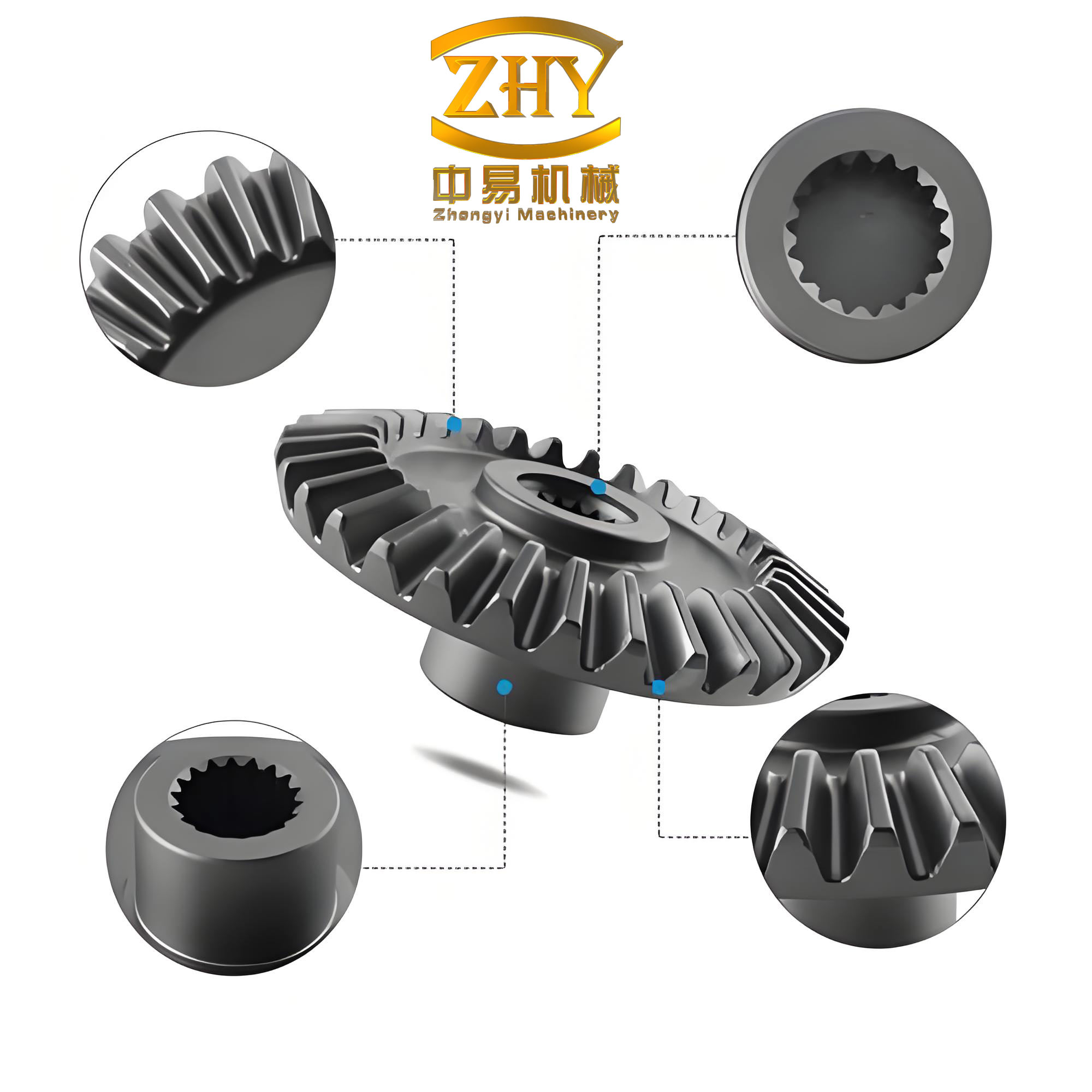
Using the measured data, we performed surface fitting with polynomials of varying orders. The fitting errors were evaluated to determine the optimal order, as summarized in Table 2. The results indicate that higher-order polynomials reduce the error significantly, with a fifth-order fit achieving a maximum error of 0.314 μm, which is within acceptable limits for gear analysis, considering typical inspection coatings like red lead paste have thicknesses around 6.35 μm.
| Polynomial Order | Maximum Error (μm) |
|---|---|
| Third | 32.8 |
| Fourth | 3.361 |
| Fifth | 0.314 |
For the fifth-order polynomial fit, the coefficients were computed based on 45 discrete points sampled from the tooth surface. The general form of the fifth-order polynomial is:
$$ z = a_0 + a_1 x + a_2 y + a_3 x^2 + a_4 xy + a_5 y^2 + a_6 x^3 + a_7 x^2 y + a_8 x y^2 + a_9 y^3 + a_{10} x^4 + a_{11} x^3 y + a_{12} x^2 y^2 + a_{13} x y^3 + a_{14} y^4 + a_{15} x^5 + a_{16} x^4 y + a_{17} x^3 y^2 + a_{18} x^2 y^3 + a_{19} x y^4 + a_{20} y^5 $$
The specific coefficients obtained for the fitted straight bevel gear surface are listed in Table 3. These values define the digital tooth surface used in subsequent analyses.
| Coefficient | Value | Coefficient | Value |
|---|---|---|---|
| a_0 | -79.1636 | a_11 | 0.00000049 |
| a_1 | -3.2171 | a_12 | -0.00001275 |
| a_2 | -1.8177 | a_13 | 0.00002023 |
| a_3 | 0.0846 | a_14 | -0.00001174 |
| a_4 | 0.0554 | a_15 | -0.00000002 |
| a_5 | -0.0248 | a_16 | -0.00000000 |
| a_6 | -0.0011 | a_17 | -0.00000001 |
| a_7 | 0.0005 | a_18 | 0.00000000 |
| a_8 | -0.0017 | a_19 | -0.00000008 |
| a_9 | 0.0010 | a_20 | 0.00000004 |
| a_10 | 0.000079 | – | – |
To ensure the correct tooth thickness in the digital model, we applied a rotation transformation. The midpoint on the pitch cone was identified, and the surface was rotated such that the y-coordinate at the mid-face width point on the pitch line is zero. This aligns the points on both flanks, and rotating by an angle φ = π/Z generates the full tooth thickness. The rotation angle is calculated based on the gear geometry to maintain design specifications.
With the digital tooth surface defined, we proceeded to construct a finite element model. Using mapping mesh techniques, a structured grid was generated to discretize the gear volume. The mesh consists of hexahedral elements, specifically SOLID45 type with eight nodes, which are suitable for stress analysis. The material properties assigned to the straight bevel gear model are summarized in Table 4, including elastic modulus, Poisson’s ratio, and density, typical for steel alloys used in gear applications.
| Property | Value |
|---|---|
| Elastic Modulus (GPa) | 210 |
| Poisson’s Ratio | 0.3 |
| Density (kg/m³) | 7800 |
The finite element model includes three teeth to capture the effects of adjacent teeth while minimizing computational cost. The nodes and elements were imported into ANSYS for analysis. Boundary conditions were applied by constraining all degrees of freedom on the gear back face and symmetric planes, simulating a fixed support. This setup ensures that the model accurately represents the gear’s mounting conditions in practical applications.
Load application was simplified by applying a concentrated force at the tooth tip in the direction of the normal pressure angle, representing the worst-case scenario during meshing when a single tooth pair carries the full load. The load magnitude was determined based on standard gear design practices, considering the torque transmission requirements. The stress distribution and deformation were then computed through static analysis.
The results reveal that the maximum equivalent stress occurs at the load application point on the tooth tip, with significant bending stresses at the tooth root. The deformation pattern shows bending of the tooth, consistent with theoretical expectations. This analysis underscores the importance of using measured data for straight bevel gears, as it captures stress concentrations that might be overlooked in idealized models.
Discussion on Curvature and Stress Implications
The curvature analysis of the fitted straight bevel gear surface provides insights into the meshing behavior and contact characteristics. By computing the Gaussian and mean curvatures at various points, we can identify regions of high curvature that may lead to stress concentrations. For instance, areas with high Gaussian curvature indicate significant surface bending, which could affect the contact patch size and pressure distribution during operation. This is particularly relevant for straight bevel gears, where misalignments or manufacturing errors can alter the intended contact pattern.
In the finite element analysis, the stress results highlight the critical areas prone to failure, such as the tooth root where bending stresses peak. The use of a digital model based on measured data allows for a more accurate prediction of these stresses compared to theoretical models. For example, the von Mises stress distribution shows that the maximum stress exceeds the material yield strength in localized regions, suggesting potential fatigue initiation sites. This information can guide design improvements, such as fillet optimization or material selection, to enhance the durability of straight bevel gears.
Moreover, the mapping mesh technique employed in this study ensures that the element alignment follows the tooth geometry, improving the accuracy of stress calculations. The choice of element type and size was validated through convergence studies, ensuring that the results are mesh-independent. This approach is essential for reliable finite element analysis of complex components like straight bevel gears, where stress gradients are steep.
Conclusion
This study demonstrates a comprehensive approach for analyzing straight bevel gears based on measured tooth surface data. By combining coordinate measurement, polynomial surface fitting, and finite element modeling, we achieve a high-fidelity representation of the actual gear geometry. The fifth-order polynomial fit provides sufficient accuracy for engineering applications, with errors below practical thresholds. The curvature analysis elucidates the surface topology, while the static stress analysis identifies critical stress regions under load. This methodology accounts for manufacturing variances, offering a realistic assessment of gear performance and serving as a valuable tool for design validation and optimization of straight bevel gears in industrial applications.