
In the field of power transmission, straight miter gears are crucial components for transmitting motion and power between intersecting shafts, typically at a 90-degree angle. The performance of a gear pair is fundamentally governed by the geometry and quality of the mating tooth flanks, which are complex three-dimensional surfaces. Theoretical design aims for optimal contact patterns and stress distribution. However, the actual manufactured tooth surface of a straight miter gear inevitably deviates from its ideal theoretical model due to machine tool inaccuracies, setup errors, and deformations induced during processes like heat treatment. Therefore, analyzing the meshing performance based on the actual, as-manufactured tooth surface is a critical step towards achieving true digital manufacturing and reliable gear performance prediction. This article details a comprehensive methodology, from measurement to analysis, for evaluating the static mechanical performance of manufactured straight miter gears.
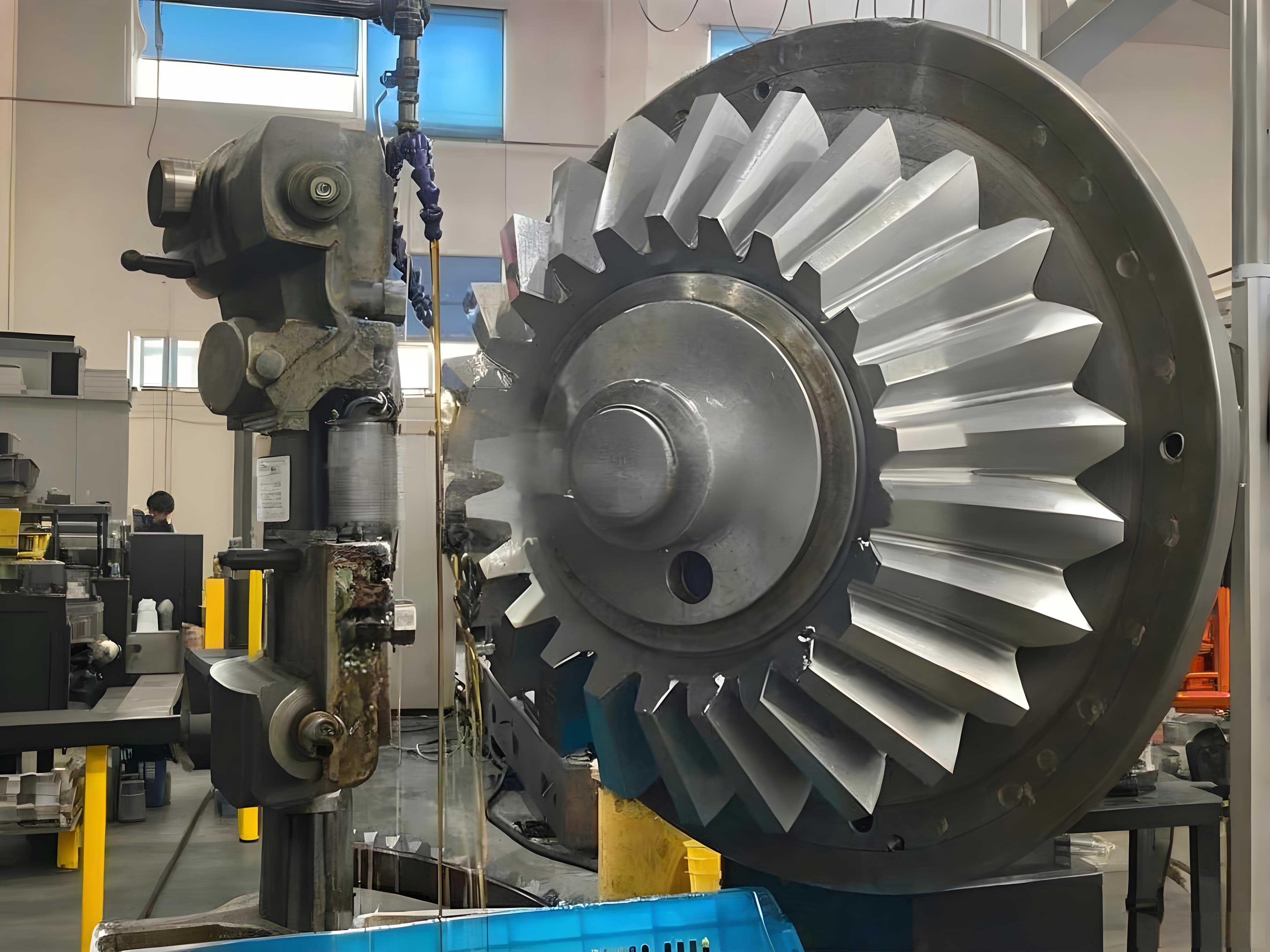
The core challenge in performing a high-fidelity analysis lies in constructing an accurate digital twin of the physical gear. This process begins with precise metrology. A coordinate measuring machine (CMM) or a dedicated gear inspection center is used to sample a dense point cloud from the actual tooth surface of the straight miter gear. Let this set of measured discrete points be represented as $P_i(x_i, y_i, z_i)$ where $i = 1, 2, …, n$. These points encode the real geometry, inclusive of all manufacturing imperfections. The next step is to reconstruct a continuous mathematical representation, or a digital flank, from this scattered data.
A robust approach is to use a parametric polynomial surface fit. Assuming the surface is sufficiently smooth, it can be approximated by a bivariate polynomial. The accuracy of this approximation generally increases with the polynomial order. Let the desired surface be represented as $z = f(x, y)$. We define a basis of polynomial terms. For a general fit, the function can be expressed as a linear combination of these basis functions $b_j(x, y)$:
$$
f(x, y) = \sum_{j=1}^{m} a_j b_j(x, y)
$$
Here, $a_j$ are the unknown coefficients to be determined. The most common method is least-squares fitting, which minimizes the sum of squared errors between the measured $z_i$ values and the fitted surface values at the corresponding $(x_i, y_i)$ coordinates. The error function $E$ is defined as:
$$
E(a_1, a_2, …, a_m) = \sum_{i=1}^{n} \left[ z_i – \sum_{j=1}^{m} a_j b_j(x_i, y_i) \right]^2
$$
To minimize $E$, we take the partial derivative with respect to each coefficient $a_k$ and set it to zero:
$$
\frac{\partial E}{\partial a_k} = -2 \sum_{i=1}^{n} \left[ z_i – \sum_{j=1}^{m} a_j b_j(x_i, y_i) \right] b_k(x_i, y_i) = 0, \quad \text{for } k=1,…,m
$$
This leads to a system of $m$ linear equations (the normal equations) which can be solved for the coefficient vector $\mathbf{a}$ using standard linear algebra techniques like Gaussian elimination. The quality of the fit for a straight miter gear surface must be exceptionally high to capture subtle deviations. The following table illustrates how the maximum fitting error typically decreases with increasing polynomial order:
| Polynomial Order | Maximum Fitting Error (µm) |
|---|---|
| 3 | 32.8 |
| 4 | 3.361 |
| 5 | 0.314 |
Given that the thickness of marking paste used in contact pattern checks is often around 6.35 µm, a fifth-order polynomial fit, with sub-micron error, is deemed sufficient for high-precision analysis of the straight miter gear flank.
Once the digital surface is obtained, it is valuable to analyze its local geometric properties, particularly its curvature. The curvature at a point on the straight miter gear tooth flank varies with direction. The fundamental measures are the principal curvatures, $k_1$ and $k_2$ (with $|k_1| \ge |k_2|$), which are the maximum and minimum normal curvatures at that point. They describe the surface’s bending in its most and least curved directions. For a parametric surface $\vec{r}(u, v)$, the normal curvature $k_n$ in a direction defined by $du:dv$ is given by:
$$
k_n = \frac{L\, du^2 + 2M\, du\, dv + N\, dv^2}{E\, du^2 + 2F\, du\, dv + G\, dv^2}
$$
where $E, F, G$ are coefficients of the first fundamental form (metric tensor) and $L, M, N$ are coefficients of the second fundamental form. Finding the extrema of $k_n$ leads to the principal curvatures, which are the roots of the equation:
$$
(EG – F^2)k_n^2 – (EN + GL – 2FM)k_n + (LN – M^2) = 0
$$
From the principal curvatures, two essential invariant scalar quantities are derived. The Gaussian curvature $K$ describes the intrinsic curvature of the surface:
$$
K = k_1 \cdot k_2
$$
The mean curvature $H$ describes the average extrinsic bending:
$$
H = \frac{k_1 + k_2}{2}
$$
These metrics are crucial for understanding the contact mechanics when two straight miter gear flanks interact, as they influence the size and shape of the contact ellipse under load.
To demonstrate the complete workflow, a case study was performed on a pair of straight miter gears. The basic design parameters of the gear pair are summarized below:
| Parameter | Pinion | Gear |
|---|---|---|
| Number of Teeth, $Z$ | 16 | 28 |
| Module, $m$ (mm) | 2.5 | 2.5 |
| Pressure Angle, $\alpha$ (°) | 20 | 20 |
| Shaft Angle, $\Sigma$ (°) | 90 | 90 |
| Face Width, $B$ (mm) | 12.09 | 12.09 |
The tooth flanks of the manufactured straight miter gears were measured on a high-precision gear inspection center (e.g., a Klingelnberg P65 type). A point cloud of 45 discrete points was sampled from a representative tooth flank of the gear (the larger member of the pair). Using the least-squares method described, a fifth-order polynomial was fitted. The general form of the fitted equation for this specific straight miter gear is:
$$
\begin{aligned}
z = f(x, y) = & a_0 + a_1 x + a_2 y + a_3 xy + a_4 x^2 + a_5 y^2 + a_6 x^2y + a_7 xy^2 \\
& + a_8 x^3 + a_9 y^3 + \dots + a_{19} x^5 + a_{20} y^5
\end{aligned}
$$
A subset of the calculated coefficients is presented for illustration:
| Coefficient | Value | Coefficient | Value |
|---|---|---|---|
| $a_0$ | -79.16365089 | $a_{11}$ | 4.9e-7 |
| $a_1$ | -3.21715145 | $a_{12}$ | -1.275e-5 |
| $a_2$ | -1.81779231 | $a_{13}$ | 2.023e-5 |
| $a_3$ | 0.08467900 | $a_{14}$ | -1.174e-5 |
| $a_4$ | 0.05545672 | $a_{15}$ | -2.0e-8 |
| $a_5$ | -0.02480332 | … | … |
| $a_{10}$ | 7.9e-5 | $a_{20}$ | 4.0e-8 |
The fitted surface represents a single tooth face. To create a solid, three-dimensional model of the tooth for finite element analysis (FEA), the tooth thickness must be generated. This is achieved by rotating the fitted surface about the gear axis. A key control point is defined on the pitch cone at the mid-face width location. The rotation angle $\phi$ required to achieve the correct theoretical tooth thickness $s$ at this point is given by $s = r \cdot \phi$, where $r$ is the pitch radius at mid-face width. More precisely, if the tooth thickness corresponds to an angular span of $\pi / Z$, the fitted flank is rotated by $\pm \pi / (2Z)$ to generate the two opposite sides of the tooth, ensuring they meet correctly at the reference point. The coordinate transformation for rotation about the gear axis (assumed to be the X-axis here) is:
$$
\begin{aligned}
y’ &= y \cos \phi – z \sin \phi \\
z’ &= y \sin \phi + z \cos \phi
\end{aligned}
$$
This process constructs a precise, watertight solid model of the tooth based on the measured data of the straight miter gear.
The next phase is the creation of a high-quality finite element mesh. A mapped meshing technique is employed on the digitally reconstructed tooth volume. This technique allows for structured, hexahedral elements, which are generally preferable for stress analysis due to their superior accuracy compared to tetrahedral elements. The solid model is divided into logical volumes that can be discretized with a regular grid. For this analysis, an 8-node hexahedral element (e.g., SOLID185 in ANSYS) is selected. The material properties assigned are typical for case-hardened steel gears:
| Material Property | Value |
|---|---|
| Young’s Modulus, $E$ | 210 GPa |
| Poisson’s Ratio, $\nu$ | 0.3 |
| Density, $\rho$ | 7850 kg/m³ |
A full-gear model, while possible, is computationally intensive. In practice, the load is shared among very few teeth. Therefore, a three-tooth segment model is constructed, which provides a good compromise between computational efficiency and accuracy, allowing for the simulation of load sharing between adjacent teeth. The mesh is refined along the tooth profile and root to capture stress gradients accurately. Boundary conditions are applied to simulate the gear’s mounting: all degrees of freedom are constrained on the bore surface and the two lateral symmetric faces of the three-tooth segment, effectively fixing it in space.
To analyze the critical bending stress condition, a simplified static load case is applied. The worst-case bending scenario for a tooth often occurs when the load is applied at the highest point of single tooth contact (HPSTC). For simplicity and a conservative estimate, the load is applied as a concentrated force at the tooth tip. The force magnitude is calculated based on the desired torque transmission. Its direction is set along the line of action, following the pressure angle at the tip circle. The force is distributed over several nodes at the tip to avoid unrealistic stress concentrations. The load application for the three-tooth straight miter gear segment is schematically represented by a resultant force vector acting on the middle tooth’s tip.
Solving this finite element model yields the stress and deformation fields. The results clearly show the characteristic bending of the loaded tooth. The maximum von Mises stress is observed at the load application point on the tooth tip due to the concentrated force. Crucially, a high stress concentration develops at the tooth root fillet on the loaded side, which corresponds to the bending stress. This root stress is the primary focus for gear bending fatigue strength evaluation. The stress distribution along the tooth root can be extracted to identify the maximum tensile stress, which is compared against the material’s endurance limit. Furthermore, the deformation pattern shows the tooth twisting and bending, which influences the mesh stiffness and dynamic behavior of the straight miter gear pair. The analysis of this physically accurate, measurement-based model provides insights that are far more reliable than those from a purely theoretical geometry, as it incorporates the actual manufacturing signature of the straight miter gear.
In conclusion, this integrated methodology—encompassing high-precision measurement of a straight miter gear, advanced polynomial surface fitting with validation, digital solid model reconstruction, and structured finite element analysis—provides a powerful tool for the digital twin and performance assessment of manufactured gears. The fifth-order polynomial fit proves adequate for capturing the nuanced geometry of the straight miter gear flank with sub-micron fidelity. The subsequent FEA, based on this realistic geometry, delivers a static stress analysis that accounts for the real-world effects of manufacturing errors and heat treatment distortions. This approach is essential for moving beyond idealized design models, enabling predictive analysis, quality control, and performance optimization of straight miter gears in demanding applications. It forms a cornerstone for the digitalization of gear manufacturing and validation processes.