
In this study, I investigate the influence of installation errors on the transmission error of a helical gear pair used in the main gearbox of a heavy commercial vehicle. The helical gear pair under consideration consists of a pinion and a gear with specific geometric parameters. To accurately capture the contact behavior and transmission error, I construct a three-dimensional finite element model by meshing only a subset of the gear teeth, which balances computational efficiency and solution accuracy. The model is validated against Hertz contact theory for different load torques. Subsequently, I systematically simulate the transmission error under three types of installation errors: center distance error, shaft intersection angle error (axis misalignment in the common plane), and shaft stagger angle error (axis misalignment perpendicular to the common plane). By evaluating the peak-to-peak value of the transmission error, I quantify the contribution of each installation error type. The results indicate that the stagger angle error has the most significant impact on the transmission error, followed by the shaft intersection angle error, while the center distance error exhibits the weakest influence. This work provides a theoretical basis for controlling installation tolerances to mitigate gear whine noise in heavy-duty transmissions.
1. Introduction
Transmission error (TE) is widely recognized as the primary excitation source of gear whine noise. For a helical gear pair, even small deviations in the relative position of the two gears due to manufacturing or assembly tolerances can alter the contact pattern and increase the fluctuation of TE. Therefore, a thorough understanding of how installation errors affect TE is essential for optimizing gearbox noise, vibration, and harshness (NVH) performance. Many researchers have studied the influence of misalignments on gear dynamics, but a comprehensive quantitative comparison among the three fundamental types of installation errors for a heavy-duty helical gear pair is still needed. In this paper, I focus on a real production helical gear pair and perform a finite element (FE) analysis to evaluate the sensitivity of TE to each error type. The study includes model validation, parametric simulations, and contribution analysis.
2. Gear Pair Parameters and Installation Error Definitions
2.1 Macroscopic Parameters of the Helical Gear Pair
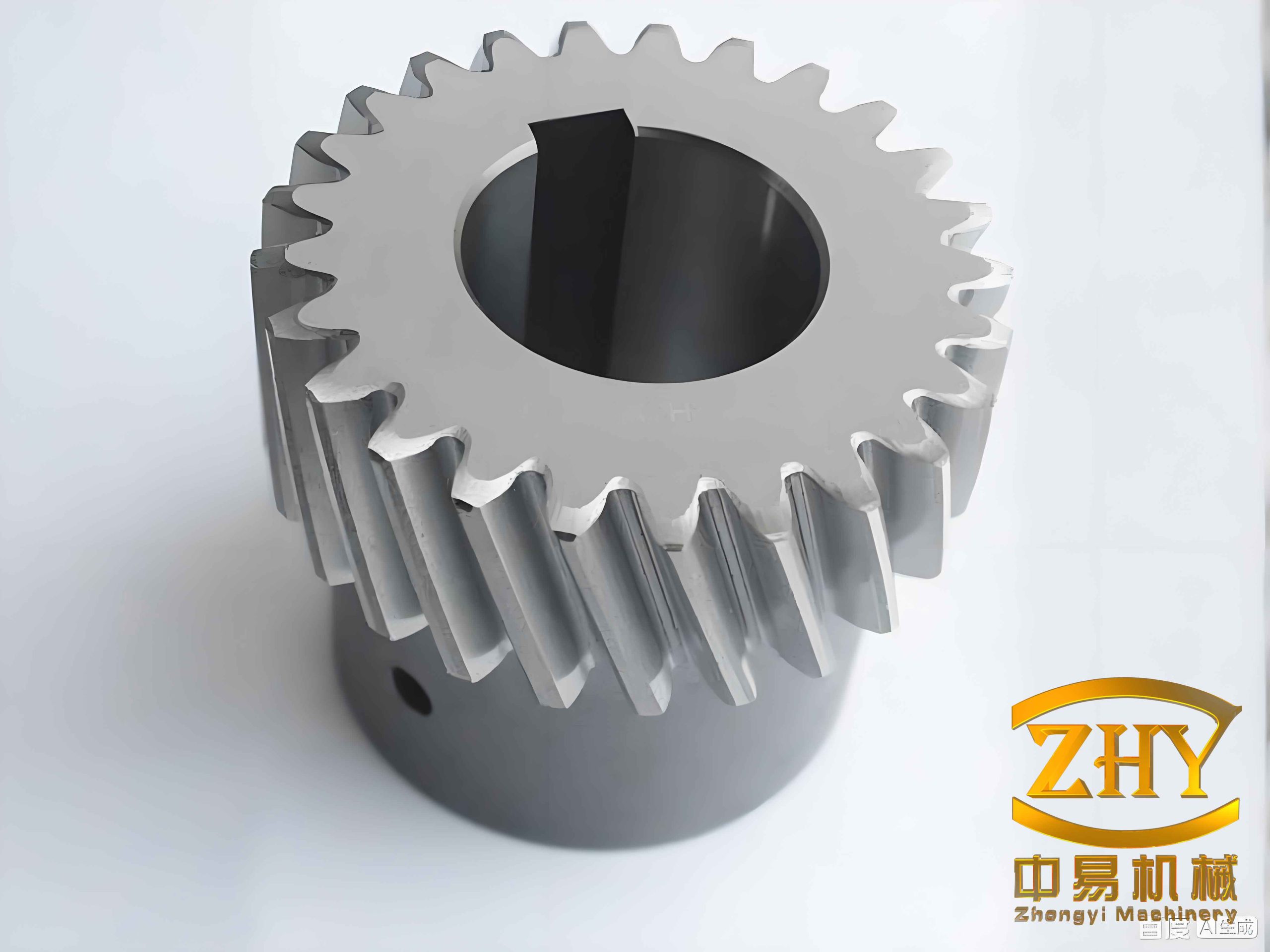
The helical gear pair studied in this work is a reduction pair installed in the main box of a heavy commercial vehicle transmission. The macroscopic parameters are summarized in Table 1.
| Parameter | Pinion (Driving) | Gear (Driven) |
|---|---|---|
| Number of teeth \(z\) | 34 | 41 |
| Normal module \(m_n\) (mm) | 3.55 | 3.55 |
| Normal pressure angle \(\alpha_n\) (°) | 19 | 19 |
| Helix angle \(\beta\) (°) | 30.7 | 30.7 |
| Hand of helix | Right | Left |
| Pitch circle diameter \(d\) (mm) | 140.373 | 169.273 |
| Base circle diameter \(d_b\) (mm) | 130.313 | 157.142 |
| Addendum \(h_a\) (mm) | 4.614 | 4.437 |
| Dedendum \(h_f\) (mm) | 5.325 | 5.502 |
| Face width \(B\) (mm) | 43.5 | 35.5 |
| Center distance \(a\) (mm) | 155 | |
2.2 Classification of Installation Errors
For a cylindrical helical gear pair, installation errors are categorized into three basic types:
- Center distance error (\(\Delta a\)): Deviation of the actual center distance from the nominal value.
- Shaft intersection angle error (\(\Delta F_{\Sigma\delta}\)): Angular misalignment measured in the common plane of the two ideal axes.
- Shaft stagger angle error (\(\Delta F_{\Sigma\beta}\)): Angular misalignment measured in the plane perpendicular to the common plane.
These errors cause the contact lines to deviate from the ideal involute path, leading to increased transmission error fluctuations.
3. Finite Element Modeling and Validation
3.1 Three-Dimensional Solid Model and Mesh Generation
I start by creating the exact involute tooth profile using the parametric equations:
$$
x = r_b \cos\theta + r_b \theta \sin\theta,\quad y = r_b \sin\theta – r_b \theta \cos\theta,\quad z = 0,
$$
where \(r_b\) is the base circle radius and \(\theta\) is the roll angle. Using SolidWorks, I generate the 3D solid model of the helical gear pair. To reduce computational cost, only eight teeth are modeled for each gear. The mesh is generated in Hypermesh with refined sizes: 0.3 mm on the tooth profile, 0.1 mm at the root fillet, and 1.0 mm along the face width. The final mesh consists of C3D8R elements (linear hexahedral with reduced integration). The material is 20CrNiMo alloy steel with elastic modulus \(E = 2.07 \times 10^5\) MPa, Poisson’s ratio \(\nu = 0.3\), and density \(\rho = 7.8 \times 10^{-9}\) t/mm³.
3.2 Contact and Boundary Conditions
In Abaqus/Explicit, I define a “hard” normal contact between tooth flanks to prevent penetration, and a frictionless tangential behavior assuming good lubrication. Two reference points are created at the centers of the pinion and gear bores, coupled to their respective inner surfaces via kinematic coupling. Two analysis steps are used: Step 1 (0.04 s) ramps the pinion angular velocity to 20 rad/s and applies the load torque to the gear; Step 2 (0.04 s) maintains constant speed and torque to acquire stable meshing data for four tooth engagements. Load torques ranging from 200 N·m to 1000 N·m are considered.
3.3 Validation via Hertz Contact Theory
For a helical gear pair with a face contact ratio greater than 1, the maximum contact stress usually occurs at the pitch point. According to the ISO 6336 standard, the Hertzian contact stress is:
$$
\sigma_H = Z_E Z_\varepsilon Z_H Z_\beta \sqrt{\frac{K F_t}{b d_1} \frac{u+1}{u}},
$$
where \(Z_E\) is the elasticity factor:
$$
Z_E = \sqrt{\frac{1}{\pi \left( \frac{1-\nu_1^2}{E_1} + \frac{1-\nu_2^2}{E_2} \right) }},
$$
\(Z_\varepsilon\) is the contact ratio factor, \(Z_H\) is the zone factor, \(Z_\beta\) is the helix angle factor, \(K\) is the load factor (product of application factor \(K_A = 1.25\), dynamic factor \(K_V = 1\), face load factor \(K_\beta = 1\), and transverse load factor \(K_\alpha = 1.4\)), \(F_t\) is the tangential force, \(b\) is the smaller face width, \(d_1\) is the pinion pitch diameter, and \(u = z_2/z_1\).
I compute the theoretical contact stress for each torque and compare with the maximum contact stress extracted from the FE simulation. Table 2 shows the comparison at different torques.
| Load Torque (N·m) | FEM Stress (MPa) | Hertz Stress (MPa) | Error (%) |
|---|---|---|---|
| 200 | 419 | 492 | 14.8 |
| 400 | 593 | 661 | 10.3 |
| 600 | 723 | 803 | 10.0 |
| 800 | 847 | 928 | 8.7 |
| 1000 | 960 | 1043 | 8.0 |
The maximum error is 14.8% at low torque; all errors are within acceptable engineering accuracy, confirming the validity of the FE model.
4. Transmission Error Computation under Installation Errors
4.1 Definition of Transmission Error
Transmission error is defined as the difference between the actual angular position of the driven gear and its theoretical position based on the ideal gear ratio:
$$
TE = (\varphi_2 – \varphi_2^0) – \frac{z_1}{z_2} (\varphi_1 – \varphi_1^0),
$$
where \(\varphi_1, \varphi_2\) are the actual angles of pinion and gear, and \(\varphi_1^0, \varphi_2^0\) are their initial angles.
4.2 Baseline (No Installation Error)
I first simulate the helical gear pair without any installation error under torques from 500 N·m to 1000 N·m. The time-varying TE curves for the middle two tooth engagements are extracted. The peak-to-peak values increase with torque, as shown in Table 3.
| Torque (N·m) | 500 | 600 | 700 | 800 | 900 | 1000 |
|---|---|---|---|---|---|---|
| TE peak-to-peak (μm) | 4.2 | 4.8 | 5.3 | 5.9 | 6.4 | 7.0 |
4.3 Center Distance Error
I introduce center distance errors \(\Delta a\) of 5, 10, 15, and 20 μm while keeping the load torque at 1000 N·m. The TE curves show increased amplitude and peak-to-peak values compared to the baseline. Table 4 lists the results.
| \(\Delta a\) (μm) | 0 | 5 | 10 | 15 | 20 |
|---|---|---|---|---|---|
| TE peak-to-peak (μm) | 7.0 | 7.1 | 7.2 | 7.4 | 7.6 |
4.4 Shaft Intersection Angle Error
The shaft intersection angle error (in the common plane) is applied with the same magnitudes. The TE peak-to-peak increases more significantly, as shown in Table 5.
| \(\Delta F_{\Sigma\delta}\) (μm) | 0 | 5 | 10 | 15 | 20 |
|---|---|---|---|---|---|
| TE peak-to-peak (μm) | 7.0 | 7.5 | 8.1 | 8.8 | 9.5 |
4.5 Shaft Stagger Angle Error
The shaft stagger angle error produces the largest increase in TE fluctuation. Results are summarized in Table 6.
| \(\Delta F_{\Sigma\beta}\) (μm) | 0 | 5 | 10 | 15 | 20 |
|---|---|---|---|---|---|
| TE peak-to-peak (μm) | 7.0 | 8.0 | 9.2 | 10.5 | 12.0 |
4.6 Contribution Analysis of Installation Errors
To directly compare the influence of the three error types, I plot the peak-to-peak TE as a function of error magnitude. The trends are summarized in Table 7.
| Error magnitude (μm) | Center distance | Intersection angle | Stagger angle |
|---|---|---|---|
| 5 | 7.1 | 7.5 | 8.0 |
| 10 | 7.2 | 8.1 | 9.2 |
| 15 | 7.4 | 8.8 | 10.5 |
| 20 | 7.6 | 9.5 | 12.0 |
Clearly, the stagger angle error has the strongest influence, followed by the intersection angle error, while the center distance error has the weakest effect on the helical gear pair’s transmission error.
5. Conclusion
In this work, I establish a finite element model of a helical gear pair from a heavy commercial vehicle transmission and validate it using Hertzian contact stress calculations. The validated model is then employed to study the sensitivity of transmission error to three types of installation errors: center distance error, shaft intersection angle error, and shaft stagger angle error. Based on the simulation results, I draw the following conclusions:
- All three installation errors increase the peak-to-peak value of transmission error, with the effect becoming more pronounced as the error magnitude grows.
- Among the three error types, the shaft stagger angle error has the most significant impact on transmission error, the center distance error has the least, and the shaft intersection angle error lies in between.
- To effectively control gear whine in heavy-duty transmissions, the manufacturing and assembly tolerances for the stagger angle should be the most strictly controlled.