
In this study, I focus on developing a comprehensive finite element modeling approach for a two-stage spur gear transmission system, considering multi-source time-varying excitations. Spur gears are widely used in mechanical transmissions due to their efficiency, compact structure, and stable transmission ratio. However, vibration and noise induced by internal and external excitations are inevitable, especially as systems trend toward high-speed, heavy-load, and lightweight designs. Understanding the dynamic behavior of spur gear systems is crucial for optimizing performance and reliability. Here, I present a detailed methodology that incorporates the flexibility of transmission shafts, time-varying stiffness of spur gear pairs and bearings, and phase relationships between gear stages. The model is discretized using finite element techniques, and dynamic characteristics are solved via numerical integration. I validate the approach through simulations and experiments, demonstrating its effectiveness in capturing complex vibrational responses.
The core of this work lies in modeling a two-stage spur gear transmission system, which consists of input, intermediate, and output shafts, two pairs of spur gears, and six deep-groove ball bearings. Spur gears are selected for their simplicity and common use in industrial applications. The system parameters are summarized in tables below. I consider the shafts as flexible components, discretizing them into beam elements based on Timoshenko beam theory. Each spur gear pair is treated as a meshing unit with time-varying stiffness, while bearings are modeled as spring-damper elements with time-dependent stiffness. The finite element model assembles these units to form a coupled dynamic system.
| Parameter | Input Shaft | Intermediate Shaft | Output Shaft |
|---|---|---|---|
| Length (m) | 0.24 | 0.16 | 0.18 |
| Radius (mm) | 5 | 5 | 5 |
| Density (kg/m³) | 7850 | 7850 | 7850 |
| Shear Modulus (Pa) | 8e10 | 8e10 | 8e10 |
| Parameter | First-Stage Driving Gear | First-Stage Driven Gear | Second-Stage Driving Gear | Second-Stage Driven Gear |
|---|---|---|---|---|
| Moment of Inertia (kg·m²) | 2e-4 | 3.04e-3 | 1e-4 | 8.71e-3 |
| Number of Teeth | 36 | 90 | 29 | 100 |
| Module (mm) | 1.5 | 1.5 | 1.5 | 1.5 |
| Pressure Angle (°) | 20 | 20 | 20 | 20 |
| Face Width (mm) | 12 | 12 | 12 | 12 |
| Mass (kg) | 0.16 | 1.3 | 0.09 | 1.6 |
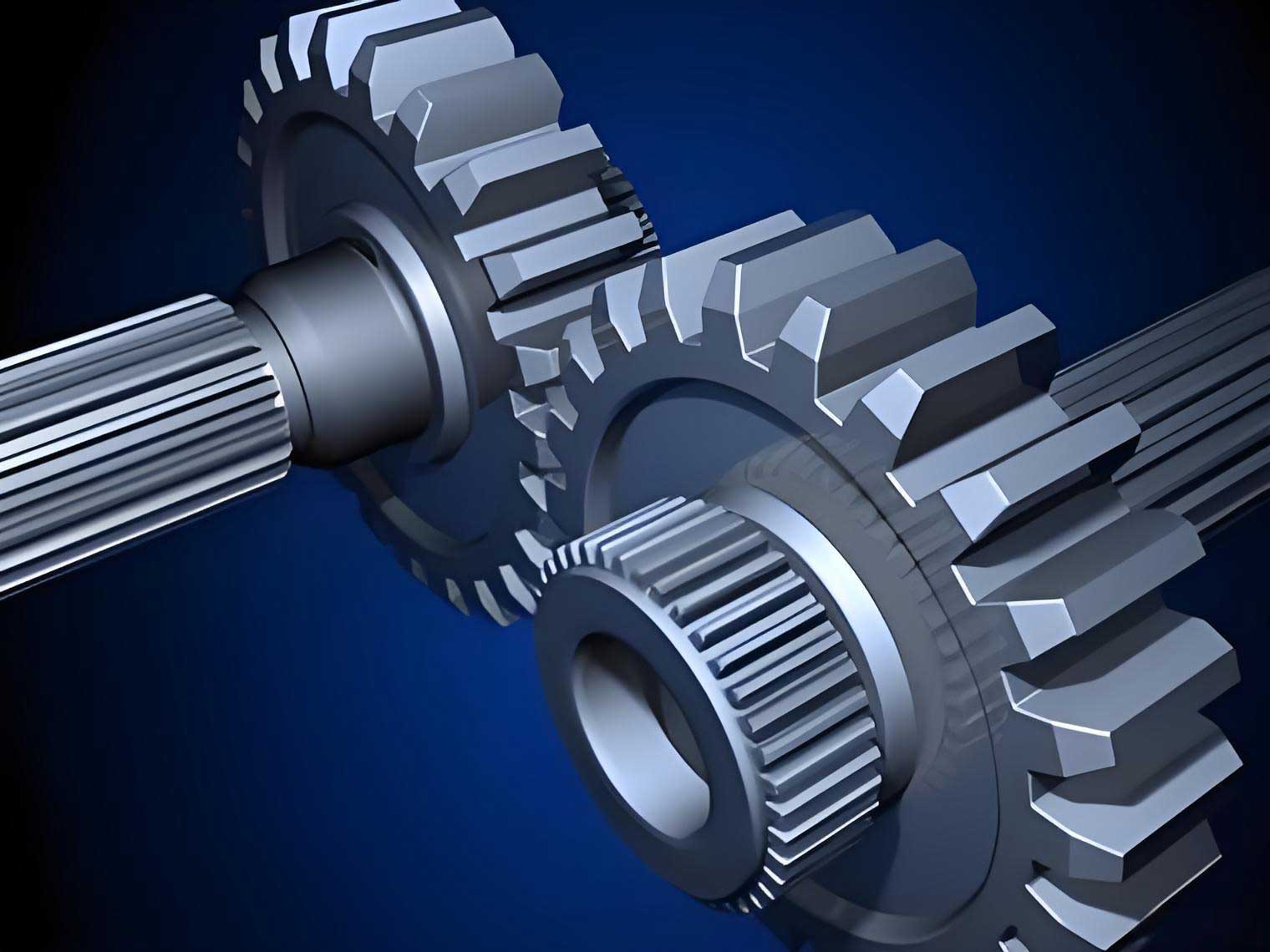
To visualize the configuration of spur gears in such systems, I include an image that illustrates typical spur gear arrangements. This helps in understanding the meshing interactions and structural layout.
The finite element modeling process begins by discretizing the continuous system into basic units: shaft-shaft elements, shaft-spur gear elements, shaft-bearing elements, and spur gear-spur gear elements. For the shafts, I divide them into multiple segments—12 elements for the input shaft, 8 for the intermediate shaft, and 9 for the output shaft—each with nodes numbered sequentially. Spur gears are attached at specific nodes: the first-stage driving gear at node 7, the first-stage driven gear at node 16, the second-stage driving gear at node 20, and the second-stage driven gear at node 29. Bearings are coupled at support nodes, resulting in a total of 95 degrees of freedom. This discretization allows for capturing detailed vibrational modes, including bending, torsion, and translation of spur gears and shafts.
For the shaft segment elements, I employ Timoshenko beam theory to account for shear deformation, given the small diameter-to-length ratios. Each shaft element has two nodes, with each node possessing two transverse displacements and one torsional rotation. The displacement vector for an element is defined as:
$$ \{\delta\}^e = [\upsilon_i, \omega_i, \theta_i, \upsilon_j, \omega_j, \theta_j]^T $$
where $\upsilon$ and $\omega$ represent transverse displacements, and $\theta$ is the torsional angle. The stiffness matrix $[K_s]$ and mass matrix $[M_s]$ are derived from beam theory, incorporating material properties like elastic modulus and density. Damping is modeled using Rayleigh damping, expressed as:
$$ [C_s] = \alpha [M_s] + \beta [K_s] $$
with coefficients $\alpha = 3$ and $\beta = 8 \times 10^{-7}$ for structural steel. This approach effectively captures the energy dissipation in spur gear systems.
The spur gear meshing unit is crucial for modeling dynamic interactions. I assume the spur gears are elastic bodies with viscous damping, experiencing torsional and transverse vibrations but no axial motion. The time-varying mesh stiffness $k_m(t)$ of spur gears is computed using finite element analysis over a meshing cycle, as shown in the stiffness curve. For a spur gear pair, the elastic meshing force is given by:
$$ F_k = k_m(t) \left( \upsilon_p \sin \alpha + \omega_p \cos \alpha – r_p \theta_p – \upsilon_g \sin \alpha – \omega_g \cos \alpha – r_g \theta_g + e(t) \right) $$
where $\alpha$ is the pressure angle, $r_p$ and $r_g$ are base circle radii of the driving and driven spur gears, and $e(t)$ is the transmission error, typically sinusoidal: $e(t) = e_1 \sin(2\pi f_{m1} t)$ for the first-stage spur gears. The time-varying stiffness $k_m(t)$ introduces periodic excitations that significantly influence spur gear dynamics.
Bearings are modeled as spring elements with time-varying stiffness due to rolling element passage. For deep-groove ball bearings, stiffness varies based on load distribution—either “odd pressure” or “even pressure” conditions. The radial stiffness $k_b(t)$ is expressed as:
$$ k_b(t) = k_{bs} + k_a \sin(2\pi f_b t + \beta_b) $$
where $k_{bs}$ is the static stiffness, $k_a$ is the amplitude, $f_b$ is the bearing pass frequency, and $\beta_b$ is the phase angle. Parameters for the bearings used are listed in Table 3.
| Parameter | Value |
|---|---|
| Inner Race Diameter (mm) | 28.7 |
| Outer Race Diameter (mm) | 46.6 |
| Ball Diameter (mm) | 8.7 |
| Number of Balls | 8 |
| Pitch Diameter (mm) | 37.65 |
| Radial Clearance (mm) | 0.5 |
| Odd Pressure Stiffness (N/m) | 8.21e8 |
| Even Pressure Stiffness (N/m) | 8.95e8 |
In two-stage spur gear systems, phase relationships between gear pairs are essential. I define coordinate systems for each stage, with an inter-shaft angle $\beta$. For the second-stage spur gears, the pressure angle relative to the first-stage is adjusted to $\alpha_2 = \beta – (\pi/2 – \alpha)$. This affects the meshing force projection, modifying the dynamic equations accordingly. The elastic force for the second-stage spur gear pair becomes:
$$ F_{k2} = k_{m2}(t) \left( \upsilon_{p2} \sin \alpha_2 + \omega_{p2} \cos \alpha_2 – r_{p2} \theta_{p2} – \upsilon_{g2} \sin \alpha_2 – \omega_{g2} \cos \alpha_2 – r_{g2} \theta_{g2} + e_2(t) \right) $$
where $k_{m2}(t)$ is the time-varying stiffness for the second-stage spur gears, and $e_2(t) = e_2 \sin(2\pi f_{m2} t)$ with $f_{m2}$ as the second-stage meshing frequency. Incorporating this phase ensures accurate coupling between spur gear stages.
Assembling the global system involves combining stiffness, mass, and damping matrices from all elements. The overall dynamic equation is:
$$ [M]\{\ddot{x}(t)\} + [C]\{\dot{x}(t)\} + [K(t)]\{x(t)\} = \{F(t)\} $$
where $\{x(t)\}$ is the displacement vector, $[M]$ is the mass matrix, $[C]$ is the damping matrix, $[K(t)]$ is the time-varying stiffness matrix (including contributions from spur gears and bearings), and $\{F(t)\}$ is the external force vector. The stiffness matrix $[K(t)]$ is periodic due to spur gear meshing and bearing variations. I solve this equation using the Newmark integration method, which offers unconditional stability for transient dynamics.
Before dynamic analysis, I examine static deformation of the spur gear shafts under load. Assuming a torque of 10 N·m and input speed of 500 rpm, the shaft deformations are computed via:
$$ \{\delta_S\} = \frac{F}{[K_s]} $$
where $[K_s]$ is the shaft stiffness matrix. Results show maximum deformations at spur gear coupling nodes: 0.55 μm for the input shaft, 1.98 μm for the intermediate shaft, and 1.70 μm for the output shaft. This highlights the importance of shaft flexibility in spur gear systems, as it influences load distribution and vibrational responses.
Natural frequency analysis is conducted by solving the eigenvalue problem:
$$ ([K] – \omega_i^2 [M]) \phi_i = 0 $$
where $[K]$ is the mean stiffness matrix, $\omega_i$ are natural frequencies, and $\phi_i$ are mode shapes. Ignoring damping, I obtain the first 10 natural frequencies, listed in Table 4. The modes involve torsional vibrations of spur gear pairs and bending/whirling of shafts, characteristic of spur gear transmission dynamics.
| Mode | Frequency (Hz) | Description |
|---|---|---|
| 1 | 127 | Torsional vibration of first-stage spur gears |
| 2 | 203 | Mixed torsional-transverse vibration |
| 3 | 1055 | Torsional vibration of second-stage spur gears |
| 4 | 1129 | Shaft bending with gear coupling |
| 5 | 1130 | Higher torsional mode |
| 6 | 1230 | Shaft whirling and spur gear interaction |
| 7 | 2119 | Complex bending of multiple shafts |
| 8 | 2875 | High-frequency torsional resonance |
| 9 | 2969 | Shaft deflection coupled with spur gear motion |
| 10 | 5120 | Localized vibration in spur gear teeth |
Dynamic simulations under multi-source excitations reveal key insights. For the first-stage spur gear pair, I compare dynamic meshing forces with rigid and flexible shaft assumptions. With rigid shafts, the time-domain response shows beating phenomena and higher amplitudes, while flexible shafts reduce dynamic loads and smooth the signal. Frequency spectra indicate that rigid shafts produce numerous harmonics, including first-stage meshing frequency $f_{m1}$, its multiples, and second-stage meshing frequency $f_{m2}$ components. In contrast, flexible shafts filter out some frequencies due to damping effects, emphasizing the role of shaft compliance in spur gear systems.
To quantify this, I derive the dynamic load spectrum. For spur gears, the meshing frequency is calculated as $f_m = \frac{N \times \text{rpm}}{60}$, where $N$ is the number of teeth. For instance, at 500 rpm, $f_{m1} = 500 \times 36 / 60 = 300$ Hz for the first-stage spur gears, but in the reference, values differ based on gearing ratios. I adjust simulations accordingly, ensuring consistency. The acceleration response at bearing locations shows peaks at $f_{m1}$, $2f_{m1}$, $f_{m2}$, and bearing pass frequency $f_b$, with sidebands due to modulation effects.
Experimental validation is performed using a spur gear test bench. Accelerometers measure radial vibrations at bearing housings under conditions of 960 rpm input speed and 10 N·m load torque. The measured acceleration spectrum aligns well with simulations, displaying dominant frequencies at $f_{m1} = 576$ Hz and $f_{m2} = 186$ Hz for the spur gears, along with $f_b$ and its harmonics. Discrepancies near certain frequencies are attributed to foundation dynamics not modeled in simulations. I further conduct a speed sweep from 500 to 3000 rpm, comparing simulated and experimental acceleration trends. Both show resonance peaks around 1700 rpm and 2200 rpm, where meshing frequencies coincide with natural frequencies of the spur gear system, confirming model accuracy.
The effectiveness of this finite element modeling method is evident in its ability to capture complex behaviors of spur gear transmissions. By incorporating shaft flexibility, time-varying spur gear mesh stiffness, and bearing dynamics, the model predicts vibrational responses that match experimental data. This approach is scalable for multi-stage spur gear systems and can aid in design optimization to reduce noise and wear. Future work could explore nonlinear effects like backlash in spur gears or incorporate thermal influences on stiffness.
In conclusion, I have developed a detailed finite element model for two-stage spur gear transmission systems under multi-source time-varying excitations. The model highlights the significance of spur gear interactions, shaft flexibility, and phase relationships. Through simulations and experiments, I demonstrate that considering these factors leads to more accurate dynamic predictions. This methodology provides a robust tool for analyzing and improving spur gear system performance in various engineering applications.