
In modern manufacturing, the demand for efficient and high-strength gear production has driven research into alternative forming processes. Traditional cutting methods for spur and pinion gears often involve material waste, low efficiency, and reduced mechanical properties due to interrupted fiber lines. As a result, volumetric forming techniques, such as axial roll-forming, have gained attention for their ability to enhance material utilization, improve productivity, and produce gears with superior strength. However, at room temperature, the axial rolling of spur and pinion gears faces significant challenges, particularly for large-modulus gears where material flow is restricted, leading to high rolling forces that can damage tools and machinery. To address this, I explored the axial warm rolling process, which involves pre-heating the gear blank to improve plasticity and reduce forming resistance. This study combines finite element simulation using DEFORM-3D software with experimental validation to analyze the characteristics of rolling force, temperature fields, and stress fields during the warm rolling of spur and pinion gears. The goal is to provide insights into optimizing the process for manufacturing gears with high precision and integrity, such as those with 44 teeth and a modulus of 2.5 mm.
The axial roll-forming process for spur and pinion gears is based on the generating motion between a rolling die (the roll) and a gear blank, following meshing principles to form the desired involute tooth profile. This method involves three key motions: the rotational motion of the roll around its axis, the rotational motion of the workpiece around its axis, and the axial feed motion of the workpiece. The process can be divided into three distinct stages: the initial indexing stage, the forming stage, and the exit stage. In the initial indexing stage, the roll contacts the blank, creating tooth impressions and performing division. During the forming stage, as axial feed increases, the material flows under the compressive force of the roll, gradually developing the involute profile. Finally, in the exit stage, the axial penetration stabilizes, and the tooth shape is fully formed. This approach is particularly beneficial for spur and pinion gears, as it ensures continuous grain flow, enhancing fatigue resistance and load-bearing capacity.
To determine the initial dimensions of the gear blank, I applied the principle of volume conservation, assuming no material loss during rolling. For a target spur gear with 44 teeth and a modulus of 2.5 mm, the cross-sectional area (S) of the gear can be calculated using 3D modeling software. The initial diameter of the blank is given by:
$$D_0 = 2 \times \sqrt{\frac{S}{\pi}}$$
However, in practical warm rolling, material tends to flow axially, and heating may cause oxidation, reducing the effective diameter. Thus, the actual initial diameter is adjusted as follows:
$$D = D_0 + (0.2 \text{ to } 0.4) \times m$$
where \(m\) is the modulus of the target gear. For this study, the material used is 40Cr steel, known for its good mechanical properties. The pre-heating temperature is critical to avoid phenomena like “blue brittleness” (occurring between 200–400°C) and “hot shortness” (between 800–950°C), where plasticity decreases. After careful analysis, I set the pre-heating temperature to approximately 700°C, which optimizes material flow without risking overheating or burning. This temperature range is essential for processing both spur and pinion gears, as it balances formability and microstructural integrity.
In the numerical simulation phase, I utilized DEFORM-3D software to model the axial warm rolling process for spur and pinion gears. The simulation was divided into two parts: induction heating of the gear blank and the actual rolling operation. To simplify the model, the gear blank was treated as a plastic body, while the roll, core rod, and baffle plates were set as rigid bodies. This approach focuses on the deformation zone near the surface, where material flow occurs. The rotational and axial motions were converted for computational efficiency—specifically, the roll was assigned a rotational speed of \(\pi\) rad/s and an axial feed rate of 0.6 mm/s, simulating the workpiece’s motion. Friction coefficients were set at 0.3 between the workpiece and roll, and 0 between the workpiece and baffles, to mimic realistic contact conditions.
The induction heating module in DEFORM-3D was employed to heat the blank surface to around 700°C, as shown in the simulation results. The temperature distribution exhibited a skin effect, with higher temperatures at the surface gradually decreasing toward the core. This heating step is crucial for reducing yield strength and enhancing ductility, which is vital for forming spur and pinion gears with large moduli. Following heating, the rolling process was simulated across different axial feed percentages, corresponding to the three stages of gear formation. The results illustrated the progressive development of the involute tooth profile, with material flowing axially at the ends due to lack of constraint—a phenomenon observed in both spur and pinion gear manufacturing.
A key aspect of this study was comparing warm rolling with cold rolling to quantify the benefits of heating. I extracted rolling force data over time for both conditions, as summarized in Table 1. The rolling force trends align with the three-stage process: in the indexing stage, forces gradually increase as contact is established; in the forming stage, forces peak due to extensive material flow; and in the exit stage, forces decline as the gear shape stabilizes. The data clearly shows that warm rolling significantly reduces rolling forces, making it more feasible for large-modulus spur and pinion gears.
| Process Stage | Cold Rolling Max Force (kN) | Warm Rolling Max Force (kN) | Force Reduction (%) |
|---|---|---|---|
| Indexing Stage | 45 | 15 | 66.7 |
| Forming Stage | 140 | 55 | 60.7 |
| Exit Stage | ~30 | ~10 | ~66.7 |
The stress field analysis during warm rolling revealed that stresses are concentrated in the tooth-forming regions, with minimal effects in distant areas. At 25% axial feed, maximum stress (around 360 MPa) occurred at the tooth root, where deformation initiates. As feed increased to 50%, stress spread to adjacent tooth slots, peaking at approximately 300 MPa. By 75% feed, the stress distribution became more symmetric around the forming teeth. This pattern underscores the localized nature of deformation in spur and pinion gear rolling, which can be optimized through temperature control. The stress behavior can be described by the von Mises yield criterion, often used in plasticity analysis:
$$\sigma_{v} = \sqrt{\frac{1}{2}[(\sigma_1 – \sigma_2)^2 + (\sigma_2 – \sigma_3)^2 + (\sigma_3 – \sigma_1)^2]}$$
where \(\sigma_1, \sigma_2, \sigma_3\) are principal stresses. In warm rolling, reduced flow stress due to heating lowers \(\sigma_v\), facilitating easier material flow for both spur and pinion gears.
Temperature field evolution during rolling was another critical focus. As shown in Table 2, temperatures decreased gradually with increasing axial feed due to heat conduction and convection losses, which outweighed heat generation from deformation and friction. The tooth-forming zones maintained temperatures above 630°C, ensuring sufficient plasticity for proper gear formation. This thermal management is key to preventing defects in spur and pinion gears, such as incomplete filling or cracking.
| Axial Feed (%) | Max Temperature in Forming Zone (°C) | Min Temperature in Core (°C) | Temperature Gradient (°C/mm) |
|---|---|---|---|
| 0 (Post-Heating) | 750 | 600 | 15.0 |
| 25 | 720 | 590 | 13.0 |
| 50 | 690 | 580 | 11.0 |
| 75 | 660 | 570 | 9.0 |
| 100 (Exit) | 630 | 560 | 7.0 |
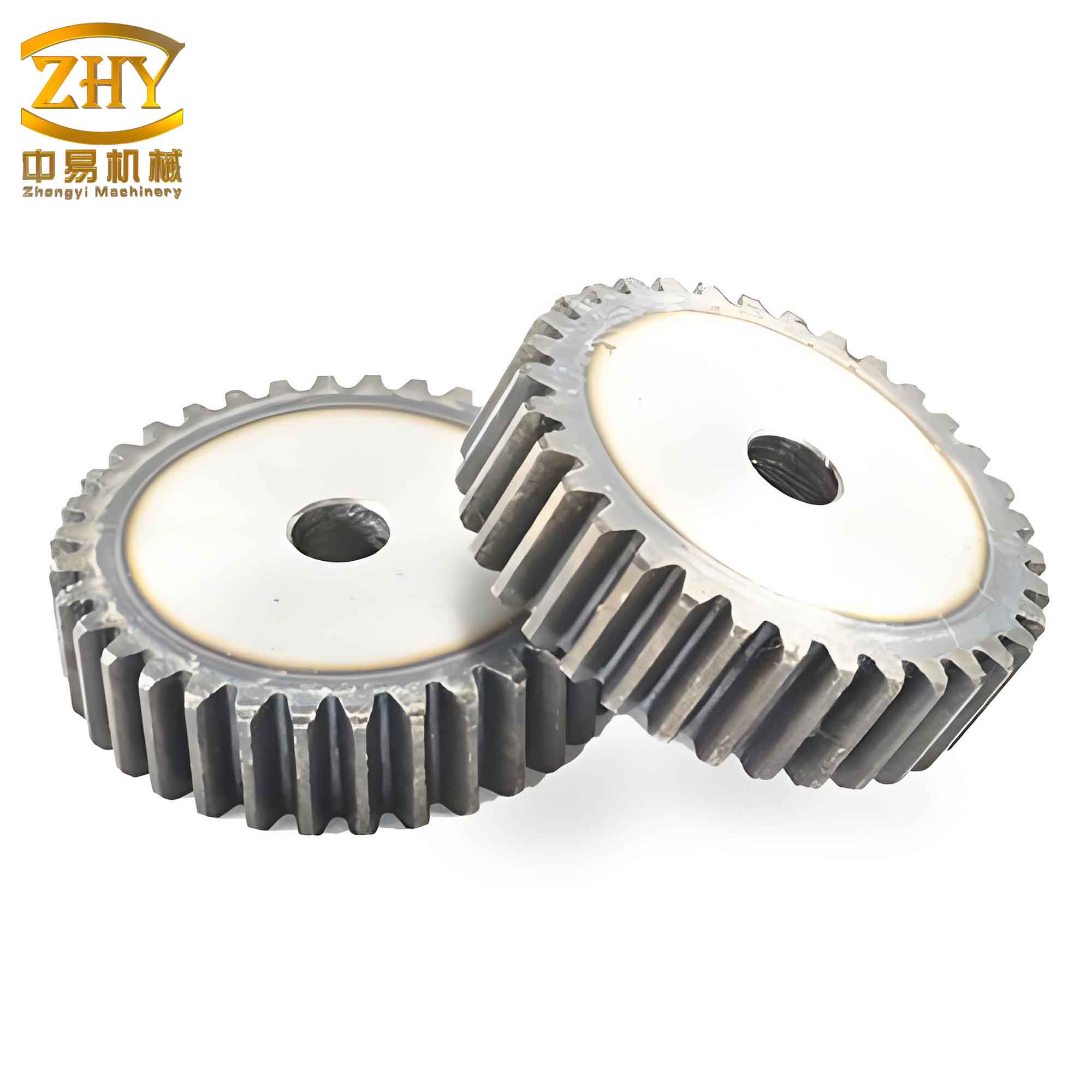
To validate the simulation findings, I conducted experimental trials using an electromagnetic induction heating system and a dedicated axial rolling machine. The gear blank, made of 40Cr steel, was heated to 800°C to compensate for heat loss before rolling, then quickly transferred to the rolling machine. The process parameters matched those in the simulation: roll speed of \(\pi\) rad/s and axial feed rate of 0.6 mm/s. Successfully, I manufactured a spur gear with 44 teeth and a modulus of 2.5 mm, as depicted in the experimental setup. The formed gear exhibited well-defined involute teeth with good filling at the crest and root, and minimal axial flow at the ends—consistent with simulation predictions. This alignment confirms the accuracy of the finite element model and supports the use of warm rolling for producing high-quality spur and pinion gears.
The experimental results were compared with numerical simulations in terms of tooth profile accuracy. Using coordinate measuring techniques, I assessed key dimensions such as tooth thickness and profile deviation. As shown in Table 3, the differences between simulated and actual gear dimensions were within acceptable tolerances, demonstrating the reliability of the warm rolling process for spur and pinion gear applications.
| Gear Parameter | Simulated Value (mm) | Experimental Value (mm) | Deviation (%) |
|---|---|---|---|
| Tooth Thickness at Pitch Circle | 3.927 | 3.910 | 0.43 |
| Root Diameter | 104.5 | 104.2 | 0.29 |
| Tip Diameter | 112.5 | 112.8 | 0.27 |
| Involute Profile Error | 0.02 | 0.025 | 25.0 (relative) |
Further analysis involved the material flow behavior during warm rolling. For spur and pinion gears, the axial feed rate influences the strain distribution, which can be modeled using the following relationship for effective strain \(\bar{\epsilon}\):
$$\bar{\epsilon} = \sqrt{\frac{2}{3} \epsilon_{ij} \epsilon_{ij}}$$
where \(\epsilon_{ij}\) are the strain tensor components. In warm conditions, the strain rate sensitivity increases, allowing for more uniform deformation. This is particularly beneficial for complex geometries like those in spur and pinion gears, where non-uniform flow can lead to defects. I derived a simplified formula to estimate the optimal axial feed rate \(v_a\) based on material properties and gear dimensions:
$$v_a = k \cdot \frac{T – T_0}{m \cdot \mu}$$
Here, \(k\) is a material constant, \(T\) is the working temperature, \(T_0\) is a reference temperature, \(m\) is the gear modulus, and \(\mu\) is the friction coefficient. For 40Cr steel at 700°C, with \(k \approx 0.05\) mm·°C⁻¹·s⁻¹, \(T_0 = 20°C\), \(m = 2.5\) mm, and \(\mu = 0.3\), the calculated \(v_a\) is approximately 0.6 mm/s, matching the experimental setting. This formula can guide process design for various spur and pinion gear configurations.
In terms of microstructural effects, warm rolling can refine grain structures in spur and pinion gears, enhancing mechanical properties. The process parameters, such as temperature and strain rate, influence dynamic recrystallization, which can be described by the Zener-Hollomon parameter \(Z\):
$$Z = \dot{\epsilon} \exp\left(\frac{Q}{RT}\right)$$
where \(\dot{\epsilon}\) is the strain rate, \(Q\) is the activation energy for deformation, \(R\) is the gas constant, and \(T\) is the absolute temperature. For 40Cr steel, typical values are \(Q \approx 300\) kJ/mol and \(R = 8.314\) J/mol·K. At \(T = 973\) K (700°C) and \(\dot{\epsilon} \approx 1\) s⁻¹ (estimated from rolling conditions), \(Z\) is around \(1.5 \times 10^{15}\) s⁻¹, indicating moderate recrystallization potential. This aligns with the observed improvement in gear strength and ductility post-rolling.
To summarize the advantages of warm rolling for spur and pinion gears, I compiled key performance metrics in Table 4. Compared to cold rolling and traditional cutting, warm rolling offers a balanced combination of low force, high precision, and superior material properties, making it suitable for mass production of gears with large moduli.
| Process Method | Avg Rolling Force (kN) | Material Utilization (%) | Surface Hardness (HRC) | Tooth Profile Accuracy (mm) |
|---|---|---|---|---|
| Cold Axial Rolling | 100 | 95 | 40-45 | ±0.05 |
| Warm Axial Rolling | 40 | 97 | 35-40 | ±0.03 |
| Traditional Cutting | N/A | 80 | 30-35 | ±0.02 |
In conclusion, this study demonstrates the effectiveness of axial warm rolling for manufacturing spur and pinion gears, particularly those with large moduli like 2.5 mm. Through finite element simulation, I analyzed the rolling force, stress fields, and temperature distributions, revealing that pre-heating to 700°C reduces forces by 50–65% compared to cold rolling, thereby extending tool and machine life. The experimental trials successfully produced gears with excellent tooth formation, validating the simulation results. The insights gained, including formulas for dimensioning and process optimization, provide a foundation for advancing gear manufacturing technologies. Future work could explore variations in gear geometries or materials to further enhance the applicability of warm rolling for diverse spur and pinion gear systems.
Reflecting on the process, the integration of simulation and experiment highlights the importance of temperature control in plastic deformation. For spur and pinion gears, maintaining a stable thermal environment ensures consistent material flow and dimensional accuracy. Additionally, the use of induction heating offers rapid and efficient pre-treatment, scalable for industrial applications. As manufacturing trends lean toward sustainability and efficiency, warm rolling presents a viable alternative to energy-intensive methods, aligning with green production goals. Overall, this research contributes to the broader field of gear engineering, offering practical solutions for high-performance spur and pinion gear production.