
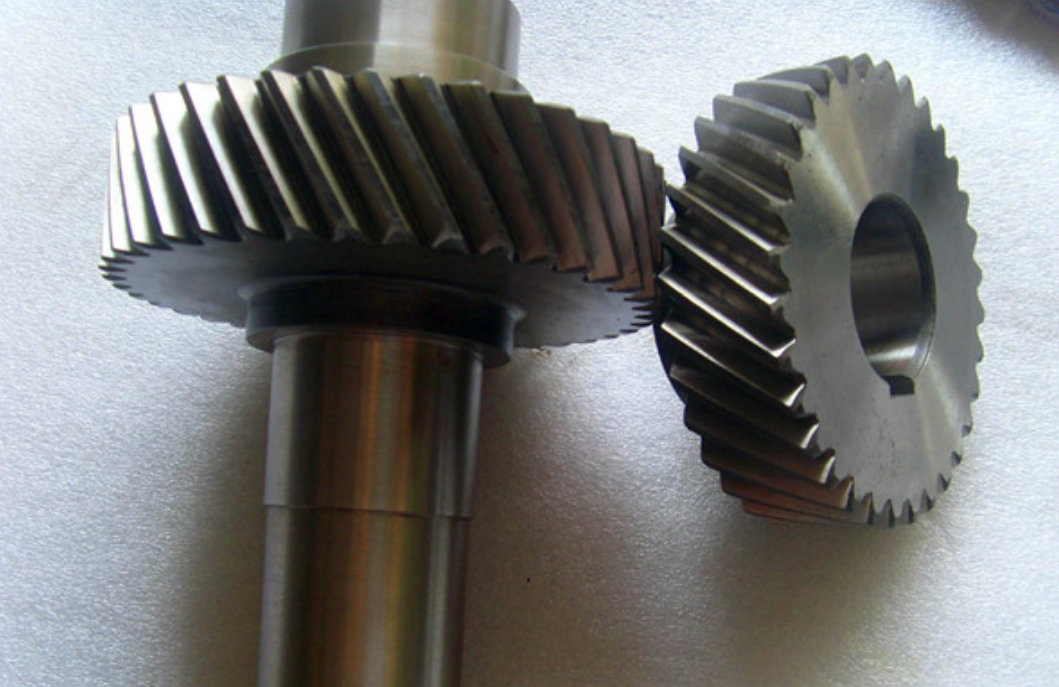
In the realm of heavy-duty transportation, trucks serve as the backbone of road freight, and with the trend toward heavier loads, the performance demands on these vehicles have escalated significantly. The transmission system is a critical component of heavy trucks, acting as the core determinant of overall vehicle performance. Within transmissions, helical gears are commonly employed due to their smooth engagement and high load-bearing capacity. However, in practical production, helical gears at various stages often suffer from damage due to overload, primarily manifesting as root cracks and fractures. Empirical observations from real-world operations indicate that assembly errors are a leading cause of such failures in heavy truck transmission helical gears. Currently, permissible assembly tolerances are often set based on engineer experience, lacking robust theoretical and technical support. Therefore, this study aims to conduct a comprehensive finite element simulation analysis of the mechanical performance of helical gears in heavy truck transmissions to derive allowable assembly errors, thereby guiding practical assembly processes and ensuring reliability.
Helical gears, with their angled teeth, offer advantages over spur gears, including reduced noise and higher load capacity, but they are also more sensitive to misalignments. This sensitivity underscores the importance of precise assembly. In this investigation, I focus on two primary sources of assembly error: shaft non-parallelism and tooth flank clearance. Through static and dynamic simulation analyses, I quantify the impact of these errors on contact stress, ultimately establishing tolerance limits that balance performance with manufacturability.
The foundation of any accurate simulation lies in a precise geometric model. The helical gear pair under study is defined by key parameters, which are summarized in the table below. These parameters are essential for constructing the three-dimensional model and for subsequent finite element analysis.
| Parameter | Driving Gear | Driven Gear |
|---|---|---|
| Number of Teeth, \( z \) | 14 | 35 |
| Pressure Angle, \( \alpha \) (°) | 20 | 20 |
| Module, \( m_n \) (mm) | 5 | 5 |
| Face Width, \( b \) (mm) | 20 | 20 |
| Helix Angle, \( \beta \) (°) | 15 | 15 |
Using Pro/ENGINEER (Pro/E) three-dimensional modeling software, I constructed a detailed model of this helical gear pair based on the parameters in Table 1. The accuracy of this model is paramount for reliable simulation results. The geometry of helical gears involves complex surfaces, and the model must accurately represent the tooth flank profile, which can be described mathematically. For a helical gear, the transverse module \( m_t \) is related to the normal module \( m_n \) by the helix angle \( \beta \):
$$ m_t = \frac{m_n}{\cos \beta} $$
The pitch diameter \( d \) is then given by:
$$ d = m_t \cdot z = \frac{m_n \cdot z}{\cos \beta} $$
For the driving helical gear in this study, using the values from Table 1:
$$ d_{drive} = \frac{5 \, \text{mm} \times 14}{\cos 15^\circ} \approx \frac{70}{0.9659} \approx 72.48 \, \text{mm} $$
Similar calculations apply to the driven helical gear. The three-dimensional model serves as the basis for importing into finite element analysis (FEA) software for meshing and solving.
The static contact stress analysis examines the stress state when the helical gears are in a fixed meshing position under load. This is crucial for understanding the initial stress distribution before dynamic effects come into play. The contact stress between gear teeth can be approximated using Hertzian contact theory, though for helical gears, the line contact becomes elliptical. A simplified expression for maximum contact stress \( \sigma_H \) is:
$$ \sigma_H = Z_E \sqrt{\frac{F_t}{b \cdot d_1} \cdot \frac{u \pm 1}{u} \cdot K_A \cdot K_V \cdot K_{H\beta} \cdot K_{H\alpha}} $$
where \( Z_E \) is the elasticity factor, \( F_t \) is the tangential load, \( b \) is the face width, \( d_1 \) is the pitch diameter of the pinion, \( u \) is the gear ratio, and \( K \) factors account for application, dynamic load, face load distribution, and transverse load distribution, respectively. For helical gears, the load distribution factor \( K_{H\beta} \) is particularly sensitive to misalignment.
Static Analysis Under Shaft Non-Parallelism
Shaft non-parallelism, where the axes of the driving and driven helical gears are not perfectly parallel, introduces a twisting moment and uneven load distribution. In this simulation, the driven gear shaft is assumed to be correctly aligned, while the driving gear shaft is outwardly twisted by a specific angle \( \theta \). Based on empirical assembly data and measurements, I analyzed angles from 0.2° to 0.6°. The three-dimensional model was modified to incorporate these twists, and then meshed for FEA. The mesh consisted of 18,642 nodes to ensure solution accuracy.
The contact stress results for both the driving and driven helical gears at different misalignment angles are summarized below. The material used for these helical gears has an allowable maximum contact stress of 1 GPa.
| Shaft Misalignment Angle, \( \theta \) (°) | Contact Stress in Driving Helical Gear (GPa) | Contact Stress in Driven Helical Gear (GPa) |
|---|---|---|
| 0.2 | 0.45 | 0.38 |
| 0.4 | 0.72 | 0.65 |
| 0.6 | 0.98 | 0.89 |
The data shows a clear increase in contact stress with increasing misalignment for both helical gears. At \( \theta = 0.6^\circ \), the stress in the driving helical gear approaches the 1 GPa limit. To incorporate a safety margin and prevent root cracks, the static analysis suggests that the shaft non-parallelism should be limited to \( \theta \leq 0.4^\circ \).
Static Analysis Under Tooth Flank Clearance
Tooth flank clearance, or backlash, refers to the gap between the non-driving flanks of meshing gear teeth. In assembly, unintended clearance can occur, altering the contact pattern. I simulated clearances of 0.2 mm, 0.4 mm, and 0.6 mm to analyze their static impact on the helical gear pair.
The results for static contact stress under varying tooth flank clearance are presented in the following table. The relationship between clearance \( \delta \) and stress \( \sigma \) can be modeled as approximately linear for this range, as seen in the data.
| Tooth Flank Clearance, \( \delta \) (mm) | Contact Stress in Driving Helical Gear (GPa) | Contact Stress in Driven Helical Gear (GPa) |
|---|---|---|
| 0.2 | 0.30 | 0.28 |
| 0.4 | 0.52 | 0.48 |
| 0.6 | 0.68 | 0.63 |
In all cases, the contact stresses remain below the 1 GPa material limit. Therefore, based solely on static analysis, the tooth flank clearance for these helical gears could be permitted up to \( \delta \leq 0.6 \) mm. However, static analysis does not account for dynamic loads encountered during operation.
Dynamic Analysis Under Shaft Non-Parallelism
Dynamic simulation captures the effects of time-varying loads, impacts, and vibrations, which are critical for helical gears in real transmission operation. The dynamic contact stress is typically higher than the static value due to shock loads and meshing impacts. Using the static limit of \( \theta \leq 0.4^\circ \) as a starting point, I performed transient dynamic analyses for misalignments of 0.2° and 0.4°, focusing on the peak dynamic contact stress along the contact line.
The dynamic contact stress values are compared below. The increase from static to dynamic stress can be quantified by a dynamic factor \( K_V \), which for helical gears is often a function of pitch line velocity and gear accuracy.
| Condition | Dynamic Contact Stress in Driving Helical Gear (GPa) | Dynamic Contact Stress in Driven Helical Gear (GPa) |
|---|---|---|
| Shaft Misalignment \( \theta = 0.2^\circ \) | 0.80 | 0.90 |
| Shaft Misalignment \( \theta = 0.4^\circ \) | 0.90 | 1.10 |
The dynamic stresses show significant increases. For the driven helical gear at \( \theta = 0.4^\circ \), the stress reaches 1.1 GPa, exceeding the allowable limit. This indicates that the static-derived limit is insufficient for dynamic conditions. The percentage increase from static to dynamic stress is approximately 12.8% for the driving helical gear and 22% for the driven helical gear at \( \theta = 0.2^\circ \). A general expression for dynamic stress \( \sigma_{Hdyn} \) could be:
$$ \sigma_{Hdyn} = \sigma_{Hstatic} \cdot K_{dyn} $$
where \( K_{dyn} \) is an empirical dynamic amplification factor, often between 1.1 and 1.3 for helical gears in truck transmissions. Therefore, considering dynamic performance, the shaft non-parallelism for these helical gears must be more stringent: \( \theta \leq 0.2^\circ \).
Dynamic Analysis Under Tooth Flank Clearance
Similarly, dynamic analyses were conducted for tooth flank clearances of 0.2 mm, 0.4 mm, and 0.6 mm. The presence of clearance can cause impactive engagement when the load reverses or during torque fluctuations, significantly elevating stress.
The dynamic contact stresses under varying clearance are tabulated below. The driven helical gear consistently exhibits higher dynamic stress, which is a critical observation for design.
| Tooth Flank Clearance, \( \delta \) (mm) | Dynamic Contact Stress in Driving Helical Gear (GPa) | Dynamic Contact Stress in Driven Helical Gear (GPa) |
|---|---|---|
| 0.2 | 0.60 | 0.80 |
| 0.4 | 0.75 | 0.90 |
| 0.6 | 0.95 | 1.20 |
At \( \delta = 0.6 \) mm, the dynamic stress in the driven helical gear reaches 1.2 GPa, far exceeding the 1 GPa limit. Even at 0.4 mm, the stress is 0.9 GPa, which is near the limit with little safety margin. The impact of clearance on dynamic stress can be modeled by considering an effective error force \( F_{error} \) proportional to the clearance and system stiffness \( k \):
$$ F_{error} = k \cdot \delta $$
This error force contributes to the dynamic load \( F_{dyn} \):
$$ F_{dyn} = F_{static} + F_{error} \cdot f(\omega, t) $$
where \( f(\omega, t) \) is a function of rotational speed \( \omega \) and time, representing impact dynamics. Consequently, to ensure the longevity of the helical gears under operational shocks, the tooth flank clearance must be limited to \( \delta \leq 0.4 \) mm based on dynamic analysis.
Comprehensive Discussion on Helical Gear Tolerance Synthesis
Combining the static and dynamic simulation results provides a holistic view of allowable assembly errors for heavy truck transmission helical gears. The following table synthesizes the derived tolerance limits from both analyses.
| Error Type | Allowable Limit from Static Analysis | Allowable Limit from Dynamic Analysis | Final Recommended Tolerance (Conservative) |
|---|---|---|---|
| Shaft Non-Parallelism Angle, \( \theta \) | ≤ 0.4° | ≤ 0.2° | ≤ 0.2° |
| Tooth Flank Clearance, \( \delta \) | ≤ 0.6 mm | ≤ 0.4 mm | ≤ 0.4 mm |
The final recommendations are governed by the more restrictive dynamic analysis, as it reflects real operating conditions. These tolerance limits are crucial for assembly process design. In practice, achieving such precision requires controlled manufacturing and assembly techniques, such as the use of alignment jigs and precise measurement of helical gear positioning.
Furthermore, the performance of helical gears can be optimized by considering additional factors. For instance, the contact ratio \( \varepsilon_\gamma \) for helical gears is higher than for spur gears, given by:
$$ \varepsilon_\gamma = \varepsilon_\alpha + \frac{b \cdot \sin \beta}{\pi \cdot m_n} $$
where \( \varepsilon_\alpha \) is the transverse contact ratio. A higher contact ratio generally improves load sharing and reduces stress, but it also makes the gears more sensitive to misalignment. This trade-off underscores the importance of tight tolerances for helical gears.
Another aspect is the bending stress at the tooth root, which also contributes to crack initiation. While this study focused on contact stress, the bending stress \( \sigma_F \) can be estimated using the Lewis formula modified for helical gears:
$$ \sigma_F = \frac{F_t}{b \cdot m_n} \cdot Y_F \cdot Y_S \cdot Y_\beta \cdot K_A \cdot K_V \cdot K_{F\beta} \cdot K_{F\alpha} $$
where \( Y_F \) is the form factor, \( Y_S \) is the stress correction factor, \( Y_\beta \) is the helix angle factor, and the \( K \) factors are load modifiers. Future work could integrate bending stress analysis with contact stress for a more comprehensive assessment of helical gear assembly errors.
In terms of simulation methodology, the finite element models used herein assume linear elastic material behavior and perfect contact definition. For higher accuracy, nonlinear material models and advanced contact algorithms could be employed. However, for the purpose of establishing practical assembly tolerances, the current approach provides reliable and conservative guidelines.
The implications of this study extend beyond the specific helical gear pair analyzed. The methodology can be adapted to other gear geometries and transmission configurations. By applying similar finite element simulations, engineers can derive data-driven tolerance limits for various helical gear applications, reducing reliance on empirical rules.
In conclusion, the transmission is the primary power transfer unit in trucks, and for heavy-duty applications, the performance demands on helical gears are exceptionally high. Root cracks and fractures in gear teeth pose a significant threat to transmission reliability, often stemming from assembly errors. This investigation utilized finite element simulation to analyze the effects of shaft non-parallelism and tooth flank clearance on the contact stress of helical gears. The key findings are:
- Static simulation suggested tolerances of shaft non-parallelism ≤ 0.4° and tooth flank clearance ≤ 0.6 mm for the helical gears.
- Dynamic simulation, accounting for operational shocks, revealed that more stringent limits are necessary: shaft non-parallelism ≤ 0.2° and tooth flank clearance ≤ 0.4 mm.
- Therefore, the final recommended assembly tolerances, ensuring both static and dynamic integrity, are shaft non-parallelism ≤ 0.2° and tooth flank clearance ≤ 0.4 mm for the studied helical gear pair.
These results provide a technical basis for setting assembly specifications, thereby enhancing the durability and performance of heavy truck transmissions. Future research could explore the combined effects of multiple error sources, thermal effects, and lubrication on helical gear performance to further refine tolerance limits.