
The design efficiency and strength of shaft-line components are critical factors that directly influence the overall design cycle and operational lifespan of mechanical transmission systems. This holds particularly true for heavy-duty machinery such as marine winches. The gear shaft, as a core component transferring torque and supporting gears, must be meticulously designed and validated. This article presents a comprehensive methodology for the analysis and strength verification of a helical gear shaft used in the reducer of a large marine winch transmission mechanism. The process begins with a theoretical analysis of the force conditions and strength check for the helical gear shaft. Subsequently, a three-dimensional model is constructed using CATIA software. This model is then subjected to a detailed static structural analysis within the ANSYS Workbench finite element analysis (FEA) environment. The primary objective is to obtain detailed stress and strain distribution contours, thereby achieving a robust and visually intuitive strength verification. It is crucial to note that the torque on the gear shaft is transmitted via the gear mounted on it. Therefore, analyzing the gear shaft strength by considering the force transfer through the gear assembly offers greater practical significance. Helical gears are favored in such applications due to their smoother operation, higher load-carrying capacity, and reduced noise and impact compared to spur gears, making them ideal for high-speed, high-power transmissions. Since a spur gear can be considered a special case of a helical gear with a zero helix angle, the analytical method delineated herein is also applicable to spur gear shaft systems.
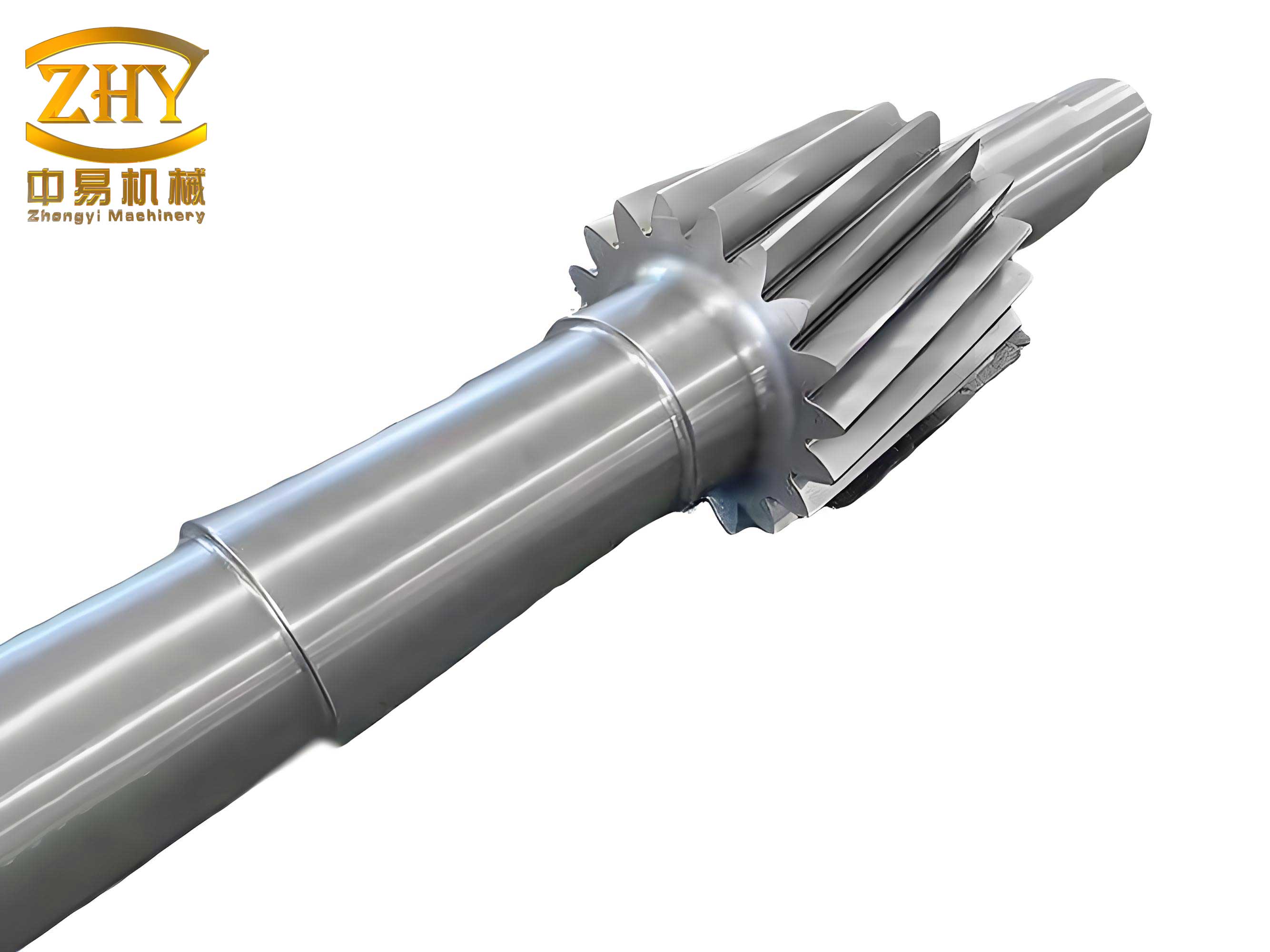
Theoretical Analysis of Gear Shaft Loading
Force Analysis on Helical Gears
The force analysis on a helical gear is foundational for determining the loads acting on the gear shaft. The following parameters are defined for the helical gear model under consideration:
- Module, \( m = 10 \, \text{mm} \)
- Number of teeth, \( z = 20 \)
- Reference diameter radius, \( r = \frac{mz}{2} = 100 \, \text{mm} \)
- Tip diameter radius, \( r_k = r + m = 110 \, \text{mm} \)
- Root diameter radius, \( r_f = r – 1.25m = 87.5 \, \text{mm} \)
- Helix angle at reference cylinder, \( \beta = 10^\circ \)
- Normal pressure angle, \( \alpha_n = 20^\circ \)
- Face width, \( b = 50 \, \text{mm} \)
When a driving torque \( T_1 \) is applied to the driving gear, a normal force \( F_n \) acts in the plane normal to the tooth surface within the plane tangent to the base cylinder, ignoring friction. This force is resolved into three mutually perpendicular components: the tangential force \( F_t \), the radial force \( F_r \), and the axial force \( F_a \). The formulas for calculating these forces and the reference diameter are as follows:
The reference diameter \( d \) is given by:
$$ d = \frac{m z}{\cos \beta} $$
The tangential force, responsible for transmitting torque, is:
$$ F_t = \frac{2 T_1}{d} $$
The axial force, induced by the helix angle, is:
$$ F_a = F_t \tan \beta $$
The radial force, which tends to separate the gears, is:
$$ F_r = \frac{F_t \tan \alpha_n}{\cos \beta} $$
Finally, the resultant normal force can be expressed as:
$$ F_n = \frac{F_t}{\cos \alpha_n \cos \beta} $$
These forces are transmitted directly to the gear shaft at the gear’s location, creating a complex state of combined loading.
Bending-Torsion Combined Strength Analysis of the Gear Shaft
The gear shaft is classified as a transmission shaft, simultaneously subjected to bending moments and torsional loads. Therefore, its design must be verified using the theory of combined bending and torsion. After the preliminary structural design of the gear shaft is complete, the magnitudes, directions, points of application, and types of external loads (torque and moments), as well as the bearing reaction forces, are determined. The shaft can be idealized as a simply supported beam on hinged supports for the purpose of strength calculation. Forces from mounted components are treated as concentrated loads acting at the midpoint of the component’s hub width. Bearing reaction forces are similarly applied at the midpoint of the assumed bearing width. The spatial force system diagram is constructed by decomposing the transmitted torque into the tangential, radial, and axial forces acting at the gear. The analysis proceeds through the following systematic steps:
1. Bearing Reactions:
Let \( L_1 \) and \( L_2 \) be the distances from the gear center to the left and right bearing centers, respectively.
Horizontal reactions (from tangential force \( F_t \)):
$$ F_{NH1} = \frac{F_t L_2}{L_1 + L_2} $$
$$ F_{NH2} = \frac{F_t L_1}{L_1 + L_2} $$
Vertical reactions (from radial force \( F_r \) and axial force \( F_a \) creating a moment):
$$ F_{NV1} = \frac{F_r L_2 + F_a (d/2)}{L_1 + L_2} $$
$$ F_{NV2} = \frac{F_r L_1 – F_a (d/2)}{L_1 + L_2} $$
2. Bending Moments:
Horizontal bending moment at the gear section:
$$ M_H = F_{NH1} \cdot L_1 = F_{NH2} \cdot L_2 $$
Vertical bending moments at the gear section:
$$ M_{V1} = F_{NV1} \cdot L_1 $$
$$ M_{V2} = F_{NV2} \cdot L_2 $$
Resultant bending moment at the gear section (considering both planes):
$$ M_1 = \sqrt{M_H^2 + M_{V1}^2} $$
$$ M_2 = \sqrt{M_H^2 + M_{V2}^2} $$
The larger of \( M_1 \) and \( M_2 \) is typically used for strength assessment.
3. Equivalent Bending Moment (von Mises Criterion for Shafts):
The combined effect of bending and torsion is evaluated using an equivalent moment \( M_e \), based on the maximum shear stress theory or the distortion energy theory, adapted for shaft design with a fatigue factor.
$$ M_e = \sqrt{M^2 + (\alpha T)^2} $$
Here, \( M \) is the resultant bending moment at the critical cross-section, \( T \) is the transmitted torque, and \( \alpha \) is a fatigue stress correction factor based on the nature of the applied torsion relative to the bending stress:
- For completely reversed torsion: \( \alpha = 1 \)
- For pulsating (zero-to-max) torsion: \( \alpha = \frac{[\sigma_{-1b}]}{[\sigma_{0b}]} \approx 0.6 \) for carbon steel
- For steady torsion: \( \alpha = \frac{[\sigma_{-1b}]}{[\sigma_{+1b}]} \approx 0.3 \) for carbon steel
The terms \( [\sigma_{-1b}] \), \( [\sigma_{0b}] \), and \( [\sigma_{+1b}] \) represent the allowable bending stresses for completely reversed, pulsating, and steady states, respectively. Typical values are listed in the table below.
| Material | Tensile Strength \(\sigma_b\) | \([\sigma_{-1b}]\) (Reversed) | \([\sigma_{0b}]\) (Pulsating) | \([\sigma_{+1b}]\) (Steady) |
|---|---|---|---|---|
| Carbon Steel | ||||
| 400 | 400 | 130 | 70 | 40 |
| 500 | 500 | 170 | 75 | 45 |
| 600 | 600 | 200 | 90 | 55 |
| 700 | 700 | 230 | 110 | 65 |
| Alloy Steel | ||||
| 800 | 800 | 270 | 130 | 75 |
| 900 | 900 | 300 | 140 | 80 |
| 1000 | 1000 | 330 | 150 | 90 |
| Cast Steel | ||||
| 400 | 400 | 100 | 50 | 30 |
| 500 | 500 | 200 | 70 | 40 |
4. Strength Condition for the Gear Shaft:
The critical cross-section of the gear shaft must satisfy the following condition:
$$ \sigma_e = \frac{M_e}{W} = \frac{\sqrt{M^2 + (\alpha T)^2}}{W} \leq [\sigma_{-1b}] $$
For a solid, round gear shaft with diameter \( d \), the section modulus \( W \) is:
$$ W = \frac{\pi d^3}{32} \approx 0.1 d^3 $$
Thus, the design/check formula becomes:
$$ \sigma_e = \frac{\sqrt{M^2 + (\alpha T)^2}}{0.1 d^3} \leq [\sigma_{-1b}] $$
This theoretical calculation provides a baseline stress value at a specific point, but it does not reveal the complete stress distribution, especially in regions with geometric discontinuities like fillets and shoulders, which are inherent in a gear shaft design.
Three-Dimensional Modeling of the Gear Shaft Assembly
The accuracy of a finite element analysis is inherently dependent on the fidelity of the model to the physical component’s mechanical behavior. To balance computational efficiency with result accuracy, appropriate simplifications are made to the gear shaft assembly model:
- Geometric Simplifications: Small fillets, chamfers, and keyways are omitted. This is a common practice in initial global stress analysis, as these features would necessitate a very fine mesh to capture stress concentrations accurately, drastically increasing solve time. Their effect can be studied in a subsequent localized submodeling analysis.
- Assembly Strategy: The helical gear and the gear shaft are modeled as separate components within CATIA’s Part Design and Assembly Design workbenches. This approach is crucial for correctly defining interaction conditions (contacts) in the subsequent FEA, allowing for a realistic simulation of force transfer at the gear-shaft interface.
The final three-dimensional assembly model, representing the helical gear press-fitted or keyed onto the gear shaft, is then prepared for export. The model is saved in a format compatible with ANSYS Workbench, typically Parasolid (.x_t) or STEP (.step), and imported into the Workbench environment via the ‘Geometry’ cell, which opens the DesignModeler (DM) application for any final geometry preparation.
Finite Element Analysis Procedure in ANSYS Workbench
Material Property Definition
Material properties are assigned in the ‘Engineering Data’ module of Workbench. For this analysis, a medium-carbon steel is assumed for both the gear and the gear shaft.
| Property | Symbol | Value | Units |
|---|---|---|---|
| Young’s Modulus | \( E \) | 2.1e5 | MPa (2.1e11 Pa) |
| Poisson’s Ratio | \( \nu \) | 0.3 | – |
| Density | \( \rho \) | 7.85e-6 | kg/mm³ |
These isotropic linear elastic properties are sufficient for a static strength analysis under the designated operating load.
Mesh Generation
The meshing process is performed in the ‘Mesh’ module. The assembly nature of the model requires a multi-body meshing strategy.
- Mesh Controls: A global mesh size control is applied. To ensure convergence and accuracy, a relevance center of ‘Fine’ is chosen, and a local sizing control is applied to the gear shaft and the gear teeth with a specified element size of 5 mm.
- Element Types: The helical gear, with its complex geometry, is meshed automatically with tetrahedral (Tet10) elements, which are well-suited for intricate shapes. The gear shaft, being largely revolved and extruded geometry, is swept with hexahedral (Hex8) elements where possible, as they generally provide better accuracy with fewer elements for prismatic regions.
- Mesh Metrics: The final mesh consists of approximately 29,472 elements and 118,219 nodes. The average element quality (based on skewness or orthogonal quality) is reported as 0.72, which is within an acceptable range for a static structural analysis, indicating a reliable mesh for stress calculation.
| Metric | Value |
|---|---|
| Number of Nodes | 118,219 |
| Number of Elements | 29,472 |
| Average Element Quality | 0.72 |
| Element Type (Gear) | Quad/Tri Dominant (Tet10) |
| Element Type (Shaft) | Hexahedral Dominant (Hex8) |
Defining Connections, Boundary Conditions, and Loads
This step is critical for simulating real-world operating conditions for the gear shaft assembly.
1. Contact Definitions:
- Gear Bore to Shaft Shoulder: This interface, where the gear sits against the shaft shoulder, is assumed to be perfectly bonded, simulating a tight interference fit or a fitted key connection that prevents separation and sliding. This is defined as a ‘Bonded’ contact.
- Gear Bore to Shaft Diameter: The cylindrical surface contact between the gear’s inner diameter and the corresponding gear shaft diameter may be defined as ‘Frictionless’ if the bond at the shoulder is considered the primary load path, or with a frictional coefficient for a more detailed analysis. For this study, ‘Frictionless’ is used to simplify the contact nonlinearity.
2. Boundary Conditions (Supports):
- Cylindrical Support: Applied on the journal surfaces of the gear shaft where the bearings are located. This support type allows rotation about the shaft axis (free in tangential direction) but constrains radial and axial movements, accurately simulating common rolling element bearing support conditions.
- Displacement Support: Applied on one end face of the gear shaft (e.g., the end opposite the power input/output). All translational degrees of freedom (X, Y, Z) are set to zero. This condition prevents rigid body motion and, in conjunction with the cylindrical supports, fully constrains the model statically.
3. Applied Loads:
- Standard Earth Gravity: An acceleration of \( 9.8066 \, \text{m/s}^2 \) is applied in the appropriate global direction (e.g., -Z). While often negligible for heavy-duty shafts, it is included for completeness.
- Torque Application: A torque of \( T = 2000 \, \text{N·m} \) is applied to the driven gear tooth. In FEA, torque is not applied directly as a moment vector to a node. Instead, it is applied as a tangential force distributed over several nodes on the gear tooth flank in contact with the mating gear. This is achieved using a ‘Force’ load with components calculated from the torque and the gear’s reference radius \( r \). The tangential component per node is derived from \( F_t = T / r \). For a more realistic distribution, a remote force or moment applied to a remote point connected to the gear face via a rigid beam connection can also be used.
Results, Discussion, and Strength Assessment of the Gear Shaft
After solving the finite element model, the results are processed to evaluate the performance of the gear shaft. The analysis intentionally omits stress concentration factors from sharp re-entrant corners to focus on the global stress field; thus, the FEA results might show elevated stresses at sharp edges which would be alleviated by proper fillets in the final design.
Deformation Analysis:
The total deformation plot reveals the displacement pattern under the combined loads. The maximum deformation is typically observed at the furthest point from the constraints, often at the tip of the loaded gear tooth or the free end of an overhung shaft section. In this assembly analysis, the maximum deformation was found to be approximately \( 0.047 \, \text{mm} \) at the tip of the loaded gear tooth. The deformation of the gear shaft itself was significantly lower, with a maximum in the range of \( 0.021 \, \text{mm} \) to \( 0.026 \, \text{mm} \) at the exposed shaft section near the gear. These values are extremely small relative to typical shaft dimensions and clearances, indicating sufficient stiffness of the gear shaft system.
Stress Analysis and Strength Verification:
The equivalent (von Mises) stress contour plot is the primary tool for strength assessment, as it combines all stress components into a single value comparable to the material’s yield strength via an appropriate safety factor.
- Stress in the Gear: The maximum stress in the helical gear, as expected, is located at the root of the loaded tooth, a classic region for bending fatigue failure. The FEA calculated a peak stress of \( \sigma_{gear-max} \approx 65.95 \, \text{MPa} \). This must be compared against the allowable contact and bending stresses for the gear material, which is a separate analysis (e.g., AGMA standards).
- Stress in the Gear Shaft: The stress distribution in the gear shaft is of paramount interest. The results show two critical regions:
- Bearing Journals: Stress concentrations appear at the edges of the cylindrical support regions, representing reaction forces from the bearings.
- Gear-Shaft Interface: The highest stresses on the gear shaft body are concentrated at the inner corner where the shaft shoulder meets the smaller diameter section that fits into the gear bore. This is a classic stress concentration site for shafts. The maximum stress value in this region was found to be in the range of \( \sigma_{shaft-max} \approx 22.0 \, \text{MPa} \).
Comparative Strength Assessment:
Referring to Table 1 for a typical carbon steel with tensile strength of 500 MPa, the allowable bending stress for completely reversed loading is \( [\sigma_{-1b}] = 170 \, \text{MPa} \). For a more conservative check under pulsating torsion, \( [\sigma_{0b}] = 75 \, \text{MPa} \) could be used.
$$ \sigma_{shaft-max} (22.0 \, \text{MPa}) \ll [\sigma_{0b}] (75 \, \text{MPa}) \ll [\sigma_{-1b}] (170 \, \text{MPa}) $$
The FEA-calculated maximum stress in the gear shaft is significantly lower than even the most conservative allowable stress. This confirms that the gear shaft, under the specified load of 2000 N·m, has a substantial safety margin. The design is thus validated from a static strength perspective. It is important to note that fatigue analysis, considering stress cycles and the actual stress concentration factors of filleted shoulders and keyways, would be the logical next step for a complete assessment.
| Component | Max. Deformation (mm) | Max. von Mises Stress (MPa) | Critical Location | Allowable Stress [σ] (MPa)* | Safety Factor (Approx.) |
|---|---|---|---|---|---|
| Helical Gear | 0.047 | 65.95 | Tooth root | ~200 (Bending Allowable) | ~3.0 |
| Gear Shaft | 0.026 | 22.0 | Shaft shoulder fillet region | 75 (Pulsating, [σ₀b]) | ~3.4 |
| *Allowable stresses are estimated based on medium-carbon steel; exact gear material specs would be used in practice. | |||||
Conclusion and Methodological Advantages
This integrated approach, leveraging the powerful data interfaces of ANSYS Workbench to import detailed CATIA models, provides a superior alternative to traditional manual calculation methods for gear shaft design. The finite element-based static strength analysis offers a comprehensive and visually detailed understanding of the stress and strain distributions throughout the entire gear shaft assembly, which is unattainable through simple bending-torsion formulas. It effectively pinpoints potential high-stress regions, such as shoulders and changes in diameter, that require careful detailing in the final design. This modern simulation-driven process significantly accelerates the development cycle for shaft-line components like the gear shaft, reduces the reliance on physical prototyping, and enhances design confidence. The methodology outlined—from theoretical load derivation to 3D modeling and advanced FEA—serves as a robust and generalizable framework for the design and validation of various gear shaft configurations and other critical rotating machinery components.