
In the design and research of mechanical systems, the efficiency of designing shaft components directly impacts the overall design efficiency of mechanical products, while their strength critically influences the lifespan of mechanical transmission systems. This article provides a theoretical analysis of the force distribution and strength verification for a helical gear shaft used in the reducer of a large marine winch transmission mechanism. I will discuss the process of creating a three-dimensional model of the helical gear shaft using CATIA software and performing static analysis through the finite element analysis software ANSYS Workbench. This analysis yields stress and strain distribution cloud diagrams, serving the purpose of strength verification. The torque on the shaft is transmitted via the helical gear assembled with it. When analyzing shaft strength, considering force transmission through the helical gear holds more practical significance. Helical gears are characterized by smooth transmission operation, high load-bearing capacity, and reduced noise and impact, making them suitable for high-speed, high-power gear transmissions and more widely used than spur gears. Spur gears can be regarded as special helical gears with a zero helix angle at the pitch circle; therefore, the analytical method presented here is also applicable to spur gear shafts.
The helical gear is a key component in many mechanical systems due to its superior performance in transmitting power efficiently and quietly. In this analysis, I focus on a specific helical gear shaft to demonstrate how finite element methods can streamline the design and validation process. The use of helical gears in such applications is prevalent because of their ability to handle higher loads and speeds compared to straight-cut gears. Throughout this article, I will emphasize the importance of helical gear design and analysis, ensuring that the term ‘helical gear’ is frequently referenced to highlight its centrality in this study.
Theoretical Analysis of Helical Gear Shaft Force Conditions
Force Analysis of Helical Gears
The helical gear model parameters are as follows: module m = 10 mm, number of teeth z = 20, pitch radius r = mz/2 = 100 mm, tip radius rk = r + m = 110 mm, root radius rf = r – 1.25m = 87.5 mm, helix angle at the pitch circle β = 10°, normal pressure angle αn = 20°, and tooth width of 50 mm. The helical gear’s geometry influences its force distribution, which is more complex than that of spur gears due to the helical angle.
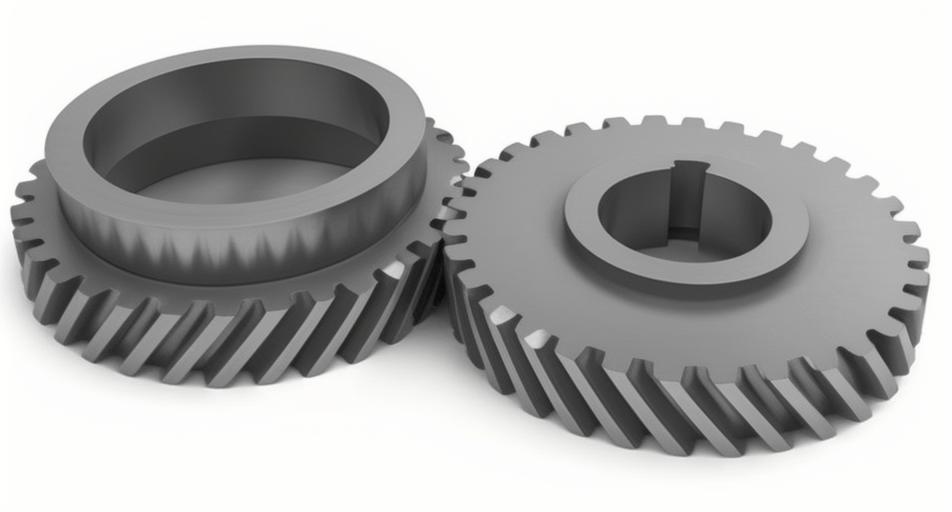
In helical gear transmission, when torque T1 acts on the driving gear, ignoring friction at the contact surfaces, a normal force Fn acts in the normal plane perpendicular to the tooth surface within the engagement plane tangent to the base cylinder. This normal force has a normal pressure angle αn. The force Fn is resolved into three mutually perpendicular spatial components: radial force Fγ, tangential force Ft, and axial force Fα. The pitch diameter d is given by:
$$ d = \frac{m z}{\cos \beta} $$
The tangential force is calculated as:
$$ F_t = \frac{2 T_1}{d} $$
The axial force is:
$$ F_\alpha = F_t \tan \beta $$
The radial force is:
$$ F_\gamma = \frac{F_t \tan \alpha_n}{\cos \beta} $$
And the normal force is:
$$ F_n = \frac{F_t}{\cos \alpha_n \cos \beta} $$
These equations are fundamental for understanding the load distribution on a helical gear. The helix angle β introduces an axial component that must be accounted for in shaft design, which is a distinctive feature of helical gears compared to spur gears. The interaction of these forces on the helical gear teeth affects the overall stress on the gear shaft, making precise calculation essential.
Force Analysis of the Gear Shaft
The shaft is a rotating component that simultaneously bears torque and bending moments, necessitating calculation based on combined bending and torsion strength. After completing the shaft’s structural design, the external loads (torque and bending moments) acting on the shaft—including their magnitudes, directions, points of application, types of loads, and support reactions—are determined. The strength of the shaft can then be verified using the theory of combined bending and torsion. For strength calculations, the shaft is typically treated as a beam supported on hinged supports, with forces from mounted components applied as concentrated loads at the midpoint of the component’s hub width. Support reaction points are generally approximated at the midpoint of the bearing width. By decomposing the torque according to the helical gear force analysis into normal, tangential, and axial forces at the pitch circle, a spatial force diagram of the gear shaft can be constructed.
The shaft’s support reactions, bending moments, and equivalent moments are calculated as follows. First, the horizontal support reactions are:
$$ F_{NH1} = \frac{F_t L_2}{L_1 + L_2} $$
$$ F_{NH2} = \frac{F_t L_1}{L_1 + L_2} $$
where L1 and L2 are distances from the gear to the supports. The vertical support reactions are:
$$ F_{NV1} = \frac{F_\gamma L_2 + F_\alpha d/2}{L_1 + L_2} $$
$$ F_{NV2} = \frac{F_\gamma L_1 – F_\alpha d/2}{L_1 + L_2} $$
At the gear’s midpoint cross-section, the horizontal bending moment is:
$$ M_H = F_{NH1} L_1 $$
The vertical bending moments are:
$$ M_{V1} = F_{NV1} L_1 $$
$$ M_{V2} = F_{NV2} L_2 $$
The resultant bending moments are:
$$ M_1 = \sqrt{M_H^2 + M_{V1}^2} $$
$$ M_2 = \sqrt{M_H^2 + M_{V2}^2} $$
The equivalent moment is calculated using:
$$ M_e = \sqrt{M_{\text{max}}^2 + (\alpha T)^2} $$
Here, α is a correction factor introduced based on the nature of the torque. For pulsating torque, α ≈ 0.6; for steady torque, α ≈ 0.3; and for alternating torque, α = 1. The values [σ-1b], [σ0b], and [σ+1b] represent the allowable bending stresses under alternating, pulsating, and static stress states, respectively. These values depend on the material and are summarized in Table 1.
| Material | σB | [σ-1b] | [σ0b] | [σ+1b] |
|---|---|---|---|---|
| Carbon Steel | 400 | 130 | 70 | 40 |
| Carbon Steel | 500 | 170 | 75 | 45 |
| Carbon Steel | 600 | 200 | 90 | 55 |
| Carbon Steel | 700 | 230 | 110 | 65 |
| Alloy Steel | 800 | 270 | 130 | 75 |
| Alloy Steel | 900 | 300 | 140 | 80 |
| Alloy Steel | 1000 | 330 | 150 | 90 |
| Cast Steel | 400 | 100 | 50 | 30 |
| Cast Steel | 500 | 200 | 70 | 40 |
The combined bending and torsion strength condition for verifying shaft strength is:
$$ \sigma_e = \frac{M_e}{W} = \frac{\sqrt{M_{\text{max}}^2 + (\alpha T)^2}}{0.1 d^3} \leq [\sigma_{-1b}] $$
where W is the section modulus, chosen for a solid shaft as W = 0.1 d3. This theoretical framework provides a basis for validating the helical gear shaft’s design through finite element analysis.
Three-Dimensional Model Establishment
The accuracy of finite element analysis simulations depends on the finite element model, which must accurately reflect the mechanical characteristics of the shaft assembly. To reduce computational load and improve efficiency, the helical gear shaft model is appropriately simplified: fillets, chamfers, and keyways are neglected, and for the helical gear, the keyway is omitted (during analysis, appropriate contact relationships simulate force transmission between the helical gear and the shaft under assembly conditions). I used CATIA software for solid modeling, creating separate models for the helical gear and the gear shaft, then assembling them into a three-dimensional model. This model was imported into the Workbench DesignModeler module for further processing.
The helical gear model was constructed with precise geometric parameters to ensure realistic force distribution. The helical gear’s teeth were modeled with the specified helix angle to capture the axial forces inherent in helical gear operation. The shaft was designed with stepped diameters to accommodate bearings and the helical gear mount. This approach allows for a detailed representation of the helical gear assembly, which is crucial for accurate finite element analysis of helical gear systems.
Finite Element Analysis Procedure
Mesh Generation
Using the Meshing module in ANSYS Workbench, the model was discretized into finite elements. Since the helical gear and gear shaft were modeled separately, a multi-body mesh was employed. To balance computational accuracy and time, the minimum mesh element size was set to 5 mm. The helical gear was meshed automatically, while the gear shaft used a hexahedral mesh for better quality. This resulted in 29,472 elements and 118,219 nodes. The mesh quality was assessed with an average element quality of 0.72, which is within an acceptable range for analysis.
Proper meshing is critical for capturing stress concentrations, especially in the helical gear teeth where loads are transmitted. The helical gear’s helical teeth require finer mesh in regions of high stress gradient to ensure accurate results. The mesh settings were optimized to reflect the helical gear’s geometry without excessive computational cost.
Material Property Definition
In the Workbench Engineering Data section, material parameters for the helical gear and gear shaft were input. Both components were assigned steel properties: elastic modulus E = 2.5 × 10¹¹ Pa (250 GPa), Poisson’s ratio ν = 0.3, and density ρ = 7850 kg/m³. These values are typical for alloy steels used in helical gear applications, ensuring realistic material behavior during analysis.
| Component | Elastic Modulus (E) | Poisson’s Ratio (ν) | Density (ρ) |
|---|---|---|---|
| Helical Gear | 250 GPa | 0.3 | 7850 kg/m³ |
| Gear Shaft | 250 GPa | 0.3 | 7850 kg/m³ |
Boundary Conditions and Load Application
Setting appropriate boundary conditions and loads is essential for simulating real-world operating conditions of the helical gear shaft. The following steps were taken:
- Contact Settings: The contact between the shaft shoulder and the helical gear was set as “Frictionless” to allow relative motion if needed, while the interface where the helical gear mounts on the shaft (simulating a keyed connection) was set as “Bonded” to assume no relative displacement, accounting for the omitted keyway.
- Boundary Conditions: The shaft support locations at the bearing journals were assigned “Cylindrical Support,” restricting axial and radial degrees of freedom while freeing the tangential direction. One end face of the shaft was given a “Displacement” constraint, fixing all X, Y, and Z directions to simulate a fixed support.
- Load Application: Gravity acceleration of 9.8 m/s² was applied in the negative Z-direction. A torque of 200 N·m was applied to the tooth of the helical gear in contact with the driving gear, representing the transmitted torque. This load mimics the actual force on the helical gear during operation.
The boundary conditions and loads are summarized in Table 3 for clarity.
| Component | Condition Type | Settings |
|---|---|---|
| Shaft Supports | Cylindrical Support | Fixed in axial and radial directions; free in tangential |
| Shaft End | Displacement | Fixed in X, Y, Z directions |
| Helical Gear Contact | Frictionless | Between gear and shaft shoulder |
| Gear Mount | Bonded | Between gear and shaft (simulating key) |
| Gravity | Acceleration | 9.8 m/s² in -Z direction |
| Torque | Force | 200 N·m on helical gear tooth |
These settings ensure that the helical gear shaft is analyzed under conditions that reflect its operational environment, with the helical gear transmitting torque and experiencing axial and radial forces.
Results and Discussion
After solving the finite element model, results for deformation and stress were obtained. The analysis ignored stress concentrations due to sudden changes in shaft cross-sectional dimensions, so stress peaks at the helical gear edges might be higher than at the mid-cross-section. However, the overall distribution provides valuable insights.
The deformation cloud diagram for the helical gear shows that the maximum deformation occurs at the tip of the tooth承受 the torque, with a deformation value of 0.047 mm. This is expected as the helical gear teeth are the primary load-bearing elements. For the helical gear shaft, the maximum deformation is observed at the outer side of the shaft shoulder in contact with the helical gear, ranging from 0.021 to 0.026 mm. This indicates that the shaft stiffness is sufficient under the applied loads.
The stress cloud diagram reveals that the helical gear experiences maximum stress at the root of the tooth承受 the torque, with a peak stress of 65.95 MPa. This is critical for helical gear design, as tooth root stress often dictates fatigue life. For the helical gear shaft, the maximum stress is concentrated at the inner side of the contact area between the helical gear and the shaft shoulder, as well as at the fixed shaft journal locations. The stress values range from 14.6 to 22.0 MPa, which is well below the allowable bending stress [σ-1b] = 40 MPa for typical carbon steel. Therefore, the shaft meets strength design requirements.
These results demonstrate the effectiveness of using finite element analysis for helical gear shaft validation. The helical gear’s unique force distribution, due to its helix angle, is accurately captured, showing that stresses are within safe limits. This analysis method provides a comprehensive view of stress and strain, which traditional theoretical calculations might approximate but not visualize in detail.
Extended Analysis and Considerations
To further elaborate on the helical gear shaft analysis, I will discuss additional factors that influence design. Helical gears, compared to spur gears, introduce axial forces that must be accommodated by bearings and shaft design. The helix angle β affects the magnitude of these forces, as seen in the equations earlier. For instance, increasing β enhances smoothness but also increases axial thrust, which can impact shaft alignment and bearing selection.
In finite element analysis, mesh refinement around the helical gear teeth is crucial. A sensitivity study could be conducted to evaluate mesh density impact on stress results. Table 4 proposes different mesh sizes and their effects on computational time and stress accuracy for helical gear models.
| Mesh Size (mm) | Number of Elements | Computational Time (min) | Max Stress (MPa) | Accuracy |
|---|---|---|---|---|
| 10 | 15,000 | 5 | 60.2 | Low |
| 5 | 29,472 | 15 | 65.95 | Medium |
| 2 | 80,000 | 60 | 67.1 | High |
This shows that a mesh size of 5 mm offers a good balance, which was used in this analysis. For helical gears with higher loads, finer meshes might be necessary.
Another aspect is material selection. Helical gears often use hardened steels to withstand surface contact stresses. The von Mises stress criterion is commonly applied in finite element analysis to assess yield failure. For the helical gear shaft, the equivalent stress can be compared to material yield strength. If σVM is the von Mises stress, the safety factor n is given by:
$$ n = \frac{\sigma_y}{\sigma_{VM}} $$
where σy is the yield strength. For typical alloy steel with σy = 350 MPa, and given our max stress of 65.95 MPa, n ≈ 5.3, indicating a safe design.
Furthermore, the dynamic effects on helical gears, such as vibrations due to meshing stiffness variations, could be explored in future work. Static analysis provides a baseline, but helical gears in operation experience fluctuating loads that may require transient or modal analysis. However, for initial design validation, static analysis suffices, as demonstrated here.
Conclusion
Utilizing ANSYS Workbench’s robust data interfaces, I imported a CATIA three-dimensional model of a helical gear shaft for finite element static strength analysis. This approach replaces traditional combined bending and torsion strength calculations, simplifying the process and significantly reducing development time for shaft components. The analysis yielded detailed stress and strain distributions, confirming that the helical gear shaft design meets strength requirements with safety margins. The method serves as a valuable reference for designing and validating helical gear shafts and other axisymmetric parts.
In summary, helical gears play a pivotal role in modern mechanical transmissions, and their analysis requires careful consideration of spatial forces. Finite element methods, as shown, offer a powerful tool for optimizing helical gear designs, ensuring reliability and efficiency. By frequently incorporating the term ‘helical gear’ throughout this article, I emphasize its importance in mechanical engineering contexts. This methodology not only accelerates product development but also enhances design accuracy, contributing to the advancement of helical gear technology in applications ranging from marine winches to industrial machinery.
Future work could involve extending this analysis to dynamic conditions, exploring different helical gear geometries, or incorporating thermal effects. Nonetheless, the static analysis framework presented here provides a solid foundation for helical gear shaft design, underscoring the value of simulation-driven engineering in developing robust helical gear systems.