
In modern industrial applications, gear grinding plays a critical role in achieving high precision and performance in power transmission systems. Gear grinding, particularly worm wheel gear grinding, is essential for finishing hard-to-machine materials and ensuring dimensional accuracy. However, challenges such as grinding cracks and profile deviations often arise during gear profile grinding, necessitating advanced methods for topological modification and precision control. This article presents a comprehensive approach to flexible topological modification in gear grinding, focusing on mathematical modeling, kinematic analysis, and electronic gearbox integration to enhance accuracy and mitigate issues like grinding cracks.
The standard involute tooth flank serves as the foundation for gear design. In a planar coordinate system, the involute profile can be parameterized based on the base circle radius and pressure angle. For a left tooth flank, the parametric equations in the transverse section are derived as follows. Let $r_b$ be the base radius, $\phi$ the roll angle, $\theta_M$ the unwinding angle, $\alpha_M$ the pressure angle at point M, and $\delta$ the start angle of the involute. The coordinates of any point M on the involute are given by:
$$ x_0 = r_b [\cos(\delta + \phi) + \phi \sin(\delta + \phi)] $$
$$ y_0 = r_b [\sin(\delta + \phi) – \phi \cos(\delta + \phi)] $$
$$ z_0 = 0 $$
To generate the helical gear tooth surface, this profile is rotated around the gear axis with a helical motion. The transformation matrix $\mathbf{M}$ for rotation by angle $\varphi$ and helical parameter $p = r_b / \tan \beta_b$ (where $\beta_b$ is the base helix angle) is applied:
$$ \mathbf{M} = \begin{bmatrix}
\cos \varphi & -\sin \varphi & 0 & 0 \\
\sin \varphi & \cos \varphi & 0 & 0 \\
0 & 0 & 1 & p \varphi \\
0 & 0 & 0 & 1
\end{bmatrix} $$
The standard involute tooth surface equation becomes:
$$ x = r_b [\cos(\delta + \phi + \varphi) + \phi \sin(\delta + \phi + \varphi)] $$
$$ y = r_b [\sin(\delta + \phi + \varphi) – \phi \cos(\delta + \phi + \varphi)] $$
$$ z = p \varphi $$
Topological modification involves altering the tooth flank in both profile and longitudinal directions to improve load distribution and reduce stress concentrations, which can prevent grinding cracks. For double parabolic crowning, the profile modification $\Delta y_p$ and longitudinal modification $\Delta y_g$ are defined as:
$$ \Delta y_p = h \left( \frac{4y^2}{\left( \frac{1}{2} \tan \alpha_a – \frac{1}{2} \tan \alpha_f \right)^2} – 1 \right) \left( \frac{1}{2} \tan \alpha_a – \frac{1}{2} \tan \alpha_f \right)^2 – r_b \left( \frac{1}{2} \tan \alpha_a – \frac{1}{2} \tan \alpha_f \right) $$
and
$$ \Delta y_g = g \left( \frac{4 \varphi^2}{b^2} – 1 \right) $$
where $h$ and $g$ are the maximum crowning amounts in profile and longitudinal directions, $\alpha_a$ and $\alpha_f$ are the tip and root pressure angles, and $b$ is the face width. The modified tooth surface equations incorporate these adjustments:
$$ x = r_b \left[ \cos(\delta + \phi + \varphi – \Delta \varphi) + \phi \sin(\delta + \phi + \varphi – \Delta \varphi) \right] + \Delta y_g \sin(\delta + \phi + \varphi – \Delta \varphi) $$
$$ y = r_b \left[ \sin(\delta + \phi + \varphi – \Delta \varphi) – \phi \cos(\delta + \phi + \varphi – \Delta \varphi) \right] – \Delta y_g \cos(\delta + \phi + \varphi – \Delta \varphi) $$
$$ z = p \varphi $$
with $\Delta \varphi = y_l / r_b$. The normal vector $\mathbf{n}_g$ to the modified surface is computed as the cross product of partial derivatives with respect to $\phi$ and $\varphi$.
To quantify deviations, the tooth flank is discretized into a grid, typically with 9 points along the profile and 5 points along the lead, totaling 45 measurement points. The deviation $\epsilon_{ij}$ at each point is calculated as the dot product of the difference between the modified and standard position vectors with the standard normal vector:
$$ \epsilon_{ij} = (\mathbf{r}_g’ – \mathbf{r}_g) \cdot \mathbf{n}_g $$
where $\mathbf{r}_g$ and $\mathbf{r}_g’$ are the position vectors of the standard and modified surfaces, respectively.
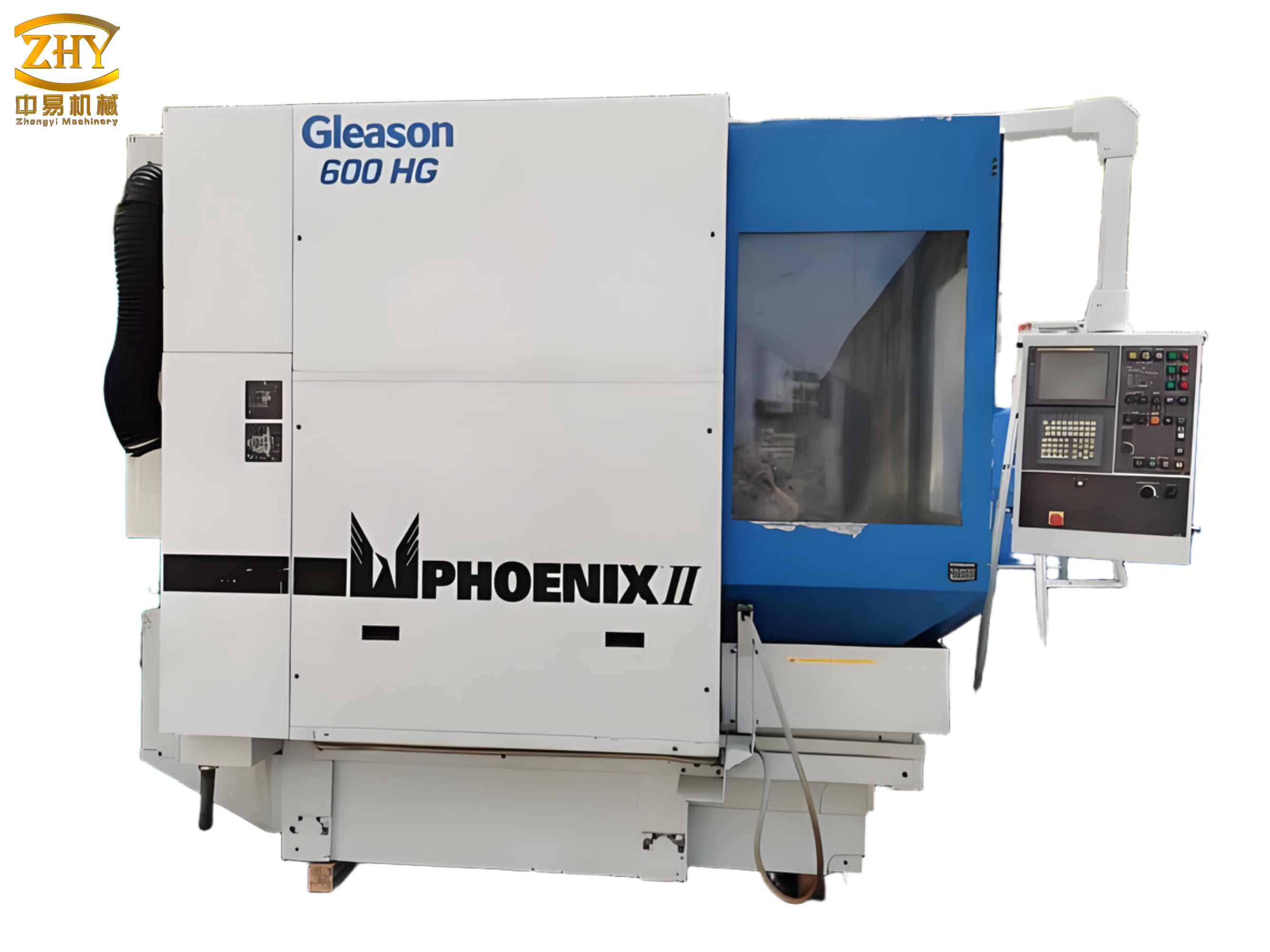
The worm wheel gear grinding process involves multiple axes of motion. The machine typically includes linear axes (X1, Y1, Z1 for radial, tangential, and axial feed) and rotational axes (B1 for wheel rotation, C1 for workpiece rotation). The electronic gearbox (EGB) synchronizes these motions during generating gear grinding. The kinematic relationship between axes is expressed as:
$$ \varphi_{C1} = K_B \frac{Z_w}{Z_g} \varphi_{B1} + K_Z \frac{360 \sin \gamma_w}{\pi m_n Z_g} F_{Z1} + K_Y \frac{360 \cos \gamma_w}{\pi m_n Z_g} F_{Y1} $$
where $Z_g$ and $Z_w$ are the gear and wheel tooth numbers, $m_n$ is the normal module, $\gamma_w$ is the wheel lead angle, and $K_B$, $K_Y$, $K_Z$ are motion coefficients. The coordinate transformation from the wheel to the gear coordinate system is given by the matrix $\mathbf{M}_{gw}$, which combines rotations and translations.
The mathematical model for gear grinding involves solving the engagement condition between the worm wheel and gear. The position vector $\mathbf{r}_g$ and normal vector $\mathbf{n}_g$ in the gear coordinate system are derived from the wheel coordinates via transformation:
$$ \mathbf{r}_g(\phi, \tau, \varphi_{B1}, F_{Y1}, F_{Z1}) = \mathbf{M}_{gw} \cdot \mathbf{r}_w(\zeta, \tau) $$
$$ \mathbf{n}_g(\phi, \tau, \varphi_{B1}, F_{Y1}, F_{Z1}) = \mathbf{L}_{gw} \cdot \mathbf{n}_w(\zeta, \tau) $$
where $\mathbf{L}_{gw}$ is the linear part of $\mathbf{M}_{gw}$. The meshing equations ensure continuous contact:
$$ f_1 = \frac{\partial \mathbf{r}_g}{\partial \varphi_{B1}} \cdot \mathbf{n}_g = 0 $$
$$ f_2 = \frac{\partial \mathbf{r}_g}{\partial F_{Y1}} \cdot \mathbf{n}_g = 0 $$
$$ f_3 = \frac{\partial \mathbf{r}_g}{\partial F_{Z1}} \cdot \mathbf{n}_g = 0 $$
Solving these equations yields the parameters $\zeta$ and $\tau$, which define the grinding points.
To achieve topological modification, additional motions are applied to the machine axes. The inverse kinematics solution determines the required adjustments. Let $\mathbf{P}_g$ and $\mathbf{P}_w$ be the parameter matrices for the gear and wheel surfaces:
$$ \mathbf{P}_g = \begin{bmatrix} \mathbf{n}_g & \mathbf{r}_g \\ 0 & 1 \end{bmatrix}, \quad \mathbf{P}_w = \begin{bmatrix} \mathbf{n}_w & \mathbf{r}_w \\ 0 & 1 \end{bmatrix} $$
The transformation equation is:
$$ \mathbf{P}_g = \mathbf{M}_{gw}^{-1} \cdot \mathbf{P}_w $$
Expanding this, the following system of equations is obtained for the axis motions:
$$ x = i \cos \varphi_{B1} \cos \varphi_{C1} – j \cos \varphi_{B1} \sin \varphi_{C1} \sin \Sigma_{gw} + k \cos \varphi_{B1} \sin \varphi_{C1} \cos \Sigma_{gw} – F_{X1} \sin \varphi_{B1} – F_{Z1} \cos \varphi_{B1} \sin \Sigma_{gw} $$
$$ y = i \sin \varphi_{C1} + j \cos \varphi_{C1} \sin \Sigma_{gw} – k \cos \varphi_{C1} \cos \Sigma_{gw} + F_{Z1} \cos \Sigma_{gw} $$
$$ z = i \cos \varphi_{B1} \sin \varphi_{C1} + j \cos \varphi_{B1} \cos \varphi_{C1} \sin \Sigma_{gw} – k \cos \varphi_{B1} \cos \varphi_{C1} \cos \Sigma_{gw} + F_{X1} \cos \varphi_{B1} – F_{Z1} \sin \varphi_{B1} \sin \Sigma_{gw} $$
Similar equations hold for the normal vectors. This system is overdetermined, so numerical methods like least squares are used to find the axis motions $l_{Xi}$, $l_{Yi}$, $l_{Zi}$ for the modified surface and $l_{Xe}$, $l_{Ye}$, $l_{Ze}$ for the standard surface. The additional motions are:
$$ \Delta l_X = l_{Xi} – l_{Xe} $$
$$ \Delta l_Y = l_{Yi} – l_{Ye} $$
$$ \Delta l_Z = l_{Zi} – l_{Ze} $$
These increments are integrated into the electronic gearbox control model. The EGB synchronizes the axes by adding the additional motions to the position control loops. The flexible EGB structure allows real-time adjustment of grinding paths, enhancing precision in gear profile grinding and reducing the risk of grinding cracks.
To validate the method, numerical simulations were conducted for a helical gear with parameters as shown in Table 1. The gear grinding process was simulated for both traditional and flexible EGB-based modification methods.
| Parameter | Worm Wheel | Gear |
|---|---|---|
| Number of Threads/Teeth | 3 | 35 |
| Module (mm) | 4 | 4 |
| Lead Angle (°) | 2.559 | – |
| Pressure Angle (°) | – | 20 |
| Outer Diameter (mm) | 279 | – |
| Helix Angle (°) | – | 30 |
| Face Width (mm) | – | 30 |
In the first simulation, a longitudinal crowning of 11.5 μm was applied. The additional motions for the X, Y, and Z axes are summarized in Table 2. The deviations of the ideal, traditional, and EGB-based modified surfaces are compared in Table 3.
| Axis | Profile Point 1 | Profile Point 2 | Profile Point 3 | Profile Point 4 | Profile Point 5 | Profile Point 6 | Profile Point 7 | Profile Point 8 | Profile Point 9 |
|---|---|---|---|---|---|---|---|---|---|
| X | -0.21 | 6.68 | 5.21 | -0.74 | 35.03 | -2.95 | 0.42 | 25.46 | -50.38 |
| Y | 0 | 8.48 | 0 | 0 | 0 | 1.54 | 0 | 9.03 | 0 |
| Z | 1.37 | -18.45 | -5.29 | 8.63 | -2.66 | -21.67 | 0.54 | -1.49 | -3.98 |
| Method | Lead Point 1 | Lead Point 2 | Lead Point 3 | Lead Point 4 | Lead Point 5 | Lead Point 6 | Lead Point 7 | Lead Point 8 | Lead Point 9 |
|---|---|---|---|---|---|---|---|---|---|
| Ideal | 22.4 | 17.3 | 13.7 | 11.7 | 11.2 | 12.3 | 14.9 | 19.1 | 24.8 |
| Traditional | 25.6 | 22.5 | 15.8 | 15.0 | 13.6 | 13.7 | 17.0 | 22.0 | 26.5 |
| EGB-Based | 16.8 | 10.8 | 5.6 | 2.1 | 0.4 | 0.1 | 1.5 | 4.2 | 8.9 |
The root mean square (RMS) and maximum deviations for the EGB-based method were reduced by 45.7% and 53.7% for the right flank, and 40.3% and 52.6% for the left flank, compared to traditional grinding.
In the second simulation, combined profile and longitudinal crowning (7.5 μm and 11.5 μm) was applied. The additional motions are listed in Table 4, and deviations in Table 5.
| Axis | Profile Point 1 | Profile Point 2 | Profile Point 3 | Profile Point 4 | Profile Point 5 | Profile Point 6 | Profile Point 7 | Profile Point 8 | Profile Point 9 |
|---|---|---|---|---|---|---|---|---|---|
| X | 3.22 | 0.26 | 5.21 | -1.26 | 2.56 | -18.95 | 7.11 | 23.33 | -43.56 |
| Y | -25.81 | 0 | 4.34 | -0.02 | 0 | 6.54 | -2.51 | -8.98 | 2.41 |
| Z | -42.42 | 13.45 | 0.54 | -0.23 | -7.18 | -62.35 | 7.14 | -2.65 | -2.02 |
| Method | Lead Point 1 | Lead Point 2 | Lead Point 3 | Lead Point 4 | Lead Point 5 | Lead Point 6 | Lead Point 7 | Lead Point 8 | Lead Point 9 |
|---|---|---|---|---|---|---|---|---|---|
| Ideal | 28.9 | 15.4 | 8.3 | 4.4 | 3.6 | 5.4 | 10.3 | 18.4 | 31.8 |
| Traditional | 38.6 | 26.2 | 15.8 | 8.2 | 4.2 | 12.5 | 22.5 | 30.3 | 37.8 |
| EGB-Based | 33.2 | 23.5 | 17.3 | 6.3 | 4.8 | 5.2 | 12.8 | 18.4 | 27.3 |
The EGB-based method reduced RMS and maximum deviations by 48.9% and 56.1% for the right flank, and 45.3% and 57.6% for the left flank. This demonstrates significant improvement in gear profile grinding accuracy and reduction in potential grinding cracks.
In conclusion, the flexible topological modification method based on electronic gearbox control effectively enhances precision in worm wheel gear grinding. By deriving additional motions through inverse kinematics and integrating them into the EGB, tooth flank deviations are minimized, and issues like grinding cracks are mitigated. The numerical simulations confirm the superiority of this approach over traditional methods, making it a valuable advancement in gear manufacturing technology. Future work could focus on real-time adaptive control and optimization for complex gear geometries.