
The generation of non-circular gears via gear hobbing stands as a pivotal method for the efficient and precise manufacturing of straight or helical non-circular gears with convex pitch curves. The inherent non-circularity of the pitch curve introduces significant fluctuations in the cutting force during the gear hobbing process. These fluctuations critically impact the stability of the manufacturing process and the final machining accuracy, establishing the analysis and control of cutting force as a paramount research topic in the field of non-circular gear production. This study delves into the characteristics of cutting force fluctuation during the gear hobbing of non-circular gears, proposes a method for its suppression, and investigates the influence of process parameters.
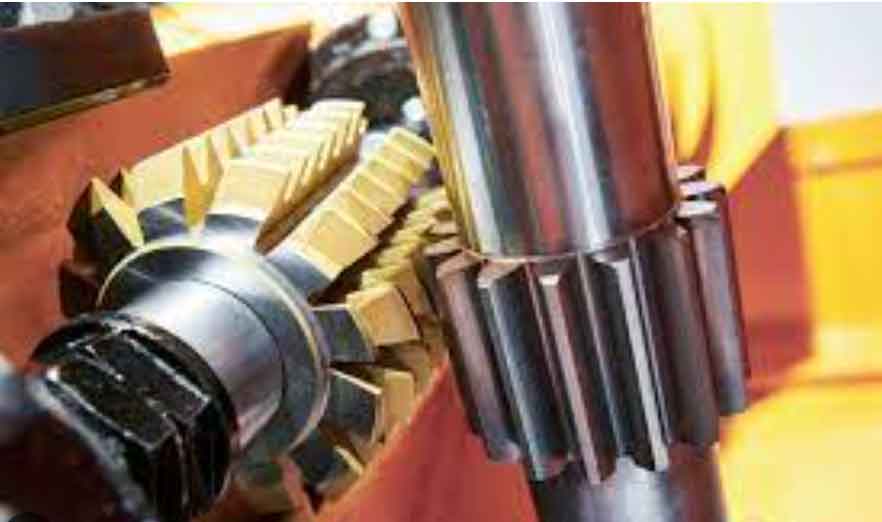
Gear hobbing is an efficient generating process ideal for non-circular gears, relying on multi-axis synchronous motion governed by variable transmission ratios to machine pitch curves of various shapes. The fundamental kinematic model for gear hobbing a non-circular gear, considering the equivalent rack generation principle and ignoring axial shift of the hob, can be described by the following relationships governing the rotational speed of the gear blank (C-axis), \(\omega_C\), and the translational velocity of the hob in the radial direction (X-axis), \(v_X\):
$$ \omega_C = \frac{\sqrt{r^2 + (dr/d\phi)^2}}{r} \left( \frac{K_C \omega_B T m_n}{2\cos\beta} + K_Z v_Z \tan\beta \right) $$
$$ v_X = \frac{dr/d\phi}{r} \left( \frac{\omega_B T m_n}{2\cos\beta} + K_Z v_Z \tan\beta \right) $$
where \(r\) and \(\phi\) are the polar radius and angle of the pitch curve, \(\omega_B\) is the hob rotational speed, \(T\) is the number of hob starts, \(m_n\) is the normal module, \(\beta\) is the helix angle, \(v_Z\) is the axial feed rate, and \(K_C\), \(K_Z\) are sign coefficients depending on the hand of helix and machining direction. This basic model, while functional, does not account for the varying contact conditions along the non-circular pitch curve during gear hobbing.
The analysis of cutting forces in gear hobbing is complex due to its intermittent cutting nature. A well-established approach for cylindrical gear hobbing force prediction is the unit cutting force method, often based on the Kienzle-Victor formula which relates the specific cutting force \(K_s\) to the uncut chip thickness \(h\):
$$ K_s = \frac{K_c}{h^{u}} $$
where \(K_c\) and \(u\) are material-dependent constants. The cutting force \(F_c\) for a given cutting edge engagement is then \(F_c = A \cdot K_s\), where \(A\) is the uncut chip cross-sectional area. This establishes a direct, positive correlation between the volume of material removed in a single cut and the instantaneous cutting force. Therefore, analyzing the fluctuation of the undeformed chip volume provides crucial insight into the fluctuation of cutting forces during gear hobbing.
To obtain the undeformed chip geometry for a non-circular gear during gear hobbing, a solid modeling-based simulation method is employed. The swept volume of a single hob tooth row is generated based on its motion trajectory derived from the hobbing kinematic model. Through Boolean subtraction operations between this swept volume and the gear blank model at discrete rotational increments of the hob, the solid model of the chip generated in each intermittent cut is extracted. The volume of this chip serves as the primary indicator for predicting cutting force magnitude in that specific cut.
Cutting Force Fluctuation Under the Basic Hobbing Model
An oval gear with a high eccentricity is selected as a case study to analyze the force fluctuation characteristics inherent in the gear hobbing process under the basic kinematic model. Key parameters for the gear and hob are summarized below:
| Category | Parameter | Value |
|---|---|---|
| Non-Circular Gear | Number of Teeth | 30 |
| Normal Module, \(m_n\) | 4 mm | |
| Helix Angle, \(\beta\) | 15° (Right Hand) | |
| Pitch Curve Type | 2nd Order Ellipse | |
| Eccentricity | 0.3 | |
| Hob Axial Feed, \(v_Z\) | 2 mm/rev | |
| Hob | Number of Starts, \(T\) | 1 |
| Outside Diameter | 100 mm | |
| Number of Gashes | 8 | |
| Helix Angle | Right Hand |
Simulating a full-depth gear hobbing cycle using the basic model reveals a dramatic fluctuation in the undeformed chip volume, as shown in the analysis results. The volume varies significantly along the pitch curve. Critically, the maximum chip volume—and consequently the peak cutting force during the gear hobbing operation—is observed near the positions of maximum pitch curve radius (the minor axis of the oval). This location corresponds to the region of minimum curvature. The ratio between the maximum and minimum chip volume can exceed 19:1 under this model, indicating severe and potentially destabilizing cutting force variation. This theoretical finding aligns with practical observations in gear hobbing of oval gears for flow meters, where noticeable machine vibration and chatter often occur when the hob engages the minor axis region.
Suppression of Force Fluctuation via Constant Arc Length Increment Hobbing
To mitigate the severe force fluctuations associated with the basic gear hobbing model, a modified kinematic strategy is proposed. Inspired by constant surface speed machining for camshafts, the objective is to achieve a constant arc length of pitch curve engagement per unit time. This requires the active involvement of the hob axial shift (Y-axis) to maintain a constant relative position between the hob’s reference line and the pitch curve’s point of tangency.
In this enhanced gear hobbing model, the hob’s radial (X) and rotational (C) motions are compensated by a timed axial shift (Y) of the hob. The necessary compensatory velocity for the Y-axis, \(v_Y\), is derived from the rate of change of the perpendicular distance from the pitch curve tangent point to the hob axis line. The complete set of kinematic equations for this constant arc length increment gear hobbing model becomes:
$$ \omega_C = \frac{\sqrt{r^2 + (dr/d\phi)^2}}{r} \left( \frac{K_C \omega_B T m_n}{2\cos\beta} + K_Z v_Z \tan\beta + v_Y \frac{\cos\lambda}{\cos\beta} \right) $$
$$ v_X = \frac{dr/d\phi}{r} \left( \frac{\omega_B T m_n}{2\cos\beta} + K_Z v_Z \tan\beta + v_Y \frac{\cos\lambda}{\cos\beta} \right) $$
$$ v_Y = \frac{ \frac{(dr/d\phi)^2}{\sqrt{r^2+(dr/d\phi)^2}} + \frac{r\frac{d^2r}{d\phi^2}\sqrt{r^2+(dr/d\phi)^2} – \frac{dr}{d\phi}\left( r\frac{dr}{d\phi}+\frac{dr}{d\phi}\frac{d^2r}{d\phi^2} \right) }{ \left( r^2+(dr/d\phi)^2 \right)^{2} } }{ \frac{\cos\lambda}{\cos\beta} } $$
where \(\lambda\) is the hob setting angle. Implementing this model for the same oval gear gear hobbing simulation yields a transformed chip volume profile. The fluctuation is substantially reduced, with the maximum-to-minimum volume ratio dropping from over 19:1 to approximately 6:1. Furthermore, the peak chip volume no longer occurs at the point of maximum radius (minimum curvature). Instead, it shifts to a point on the engaging flank of the tooth, leading to a smoother transition of cutting forces. This strategy effectively eliminates the sudden, severe force spike observed in the basic model, thereby enhancing the stability of the entire gear hobbing process. Experimental trials on a dedicated CNC gear hobbing platform confirm that using this model eliminates the pronounced vibration and chatter when cutting the minor axis region, as the local cutting time per tooth space is effectively increased, reducing the instantaneous chip load.
| Hobbing Model Feature | Basic Model (No Hob Shift) | Constant Arc Length Model (With Hob Shift) |
|---|---|---|
| Core Principle | Fixed hob axial position relative to gear center. | Hob shifts axially (Y-axis) to maintain constant engagement arc length. |
| Force Fluctuation | Severe. Directly correlated with pitch radius. | Significantly Suppressed. Smoother transition. |
| Max Chip Volume Location | At pitch curve point of maximum radius (min curvature). | Shifts to a point on the engaging flank, not at max radius. |
| Max:Min Volume Ratio (Example) | > 19 : 1 | ≈ 6 : 1 |
| Process Stability | Poor, risk of chatter/vibration at high-radius regions. | Greatly Improved, enabling stable gear hobbing of eccentric profiles. |
Influence of Hobbing Depth on Force Fluctuation
Beyond the kinematic model, the chosen gear hobbing strategy significantly influences cutting forces. For non-circular gears, radial infeed is typically employed, where the hob is plunged to a certain depth, a full revolution is completed, and then the hob is plunged further for the next cut. The depth of cut in each pass is a critical controllable parameter. Simulations were conducted for the oval gear using the basic hobbing model at different radial infeed depths: 25%, 50%, 75%, and 100% of the full tooth depth. The results clearly show that while the pattern of fluctuation (the relative peaks and valleys along the pitch curve) remains consistent, the absolute magnitude of the chip volume scales almost linearly with the depth of cut. Therefore, employing a multi-pass gear hobbing strategy with a reduced depth of cut per pass is an effective practical method to control the absolute magnitude of peak cutting forces, ensuring that the cutting conditions remain within a stable and manageable range throughout the machining of the non-circular profile.
In conclusion, the gear hobbing of non-circular gears is inherently prone to significant cutting force fluctuations due to the varying geometry of the pitch curve. The volume of the undeformed chip in a single intermittent cut serves as a reliable proxy for predicting instantaneous cutting force. The conventional basic hobbing model leads to severe force peaks at regions of maximum pitch radius. Adopting a constant arc length increment gear hobbing model, facilitated by active hob axial shift, effectively redistributes and suppresses these force fluctuations, markedly improving process stability. Furthermore, employing a multi-pass radial infeed strategy with a controlled depth of cut per pass is crucial for managing the absolute magnitude of cutting forces. These findings provide a theoretical foundation for optimizing gear hobbing schemes, leading to more stable, precise, and efficient manufacturing of non-circular gears.