
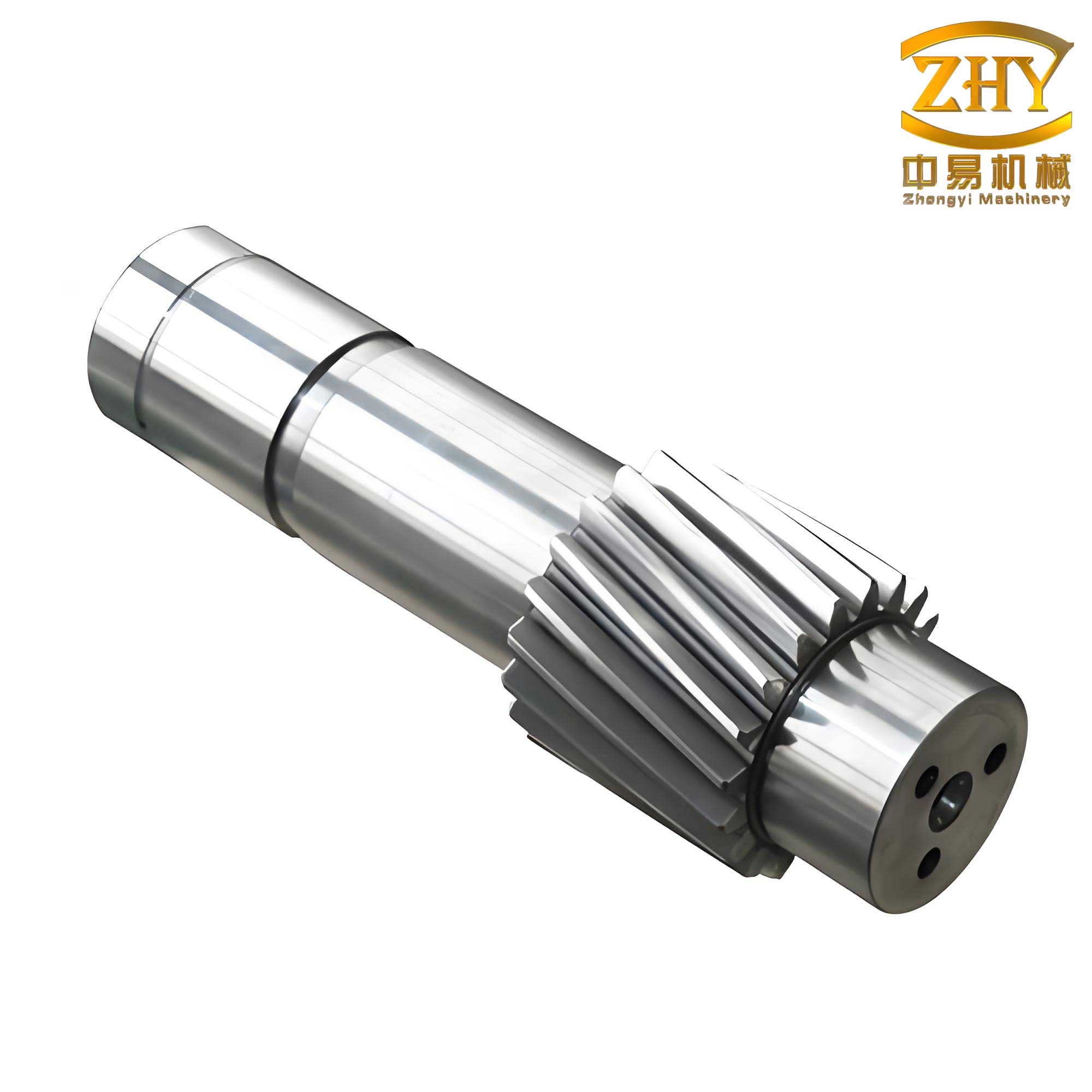
In the manufacturing of automotive transmission components, gear shafts play a critical role due to their structural complexity and high performance requirements. As an engineer specializing in hot forging processes, I have extensively worked on developing efficient methods for producing gear shafts, particularly using hot die forging presses. This article delves into the technical aspects of forging gear shafts, focusing on process analysis, die design, and operational steps, with an emphasis on optimizing material usage and ensuring dimensional accuracy. Gear shafts are often subjected to severe working conditions, requiring precise metallurgical properties and surface integrity, which makes their forging process a challenging yet rewarding endeavor.
The gear shaft in question is typically made from 8620H steel, a material chosen for its hardenability and toughness after carburizing and quenching. The forging net weight is approximately 9 kg, with a billet weight of 9.4 kg, indicating a material utilization efficiency that we strive to improve. The structure of gear shafts features a long axis with significant cross-sectional variations, including a central flange and tapered ends. These characteristics necessitate a careful forging approach to avoid defects such as folds, underfills, or excessive flash. Based on my experience, I will outline a process that involves upsetting and forging on a 31.5 MN hot die forging press, which has proven effective in meeting technical specifications while reducing material waste.
Process analysis begins with evaluating the feasibility of horizontal versus vertical forging orientations. For gear shafts, the long axis and abrupt section changes pose unique challenges. In horizontal forging, the central flange forms primarily through piercing or pressing, which often requires large flash volumes to ensure complete cavity filling. Through calculations, I determined that horizontal forging could generate flash weights up to 0.9 kg per gear shaft, significantly impacting material efficiency. In contrast, vertical forging allows the flange to be formed via upsetting, a more efficient deformation mode that reduces flash to about 0.4 kg per piece, saving 0.5 kg of raw material. This aligns with the general principle of hot die forging presses, where radial metal flow is more pronounced than vertical flow, making upsetting favorable for flange formation. However, the limited and fixed stroke of the press imposes constraints on billet length relative to die opening dimensions, which must be addressed in design.
To quantify the deformation requirements, I analyze the central flange section of gear shafts. The flange has dimensions of approximately 141 mm in diameter and 30 mm in height, with a volume calculated as:
$$ V = \pi r^2 h = \pi \left( \frac{141}{2} \right)^2 \times 30 \approx 468,200 \, \text{mm}^3 $$
This corresponds to a weight of about 3.7 kg, assuming a steel density of 7.85 g/cm³. Using a billet diameter of 60 mm, the required length for this section is:
$$ L = \frac{V}{\pi r^2} = \frac{468,200}{\pi \left( \frac{60}{2} \right)^2} \approx 167 \, \text{mm} $$
The aspect ratio or height-to-diameter ratio ψ is critical for upsetting stability:
$$ \psi = \frac{L}{d} = \frac{167}{60} \approx 2.78 $$
According to upsetting rules, if ψ ≤ 2.5, direct upsetting is feasible without pre-forming; however, for ψ up to 3.9, a conical upsetting step is necessary to prevent buckling and folding. Thus, for gear shafts with ψ = 2.78, a pre-upsetting operation is essential. I designed a conical cavity for this purpose, with dimensions derived from empirical formulas:
$$ d_1 = 1.05 \times d_0 = 1.05 \times 61 \approx 64 \, \text{mm} $$
$$ d_2 = 1.45 \times d_1 = 1.45 \times 64 \approx 92.9 \, \text{mm} $$
$$ L_1 = 0.62 \times L = 0.62 \times 167 \approx 104 \, \text{mm} $$
Here, d0 accounts for billet thermal expansion. This pre-form ensures that the final upsetting of gear shafts proceeds smoothly without instability.
The overall billet dimensions for gear shafts are φ60 mm × 425 mm, but the press stroke of 360 mm and die closure height of 490 mm present a feeding challenge. To enable billet insertion at the top dead center, I modified the die design by reducing the upper die height by 38.5 mm, increasing the open space. This adjustment allows the billet to be placed into the die cavity without interference, a crucial step for operational efficiency. The following table summarizes key parameters for the gear shafts forging process:
| Parameter | Value | Description |
|---|---|---|
| Forging Weight | 9 kg | Net weight after forging |
| Billet Weight | 9.4 kg | Initial weight with flash allowance |
| Billet Dimensions | φ60 mm × 425 mm | Diameter and length |
| Flange Volume | 468,200 mm³ | Volume of central section |
| Aspect Ratio ψ | 2.78 | Height-to-diameter ratio for upsetting |
| Flash Weight (Vertical) | 0.4 kg | Estimated flash in vertical forging |
| Flash Weight (Horizontal) | 0.9 kg | Estimated flash in horizontal forging |
In die design for gear shafts, I focus on pre-forging and finish-forging cavities. The pre-forging shape aims to facilitate metal flow in the finish die, primarily through upsetting, while avoiding backflow that causes folds. For positioning, the lower end of the pre-form is cylindrical to align with the die cavity, leveraging the press’s lower ejector mechanism for small or zero draft angles. The finish-forging cavity is designed with a 1.5% shrinkage allowance on the cold forging dimensions. To ensure proper filling, especially in deep sections like the upper end of gear shafts (φ55 mm × 50.2 mm), I incorporate a pre-forming step that approximates the final shape, reducing the risk of underfills. The die cavities are detailed below:
| Cavity Type | Key Dimensions | Purpose |
|---|---|---|
| Pre-upsetting Cone | d1 = 64 mm, d2 = 92.9 mm, L1 = 104 mm | Concentrate material for flange |
| Pre-forging Cavity | Cylindrical base φ70.2 mm, tapered upper section | Prepare shape for finish forging |
| Finish-forging Cavity | With 1.5% expansion, added damping grooves in flash land | Achieve final dimensions with minimal flash |
The structural design of dies for gear shafts is critical to withstand high stresses and thermal cycles. Given the concentrated forces at the die root during upsetting and ejection, I opted for a split die configuration with a stepped ejector. This design separates the cavity into upper and lower parts, joined by a piloting interface to maintain alignment. The stepped ejector provides a larger contact area with the forging, reducing pressure during ejection and preventing surface damage on gear shafts. Additionally, it facilitates cleaning of scale and debris from deep cavities. The die assembly includes high-strength screws (grade 12.9) to resist cyclic loading and prevent failure. The flash land in the finish die incorporates damping grooves to increase horizontal resistance, promoting better cavity filling for gear shafts. The resistance force F in the flash area can be estimated using:
$$ F = k \sigma_y A $$
where k is a friction factor, σy is the yield stress of the material at forging temperature, and A is the contact area. For gear shafts, optimizing this force helps balance metal flow.
Operational steps for forging gear shafts involve a sequence of heating, pre-upsetting, finish-forging, and trimming. First, billets are heated to approximately 1200°C to ensure proper ductility. Then, in the pre-upsetting die, the billet is placed with its lower end positioned against the die base, and the press executes a stroke to form the conical pre-form. This step is crucial for gear shafts to achieve the necessary material distribution for the flange. Next, the pre-formed billet is transferred to the finish-forging die, where it is upset to the final shape. During these operations, die cooling and lubrication with graphite emulsion are applied sparingly to avoid hydraulic locking of ejectors, which could cause dimensional errors in gear shafts. Scale removal is performed using extended blow pipes to clear deep cavities with compressed air. The table below outlines the operational parameters:
| Step | Temperature | Press Force | Duration |
|---|---|---|---|
| Heating | 1200°C | N/A | Depends on furnace |
| Pre-upsetting | 1150-1180°C | ~15 MN | Single stroke |
| Finish-forging | 1100-1150°C | ~31.5 MN | Single stroke |
| Trimming | 800-1000°C | Separate press | Quick operation |
In production, gear shafts forged via this method exhibit excellent forming quality, with complete metal flow lines and uniform flash. Mechanical testing confirms that the forged gear shafts meet all specifications for strength and durability after heat treatment. The material savings of 0.5 kg per piece translate to significant cost reductions in high-volume manufacturing. However, challenges such as minor underfills in pre-upsetting and ejector screw integrity require ongoing attention. By using high-strength fasteners and precise process control, these issues are mitigated. The success of this approach underscores the importance of tailored die design and process optimization for complex components like gear shafts.
To further analyze the forging of gear shafts, I consider the metallurgical aspects. The deformation during upsetting affects grain structure, which influences the final properties of gear shafts. The strain rate ε̇ in hot forging can be expressed as:
$$ \dot{\epsilon} = \frac{v}{h} $$
where v is the press speed and h is the instantaneous height. For gear shafts, controlling strain rates ensures recrystallization and fine grain formation. Additionally, the cooling rate after forging impacts the microstructure; isothermal normalization is often applied to gear shafts to achieve uniformity. The relationship between cooling rate and hardness can be modeled using:
$$ H = H_0 + k_c \log(t) $$
where H is hardness, H0 is a constant, kc is a material coefficient, and t is cooling time. This is critical for gear shafts undergoing carburizing.
In die life considerations for gear shafts, thermal fatigue is a major concern due to cyclic heating and cooling. The die stress σ_die can be approximated by:
$$ \sigma_{\text{die}} = E \alpha \Delta T $$
where E is Young’s modulus, α is the thermal expansion coefficient, and ΔT is the temperature range. Using H13 steel for dies, with proper cooling, the lifespan exceeds thousands of forgings for gear shafts. The table below compares material properties relevant to gear shafts forging:
| Material | Yield Strength at 1100°C (MPa) | Thermal Conductivity (W/m·K) | Application |
|---|---|---|---|
| 8620H Steel | ~50 | ~30 | Gear shafts forging |
| H13 Die Steel | ~1000 (at room temp) | ~25 | Forging dies |
| Graphite Emulsion | N/A | N/A | Lubricant and coolant |
Future improvements for forging gear shafts may involve simulation software to predict metal flow and defect formation. Finite element analysis (FEA) can optimize pre-form shapes for gear shafts, reducing trial-and-error. The governing equation for plastic deformation in forging is:
$$ \sigma_{ij} = 2K \left( \dot{\epsilon}_{ij} \right)^m $$
where K is the consistency index and m is the strain rate sensitivity. Applying this to gear shafts design enhances accuracy.
In conclusion, the vertical forging process on hot die forging presses offers a robust solution for producing high-quality gear shafts with material efficiency. Through detailed process analysis, die design, and operational care, gear shafts meet stringent automotive standards. The integration of conical pre-upsetting, split dies with stepped ejectors, and controlled flash design ensures reliable production of gear shafts. As demand for lightweight and durable transmission components grows, refining these forging techniques for gear shafts will remain a priority in advanced manufacturing.