
The manufacturing of cylindrical gears, fundamental components prized for their high transmission efficiency, broad applicability, and strong load-bearing capacity, has long been dominated by machining processes such as milling, hobbing, and shaping. However, these methods are increasingly challenged by demands for higher performance, material efficiency, and cost reduction, as they often result in gears with compromised mechanical properties, significant material waste, and elevated production costs.
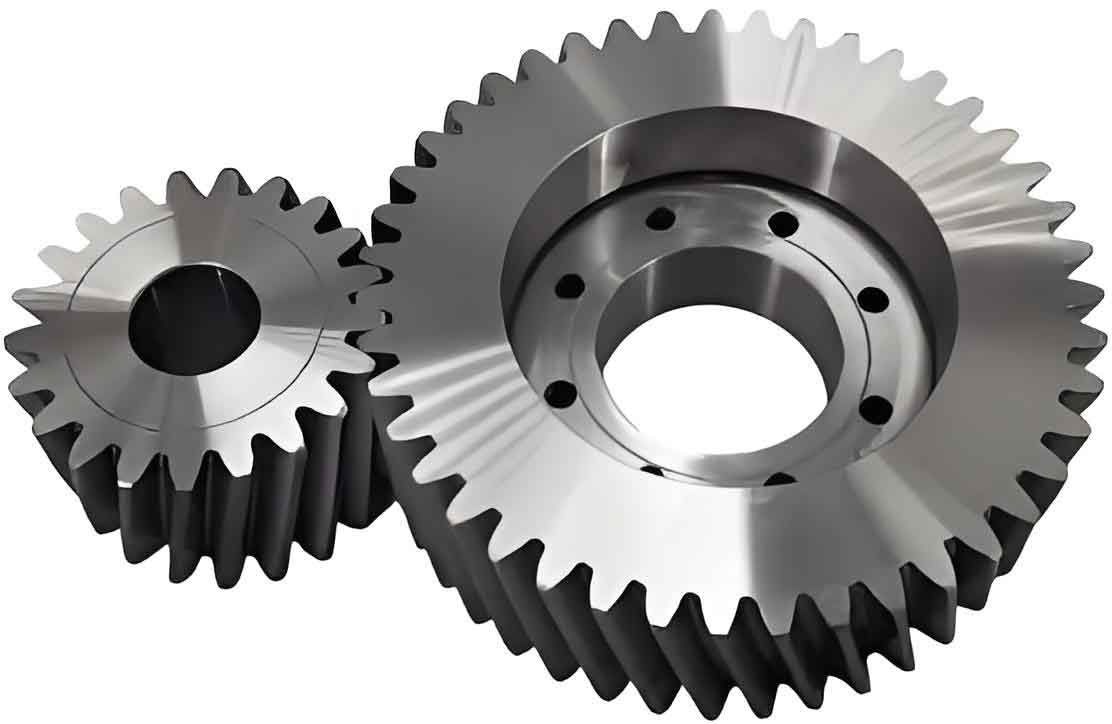
Cross-rolling emerges as an advanced near-net-shape forming technology offering a compelling alternative for cylindrical gears production. It boasts advantages including high production rates, superior material utilization, and excellent surface quality. A critical parameter in this process is the forming force, which is influenced by material properties, roller geometry, and processing parameters. Accurately predicting this force is paramount for optimal roller design, machine tool selection, and ensuring final gear quality and tool life. This work presents a comprehensive study integrating constitutive modeling, theoretical analysis, finite element simulation, and experimental validation to establish a reliable model for the forming force in the cross-rolling of cylindrical gears.
Constitutive Modeling of Gear Steel
The accurate characterization of material behavior under deformation is the foundation for any force prediction model. To this end, isothermal compression tests were conducted on 40CrNiMo gear steel, a common material for high-strength cylindrical gears. Specimens were compressed at various temperatures and strain rates to obtain true stress-strain curves, as exemplified in the figure below. The data reveals the expected trends: flow stress decreases with increasing temperature and increases with increasing strain rate.
The Johnson-Cook (J-C) constitutive model is widely used to describe material behavior under high strain rates and varying temperatures. Its general form is:
$$ \sigma = (A + B\varepsilon^n)\left(1 + C\ln \dot{\varepsilon}^*\right)\left[1 – \left(\frac{T – T_0}{T_m – T_0}\right)^m \right] $$
Where \( \sigma \) is the equivalent stress, \( \varepsilon \) is the equivalent plastic strain, \( \dot{\varepsilon}^* = \dot{\varepsilon}/\dot{\varepsilon}_0 \) is the dimensionless strain rate, \( T \) is the deformation temperature, \( T_0 \) is the reference temperature, \( T_m \) is the melting temperature, and \( A, B, n, C, m \) are material constants. Using room temperature (20°C) and a strain rate of 0.005 s⁻¹ as reference conditions, the constants for the standard J-C model were fitted. However, comparison with experimental data showed that the standard model tended to overpredict stress at higher temperatures.
A modified Johnson-Cook model, incorporating a polynomial strain-hardening term, was adopted to improve accuracy:
$$ \sigma = (A_1 + B_1\varepsilon + B_2\varepsilon^2 + B_3\varepsilon^3)\left(1 + C_1\ln \dot{\varepsilon}^*\right)\left[1 – \left(\frac{T – T_0}{T_m – T_0}\right)^m \right] $$
The material constants for 40CrNiMo steel were determined through regression analysis of the experimental data. The final modified constitutive model is expressed as:
$$ \sigma = (-221 + 17519\varepsilon – 64889\varepsilon^2 + 82894\varepsilon^3)(1 + 0.017\ln \dot{\varepsilon}^*)\left[1 – \left(\frac{T – 20}{1510 – 20}\right)^{0.7744} \right] $$
The accuracy of this modified model was validated by calculating the Root Mean Square Error (RMSE) between predicted and experimental stress values across all test conditions, yielding a value of 9.575 MPa, confirming its reliability for subsequent force analysis.
| Model Parameter | Symbol | Value |
|---|---|---|
| Initial Yield Stress Coefficient | \(A_1\) | -221 MPa |
| Linear Strain Hardening Coefficient | \(B_1\) | 17519 MPa |
| Quadratic Strain Hardening Coefficient | \(B_2\) | -64889 MPa |
| Cubic Strain Hardening Coefficient | \(B_3\) | 82894 MPa |
| Strain Rate Coefficient | \(C_1\) | 0.017 |
| Thermal Softening Exponent | \(m\) | 0.7744 |
Theoretical Analysis of Forming Force for Cylindrical Gears
The cross-rolling process involves three primary force components: radial force \(F_\tau\), circumferential (tangential) force \(F_t\), and axial force \(F_z\). The theoretical model focuses on predicting the radial forming force, which is critical for load capacity.
The general expression for the forming force \(F\) is:
$$ F = \bar{\sigma} \cdot A_c $$
Where \( \bar{\sigma} \) is the average contact pressure (stress) and \( A_c \) is the projected contact area between the tool (rolling die) and the workpiece. Therefore, accurately determining both the contact area evolution and the mean stress during the complex gear-tooth forming process is essential.
Tooth Height Evolution Model
During cross-rolling, the material from the workpiece blank is displaced to form the gear teeth. Assuming volume constancy in plane strain conditions, the growth of the tooth height is directly linked to the penetration depth of the rolling die. The process is analyzed in two distinct stages, governed by which part of the die profile is in contact.
Stage 1: The die tip (fillet and tip radius) penetrates the workpiece. The increase in tooth height \(H_1\) is relatively small and is solved by equating the area penetrated by the die to the area added to the forming tooth flank, approximated as a trapezoid.
Stage 2: The involute flank of the die begins to contact and form the workpiece. The tooth height \(H_2\) increases more significantly. The relationship is found by equating the more complex penetrated area (a polygon) to the area of the growing involute tooth segment.
The mathematical formulation involves coordinate transformations based on gear generation principles, where the rolling die is treated as a generating tool. The workpiece tooth profile in its moving coordinate system \(O_1X_1Y_1\) is derived from the tool (rack) profile:
$$ \begin{bmatrix} x_{gi} \\ y_{gi} \\ 1 \end{bmatrix} = \begin{bmatrix} \cos\gamma & -\sin\gamma & r_2\cos\gamma + S\sin\gamma \\ \sin\gamma & \cos\gamma & r_2\sin\gamma – S\cos\gamma \\ 0 & 0 & 1 \end{bmatrix} \begin{bmatrix} x_{ti} \\ y_{ti} \\ 1 \end{bmatrix} $$
Where \( (x_{ti}, y_{ti}) \) are the tool coordinates, \( (x_{gi}, y_{gi}) \) are the generated workpiece coordinates, \( r_2 \) is the workpiece pitch radius, \( \gamma \) is the workpiece rotation angle, and \( S \) is the tool displacement. By solving the area equivalence equations numerically for different penetration depths, the relationship between die penetration and tooth height growth for a specific cylindrical gear geometry (module 1.75 mm, 46 teeth) is established.
Contact Area Model
Determining the instantaneous contact area \(A_c\) is highly complex due to the continuously changing, non-planar contact interface. The approach simplifies the problem by “unwrapping” the contact. For a given penetration depth (corresponding to a specific forming moment), the interference zone between the die profile and the pre-formed workpiece profile is calculated. The length of this interference arc along the tooth profile, \(l_r\), is determined using numerical methods (e.g., in MATLAB).
The total contact area for one tooth is then obtained by integrating this contact arc length over the axial width \(b\) of the workpiece, considering the two stages of penetration:
Stage 1 Contact Area: \( S_1 = \int_{0}^{H_{D} / \sin\alpha_0} \frac{l_{r1}}{2} \, dz \)
Stage 2 Contact Area: \( S_2 = \int_{H_{D} / \sin\alpha_0}^{(H_{N} – H_{D}) / \sin\alpha_0} \frac{l_{r1} + l_{r2}}{2} \, dz \)
Where \(H_D\) and \(H_N\) are critical penetration depths marking the transition between stages, \( \alpha_0 \) is the pressure angle, and \( l_{r1}, l_{r2} \) are the contact arc lengths in stages 1 and 2, respectively. The total projected contact area for a single-tooth engagement model is \( A_c = S_1 + S_2 \). For a more realistic scenario, a double-tooth engagement model is also considered, where the contact area is approximately doubled: \( A_c’ \approx 2(S_1 + S_2) \).
Average Stress and Forming Force Model
The average contact pressure \( \bar{\sigma} \) is derived using the slab method under plane strain conditions. Analyzing the stress equilibrium on a differential element in the deformation zone and applying the yield criterion and a constant friction condition (\( \tau = \mu k \), where \( k = \sigma_s / \sqrt{3} \)), the normal stress distribution on the contact surface is obtained. Integrating this stress over the contact area gives the total forming force for the single-tooth model:
$$ F_{one} = \bar{\sigma} (S_1 + S_2) = \left[ \frac{ \int_{r_N}^{r_H} \left( -\frac{2\mu \sigma_s}{\sqrt{3} (\pi m/2)} r + \frac{2\sigma_s}{\sqrt{3}} \left(1 + \frac{\mu}{\pi m/2} r_H \right) \right) dr }{S_1 + S_2} \right] (S_1 + S_2) $$
This simplifies to the integral form. The double-tooth model force is \( F_{two} \approx 2 F_{one} \). The flow stress \( \sigma_s \) in these equations is provided by the modified Johnson-Cook constitutive model established earlier, evaluated at the appropriate strain, strain rate, and temperature (room temperature for cold rolling).
Finite Element Simulation and Model Validation
To validate the theoretical models, a 3D finite element (FE) simulation of the cross-rolling process was performed using DEFORM software. The simulation setup is summarized in the table below:
| Parameter | Setting |
|---|---|
| Workpiece Material | 40CrNiMo (Modified J-C Model) |
| Workpiece Dimensions | Ø80.8 mm (initial), 40 mm width |
| Gear Specifications | Module 1.75 mm, 46 Teeth, 20° Pressure Angle |
| Rolling Die | Rigid body, 128 Teeth (with tapered entry/exit zones) |
| Friction Condition | Shear friction, factor = 0.15 |
| Process Conditions | Cold rolling (20°C), Axial feed = 0.7 mm/s |
The FE analysis revealed the typical stages of gear cross-rolling: division (initial indentation), forming (tooth height growth and profile generation), and finishing (profile calibration). The material flow and tooth filling were observed. Key results for validation were extracted:
1. Tooth Height Growth: The FE-predicted tooth height increase at different penetration depths showed good agreement with the theoretical model, especially in the central cross-section where axial material flow is minimized. This validated the area-equivalence principle and the geometric model for cylindrical gears formation.
2. Contact Area: The instantaneous contact area from the FE simulation was compared against the theoretical calculation. For the single-tooth model, the trends matched well, with the theoretical area being slightly higher during forming due to assumptions about perfect material confinement. For the double-tooth model, the theoretical area was consistently higher because the FE simulation often showed only one tooth in full engagement at a time, while the theory assumed perfect double-tooth contact.
3. Forming Force: The radial forming force history from the FE simulation exhibited a characteristic single-peak curve, rising during initial penetration and engagement, reaching a maximum, and then decreasing during the finishing phase. The comparison of peak force values is critical:
- Single-tooth Model: Theoretical peak force = 258.5 kN, FE peak force = 255.4 kN. The relative error is 1.23%.
- Double-tooth Model: Theoretical peak force = 347.8 kN, FE peak force = 316.0 kN. The relative error is 10.08%.
The higher error for the double-tooth model is attributed to the discrepancy between the assumed perfect double contact in the theory and the actual intermittent contact observed in the simulation.
Experimental Verification
Physical cross-rolling tests were conducted on a dedicated rolling mill to provide final validation. The experimental conditions mirrored the simulation parameters. A 40CrNiMo workpiece was rolled using a tapered die to produce a spur cylindrical gear with 46 teeth. The forming force was measured in-situ using load cells, and the formed gear was inspected using a coordinate measuring system to verify tooth dimensions.
Experimental Results:
- The formed gear exhibited good profile accuracy and surface quality, confirming the feasibility of the process.
- The measured radial forming force history matched the predicted single-peak trend from the FE simulation. The experimental peak force was 331.2 kN.
- The final tooth height measurements from the experiment aligned closely with both the theoretical and FE predictions, with a maximum relative error of 4.48% against the theory.
| Validation Metric | Theoretical Value | FE Simulation Value | Experimental Value | Relative Error (Theory vs. Exp.) |
|---|---|---|---|---|
| Peak Forming Force (Double-tooth context) | 347.8 kN | 316.0 kN | 331.2 kN | 4.48% |
| Tooth Height Growth | Model-based | Simulation-based | Measured | < 4.48% |
Conclusion
This study successfully developed and validated an integrated methodology for predicting the forming force in the cross-rolling of cylindrical gears. The key conclusions are:
- A modified Johnson-Cook constitutive model was established for 40CrNiMo gear steel, providing an accurate description of its flow stress behavior under relevant conditions (RMSE = 9.575 MPa).
- A theoretical forming force model was derived by integrating a geometrically-based tooth height evolution model, a contact area calculation via the interference method, and an average stress solution from the slab method under plane strain.
- Finite element simulations confirmed the physical validity of the process stages and provided quantitative validation. The peak forming force predicted by the theoretical single-tooth model showed excellent agreement with simulation (1.23% error).
- Experimental cross-rolling tests provided final confirmation. The theoretical model’s prediction of the maximum forming force was within 4.48% of the measured experimental value, demonstrating its practical accuracy and suitability for industrial application in the design and analysis of cylindrical gear cross-rolling processes.