
Abstract
Non-circular gears, as a novel type of gear, exhibit the advantages of a compact structure, stable transmission, and variable transmission ratios, building upon the benefits of conventional cylindrical gears. They are widely utilized in reversing devices for pumping units. This thesis focuses on the research of four-axis linkage CNC gear shaping technology for non-circular gears, aiming to provide a theoretical basis for improving the quality and efficiency of their manufacturing process.
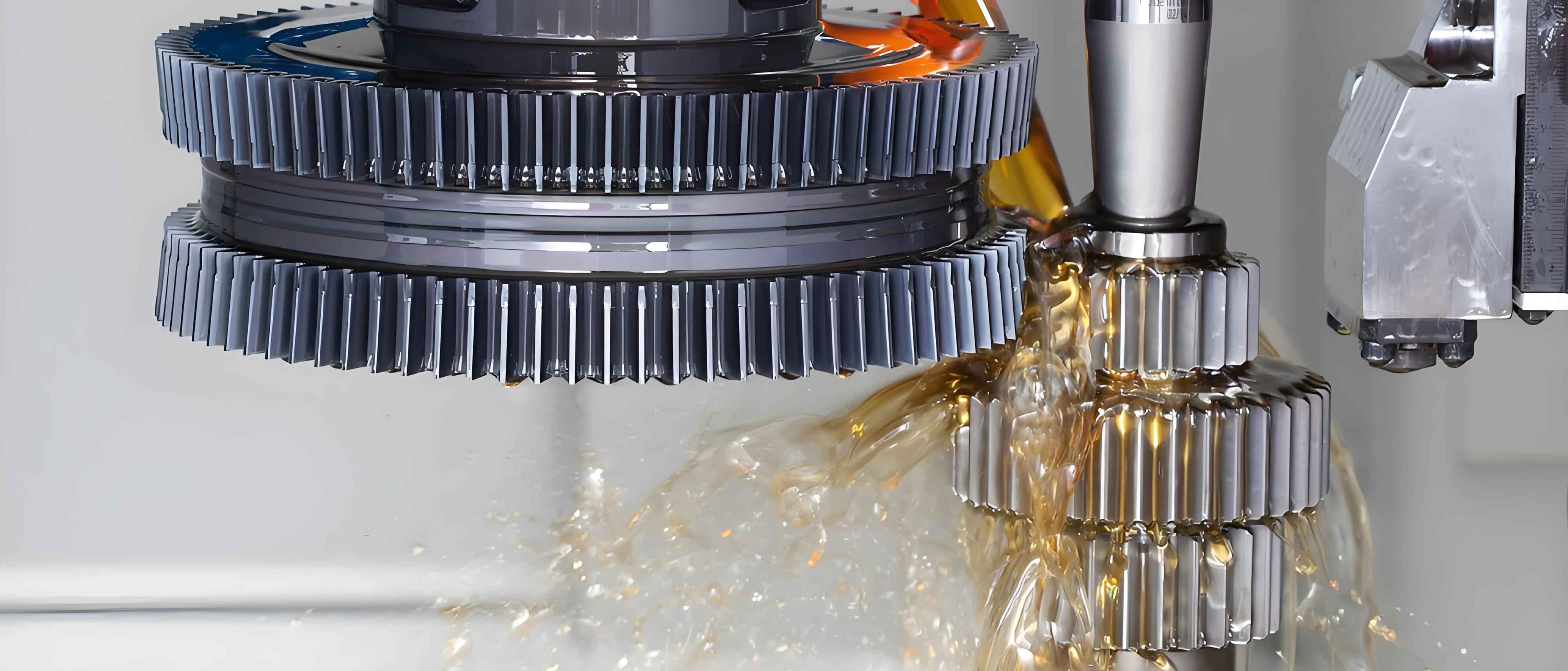
Keywords: Non-circular gear; Four-axis linkage; Kinematics modeling; Automatic programming; CNC gear shaping
1. Introduction
With the rapid development of numerical control machining technology, CNC gear shaping has been applied to the manufacturing of non-circular gears due to its high efficiency, wide processing range, and precision. However, current non-circular gear shaping equipment predominantly employs three-axis linkage CNC gear shaping machines, which can only retract along the centerline direction and may encounter retraction interference issues, thereby reducing processing efficiency. As industrial equipment standards continue to rise, there are increasing demands for the processing quality and efficiency of non-circular gears. Simultaneously, with the enhanced performance of numerical control machine tools, four-axis linkage CNC gear shaping machines have emerged as the future trend.
Table 1. Comparison between Three-Axis and Four-Axis Linkage CNC Gear Shaping Machines
| Features | Three-Axis Linkage | Four-Axis Linkage |
|---|---|---|
| Retraction Direction | Along centerline | Along normal direction |
| Interference Issues | Possible | Reduced |
| Processing Efficiency | Lower | Higher |
| Complexity | Lower | Higher (due to additional axis) |
2. Literature Review
2.1 Research Status of CNC Gear Hobbing Technology
CNC gear hobbing offers high efficiency and precision, especially in the processing of helical non-circular gears. However, it requires advanced manufacturing equipment (four to six-axis CNC hobbing machines), leading to complex processing technology. Additionally, CNC hobbing machines are expensive, have high processing costs, and cannot process non-circular internal gears or non-circular gears with concave pitch curves.
2.2 Research Status of CNC Gear Shaping Technology
CNC gear shaping technology has lower manufacturing equipment requirements (three or four-axis CNC gear shaping machines) and demonstrates strong processing applicability and high precision. It can effectively address the issues of gear hobbing and accurately and efficiently process non-circular internal gears and non-circular external gears with concave pitch curves. It is currently one of the most versatile and widely applied methods for non-circular gear processing.
Table 2. Advantages of CNC Gear Shaping Technology
| Advantages | Description |
|---|---|
| Lower Equipment Requirements | Requires three or four-axis CNC machines |
| Strong Processing Applicability | Suitable for various types of non-circular gears |
| High Precision | Ensures accurate gear shaping |
2.3 Kinematics Modeling and Error Compensation for CNC Gear Shaping Machines
Research on kinematics modeling and error compensation for CNC gear shaping machines has been conducted to improve processing accuracy. This includes analyzing retraction interference mechanisms, deriving mathematical models for various types of retractions, and developing automatic programming systems.
3. Mathematical Modeling for Four-Axis Linkage CNC Gear Shaping of Non-Circular Gears
3.1 Basic Movements in Four-Axis Linkage CNC Gear Shaping
During four-axis linkage CNC gear shaping for non-circular gears, the gear cutter and gear blank undergo six basic movements:
- Shaping Main Movement: Reciprocating shaping movement of the gear cutter along the Z-axis.
- Circular Feed Movement: Rotational movement around the 2C-axis.
- Tooth Division Movement: Rotational movement of the gear blank around the 1C-axis.
- Feed Movement of Gear Cutter: Feed movement of the gear cutter in the tooth depth direction.
- Relative Position Adjustment Movement: Linear movement of the gear cutter and gear blank along the X and Y axes.
- Tool Retreatment Movement: Tool retreatment along the normal direction of the pitch curve.
3.2 Coordinate Transformation and Envelope Equation
Coordinate transformation relationships are established to derive the envelope equation of the gear cutter in the gear blank coordinate system. This involves various mathematical transformations and the use of homogeneous coordinate transformation matrices.
4. Automatic Programming for Four-Axis Linkage CNC Gear Shaping of Non-Circular Gears
4.1 Design Ideas for Automatic Programming System
The purpose of developing an automatic programming system for four-axis linkage CNC gear shaping of non-circular gears is to input basic gear parameters and shaping parameters, perform numerical calculations and processing, generate tool path trajectories, and convert tool position data into G-code required for CNC gear shaping.
Table 3. Modules of Automatic Programming System
| Module | Description |
|---|---|
| Non-Circular Gear Parameter Input | Input basic parameters of non-circular gears |
| Shaping Parameter Input | Input shaping parameters |
| G-Code Generation | Generate G-code for CNC gear shaping |
| Axis and Workpiece Movement Display | Display movements of machine axes and workpiece |
4.2 Simulation of Four-Axis Linkage CNC Gear Shaping Process
Simulation of the four-axis linkage CNC gear shaping process involves establishing three-dimensional models of machine components, gear cutters, gear blanks, and fixtures in modeling software, importing them into simulation software, setting system parameters, and analyzing simulation results.
Table 4. Steps for Simulation
| Step | Description |
|---|---|
| Model Creation | Create 3D models of components in modeling software |
| Import Models | Import models into simulation software |
| Set System Parameters | Configure machine collision detection, axis allocation, travel limits, etc. |
| Import NC Program | Import the NC program for simulation |
| Analyze Results | Use AUTO-DIFF to analyze simulation results and check for errors |
5. Experimental Verification
To verify the correctness of the simulation, experiments were conducted on a four-axis linkage CNC gear shaping machine. The G-code generated by the automatic programming system was used to process non-circular gears, and the results were analyzed to evaluate the accuracy and efficiency of the process.
5.1 Tooth Profile Error Detection
Tooth profile errors were detected by performing 3D and 2D comparative analyses of the non-circular gear. This involved creating a cross-sectional plane through the gear and comparing the tooth profile with the ideal profile.
6. Conclusion
This thesis conducted research on four-axis linkage CNC gear shaping technology for non-circular gears, establishing a mathematical model, designing an automatic programming system, and conducting experimental verification. The research provides a theoretical basis for improving the quality and efficiency of non-circular gear shaping.
However, further research is needed to consider errors caused by force-induced deformation and thermal deformation, analyze the sensitivity of errors in each motion axis, and investigate the impact of different processing parameters on shaping efficiency and accuracy.
Mathematical Equations and Notations
During the research, various mathematical equations and notations were used, such as:
- Homogeneous Coordinate Transformation Matrix:
100001000010xtytzt1
- Kinematics Transformation Matrix:
TW12=cos(2C)sin(2C)00−sin(2C)cos(2C)000010XC2YC2ZC21
These equations and notations were utilized in the derivation of the envelope equation, coordinate transformations, and simulations.