
In mechanical transmission systems, bevel gears are essential components for torque transmission and speed adjustment, particularly in applications like forklifts. The sudden fracture of a driving bevel gear during unloading operations prompted this investigation. As an engineer specializing in failure analysis, I conducted a thorough examination to determine the root cause, employing techniques such as macro analysis, chemical composition analysis, metallographic examination, hardness testing, and scanning electron microscopy (SEM). This study aims to elucidate the failure mechanisms and offer recommendations to prevent similar incidents, with a focus on the critical role of bevel gears in industrial machinery.
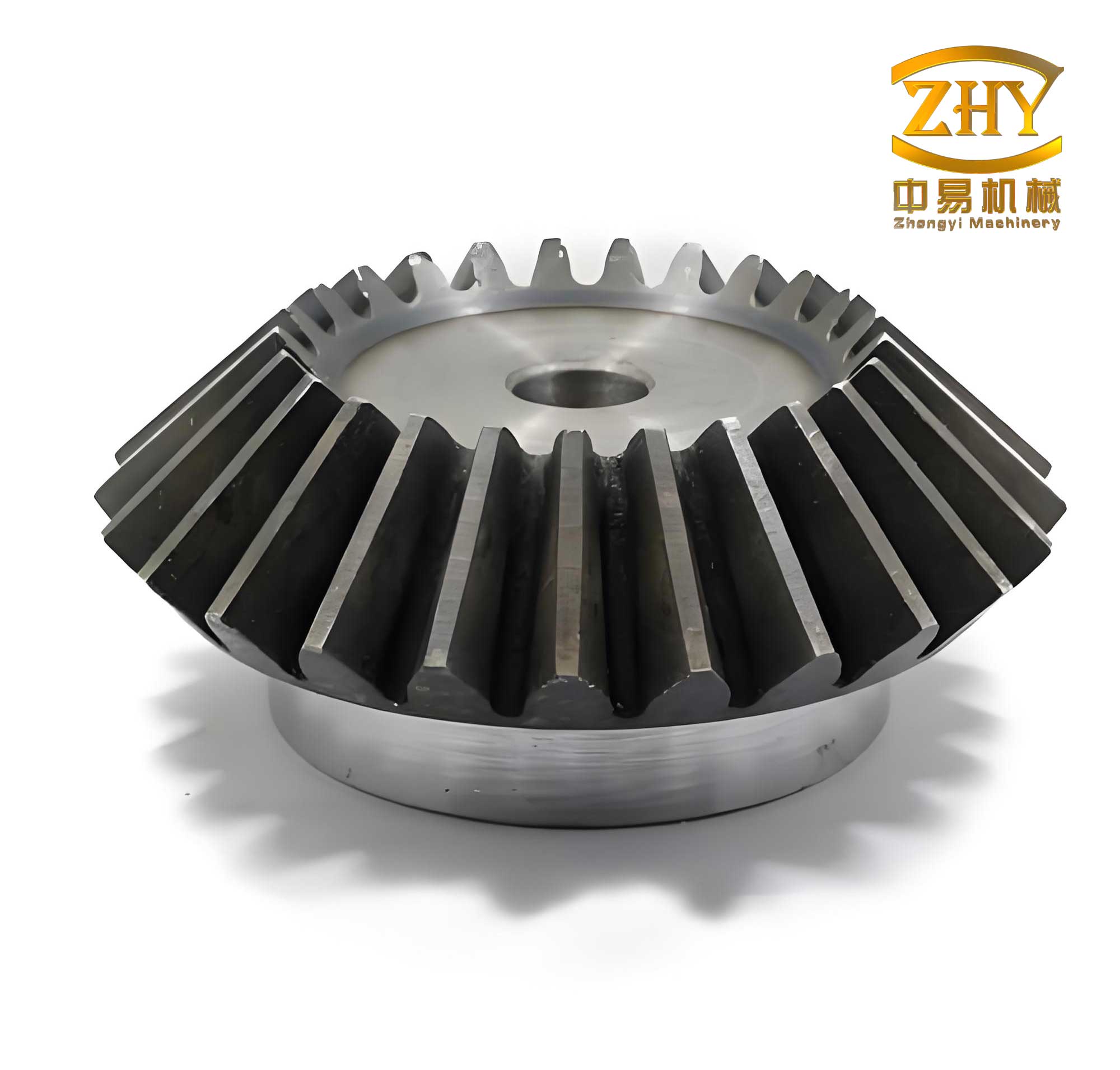
Bevel gears, especially those made from alloy steels like 20CrMnTi, are subjected to high stresses during service. Their performance relies on proper heat treatment, including carburizing and quenching, to achieve surface hardness and wear resistance. However, this process can introduce hydrogen into the material, leading to embrittlement. In this case, the fracture occurred at the transition step between diameters of 45 mm and 40 mm, a stress concentration zone. I will detail the analytical methods and findings, emphasizing how hydrogen embrittlement precipitated the failure of these bevel gears.
The bevel gear in question was manufactured from 20CrMnTi steel, with a processing sequence involving forging, isothermal normalizing, machining, gear cutting, carburizing quenching and tempering, fine grinding, pairing, and assembly. The heat treatment protocol involved carburizing at (910 ± 10)°C for 4.5 hours using methanol and kerosene as carburizing agents, followed by direct quenching in N32 oil and tempering at 180°C for 2 hours. This study replicates industrial conditions to assess the integrity of bevel gears under operational loads.
Materials and Analytical Methods
To investigate the fracture, I collected samples from the broken bevel gear. The analysis encompassed multiple techniques to evaluate material properties and failure characteristics. Macro analysis provided an initial assessment of the fracture morphology, while chemical composition analysis verified compliance with standards. Metallographic examination revealed microstructural features and inclusions, hardness testing measured surface and core hardness, and SEM fractography identified fracture modes. Each method contributed to a holistic understanding of why bevel gears fail, with particular attention to hydrogen-related issues.
Results of Physicochemical Examinations
Macro Analysis
The fracture surface of the bevel gear exhibited a flat, crystalline appearance, indicative of brittle fracture. The surface was clean and bright gray, with distinct zones: the fracture origin at the transition step, a relatively flat propagation region, and a rough transient fracture area with radial patterns. This macro morphology suggests that the bevel gear failed under low stress, typical of hydrogen embrittlement, rather than fatigue. The abrupt fracture highlights the vulnerability of bevel gears to such mechanisms when hydrogen is present.
Chemical Composition Analysis
I analyzed the chemical composition of the fractured bevel gear using spectroscopic methods. The results, compared to GB/T 3077-2015 standards for 20CrMnTi steel, are summarized in Table 1. The composition aligns with specifications, indicating that material chemistry was not the primary cause of failure. This underscores that other factors, such as heat treatment or design, likely contributed to the fracture of these bevel gears.
| Element | Measured Value (wt.%) | Standard Requirement (wt.%) |
|---|---|---|
| C | 0.20 | 0.17-0.23 |
| Si | 0.26 | 0.17-0.37 |
| Mn | 1.10 | 0.80-1.10 |
| P | 0.017 | ≤0.035 |
| S | 0.010 | ≤0.035 |
| Cr | 1.28 | 1.00-1.30 |
| Ti | 0.07 | 0.04-0.10 |
This compliance confirms that the bevel gears were made from appropriate alloy steel, shifting focus to processing and environmental factors.
Metallographic Examination
Metallographic samples were taken from the fracture region and examined unetched and after etching with 4% nitric alcohol solution. Unetched observations showed low inclusion levels, rated as A0 for sulfides, B0.5 for alumina, C1.5 for silicates, D1.5 for globular oxides, and DS0 for single-particle spheres per GB/T 10561-2005. This indicates good material cleanliness for bevel gears. However, secondary cracks were observed near the fracture origin and in the subsurface, exhibiting intermittent, zigzag patterns with predominantly intergranular propagation mixed with transgranular modes. After etching, the carburized surface layer showed a microstructure of martensite and retained austenite, rated as carbide grade 2 and martensite-retained austenite grade 5 per QC/T 262-1999. Cracks in this layer were intergranular without decarburization. The core microstructure consisted of low-carbon martensite, tempered bainite, and少量铁素体 (minor ferrite), with microcracks present. These features suggest hydrogen-induced cracking, common in susceptible bevel gears after carburizing.
Hardness Testing
Hardness measurements were performed on samples from the fracture area, with results shown in Table 2. Both surface and core hardness values were below the technical requirements specified in the product drawing, as was the carburized layer depth. This reduction in hardness compromises the load-bearing capacity of bevel gears, making them more prone to failure under stress, especially when combined with hydrogen embrittlement.
| Parameter | Measured Value | Product Drawing Requirement |
|---|---|---|
| Surface Hardness (HRC) | 53.5, 55.0, 54.5 | 58-63 |
| Core Hardness (HRC) | 34.5, 34.5, 34.0 | 35-45 |
| Carburized Layer Depth (mm) | 1.45 | 1.50-1.80 |
The lower hardness may result from suboptimal carburizing or quenching parameters, affecting the performance of bevel gears in service.
SEM Fractography
SEM analysis of the fracture surface revealed characteristic features of hydrogen embrittlement. At the crack origin near the transition step, multiple steps, voids, and intergranular secondary cracks were observed. In the microvoid coalescence regions, small facets with plastic deformation and tear ridges were present, along with fine “chicken scratch” deformation lines on grain surfaces. This morphology corresponds to intergranular + quasi-cleavage fracture, typical of hydrogen-assisted cracking. The propagation and transient fracture zones also exhibited grain outlines, secondary cracks, tear ridges, and chicken scratch patterns, confirming hydrogen embrittlement as the dominant failure mode for these bevel gears. The presence of such features underscores the insidious nature of hydrogen in compromising bevel gear integrity.
Discussion on Fracture Mechanisms
Role of Hydrogen Embrittlement
Hydrogen embrittlement is a delayed fracture phenomenon where atomic hydrogen infiltrates steel during processes like carburizing, leading to reduced ductility and crack initiation under stress. For bevel gears, hydrogen can originate from carburizing atmospheres rich in hydrogen, such as those using methanol and kerosene. The hydrogen diffusion coefficient at high temperatures is significant, allowing easy penetration. Even during protective heating, hydrogen may continue to ingress. Once inside, atomic hydrogen migrates to stress concentration areas, such as the transition step in bevel gears, where it accumulates and forms molecular hydrogen, generating pressure that initiates cracks. The fracture in this case occurred at low stress, consistent with hydrogen embrittlement, rather than fatigue, as no cyclic loading features were observed. The intergranular cracks and secondary cracks further support this mechanism. The susceptibility of bevel gears to hydrogen embrittlement increases with factors like high hardness and specific microstructures.
The kinetics of hydrogen diffusion can be described by Fick’s laws. The flux of hydrogen, \( J \), is given by:
$$ J = -D \frac{\partial C}{\partial x} $$
where \( D \) is the diffusion coefficient, \( C \) is the hydrogen concentration, and \( x \) is the distance. In bevel gears, during service, hydrogen accumulates at stress concentrators, leading to a localized increase in concentration that promotes cracking. The critical hydrogen concentration for embrittlement, \( C_{crit} \), can be estimated based on stress and material properties. For bevel gears made of 20CrMnTi steel, the threshold may be lowered by microstructural features.
Influence of Heat Treatment
Heat treatment, particularly carburizing and quenching, plays a pivotal role in determining the performance of bevel gears. In this instance, the carburizing process at 910°C with methanol and kerosene introduced hydrogen into the steel. The subsequent quenching in oil may not have allowed sufficient hydrogen effusion, trapping it within the material. Tempering at 180°C for 2 hours might have been inadequate to remove hydrogen, as higher temperatures or longer times are often required for dehydrogenation. The microstructure resulting from this treatment—martensite in the surface and low-carbon martensite in the core—is highly susceptible to hydrogen embrittlement. Studies show that hydrogen embrittlement sensitivity follows the order: ferrite or pearlite < bainite < low-carbon martensite < mixed martensite and bainite < twin martensite. Thus, the microstructures in these bevel gears favored hydrogen-induced cracking. Optimizing heat treatment parameters, such as using alternative carburizing agents or post-treatment dehydrogenation, could mitigate risks for bevel gears.
The relationship between hardness and hydrogen embrittlement susceptibility can be expressed as:
$$ S_{HE} = k \cdot H^{n} $$
where \( S_{HE} \) is the susceptibility index, \( H \) is the hardness, and \( k \) and \( n \) are material constants. For bevel gears with surface hardness above 38 HRC, as in this case, the risk of hydrogen embrittlement increases significantly, explaining the low-stress fracture.
Stress Concentration Effects
The design of bevel gears often includes transitions in shaft diameters, which act as stress concentrators. In this fracture, the step between 45 mm and 40 mm diameters created a localized stress field. Under load, atomic hydrogen migrated to this region, driven by stress gradients, as described by the stress-assisted diffusion equation:
$$ \frac{\partial C}{\partial t} = D \nabla^2 C – \nabla \left( \frac{D C}{RT} \nabla \sigma_h \right) $$
where \( \sigma_h \) is the hydrostatic stress, \( R \) is the gas constant, and \( T \) is temperature. The stress concentration factor, \( K_t \), for a step can be approximated using formulas like:
$$ K_t = 1 + 2\sqrt{\frac{a}{\rho}} $$
where \( a \) is the defect size and \( \rho \) is the fillet radius. For bevel gears with sharp transitions, \( K_t \) can be high, exacerbating hydrogen accumulation. This mechanical factor, combined with hydrogen presence, led to crack initiation and rapid propagation, culminating in the brittle fracture of the bevel gear. Redesigning the transition with a larger radius or smoother contour could reduce stress concentration and enhance the durability of bevel gears.
Material and Microstructural Factors
The material 20CrMnTi steel is commonly used for bevel gears due to its good hardenability and toughness. However, its microstructure after carburizing and quenching—martensite and retained austenite—is prone to hydrogen embrittlement. The presence of non-metallic inclusions, though low in this case, can act as nucleation sites for cracks if hydrogen is present. The core microstructure of low-carbon martensite and bainite also contributes to susceptibility, as these phases can trap hydrogen at interfaces and dislocations. The hardness deficiencies noted earlier further reduce fracture resistance. For bevel gears, achieving a balance between hardness and toughness is crucial; excessive hardness without proper hydrogen management can lead to premature failure. Microstructural refinement through controlled cooling or alloy adjustments might improve hydrogen resistance in bevel gears.
The hydrogen trapping energy, \( E_t \), in microstructures can be modeled as:
$$ E_t = E_0 + \beta \cdot \Delta G $$
where \( E_0 \) is the base trapping energy, \( \beta \) is a constant, and \( \Delta G \) is the Gibbs free energy change. In bevel gears with martensitic structures, trapping sites like grain boundaries and dislocations have high \( E_t \), retaining hydrogen and promoting embrittlement.
Conclusions and Recommendations
Based on the analysis, the fracture of the bevel gear was primarily caused by hydrogen embrittlement resulting from hydrogen ingress during carburizing heat treatment. Atomic hydrogen accumulated at the stress concentration site of the diameter transition step, leading to intergranular crack initiation and propagation under operational loads. The brittle fracture occurred at low stress, with no evidence of fatigue or material defects. The lower-than-specified hardness and carburized layer depth may have exacerbated the failure but were not the root cause. This case highlights the critical need to address hydrogen-related risks in the manufacturing and treatment of bevel gears.
To prevent similar failures in bevel gears, I recommend the following measures. First, modify the heat treatment process to minimize hydrogen introduction, such as using alternative carburizing atmospheres with lower hydrogen potential or incorporating dehydrogenation steps, like baking at 200-250°C for several hours after quenching. Second, optimize the design of bevel gears to reduce stress concentrations, for example, by increasing the fillet radius at transition steps. Third, ensure proper control of carburizing and quenching parameters to achieve the required hardness and case depth without compromising microstructure. Fourth, implement non-destructive testing, such as ultrasonic or eddy current inspection, to detect hydrogen-induced cracks in bevel gears before service. Finally, educate personnel on the risks of hydrogen embrittlement and the importance of process controls. By adopting these strategies, the reliability and lifespan of bevel gears in forklifts and other machinery can be significantly enhanced.
In summary, bevel gears are vital components susceptible to hydrogen embrittlement if not properly managed. This study underscores the interplay between material, processing, and design factors in gear failure. Future work could explore advanced coatings or alloy modifications to improve hydrogen resistance in bevel gears, contributing to safer and more efficient industrial operations.
Additional Technical Insights
To further elaborate on the mechanisms, hydrogen embrittlement in bevel gears can be understood through thermodynamic and kinetic perspectives. The pressure buildup from hydrogen recombination at internal interfaces can be estimated using the ideal gas law:
$$ P = \frac{nRT}{V} $$
where \( P \) is the pressure, \( n \) is the number of moles of hydrogen, \( R \) is the gas constant, \( T \) is temperature, and \( V \) is the cavity volume. In bevel gears, this pressure can exceed the material’s cohesive strength, causing crack propagation. Additionally, the delayed fracture nature of hydrogen embrittlement means that bevel gears may fail after a period under stress, making it essential to consider time-dependent factors in design.
The fatigue life of bevel gears, if hydrogen is absent, can be modeled using S-N curves, but with hydrogen, the endurance limit is reduced. A modified Goodman diagram can incorporate hydrogen effects:
$$ \sigma_a = \sigma_{fat} \left(1 – \frac{\sigma_m}{\sigma_{uts}}\right) – \Delta \sigma_{H} $$
where \( \sigma_a \) is the allowable stress amplitude, \( \sigma_{fat} \) is the fatigue limit, \( \sigma_m \) is the mean stress, \( \sigma_{uts} \) is the ultimate tensile strength, and \( \Delta \sigma_{H} \) is the stress reduction due to hydrogen. For bevel gears, this highlights the need to derate loads in hydrogen-prone environments.
In terms of microstructure, the prior austenite grain size in bevel gears influences hydrogen diffusion; finer grains can reduce susceptibility by providing more boundaries for hydrogen trapping but may also increase diffusivity paths. The carbon content in martensite, given by:
$$ C_m = C_0 \cdot \exp\left(-\frac{Q}{RT}\right) $$
where \( C_0 \) is the initial carbon concentration and \( Q \) is the activation energy, affects hardness and embrittlement. For bevel gears, controlling carbon profiles during carburizing is crucial.
Table 3 summarizes key factors affecting hydrogen embrittlement in bevel gears, based on this analysis and literature.
| Factor | Effect on Hydrogen Embrittlement | Recommendation for Bevel Gears |
|---|---|---|
| Carburizing Atmosphere | High hydrogen potential introduces atomic hydrogen | Use low-hydrogen agents or add inhibitors |
| Heat Treatment Cycle | Insufficient tempering traps hydrogen | Incorporate baking or延长回火时间 |
| Microstructure | Martensite and bainite are highly susceptible | Optimize cooling to form more resistant phases |
| Stress Concentration | Amplifies hydrogen accumulation and crack initiation | Design smoother transitions and larger fillets |
| Hardness | Higher hardness increases susceptibility | Maintain hardness within optimal range |
These insights reinforce that bevel gears require integrated approaches to mitigate hydrogen embrittlement risks.
Furthermore, the economic impact of bevel gear failures in industrial settings can be substantial, leading to downtime and repair costs. Preventive maintenance, including regular inspection of bevel gears for cracks or hardness changes, is advisable. Advanced simulations using finite element analysis (FEA) can model stress distributions in bevel gears under load, helping to identify critical areas prone to hydrogen-assisted cracking. The equation for stress intensity factor, \( K_I \), in mode I cracking can guide design:
$$ K_I = Y \sigma \sqrt{\pi a} $$
where \( Y \) is a geometry factor, \( \sigma \) is applied stress, and \( a \) is crack length. For bevel gears, minimizing \( K_I \) through design modifications can delay fracture.
In conclusion, bevel gears are complex components whose failure analysis demands multidisciplinary expertise. This study demonstrates the importance of considering hydrogen embrittlement in the lifecycle of bevel gears, from manufacturing to service. By implementing the recommended practices, manufacturers can enhance the performance and safety of bevel gears in demanding applications like forklifts, ensuring reliable torque transmission and operational efficiency.