
In industrial applications, bevel gears play a critical role due to their ability to transmit power between intersecting shafts, often at right angles, while handling substantial loads with smooth operation and minimal noise and vibration. These components are extensively used in automotive differential systems, where reliability is paramount. Recently, during the production and processing of driving bevel gears made from 20CrMnTiH steel, a fracture incident occurred during the straightening process, raising concerns about potential defects in the entire batch. This analysis aims to investigate the root cause of the fracture through comprehensive testing and propose effective countermeasures to prevent such failures in future production of bevel gears.
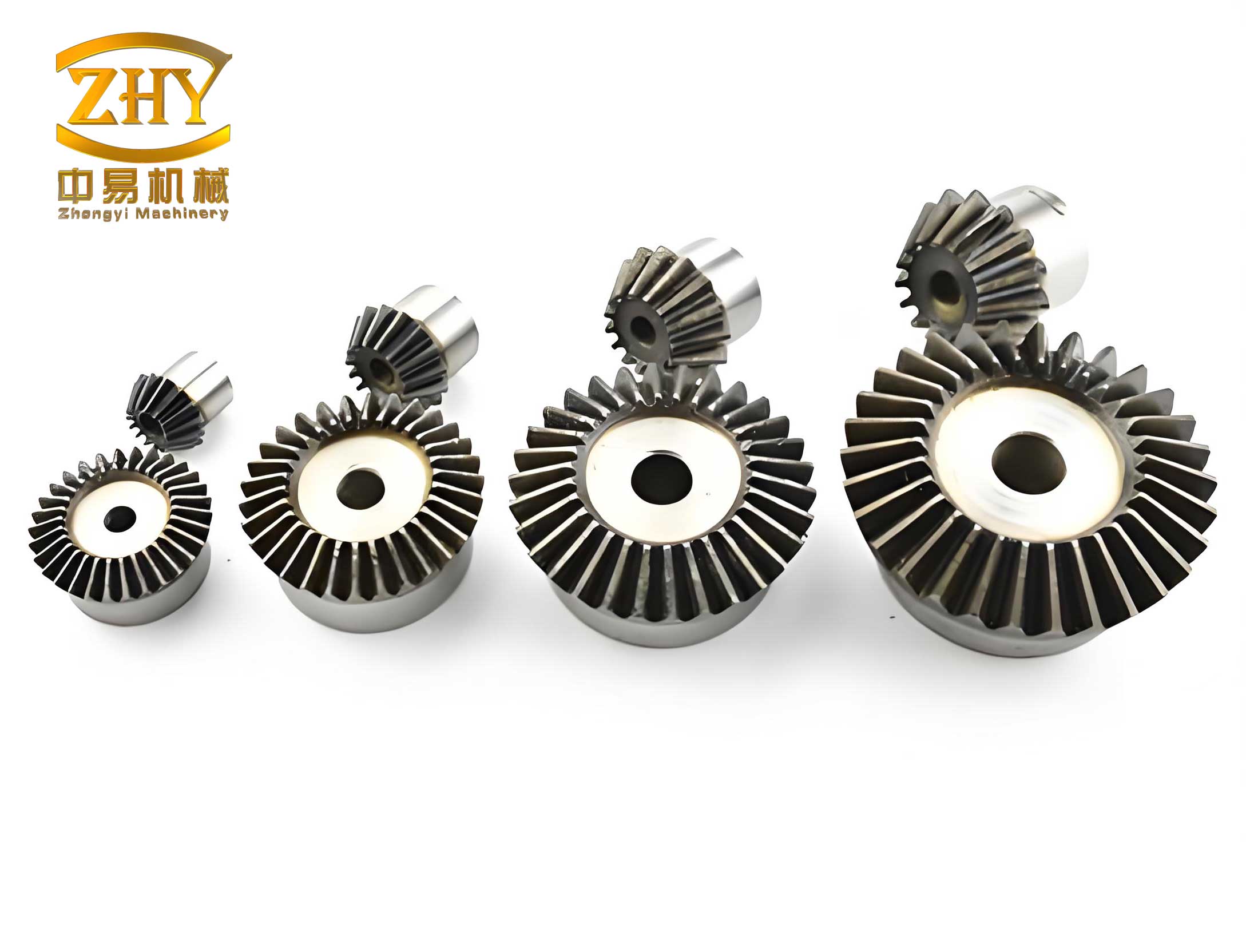
The manufacturing process for these bevel gears involves several key steps: raw material sawing, forging (at approximately 1200°C), normalizing (at 940°C), machining, carburizing and quenching (at 920–930°C with a carbon potential of 1.1–1.2, using Houghton quenching oil at 60°C), cleaning (at 70–100°C), low-temperature tempering (at 180–200°C), and finally straightening. The fracture occurred during the straightening stage, prompting a detailed failure analysis to ensure the integrity of bevel gears in automotive systems.
To understand the fracture mechanism, multiple analytical techniques were employed, including spectral analysis, high-magnification microstructure examination, scanning electron microscopy (SEM), and energy-dispersive spectroscopy (EDS). These methods help in identifying material defects, microstructural anomalies, and fracture origins that could compromise the performance of bevel gears.
Material Composition and Testing Methodology
The bevel gears are fabricated from 20CrMnTiH steel, a chromium-manganese-titanium alloy steel commonly used for high-strength components due to its good hardenability and wear resistance. The chemical composition of the steel is crucial for its mechanical properties, and it must adhere to standard specifications such as GB/T 5216—2014. Spectral analysis was conducted using a GS 1000 device from Spectro Analytical Instruments to verify the composition.
| Element | C | Si | Mn | Cr | Ti | P | S |
|---|---|---|---|---|---|---|---|
| Standard Range | 0.17–0.23 | 0.17–0.37 | 0.80–1.20 | 1.00–1.45 | 0.04–0.10 | ≤0.035 | ≤0.035 |
| Measured Value | 0.21 | 0.26 | 1.01 | 1.15 | 0.08 | 0.011 | 0.006 |
The measured composition falls within the standard range, indicating that the material meets chemical requirements. However, chemical analysis alone is insufficient to detect physical defects that may lead to fracture in bevel gears.
High-magnification microstructure analysis was performed using an Axio Scope.A1 microscope from Zeiss, with samples prepared mechanically to observe the grain structure and any cracks. This technique helps in identifying microstructural features such as decarburization, oxidation, and grain boundary weaknesses that are critical for the durability of bevel gears.
Scanning electron microscopy and energy-dispersive spectroscopy were carried out with an EVO MA25 device from Zeiss. SEM provides detailed images of fracture surfaces, while EDS analyzes elemental composition at specific points, aiding in the detection of oxides and other contaminants that could initiate cracks in bevel gears.
To quantify the stress conditions during service, the von Mises stress criterion can be applied, which is relevant for assessing yield in ductile materials like steel used in bevel gears. The von Mises stress \(\sigma_v\) is given by:
$$ \sigma_v = \sqrt{\frac{(\sigma_1 – \sigma_2)^2 + (\sigma_2 – \sigma_3)^2 + (\sigma_3 – \sigma_1)^2}{2}} $$
where \(\sigma_1\), \(\sigma_2\), and \(\sigma_3\) are the principal stresses. For bevel gears under load, this stress must remain below the material’s yield strength to prevent plastic deformation and fracture.
Macroscopic and Microscopic Analysis of Fracture
The macroscopic examination of the fracture surface revealed a distinct fracture origin at the lower left corner of the cross-section. The crack propagated from this source towards the core, leading to final rupture. The core region exhibited a ductile fracture appearance, while the instantaneous fracture zone showed brittle characteristics, indicating a mixed-mode failure typical in bevel gears under stress.
High-magnification analysis of samples taken from the crack source, crack propagation area, and instantaneous fracture zone provided further insights. The matrix structure consisted of a quenched and low-temperature tempered microstructure, which is expected for carburized bevel gears. At the crack source, intergranular cracking was observed, with significant decarburization along the crack flanks. This decarburization suggests that the crack existed prior to straightening, likely forming during forging or subsequent high-temperature processes. The presence of oxides within the cracks confirms exposure to elevated temperatures, aligning with the manufacturing history of bevel gears.
| Sample Location | Microstructure | Crack Type | Observations |
|---|---|---|---|
| Crack Source | Quenched + Tempered | Intergranular | Decarburization, oxidation along grain boundaries |
| Core Propagation Area | Quenched + Tempered | Mixed | Minor oxidation, ductile features |
| Instantaneous Fracture Zone | Quenched + Tempered | Transgranular | Cleavage fracture, no oxidation |
In the crack source area, secondary microcracks were distributed along grain boundaries with internal oxidation, as shown in SEM images. In contrast, the instantaneous fracture zone contained smooth microcracks without oxidation, indicating rapid fracture during straightening. These findings highlight the role of pre-existing defects in the failure of bevel gears.
The oxidation kinetics of steel at high temperatures can be described by the parabolic rate law, which is relevant for understanding oxide formation during forging of bevel gears. The weight gain per unit area \(w\) over time \(t\) is given by:
$$ w^2 = k_p t $$
where \(k_p\) is the parabolic rate constant, dependent on temperature and material composition. For 20CrMnTiH steel, oxidation during forging could lead to oxide penetration along grain boundaries, weakening the structure and initiating cracks in bevel gears.
Scanning Electron Microscopy and Energy-Dispersive Spectroscopy Results
SEM examination of the fracture surfaces revealed distinct morphologies at the crack source and instantaneous fracture zone. At the crack source, the structure appeared coarse with intergranular fracture features and a cloudy oxide layer, indicative of high-temperature exposure. The instantaneous fracture zone displayed a cleavage-like transgranular fracture, characteristic of brittle failure under stress. These differences underscore the impact of pre-existing flaws on the fracture behavior of bevel gears.
EDS analysis was conducted at three points along a longitudinal secondary crack in the crack source area to determine elemental composition. The results showed high oxygen content at all points, confirming the presence of high-temperature oxides. This oxidation aligns with the forging process, where temperatures around 1200°C can promote oxide formation if defects are present in the raw material used for bevel gears.
| Point | O | Fe | Cr | Mn | Si | Ti |
|---|---|---|---|---|---|---|
| 1 | 45.2 | 40.1 | 8.5 | 4.3 | 1.2 | 0.7 |
| 2 | 42.8 | 42.0 | 7.8 | 5.1 | 1.5 | 0.8 |
| 3 | 44.5 | 41.3 | 8.0 | 4.5 | 1.0 | 0.7 |
The high oxygen levels (over 40% atomic) indicate severe oxidation, which compromises the material integrity and acts as stress concentrators, leading to crack initiation in bevel gears. The fracture toughness \(K_{IC}\) of the material can be estimated to assess crack resistance. For steel, \(K_{IC}\) is related to stress intensity factor \(\Delta K\) during cyclic loading, which is critical for bevel gears under operational stresses:
$$ \Delta K = Y \sigma \sqrt{\pi a} $$
where \(Y\) is a geometric factor, \(\sigma\) is the applied stress, and \(a\) is the crack length. Pre-existing cracks from raw material defects reduce the effective \(K_{IC}\), making bevel gears prone to fracture during subsequent processing like straightening.
Root Cause Analysis and Discussion
Based on the comprehensive testing, the primary cause of the fracture in the driving bevel gears is identified as defects in the raw material. The cracks originated during the forging process, where high temperatures caused oxidation and decarburization along grain boundaries. These pre-existing cracks then propagated under the stress applied during straightening, leading to catastrophic failure. This failure mode is particularly concerning for bevel gears, as they must withstand high torque and cyclic loads in automotive applications.
The presence of intergranular cracking with oxidation suggests that the material experienced overheating or improper cooling during forging. The oxidation reaction can be modeled using the Arrhenius equation, where the rate constant \(k\) depends on temperature \(T\):
$$ k = A e^{-\frac{E_a}{RT}} $$
Here, \(A\) is the pre-exponential factor, \(E_a\) is the activation energy for oxidation, \(R\) is the gas constant, and \(T\) is the absolute temperature. For bevel gears, controlling forging temperatures is essential to minimize oxide formation and prevent defect initiation.
Additionally, the decarburization observed along crack flanks reduces the carbon content in surface layers, lowering hardness and fatigue strength. The depth of decarburization \(d\) can be approximated by Fick’s law of diffusion:
$$ d = \sqrt{D t} $$
where \(D\) is the diffusion coefficient for carbon in steel, and \(t\) is the time at high temperature. In bevel gears, decarburization weakens the surface, making it more susceptible to crack propagation under bending stresses.
The role of non-metallic inclusions cannot be overlooked in the failure analysis of bevel gears. Inclusions such as oxides or sulfides can act as stress raisers, initiating cracks under load. The stress concentration factor \(K_t\) due to an inclusion is given by:
$$ K_t = 1 + 2\sqrt{\frac{a}{\rho}} $$
where \(a\) is the inclusion size and \(\rho\) is the root radius. Larger inclusions significantly increase \(K_t\), reducing the fatigue life of bevel gears. While the EDS analysis did not show prominent inclusions, micro-cracks from oxidation served similar roles in this case.
Preventive Measures and Quality Assurance
To mitigate fracture risks in bevel gears, several countermeasures are proposed, focusing on raw material quality and in-process inspections. These measures are essential for ensuring the reliability of bevel gears in critical applications like automotive transmissions.
| Measure | Description | Purpose |
|---|---|---|
| Raw Material Ultrasonic Testing | Use探伤 materials with ultrasonic inspection to detect internal and surface defects before production. | Eliminate defective raw materials that could cause cracks in bevel gears. |
| Magnetic Particle Inspection After Straightening | Perform magnetic particle testing on all bevel gears after straightening to identify surface cracks. | Ensure no cracks are present in finished bevel gears before shipment. |
| Destructive Testing Sampling | Conduct destructive tests on samples from each batch to verify mechanical strength and microstructure. | Validate batch quality and identify process issues for bevel gears. |
| Process Control in Forging | Optimize forging temperature and cooling rates to prevent oxidation and decarburization. | Reduce defect formation during manufacturing of bevel gears. |
Implementing these measures requires a systematic approach. For instance, ultrasonic testing can detect flaws as small as 0.5 mm in diameter, which is crucial for high-stress components like bevel gears. The probability of detection \(P_d\) can be modeled using statistical methods to ensure quality control.
Furthermore, the fatigue life of bevel gears can be enhanced by surface treatments such as shot peening, which introduces compressive residual stresses. The residual stress \(\sigma_r\) after shot peening can be estimated by:
$$ \sigma_r = -S \ln\left(\frac{N}{N_0}\right) $$
where \(S\) is a material constant, \(N\) is the peening intensity, and \(N_0\) is a reference value. This improves the resistance to crack initiation in bevel gears under cyclic loading.
Regular metallurgical audits should be conducted to monitor the microstructure of bevel gears. The grain size \(d\) can be related to yield strength \(\sigma_y\) via the Hall-Petch equation:
$$ \sigma_y = \sigma_0 + \frac{k_y}{\sqrt{d}} $$
where \(\sigma_0\) is the friction stress and \(k_y\) is the strengthening coefficient. Finer grains improve toughness and fatigue performance, which is vital for the durability of bevel gears.
Conclusion
The fracture failure of 20CrMnTiH steel driving bevel gears was primarily attributed to raw material defects that led to crack formation during forging, followed by oxidation and decarburization. These pre-existing cracks propagated under straightening stresses, resulting in brittle fracture. Through detailed analysis using spectral, microscopic, SEM, and EDS techniques, the root cause was confirmed, highlighting the importance of material quality in the production of bevel gears.
The proposed countermeasures—including raw material ultrasonic testing, magnetic particle inspection, destructive sampling, and process optimization—have proven effective in preventing similar failures. After implementation, no anomalies were detected during straightening, and the bevel gears met all quality standards, earning positive feedback from clients. This case underscores the critical need for rigorous quality control in manufacturing bevel gears to ensure their performance and safety in automotive and industrial applications.
Future work could involve advanced modeling of crack propagation in bevel gears using finite element analysis (FEA) to simulate stress distributions under load. The Paris’ law for fatigue crack growth is relevant here:
$$ \frac{da}{dN} = C (\Delta K)^m $$
where \(da/dN\) is the crack growth rate per cycle, \(C\) and \(m\) are material constants, and \(\Delta K\) is the stress intensity factor range. Integrating such models into design and testing protocols can further enhance the reliability of bevel gears.
In summary, continuous improvement in material selection, processing, and inspection is essential for the longevity of bevel gears. By addressing raw material defects and implementing robust quality assurance measures, manufacturers can produce bevel gears that withstand operational demands, contributing to safer and more efficient mechanical systems.