
As an integral component in high-precision, high-load linear motion systems, the planetary roller screw assembly (PRSA) offers superior power density and stiffness compared to its ball screw counterpart. However, its torque characteristics and efficiency are significantly influenced by internal friction, which originates from complex interactions within its multi-body contact mechanics. While material properties and operating conditions play a role, the unique structural and kinematic configuration of a planetary roller screw assembly is a primary source of its distinctive frictional behavior. This article, from my perspective as a researcher in this field, aims to provide a deep, first-principles analysis of the dominant friction mechanisms, namely elastic hysteresis loss and spin-induced sliding, which are often the main contributors to the overall drag torque. Establishing a clear quantitative relationship between the applied axial load and the resulting friction torque is paramount for the optimal design, selection of lubrication, and accurate prediction of service life for any planetary roller screw assembly.
Fundamental Structure and Kinematics
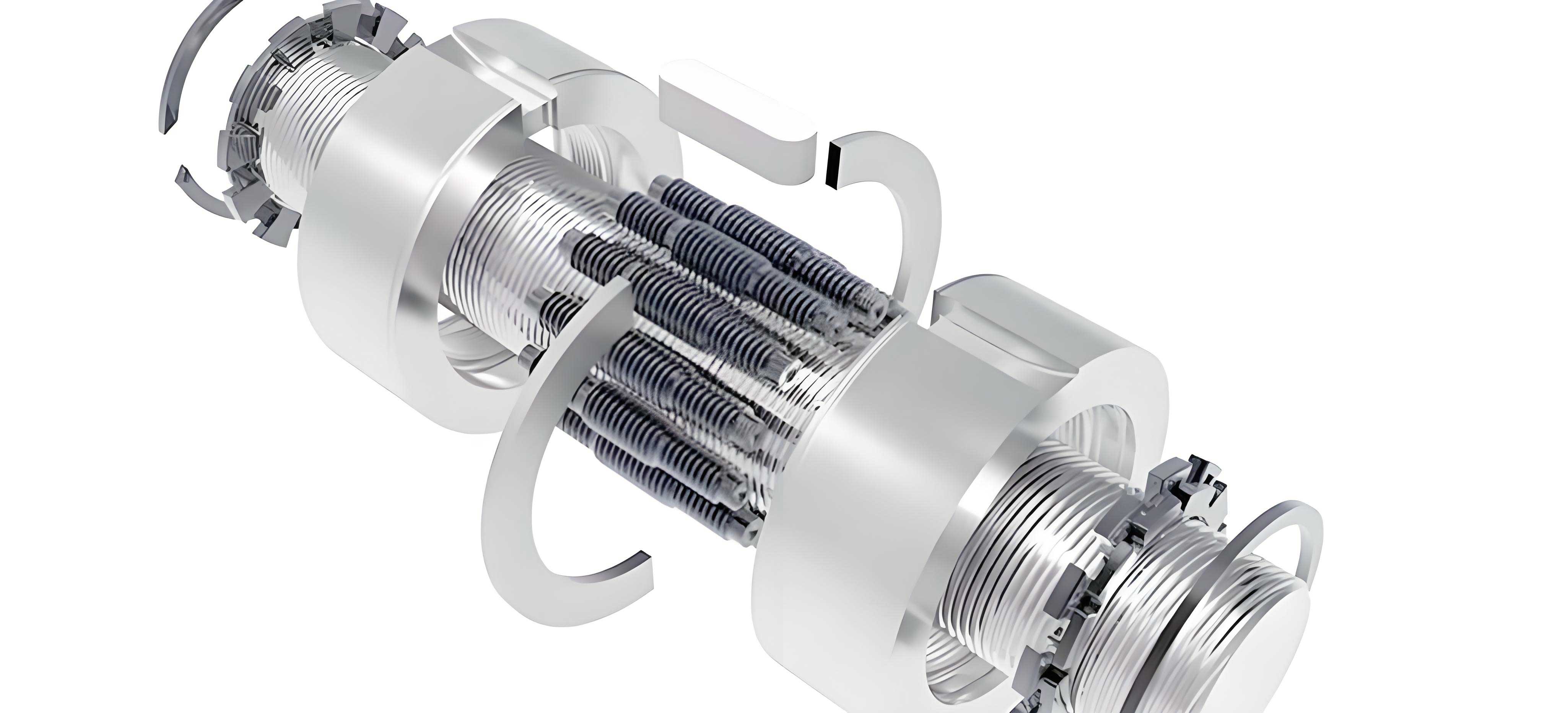
A planetary roller screw assembly fundamentally transforms rotary motion into linear motion, or vice versa, through the engagement of three primary components: a central threaded screw, a threaded nut, and a set of threaded rollers arranged circumferentially between them. The rollers are housed in a cage or carrier that maintains their angular spacing and guides their planetary motion. The key kinematic principle is that the rollers do not undergo axial translation relative to the nut; instead, they orbit around the screw axis while rotating about their own axes. The thread profiles, typically with a 45-degree angle (often denoted as $\lambda$), ensure pure rolling contact in theory. However, the constrained axis of roller rotation, which remains parallel to the screw axis, and the inclined contact surfaces lead to a kinematic condition that inherently generates sliding, a primary source of friction.
The contact geometry between a roller and the screw, and between the same roller and the nut, can be modeled as a series of discrete point contacts or, more accurately, as elliptical contact areas due to elastic deformation under load. The force transmission from the nut to the screw occurs through these loaded contact ellipses on each thread flank of every roller. For an assembly with $Z$ rollers and a screw with $n$ starts (or a nut with an equivalent number of engaged threads per roller), the total number of active contact points is substantial, making the cumulative friction effect significant.
Friction Due to Elastic Hysteresis
Elastic hysteresis is a material-dependent phenomenon where the energy expended in deforming a body during loading is not fully recovered during unloading. In the context of a planetary roller screw assembly, as a roller rolls through the contact zone with either the screw or the nut, the material ahead of the contact is compressed (loaded), while the material behind is released (unloaded). The energy loss during this cycle manifests as a resistance to rolling, known as rolling friction.
Theoretical Foundation and Derivation
To analyze this, we consider the Hertzian contact ellipse formed at the interface, as shown conceptually below. The contact ellipse has semi-major axis $a$ and semi-minor axis $b$, aligned such that rolling occurs along the direction of the $y$-axis.
The contact pressure $q$ at any point $(x, y)$ within the ellipse is given by:
$$ q(x, y) = q_0 \left(1 – \frac{x^2}{a^2} – \frac{y^2}{b^2}\right)^{1/2} $$
where $q_0 = \frac{3Q}{2\pi a b}$ is the maximum Hertzian pressure and $Q$ is the normal load at that specific contact point.
The vertical deformation (compliance) at point $(x, y)$ can be expressed as $W = W_0 – A x^2 – B y^2$, where $W_0$ is the mutual approach of the two bodies and $A$, $B$ are constants dependent on the principal curvatures of the contacting surfaces. As the roller advances a unit distance along $y$, the rate of change of deformation at $(x, y)$ is $\partial W / \partial y = -2B y$.
The work done by the pressure over a differential area $dx\,dy$ during this unit motion is therefore:
$$ dN = -q(x, y) \, dx\,dy \cdot (\partial W / \partial y) = 2B \, q(x, y) \, y \, dx\,dy $$
Integrating this over the entire contact ellipse (specifically, the leading half where $y > 0$, as this is where loading occurs) gives the total work input per unit distance:
$$ N = \int_{y=0}^{b} \int_{x=-a\sqrt{1-y^2/b^2}}^{a\sqrt{1-y^2/b^2}} 2B \, q_0 \left(1 – \frac{x^2}{a^2} – \frac{y^2}{b^2}\right)^{1/2} y \, dx\,dy = \frac{3}{8} B b Q $$
Due to elastic hysteresis, not all this energy is recovered. If we denote the energy loss coefficient by $\xi$, the energy lost per unit distance (which equals the friction force $F_R$ for that contact) is $\xi N$. Therefore, the rolling friction coefficient for the contact is:
$$ f_R = \frac{F_R}{Q} = \frac{\xi N}{Q} = \frac{3}{8} \xi B b $$
Consequently, the friction torque at a single contact point, relative to the screw or nut axis, depends on the effective moment arm. However, for the purpose of calculating the total resistive torque on the screw/nut, it is more direct to consider the power loss. The torque $M_{R,i}$ due to hysteresis at contact $i$ with load $Q_i$ is proportional to $f_R Q_i$. For a planetary roller screw assembly, we must sum the contributions from all $Z$ rollers and their engaged threads. For contacts between the rollers and the screw, the semi-minor axis $b_1$ and curvature sum $B_1$ apply, and for contacts with the nut, $b_2$ and $B_2$ apply.
The key curvature parameter $B$ is derived from the principal curvatures of the contacting bodies. For the roller-screw contact ($\rho_{11}=1/R_r, \rho_{12}=1/R_r$ for the roller; $\rho_{21}=0, \rho_{22}=2\cos\lambda / (d_m – 2R_r \cos\lambda)$ for the screw thread). For the roller-nut contact, the nut thread curvature is $\rho_{22} = -2\cos\lambda / (d_m + 2R_r \cos\lambda)$. A simplified but accurate approximation for a 45° thread angle and similar radii is $B \approx 1/(2R_r)$.
The semi-minor axis $b$ for a Hertzian contact is given by:
$$ b = m_b \left[ \frac{3Q (1 – \nu^2)}{E \Sigma \rho} \right]^{1/3} $$
where $m_b$ is a Hertzian elasticity coefficient dependent on the curvature ratio, $E$ is Young’s modulus, $\nu$ is Poisson’s ratio, and $\Sigma\rho$ is the sum of principal curvatures.
Thus, the total friction torque contribution from elastic hysteresis in a planetary roller screw assembly can be expressed as the sum of screw-roller and nut-roller contacts:
$$ M_{hys} = M_{hys,s} + M_{hys,n} = Z \sum_{i=1}^{n} \left[ \frac{3}{8} \xi B_1 b_{1,i} Q_i + \frac{3}{8} \xi B_2 b_{2,i} Q_i \right] $$
Assuming a nearly uniform load distribution $Q_i \approx Q_{avg}$ and similar geometry for each thread, this simplifies to:
$$ M_{hys} \approx \frac{3}{8} \xi Z n Q_{avg} (B_1 b_1 + B_2 b_2) $$
Substituting the expression for $b$, we see the hysteresis torque has a non-linear relationship with load: $M_{hys} \propto Q_{avg}^{4/3}$. The hysteresis loss coefficient $\xi$ is material-dependent; for hardened bearing steel, it is typically in the range of 0.007 to 0.009.
| Parameter | Symbol | Value (Example) | Unit |
|---|---|---|---|
| Number of Rollers | $Z$ | 5 | – |
| Number of Screw Starts / Engaged Threads | $n$ | 4 | – |
| Roller Radius | $R_r$ | 1.5 | mm |
| Thread Angle | $\lambda$ | 45 | deg |
| Pitch Diameter | $d_m$ | 8 | mm |
| Young’s Modulus | $E$ | 210 | GPa |
| Poisson’s Ratio | $\nu$ | 0.3 | – |
| Hysteresis Loss Coefficient | $\xi$ | 0.008 | – |
| Curvature Parameter (Approx.) | $B_1, B_2$ | $1/(2R_r)$ | mm⁻¹ |
Friction Due to Spin-Induced Sliding
While elastic hysteresis is present in all rolling contacts, the planetary roller screw assembly is particularly susceptible to another, often more significant, source of friction: spin-induced sliding. This mechanism is a direct consequence of its constrained kinematics.
Kinematic Origin of Spin
In an ideal pure rolling scenario, the instantaneous velocity vectors of the two contacting bodies at the contact point are equal. In a planetary roller screw assembly, the roller’s axis of rotation is constrained by the cage to be parallel to the screw axis. The contact normal vector at the thread flank, however, is inclined at the thread angle $\lambda$ (e.g., 45°) relative to this axis. When the angular velocity vector $\boldsymbol{\omega}_r$ of the roller is decomposed at the contact point, one component is perpendicular to the contact plane, causing a pivoting or “spinning” motion about the contact normal. This component, $\omega_s = \omega_r \cos \lambda$, is termed the spin angular velocity.
Since the contact area is an ellipse, not a single point, this spin motion results in micro-slip across the entire contact patch, except potentially at one point (the spin pole). This sliding dissipates energy through Coulomb friction.
Quantifying Spin Sliding Friction
The friction torque generated at a single contact ellipse due to spin can be calculated by integrating the moment of the micro-slip friction forces over the contact area. The differential friction force on an element $dx\,dy$ is $dF = \mu_s \, q(x,y) \, dx\,dy$, where $\mu_s$ is the local sliding friction coefficient (often taken as 0.05-0.08 under boundary/mixed lubrication). The moment arm of this force about the center of the ellipse (the spin axis) is $p = \sqrt{x^2 + y^2}$. The differential friction torque opposing the spin motion is therefore $dM_{spin} = p \, dF$.
The total spin friction torque for one contact is:
$$ M_{spin} = \iint_{\text{Ellipse}} \mu_s \, q(x,y) \, p \, dx\,dy = \mu_s \frac{3Q}{2\pi a b} \iint_{\text{Ellipse}} \left(1 – \frac{x^2}{a^2} – \frac{y^2}{b^2}\right)^{1/2} \sqrt{x^2 + y^2} \, dx\,dy $$
This integral, $I_{spin}(a, b)$, depends solely on the dimensions of the contact ellipse. It can be evaluated numerically or approximated. A common approximation for near-circular contacts ($a \approx b$) is $I_{spin} \approx \frac{3\pi}{16} a^3$. More generally, it is a function of the ellipse’s eccentricity.
Critically, in a planetary roller screw assembly, the spin friction torque $M_{spin}$ acts about the contact normal. To find its effect on the axial motion (i.e., the torque required to turn the screw or nut), we must resolve it into the axial direction. The component resisting the relative rotation between the roller and the screw/nut is $M_{spin} \cos \lambda$. This torque is experienced at both the screw-roller and nut-roller interfaces.
Therefore, the total contribution of spin-induced sliding to the axial friction torque of the planetary roller screw assembly is:
$$ M_{spin,total} = Z \sum_{i=1}^{n} \cos\lambda \left[ \mu_{s,1} \frac{3Q_i}{2\pi a_1 b_1} I_{spin}(a_1, b_1) + \mu_{s,2} \frac{3Q_i}{2\pi a_2 b_2} I_{spin}(a_2, b_2) \right] $$
Since the contact ellipse dimensions $a$ and $b$ are themselves functions of $Q^{1/3}$ (from Hertz theory), the spin friction torque also exhibits a non-linear relationship with load: $M_{spin} \propto \mu_s Q^{4/3}$. For typical geometries, the spin term often dominates the total friction in a planetary roller screw assembly, especially under higher loads.
| Contact Pair | Semi-major axis $a$ | Semi-minor axis $b$ | Eccentricity $e=\sqrt{1-(b/a)^2}$ | Approx. $I_{spin}(a,b)$ |
|---|---|---|---|---|
| Roller-Screw | $a_1 = m_{a1} \left[\frac{3Q(1-\nu^2)}{E\Sigma\rho_1}\right]^{1/3}$ | $b_1 = m_{b1} \left[\frac{3Q(1-\nu^2)}{E\Sigma\rho_1}\right]^{1/3}$ | Low (~0.1-0.3) | $\frac{3\pi}{16} b_1^3 \cdot f(e)$ |
| Roller-Nut | $a_2 = m_{a2} \left[\frac{3Q(1-\nu^2)}{E\Sigma\rho_2}\right]^{1/3}$ | $b_2 = m_{b2} \left[\frac{3Q(1-\nu^2)}{E\Sigma\rho_2}\right]^{1/3}$ | Higher (~0.4-0.6) | $\frac{3\pi}{16} b_2^3 \cdot f(e)$ |
Note: $m_a$, $m_b$ are Hertzian coefficients from elasticity theory; $f(e)$ is a correction factor >1 for elliptical contacts.
Comprehensive Friction Model and Analysis
The total friction torque $M_{total}$ in a planetary roller screw assembly under an axial load $F_a$ is the sum of the hysteresis and spin components, plus potential additional terms from seals, cage guidance, and lubricant drag (often modeled as a constant or speed-dependent term $M_0$). The load $Q_i$ on an individual contact is related to the total axial load $F_a$ through the system geometry:
$$ Q_{avg} \approx \frac{F_a}{Z n \sin\lambda \cos\lambda} $$
Combining the derived expressions, a practical friction model for a planetary roller screw assembly can be formulated as:
$$ M_{total}(F_a) = M_0 + C_{hys} \cdot F_a^{4/3} + C_{spin} \cdot F_a^{4/3} = M_0 + C_{total} \cdot F_a^{4/3} $$
where $C_{hys}$ and $C_{spin}$ are assembly-specific constants aggregating all geometric, material, and tribological parameters:
$$ C_{hys} = \frac{3}{8} \xi Z n (B_1 b_1^* + B_2 b_2^*) \cdot (Z n \sin\lambda \cos\lambda)^{-4/3} $$
$$ C_{spin} = \frac{3}{2\pi} \cos\lambda Z n (\mu_{s,1} I_{spin,1}^* + \mu_{s,2} I_{spin,2}^*) \cdot (Z n \sin\lambda \cos\lambda)^{-4/3} $$
$$ C_{total} = C_{hys} + C_{spin} $$
In these expressions, $b^*$ and $I_{spin}^*$ represent the parts of $b$ and $I_{spin}$ that are proportional to $Q^{1/3}$, with the $Q$ dependence factored out into the $F_a^{4/3}$ term.
Model Validation and Discussion
Calculations performed for a representative planetary roller screw assembly with a nominal diameter of 8 mm, lead of 0.5 mm (4 starts), and 5 rollers confirm the theoretical relationships. The spin friction term was found to be significantly larger than the hysteresis term for this configuration, often by a factor of 5 to 10, depending on the assumed sliding coefficient $\mu_s$. This dominance explains why the overall friction in a planetary roller screw assembly is generally higher than in a geometrically similar ball screw, where spin motion is minimized by the free rotation of the balls.
The calculated total friction torque curve $M_{total}(F_a)$ follows the $F_a^{4/3}$ power law closely. When compared with experimental measurements, the model shows good qualitative agreement, capturing the non-linear rise with load. Any quantitative discrepancy can typically be attributed to factors not fully captured in this basic model:
- Load Distribution: The assumption of perfectly uniform load sharing among all threads and rollers is ideal. In practice, manufacturing tolerances and elastic deflections cause non-uniform loading, affecting the summation.
- Lubrication Regime: The sliding friction coefficient $\mu_s$ is not a constant but varies with lubrication condition (boundary, mixed, elastohydrodynamic).
- Additional Losses: Friction from the roller guiding mechanism (cage), elastomeric seals, and lubricant churning ($M_0$) adds a load-independent or speed-dependent component.
- Thermal Effects: Under high-speed or high-load operation, thermal expansion can alter clearances and contact geometries.
| Friction Source | Symbol | Calculated Torque (N·m) | Percentage of Total | Dependence |
|---|---|---|---|---|
| Elastic Hysteresis | $M_{hys}$ | 0.05 – 0.10 | ~10% | $\propto \xi Q^{4/3}$ |
| Spin-Induced Sliding | $M_{spin}$ | 0.45 – 0.90 | ~80-85% | $\propto \mu_s Q^{4/3}$ |
| Other Losses (Seals, Cage, Drag) | $M_0$ | 0.05 – 0.10 | ~5-10% | Constant / Speed Dep. |
| Total Model Prediction | $M_{total}$ | 0.55 – 1.10 | 100% | $M_0 + C F_a^{4/3}$ |
Implications for Design and Application
Understanding these friction mechanisms is not an academic exercise; it provides essential levers for optimizing the performance of a planetary roller screw assembly.
1. Minimizing Spin Friction: Since spin sliding is dominant, design choices that reduce $\mu_s$ or the spin velocity component are most effective.
* Lubrication: Selecting high-performance lubricants (e.g., synthetic oils/greases with extreme pressure additives) that can maintain a durable film and lower the effective sliding coefficient is critical.
* Thread Angle: While a 45° angle is standard, a reduced thread angle $\lambda$ would decrease the spin component $\omega \cos\lambda$. However, this trade-off must be balanced against axial load capacity and manufacturability.
* Surface Finish: Ultra-smooth finishing of thread flanks reduces the asperity interaction and micro-slip resistance.
2. Material Selection for Hysteresis: Using high-quality, clean bearing steel with minimal internal damping (low $\xi$) helps minimize the hysteresis loss component.
3. Preload Management: Preload in a planetary roller screw assembly eliminates backlash but increases internal load $Q$ and thus friction. The model $M \propto F_a^{4/3}$ shows that even a small increase in preload can cause a noticeable rise in running torque and heat generation. Optimal preload must balance stiffness against efficiency and thermal growth.
4. Life Estimation: Friction is directly linked to wear and subsurface stress cycles. Accurate modeling of contact loads and sliding velocities (from spin) allows for more precise fatigue life calculations (e.g., using modified Ioannides-Harris or Lundberg-Palmgren theories) for the planetary roller screw assembly.
Conclusion and Future Perspectives
In this analysis, I have deconstructed the primary friction mechanisms inherent to the planetary roller screw assembly. The theoretical framework establishes that friction torque arises principally from two sources: material elastic hysteresis and, more significantly, kinematic spin-induced sliding at the inclined thread contacts. The derived relationships culminate in a model where the load-dependent friction torque is proportional to the axial load raised to the 4/3 power ($M \propto F_a^{4/3}$), a characteristic signature of Hertzian-contact-dominated systems.
This model serves as a vital theoretical foundation. It moves beyond empirical fitting and provides designers with insights into how geometric parameters (roller count $Z$, starts $n$, thread angle $\lambda$), material properties ($\xi$, $E$), and tribological conditions ($\mu_s$) collectively determine the performance of a planetary roller screw assembly. Future research directions to refine this model include:
* Developing more accurate, closed-form solutions for the spin friction integral $I_{spin}(a,b)$ over a wide range of ellipticities.
* Integrating a transient, thermally-coupled analysis to predict friction under dynamic operating conditions.
* Experimentally mapping the effective sliding friction coefficient $\mu_s$ across different lubrication regimes specific to the planetary roller screw assembly environment.
* Investigating the impact of non-uniform load distribution due to manufacturing errors and system deflections on the total friction torque summation.
By continuing to refine our understanding of these friction mechanisms, we can drive the development of more efficient, reliable, and higher-performance planetary roller screw assemblies for the most demanding motion control applications.