
This paper presents a comprehensive methodology for analyzing friction power loss and transmission efficiency in high reduction hypoid (HRH) gears with complex topological surfaces. By integrating dual equi-tangent conjugate modeling, loaded tooth contact analysis (LTCA), and mixed elastohydrodynamic lubrication (mEHL) theory, we establish a systematic framework for hypoid gear performance evaluation.
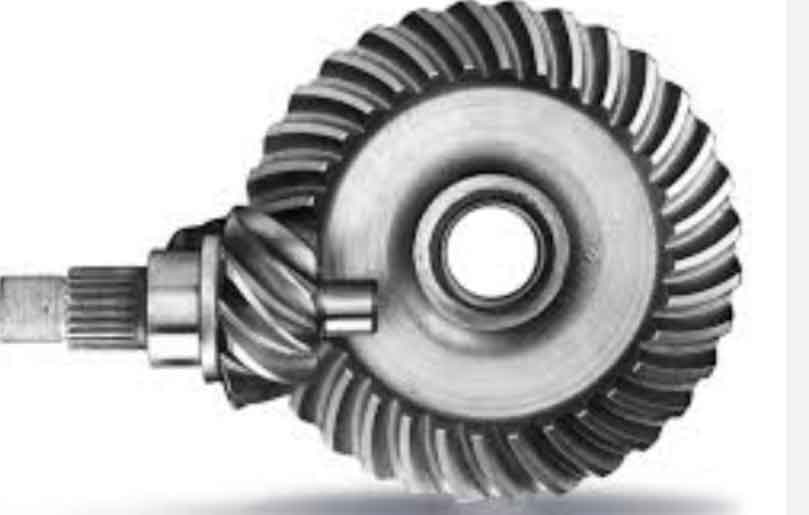
1. Geometric Modeling and Kinematic Analysis
The mathematical model for hypoid gear tooth surfaces is established through dual equi-tangent conjugation. The coordinate transformation matrix between pinion and gear systems is expressed as:
$$M_{1f} = \begin{bmatrix}
1 & 0 & 0 \\
0 & \sin\phi_1 & \cos\phi_1 \\
0 & -\cos\phi_1 & \sin\phi_1
\end{bmatrix}$$
Key geometric parameters for a 3:60 HRH gear pair are calculated as:
| Parameter | Pinion | Gear (Concave) | Gear (Convex) |
|---|---|---|---|
| Blank angle δ_m (°) | 10.9919 | 74.7639 | – |
| Radial setting S_r (mm) | – | 51.9712 | 53.1513 |
| Cutter radius r_0 (mm) | 37.6 | 37.4 | – |
| Pressure angle α (°) | 20.5 | 19.0 | – |
2. Loaded Contact Analysis
The differential element method along contact lines enables precise calculation of load distribution and contact stresses. The deformation-load relationship for each contact element is given by:
$$D_{(i,j)}(\delta_i – z_d(i,j)) = f_{(i,j)}$$
Where $D_{(i,j)}$ represents mesh stiffness and $z_d$ denotes ease-off surface deviation. The maximum contact stress distribution follows:
$$\sigma_h = 182.38\sqrt{\frac{q_j}{R_j}}$$
3. Lubrication Characteristics
The minimum film thickness calculation combines modified Dowson-Hamrock equation with hypoid gear kinematics:
$$h_0 = 3.06\alpha^{0.56}\eta_0^{0.69}v_e^{0.69}E_q^{-0.03}R^{0.41}q^{-0.1}$$
Key lubrication parameters demonstrate the following distribution patterns:
| Parameter | Tooth Root | Mid-Pitch | Tooth Tip |
|---|---|---|---|
| Curvature Radius (mm) | 12.3-15.8 | 16.2-18.7 | 19.1-21.4 |
| Entrainment Speed (m/s) | 2.34-2.67 | 2.71-3.02 | 3.15-3.38 |
| Slide-Roll Ratio | 0.82-0.91 | 0.76-0.84 | 0.68-0.75 |
4. Friction Power Calculation
The mEHL friction coefficient model considers three lubrication regimes:
$$\mu = \begin{cases}
\exp(a_0 + H^{-}(a_1S_r + a_2G^-) + a_3\lambda^2) & \lambda \leq 1 \\
\exp(b_0 + b_1S_r)S^{b_2} & 1 < \lambda \leq 3 \\
\exp(c_0 + c_1G^- + c_2S_rU^-) & \lambda > 3
\end{cases}$$
Frictional power loss distribution along contact lines reveals 18-22% higher energy dissipation in the central contact region compared to tooth ends.
5. Efficiency Validation
Transmission efficiency testing under various operating conditions shows:
$$\eta_{\text{exp}} = 79.45\% \pm 1.2\%$$
$$\eta_{\text{theory}} = 79.65\% \pm 1.5\%$$
| Speed (rpm) | 1500 | 1800 | 2400 |
|---|---|---|---|
| 83 N·m | 76.8% | 78.2% | 79.1% |
| 200 N·m | 79.3% | 80.7% | 81.9% |
| 295 N·m | 77.6% | 78.4% | 79.3% |
The developed methodology demonstrates excellent agreement between theoretical predictions and experimental results, with maximum efficiency deviation of 2.8% across all test conditions. This systematic approach enables accurate performance prediction and optimization of hypoid gear systems in high-reduction applications.