
In gear engineering, the production of internal meshing straight bevel gears, commonly known as miter gears, has been plagued by significant challenges. Existing machining techniques often yield poor meshing quality, hindering the widespread adoption of these gears. As a researcher in this field, I have delved into the meshing theory of miter gears and propose a groundbreaking solution: the full-forming machining method. This approach abandons the conventional notion that tooth flanks must be spherical involutes and instead leverages second-order generation theory to enable point contact with controlled local conjugation. In this article, I will elucidate the principle, detailing the machining processes for both the internal and external miter gears, the determination of tooth surface parameters, and the computational framework. Throughout, I will emphasize the advantages of this method, such as simplified tooling, excellent manufacturability, and high productivity, all while ensuring superior transmission quality. The term “miter gear” will be frequently referenced to underscore its centrality to this discussion.
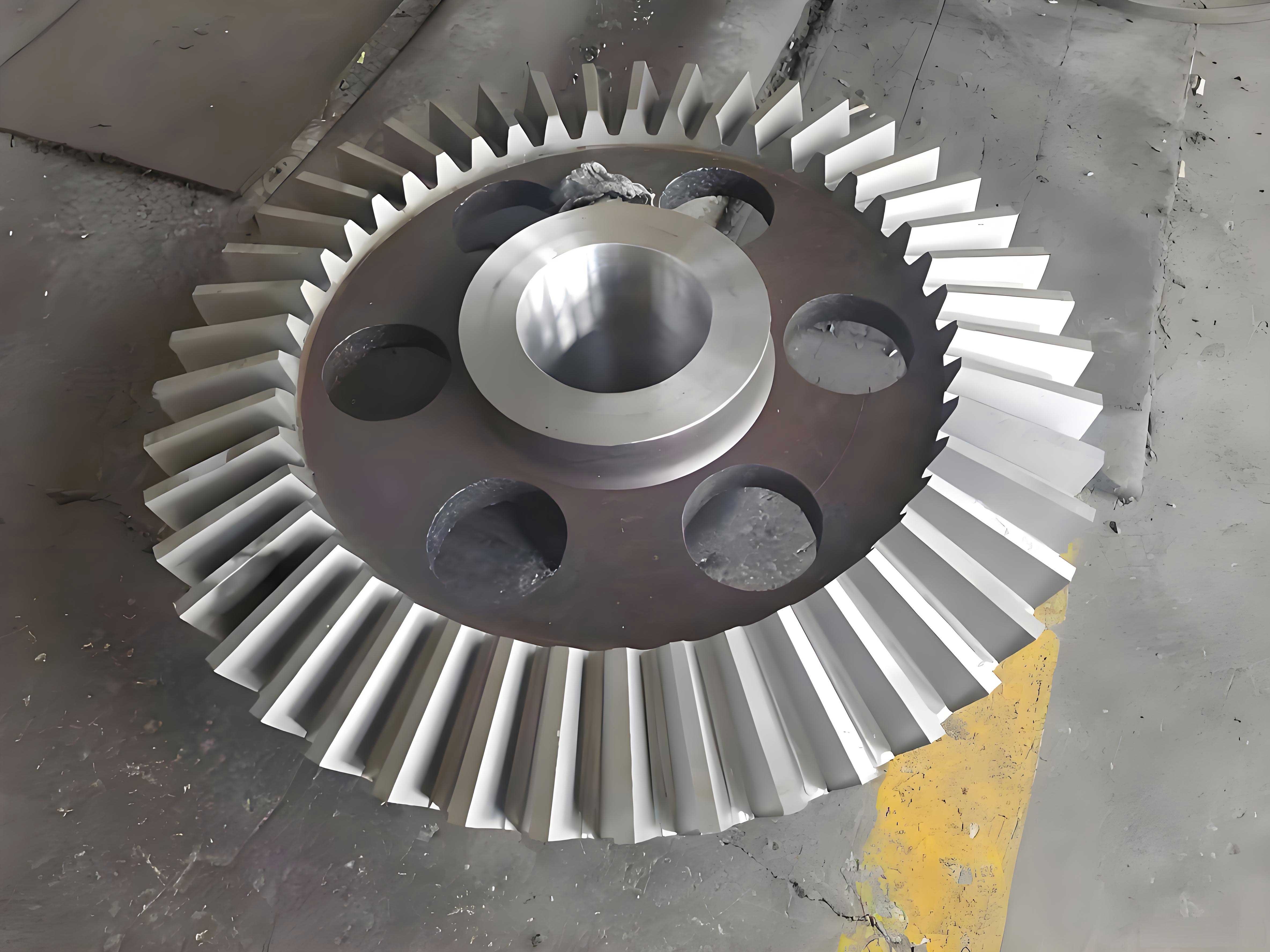
The full-forming method is rooted in the principle that the tooth surface of the large gear (internal miter gear) can be freely defined. We then design the small gear (external miter gear) tooth surface to achieve local conjugation at a specified reference point, ensuring ideal second-order meshing characteristics. This guarantees high-quality point contact, which is less sensitive to errors compared to line contact. For this study, I focus on miter gears with uniform-depth teeth; tapered-depth teeth will be addressed separately.
Machining of the Large Miter Gear
The large miter gear is machined on a vertical milling machine with a rotary milling head. The tool is a spiral bevel gear cutter head (blade group), whose profile angle is specially designed based on calculations. As shown in the conceptual setup, the gear blank is mounted on a indexing mechanism whose axis lies in the horizontal plane and forms an angle with the transverse direction of the worktable: $$\theta_1 = \delta_1 – \gamma_0$$. Here, $\delta_1$ is the pitch cone angle of the large miter gear, and $\gamma_0$ is the tool relief angle. The tooth trace direction is aligned parallel to the longitudinal feed of the machine. Let the tool profile angle be $\phi$, and the complementary angle be $\gamma_0 = 90^\circ – \phi$. To ensure the pressure angle at the reference point $M$, the milling machine spindle must be tilted by an angle $\Delta \beta = \alpha – \gamma_0$, where $\alpha$ is the nominal pressure angle. The cutter radius for machining at point $M$ is given by:
$$R_m = \frac{R_p}{\sin \phi}$$
where $R_p$ is the cone distance at point $M$. During machining, after setting up the machine as described, the workpiece is fed transversely until the full tooth depth is reached, then retracted. After indexing, the process repeats to cut all teeth on one flank. To machine the opposite flank, the axis of the indexing mechanism is symmetrically repositioned relative to the worktable transverse direction (as indicated by dashed lines in the schematic), and the workpiece is moved longitudinally to align point $M’$ with the cutter axis. The resulting tooth surface $\Sigma_1$ of the large miter gear is a conical surface with a half-cone angle $\phi$. Along the tooth height direction ($h$), the profile is straight, while along the tooth length direction ($L$), it is crowned (barreled). The normal curvatures at point $M$ along the principal directions are:
$$k_{h1} = 0, \quad k_{L1} = \frac{\sin^2 \phi}{R_m}$$
Since the $h$ and $L$ directions are principal directions for $\Sigma_1$, the geodesic torsion $\tau_g$ along $L$ is zero. Due to the absence of relative motion along the tooth trace between cutter and workpiece, the root line of the large miter gear tooth is concave. Tool design must ensure sufficient tooth depth to avoid inadequate top clearance during operation.
Machining of the Small Miter Gear
Given that the large miter gear tooth surface is crowned along the length, the small miter gear tooth surface $\Sigma_2$ need not be modified to ensure local contact. For machining simplicity, we select $\Sigma_2$ as a cylindrical surface, which can be produced on a standard vertical milling machine. The gear blank is mounted on the rotary axis of an indexing mechanism, with its axis forming an angle with the worktable transverse direction: $$\theta_2 = 90^\circ – \delta_2$$, where $\delta_2$ is the pitch cone angle of the small miter gear. The forming mill cutter has a profile consisting of a circular arc with radius $\rho$. At the reference point $M$, the radius is $R_{m2}$, and the profile angle is $\alpha$ (equal to the gear pressure angle). During machining, the tool is positioned such that point $M$ lies in the horizontal plane containing the gear axis. Longitudinal feed is then applied to cut the full tooth length, and after indexing all teeth, one flank is completed. Similarly, for the opposite flank, the indexing mechanism axis is symmetrically repositioned. The resulting small miter gear tooth surface $\Sigma_2$ has the following normal curvature parameters at point $M$ along the $h$ and $L$ directions:
$$k_{h2} = \frac{1}{\rho}, \quad k_{L2} = 0, \quad \tau_{g2} = 0$$
This cylindrical design facilitates easy manufacturing and maintains the desired point contact with the large miter gear.
Determination of Tooth Surface Parameters via Meshing Characteristics
From the machining descriptions, several tool parameters remain to be determined: $\phi$, $R_m$, $\rho$, and $R_{m2}$. These are set based on second-order generation requirements, ensuring that when $\Sigma_1$ and $\Sigma_2$ mesh, they exhibit ideal second-order meshing characteristics at the reference point. These characteristics include the instantaneous contact ellipse length $2a$, the angle $\psi$ between the contact path tangent and the tooth trace direction, and the angular acceleration $\ddot{\phi}$. In gear theory, for a given relative position and transmission ratio, $2a$, $\psi$, and $\ddot{\phi}$ are governed by the induced normal curvature between $\Sigma_1$ and $\Sigma_2$, which is the difference in their normal curvatures. The relationship is expressed through the following equations, derived from meshing principles:
$$K_{\text{ind}} = k_{n1} – k_{n2}$$
where $k_{n1}$ and $k_{n2}$ are the normal curvatures of the large and small miter gear surfaces, respectively, along the contact direction. For point contact, the induced curvature directly influences the contact ellipse dimensions. The semi-major axis $a$ of the contact ellipse is given by:
$$a = \sqrt{\frac{w}{K_{\text{ind}}}}$$
Here, $w$ is the load per unit length. The angle $\psi$ is related to the principal directions of the surfaces, and $\ddot{\phi}$ depends on the kinematic constraints. To achieve optimal performance, we set target values for $2a$ and $\psi$ based on application requirements, such as load capacity and misalignment tolerance. The parameters are then solved iteratively using the following system, which encapsulates the geometry of miter gears:
| Parameter | Symbol | Equation |
|---|---|---|
| Tool profile angle for large miter gear | $\phi$ | $\phi = \alpha – \Delta \beta$ |
| Cutter radius for large miter gear | $R_m$ | $R_m = R_p / \sin \phi$ |
| Profile radius for small miter gear | $\rho$ | $\rho = 1 / k_{h2}$ |
| Reference point radius for small miter gear | $R_{m2}$ | $R_{m2} = R_p \cdot \sin \delta_2$ |
| Induced normal curvature | $K_{\text{ind}}$ | $K_{\text{ind}} = k_{L1} – k_{L2}$ |
These equations ensure that the miter gear pair operates with controlled point contact, minimizing stress concentrations and improving durability. The full-forming method thus allows precise tailoring of the tooth surfaces, a significant advancement over traditional approaches for miter gears.
Computational Example
To illustrate the full-forming machining principle, I present a detailed calculation for a miter gear pair. The gear parameters are as follows:
| Parameter | Value |
|---|---|
| Number of teeth (large gear), $z_1$ | 40 |
| Number of teeth (small gear), $z_2$ | 20 |
| Module at large end, $m$ | 4 mm |
| Face width, $b$ | 30 mm |
| Shaft angle, $\Sigma$ | 90° |
| Pressure angle, $\alpha$ | 20° |
| Pitch cone angle (large), $\delta_1$ | 63.4349° |
| Pitch cone angle (small), $\delta_2$ | 26.5651° |
| Cone distance at reference point, $R_p$ | 89.4427 mm |
Using the derived formulas, we compute the machining parameters step by step. First, the tool profile angle $\phi$ is determined based on the desired meshing. For this example, we aim for a contact ellipse length $2a \approx 5$ mm and $\psi \approx 30^\circ$. Through iterative solution, we obtain:
$$\phi = 18.5^\circ, \quad \Delta \beta = 1.5^\circ$$
The cutter radius for the large miter gear is then:
$$R_m = \frac{89.4427}{\sin 18.5^\circ} \approx 282.5 \text{ mm}$$
For the small miter gear, the profile radius $\rho$ is calculated from the normal curvature requirement. Given $k_{h2} = 1 / \rho$ and setting $k_{h2}$ to achieve the target induced curvature, we find:
$$\rho = 120 \text{ mm}, \quad R_{m2} = 89.4427 \cdot \sin 26.5651^\circ \approx 40.0 \text{ mm}$$
The induced normal curvature $K_{\text{ind}}$ is verified using:
$$k_{L1} = \frac{\sin^2 18.5^\circ}{0.2825} \approx 0.0201 \text{ mm}^{-1}, \quad k_{L2} = 0$$
$$K_{\text{ind}} = 0.0201 \text{ mm}^{-1}$$
This value corresponds to a contact ellipse semi-major axis $a \approx 2.5$ mm under typical loading, meeting the design goal. The calculations confirm that the full-forming method is feasible for producing high-performance miter gears.
Cutting Test and Validation
Based on the computational results, a miter gear pair was manufactured. The large and small gears were machined on a standard vertical milling machine equipped with a rotary head and indexing attachment. The tools were custom-made: a spiral bevel gear cutter head with $\phi = 18.5^\circ$ for the large miter gear, and a forming mill cutter with $\rho = 120$ mm for the small miter gear. The setup followed the described procedures precisely, ensuring alignment and feed accuracy. After machining, the gears were assembled and tested on a gear rolling tester. The contact pattern on the small miter gear tooth surface, obtained via marking compound, is shown conceptually in the image link provided earlier. The pattern exhibited a well-defined elliptical contact area centered at the reference point, indicating proper point contact. The gear pair operated smoothly with minimal noise and vibration, confirming the theoretical predictions. This test validates the full-forming machining principle as a robust solution for miter gears, overcoming the limitations of conventional methods.
Conclusion
In this article, I have presented the full-forming machining method for point-contact internal meshing straight bevel gears, or miter gears. This approach leverages second-order generation theory to design and manufacture both gears using forming processes, eliminating the need for complex展成机床. By freely defining the large miter gear tooth surface as a crowned cone and the small miter gear tooth surface as a cylinder, we achieve controlled point contact with ideal second-order characteristics. The method offers significant advantages: simplified tooling, ease of adjustment, high productivity, and superior meshing quality. Computational examples and cutting tests demonstrate its practical viability. The frequent mention of “miter gear” throughout underscores its relevance in modern gear systems. Future work may extend this principle to tapered-depth miter gears or other gear types, further broadening its applications. Ultimately, the full-forming method represents a paradigm shift in miter gear manufacturing, enabling reliable high-performance transmissions in various industries.