
In the realm of automotive powertrain engineering, the final drive unit within a drive axle is a critical determinant of overall system performance, affecting torque delivery, noise-vibration-harshness (NVH), and durability. Among various gear geometries, the hyperboloidal gears system, particularly those manufactured to the Gleason system which dominates the global market, is almost universally adopted for passenger and light truck applications. The primary reason for this preference lies in their superior characteristics: exceptional smoothness of operation, compact packaging enabled by axis offset, and low noise generation compared to other gear types like straight bevel or spur gears. However, a significant and often challenging inherent characteristic of these hyperboloidal gears is the presence of substantial sliding along the path of tooth contact. This sliding action, while a consequence of their beneficial geometry, can lead to detrimental effects such as increased wear and, under severe conditions, scuffing or adhesive wear failure. This article delves into the geometric underpinnings of this inevitable sliding phenomenon in hyperboloidal gears, elucidates its implications, and proposes practical engineering methodologies for its mitigation to ensure reliable and long-lasting performance.
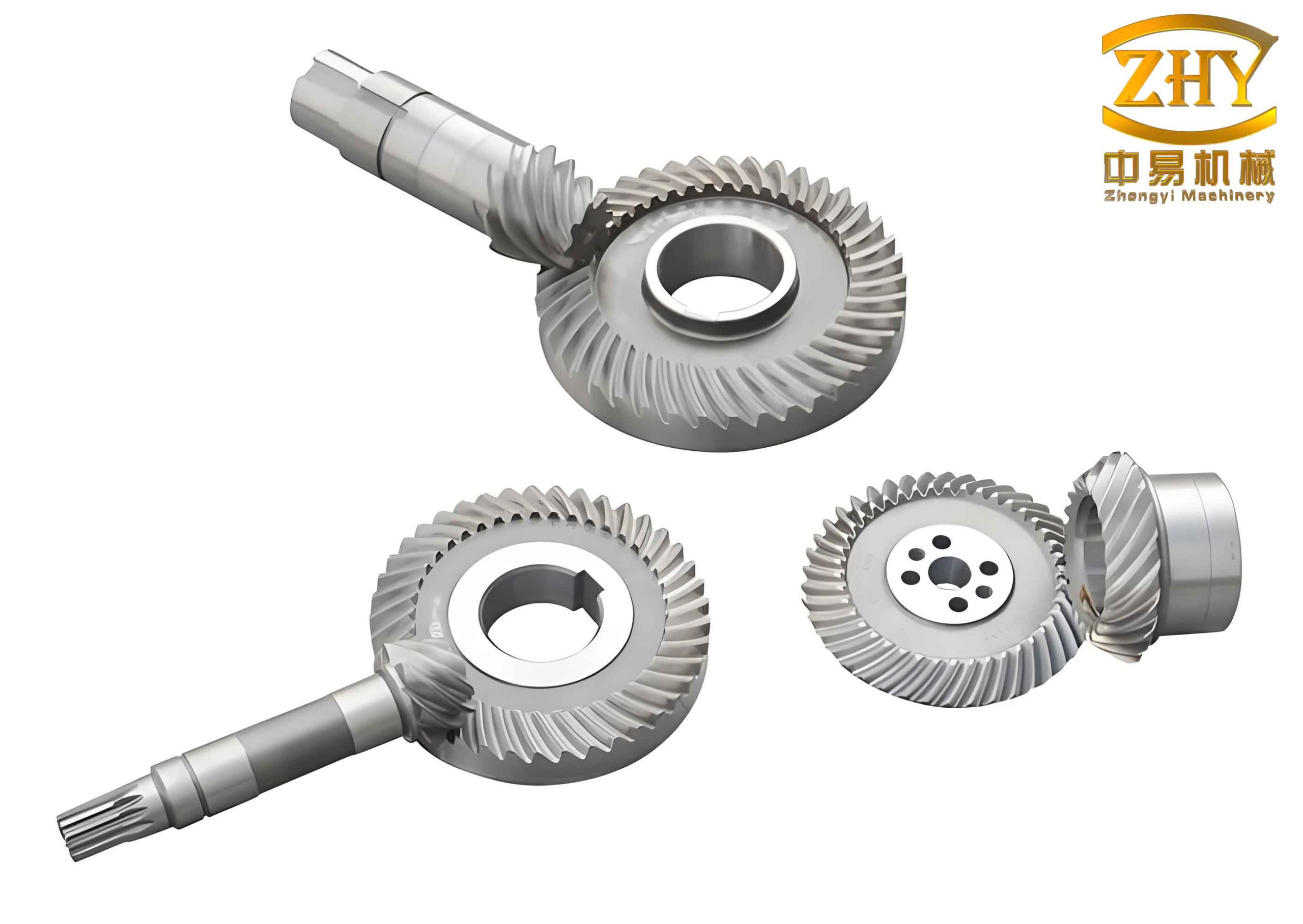
The existence of sliding in a pair of hyperboloidal gears is not a manufacturing defect but a fundamental geometric property arising from their spatial configuration. To understand this, we must examine the spatial relationship between the two gear axes. Consider two non-intersecting, non-parallel axes in space, typically arranged at a 90-degree angle but offset by a distance ‘E’, known as the offset. This configuration defines the hyperboloidal gears pair, with the pinion (drive gear) axis offset from the plane of the ring gear (driven gear). The unique working point, or pitch point ‘P’, is chosen based on torque requirements, ratio, and spatial constraints. The geometry dictates that the spiral angles of the pinion (β₁) and the ring gear (β₂) at their mean points are not equal. Their relationship is intrinsically linked to the shaft angle Σ (typically 90°) and the offset angle ε’, which is the angle between the projection of the pinion axis and the ring gear axis onto a common plane. A simplified yet fundamental relationship is:
$$ \beta_1 = \beta_2 + \epsilon’ $$
For the common case of a 90-degree shaft angle, the offset angle is significant, leading to β₁ being substantially larger than β₂. Gleason’s recommended formula for the pinion mean spiral angle highlights the parameters influencing it:
$$ \beta_1 = 25^\circ + 5^\circ \sqrt{\frac{z_2}{z_1}} + 90^\circ \frac{E}{d_2} $$
where \( z_1 \) and \( z_2 \) are the numbers of teeth on the pinion and gear respectively, \( E \) is the offset, and \( d_2 \) is the ring gear pitch diameter. This results in pinion spiral angles commonly ranging from 45° to 50°, while ring gear spiral angles are much smaller, often around 25°-30°. This disparity in spiral angles is the primary geometric root cause of the lengthwise sliding along the tooth flank.
The consequence of differing spiral angles becomes starkly apparent when considering the developed length of a single tooth on each member. While the exact calculation is complex and involves numerous formulae related to the gear blank design and machine settings, the essential kinematic relationship can be grasped through simplified geometry. The active length of a tooth along its path can be approximated by considering the face width (F) and the spiral angle (β). For the pinion and gear respectively:
$$ L_p \approx \frac{F_p}{\cos(\beta_1)} \quad , \quad L_g \approx \frac{F_g}{\cos(\beta_2)} $$
Since \( \beta_1 > \beta_2 \), and typically \( \cos(\beta_1) < \cos(\beta_2) \), it follows that for comparable face widths, the developed tooth length \( L_p \) of the pinion is greater than \( L_g \) of the ring gear. In a real hyperboloidal gears pair, a pinion tooth must traverse the entire contact path on the ring gear tooth, which is shorter than its own contact length. This mismatch forces a continuous sliding motion along the tooth flank during the entire meshing cycle. The magnitude of this sliding velocity can be a significant percentage of the rolling velocity, leading to high sliding ratios. This is a fundamental and unavoidable characteristic of hyperboloidal gears.
| Parameter | Symbol | Typical Value / Relationship | Influence on Sliding |
|---|---|---|---|
| Pinion Spiral Angle | β₁ | 45° – 50° | Higher angle increases pinion tooth length, exacerbating sliding mismatch. |
| Gear Spiral Angle | β₂ | 25° – 30° | Lower angle results in shorter gear tooth length. |
| Axis Offset | E | Design-dependent (e.g., 25-50 mm) | Directly increases β₁ via design formula, increasing sliding. |
| Pinion Face Width | F_p | Function of E and d₂ | Wider face width increases sliding contact length. |
| Gear Face Width | F_g | ~0.3 * Outer Cone Distance | Wider face width increases contact area but not the fundamental length mismatch. |
The persistent sliding action generates friction and heat at the tooth interface. If unmanaged, this can lead to two primary failure modes: abrasive wear, which gradually removes material, and adhesive wear (scuffing), where localized welding and tearing of surface asperities occur due to high flash temperatures. Counterintuitively, in hyperboloidal gears, the pinion—despite being smaller and rotating faster—often experiences slightly less severe sliding wear consequences than classical gear theory would predict. This is because the pinion tooth, having a longer contact path, moves the sliding contact zone across its surface more quickly, allowing for better heat dissipation from any given point on its flank. The ring gear tooth, with its shorter contact path, has the same sliding contact dwell on its surface for a longer portion of the mesh cycle. This effect somewhat balances the traditional life-limiting factors where the faster-rotating pinion typically wears out first.
To combat the detrimental effects of this inherent sliding in hyperboloidal gears, a multi-faceted approach is required, focusing on material selection, heat treatment, and advanced surface engineering. A critical first step is to avoid using identical steel grades for both the pinion and the ring gear. Using the same material, especially common grades like 20CrMnTiH for both members, increases the risk of adhesive wear because the identical metallurgical structure promotes localized welding when critical temperatures are reached at the sliding interface.
| Component | Recommended Steel Alloy System | Example Grade | Key Attributes |
|---|---|---|---|
| Pinion (Drive Gear) | Cr-Mo-Ni System | 20CrMoNi, 8620H | Good hardenability, core toughness, and resistance to contact fatigue. |
| Ring Gear (Driven Gear) | Cr-Mn-Ti System | 20CrMnTiH | Good carburizing response, cost-effective, adequate performance. |
The use of dissimilar alloy systems reduces the chemical affinity between the two surfaces, thereby raising the threshold for scuffing under sliding conditions. Beyond bulk material selection, surface treatment post-hardening is paramount. Two highly effective processes are Low-Temperature Ion Sulfurization and Sulfonitriding. These processes create an ultra-thin, porous layer of iron sulfides (FeS, FeS₂) on the hardened gear teeth. This layer possesses several beneficial properties for hyperboloidal gears:
- Solid Lubrication: The sulfide layer has a hexagonal close-packed crystal structure with low shear strength, significantly reducing the coefficient of friction at the sliding interface.
- Anti-Scuffing Protection: It prevents direct metal-to-metal contact, eliminating the primary condition for adhesive wear.
- Run-in Facilitation: The soft sulfide layer smoothens surface asperities, promoting faster and gentler run-in, increasing the real contact area.
- Oil Retention: The porous microstructure acts as a reservoir for lubricant, ensuring boundary lubrication during high-load events.
The effectiveness of these strategies is validated through contact pattern analysis during gear set assembly. The ideal contact pattern on the drive side (pinion concave flank) should be centered slightly toward the toe (inner end) of the pinion tooth, covering a significant portion of the active flank area. The coast side (pinion convex flank) pattern will naturally be biased toward the heel (outer end) due to the necessary gear backlash. This pattern behavior itself is a manifestation of the sliding action and the lengthwise motion of contact across the flank. The backlash, typically maintained between 0.08 mm and 0.15 mm, is crucial to prevent binding while controlling the extent of pattern separation. The contact pattern observed with marking compounds like Prussian blue often shows a concentrated area covering 40-50% of the flank. This concentration does not indicate the total contact zone but rather highlights the region of highest contact pressure and, consequently, the most intense sliding interaction.
| Surface Treatment | Process Temperature | Generated Layer | Primary Benefit for Hypoid Gears |
|---|---|---|---|
| Low-Temp Ion Sulfurization | ~200°C | Iron Sulfides (FeS/FeS₂) | Dramatic friction reduction, excellent anti-scuffing. |
| Sulfonitriding | ~570°C | Nitrides + Sulfides | Combines wear resistance from nitrides with friction reduction from sulfides. |
In conclusion, the analysis of hyperboloidal gears reveals that lengthwise sliding is an inescapable geometric consequence of their offset axes and differing spiral angles, governed by the fundamental relationship \( \beta_1 = \beta_2 + \epsilon’ \). This sliding, characterized by high sliding ratios, presents a persistent challenge in the form of friction, heat generation, and potential for adhesive wear. However, this inherent characteristic also introduces a compensatory effect where the faster-moving pinion flank experiences improved heat dissipation relative to the ring gear. Successful engineering of durable hyperboloidal gears therefore hinges on proactively managing this sliding through a synergistic approach: selecting dissimilar steel alloy systems (e.g., Cr-Mo-Ni for the pinion and Cr-Mn-Ti for the gear) to reduce chemical affinity and the risk of scuffing, and applying advanced surface treatments like low-temperature sulfurization to impart solid lubricant layers that drastically lower the coefficient of friction. By embracing these countermeasures, the exceptional performance benefits of hyperboloidal gears—their smoothness, compactness, and quiet operation—can be fully realized without compromise to their durability and reliability in automotive drive axle applications.