
In the manufacturing of hypoid gears, achieving high-quality meshing performance necessitates precise control over the machining process. Based on the geometric and kinematic characteristics of the gear pair, the adjustment parameters for machining must be calculated accurately to ensure proper tooth contact and durability. This article, from my perspective as a researcher and practitioner in gear technology, outlines the underlying principles and methodologies for determining the structural elements of the tooth surface and the corresponding machine tool adjustment parameters for hypoid gears. I will delve into the mathematical foundations, provide comprehensive formulas, and use tables to summarize key concepts, all aimed at elucidating the intricate process of hypoid gear fabrication.
The tooth surface of a hypoid gear, particularly the pinion, is a complex three-dimensional entity. To describe its geometry precisely, we employ a set of structural elements at any given point on the surface. Consider a point \( P \) on the pinion tooth surface \( \Sigma \). We define a coordinate cone whose axis coincides with the pinion axis and whose vertex aligns with the root cone vertex. This cone passes through point \( P \), and its semi-vertex angle \( \theta \) is termed the coordinate cone angle. The distance from \( P \) to the cone vertex \( R \) is the coordinate cone distance. At point \( P \), we establish three mutually perpendicular unit vectors: \( \mathbf{e}_r \) along the cone’s generatrix direction, \( \mathbf{e}_\theta \) along the circumferential direction (following the right-hand rule relative to \( \mathbf{e}_r \) and the cone axis), and \( \mathbf{e}_n \) along the normal to the cone surface. The unit normal vector to the tooth surface \( \Sigma \) at \( P \), denoted \( \mathbf{n} \), is directed from the tooth material into the void. The structural configuration of the surface at \( P \) is characterized by five fundamental elements:
- Normal Pressure Angle (\( \alpha_n \)): The angle between the tooth surface normal \( \mathbf{n} \) and the plane perpendicular to the generatrix. It is derived from the projection of \( \mathbf{n} \) onto the coordinate system. If \( \alpha_t \) is the transverse pressure angle, the relationship is given by:
$$ \cos \alpha_n = \cos \alpha_t \cos \beta $$
where \( \beta \) is the spiral angle. - Spiral Angle (\( \beta \)): The angle between the tooth trace tangent at \( P \) and the generatrix direction \( \mathbf{e}_r \). It indicates the local helix orientation. For hypoid gears, this angle varies across the tooth surface.
- Tooth Trace Curvature (\( k_g \)): This is the geodesic curvature of the tooth trace on the developed coordinate cone. It describes how the tooth line curves in the plane tangent to the cone. Its expression involves derivatives of the surface coordinates. A general form is:
$$ k_g = \frac{1}{R \sin \theta} \left( \frac{\partial \beta}{\partial \phi} \pm \tan \alpha_n \frac{\partial \ln R}{\partial \phi} \right) $$
where \( \phi \) is the angular parameter around the cone, and the sign (\(\pm\)) depends on whether the concave or convex side is considered. - Tooth Profile Curvature (\( k_f \)): This is the normal curvature of the intersection curve between the tooth surface and a sphere centered at the cone vertex passing through \( P \). It reflects the curvature along the tooth profile direction. It can be expressed as:
$$ k_f = \frac{\cos^2 \alpha_n}{R \cos \theta} \left( \frac{\partial \alpha_n}{\partial R} \mp \frac{\tan \beta}{R} \frac{\partial \alpha_n}{\partial \phi} \right) $$
again with sign conventions for concave and convex sides. - Coordinate Parameters (\( R, \theta \)): The location of point \( P \) is defined by the cone distance \( R \) and cone angle \( \theta \). These are foundational for all other elements.
The following table summarizes these five structural elements for a hypoid gear tooth surface:
| Element | Symbol | Description | Key Formula/Relation |
|---|---|---|---|
| Coordinate Cone Distance | \( R \) | Distance from point to cone vertex | Fundamental location parameter |
| Coordinate Cone Angle | \( \theta \) | Semi-vertex angle of the local coordinate cone | Defines local coordinate system |
| Normal Pressure Angle | \( \alpha_n \) | Angle between surface normal and transverse plane | \( \cos \alpha_n = \cos \alpha_t \cos \beta \) |
| Spiral Angle | \( \beta \) | Angle of tooth trace relative to generatrix | Varies along tooth length |
| Tooth Trace Curvature | \( k_g \) | Geodesic curvature of tooth trace on developed cone | \( k_g = \frac{1}{R \sin \theta} \left( \frac{\partial \beta}{\partial \phi} \pm \tan \alpha_n \frac{\partial \ln R}{\partial \phi} \right) \) |
| Tooth Profile Curvature | \( k_f \) | Normal curvature of profile on spherical section | \( k_f = \frac{\cos^2 \alpha_n}{R \cos \theta} \left( \frac{\partial \alpha_n}{\partial R} \mp \frac{\tan \beta}{R} \frac{\partial \alpha_n}{\partial \phi} \right) \) |
For a hypoid gear pair, the mating conditions determine a specific point on the pinion tooth surface, known as the modification center or contact pattern center \( P_0 \). At this point, the theoretical values of the five structural elements \( (\alpha_{n0}, \beta_0, k_{g0}, k_{f0}) \) are derived from the gear design and the machining of the gear wheel. However, to achieve a localized contact pattern around \( P_0 \), these curvatures are intentionally modified during pinion cutting. The actual machined surface has corrected curvatures:
$$ k_g’ = k_{g0} \pm \Delta k_g, \quad k_f’ = k_{f0} \pm \Delta k_f $$
where \( \Delta k_g \) and \( \Delta k_f \) are small deviations applied to control the contact ellipse size and orientation. The position of \( P_0 \) (given by \( R_0, \theta_0 \)) and these corrected elements dictate the machine tool adjustment parameters for cutting the hypoid pinion.
The machining of hypoid gears, especially the pinion, is typically performed on specialized gear cutting machines equipped with a cradle and a cutting tool (usually a face-mill cutter). The adjustment parameters define the relative positions and motions between the workpiece (pinion) and the tool. A comprehensive set of these parameters is required to generate the desired tooth surface accurately. The figure below illustrates a typical setup for finishing a hypoid pinion, highlighting the intricate geometry involved in positioning the cutter relative to the workpiece.
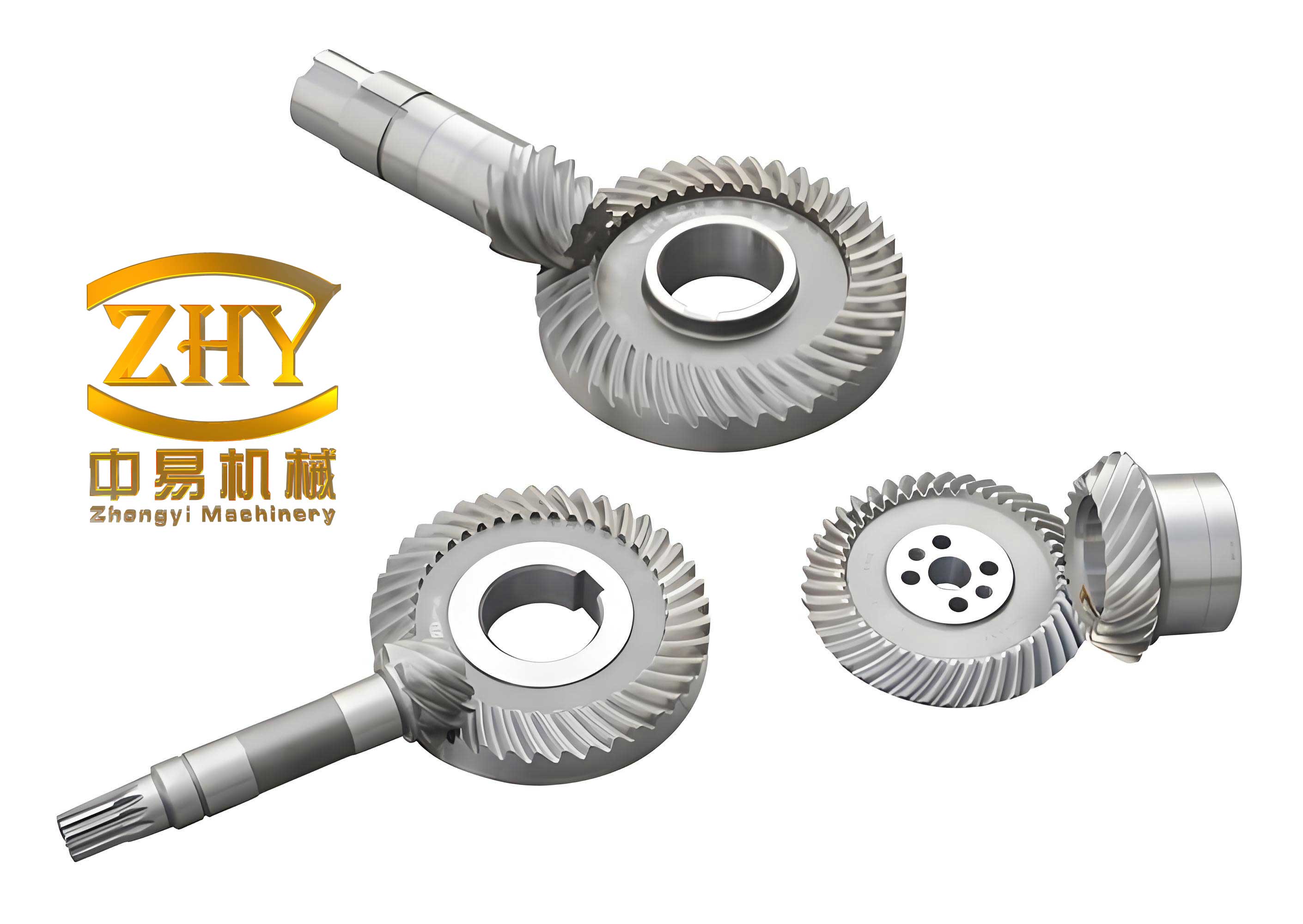
In the machine coordinate system, with origin at the machine center \( O_m \), the key planes are the central vertical plane (\( x_m O_m y_m \)) and the central horizontal plane (\( y_m O_m z_m \)). The pinion axis is set parallel to the horizontal plane but offset by a distance \( \Delta \), known as the offset distance, which is a fundamental feature of hypoid gears. The pinion root cone vertex projects onto the horizontal plane at a point offset from \( O_m \). The angle between the pinion’s root generatrix and the cradle axis is denoted as \( \theta_0′ \), often called the initial cradle angle. To define the cutter orientation, we establish a cutter installation plane that passes through the pinion vertex and is perpendicular to a specific direction. The angle between this installation plane and the pinion’s horizontal generatrix is the cutter installation plane angle \( \gamma \).
The actual formation of point \( P_0 \) on the pinion tooth surface occurs not when \( P_0 \) is in a nominal position, but when the pinion rotates by an angle \( \psi_0 \) from a reference position. This angle \( \psi_0 \) is termed the formation position angle of the modification center. Tool tilt is a critical adjustment where the cutter axis is not parallel to the cradle axis. For analysis, tool tilt is decomposed into horizontal tilt and normal tilt. Horizontal tilt angle \( \lambda_h \) is essentially the difference between the actual cradle angle and the initial one: \( \lambda_h = \theta_0′ – \theta_c \), where \( \theta_c \) is the cradle angle during cutting. After applying horizontal tilt, the cutter axis lies parallel to the machine’s horizontal plane and perpendicular to the installation plane. The projection of the cutter blade’s cutting edge onto the installation plane forms an angle \( \beta_s \) with a reference line, known as the cutter installation spiral angle.
Subsequently, normal tilt is applied by rotating the entire cutter assembly about an axis perpendicular to both the installation plane and the cutter blade edge. This introduces the normal tilt angle \( \lambda_n \). After normal tilt, the angle between the cutter blade’s normal vector at the cutting point and the installation plane becomes \( \alpha_0 \pm \lambda_n \), where \( \alpha_0 \) is the blade’s nominal profile angle (positive for outside blades, negative for inside blades). The distance from the cutting point \( P \) to the cutter axis is the generating radius \( R_c \), and the distance from the cutter tip plane to \( P \) is the blade point height \( h \). The cutter’s forming radius \( R_f \) is then: \( R_f = R_c \pm h \) (using + for outside blades, – for inside blades). The ratio of the pinion’s rotational angular velocity \( \omega_p \) to the cradle’s angular velocity \( \omega_c \) is the machine ratio \( i_m = \omega_p / \omega_c \).
Thus, the complete set of adjustment parameters for machining a hypoid pinion includes: offset distance \( \Delta \), initial cradle angle \( \theta_0′ \), formation position angle \( \psi_0 \), cradle angle \( \theta_c \), horizontal tilt angle \( \lambda_h \), normal tilt angle \( \lambda_n \), cutter installation plane angle \( \gamma \), cutter installation spiral angle \( \beta_s \), generating radius \( R_c \), blade point height \( h \), and machine ratio \( i_m \). Among these, parameters like \( \theta_0′ \), \( \psi_0 \), and \( \gamma \) can often be chosen with some flexibility based on experience or initial trials; they are termed free selection parameters. The others are calculated based on these free parameters and the required tooth surface structure at \( P_0 \). This implies that for a given hypoid gear design, multiple combinations of adjustment parameters can achieve the desired contact pattern, provided they satisfy three core requirements: (1) The modification center \( P_0 \) is formed at the designated location with the specified structural elements, ensuring correct contact pattern position and size. (2) The tooth root depth is uniform across the toe and heel of the tooth. (3) All parameter values fall within the permissible adjustment ranges of the machine and cutter.
The calculation of these adjustment parameters hinges on the kinematic geometry of the generating process. When an arbitrary point \( P(R, \theta) \) on the pinion tooth surface is being generated, let its formation position angle be \( \psi \). Its coordinates in the machine system at that instant are functions of \( R, \theta, \psi \), and the machine settings. For the modification center \( P_0 \), the formation position angle \( \psi_0 \) and the cutter installation spiral angle \( \beta_s \) are determined by solving equations derived from the surface tangency conditions. Specifically, they satisfy:
$$ \tan \beta_s = \frac{\sin(\theta_0 – \theta_c) \pm \tan \alpha_n \cos(\theta_0 – \theta_c)}{\cos(\theta_0 – \theta_c) \mp \tan \alpha_n \sin(\theta_0 – \theta_c)} $$
and
$$ \psi_0 = \arctan\left( \frac{\sin \beta_s \cos(\theta_0 – \theta_c) \pm \cos \beta_s \sin(\theta_0 – \theta_c) \tan \alpha_n}{\cos \beta_s \cos(\theta_0 – \theta_c) \mp \sin \beta_s \sin(\theta_0 – \theta_c) \tan \alpha_n} \right) $$
where \( \theta_0 \) is the coordinate cone angle at \( P_0 \). The machine ratio \( i_m \) must ensure that the cutter surface (generating surface) and the pinion tooth surface are in proper contact at \( P_0 \), meaning their relative velocity is orthogonal to the common normal. This leads to the condition:
$$ \mathbf{n} \cdot (\mathbf{v}_p – \mathbf{v}_c) = 0 $$
where \( \mathbf{v}_p \) and \( \mathbf{v}_c \) are the velocities of the pinion and cutter at the contact point. From this, \( i_m \) is expressed as a function of geometric parameters.
To establish the full relationship, consider the generating motion. As the cradle rotates through an angle \( \varphi \) from its initial position, a point \( Q \) on the cutter surface generates a point \( P \) on the pinion surface. The coordinates of \( Q \) and \( P \) in their respective systems are functions of \( \varphi \) and the adjustment parameters. The contact condition requires that these coordinates coincide at the instant of generation, and their normals are collinear. This yields a system of equations known as the generating motion equations:
$$ \begin{cases}
x_m^{(Q)}(\varphi, \beta_s, \lambda_h, \lambda_n, R_c, \gamma) = x_m^{(P)}(R, \theta, \psi, \Delta, \theta_c) \\
y_m^{(Q)}(\varphi, \beta_s, \lambda_h, \lambda_n, R_c, \gamma) = y_m^{(P)}(R, \theta, \psi, \Delta, \theta_c) \\
z_m^{(Q)}(\varphi, \beta_s, \lambda_h, \lambda_n, R_c, \gamma) = z_m^{(P)}(R, \theta, \psi, \Delta, \theta_c) \\
\mathbf{n}^{(Q)}(\varphi, \beta_s, \lambda_h, \lambda_n, R_c, \gamma) = \pm \mathbf{n}^{(P)}(R, \theta, \psi, \Delta, \theta_c)
\end{cases} $$
where the superscripts (Q) and (P) denote the cutter and pinion, respectively. By differentiating these equations and evaluating at \( P_0 \) (where \( R=R_0, \theta=\theta_0, \psi=\psi_0, \varphi=\varphi_0 \)), we obtain expressions for the partial derivatives of the surface parameters with respect to the motion variables. Substituting these derivatives into the formulas for the corrected curvatures \( k_g’ \) and \( k_f’ \), we derive a system of equations that relate the adjustment parameters \( \lambda_h, \lambda_n, R_c, \beta_s, i_m \) to the desired structural elements \( \alpha_{n0}, \beta_0, k_g’, k_f’ \). Solving this system yields the calculated values for these adjustment parameters.
The determination of the cutter installation plane angle \( \gamma \) is based on ensuring uniform root depth across the tooth. For a trial value of \( \gamma \), we compute the required blade point height \( h_t \) to achieve the specified root depth at the toe (small end) and \( h_h \) for the heel (large end). The correct \( \gamma \) is found when \( h_t = h_h \), and this common value becomes the final blade point height \( h \). This iterative process ensures the tooth root is correctly formed. If any calculated parameter exceeds the machine or cutter’s physical limits, the free selection parameters (\( \theta_0′, \psi_0, \gamma \)) must be adjusted, and the calculations repeated until all values are within admissible ranges.
To illustrate the interdependence of parameters, the following table presents a typical set of adjustment parameters for machining a hypoid pinion, along with their roles and typical calculation dependencies:
| Parameter | Symbol | Role in Machining Hypoid Gears | Determination Method |
|---|---|---|---|
| Offset Distance | \( \Delta \) | Defines the axial offset between pinion and gear axes, a key feature of hypoid gears. | Given by gear design; fixed for a pair. |
| Initial Cradle Angle | \( \theta_0′ \) | Sets initial orientation of cradle relative to pinion root generatrix. | Free selection parameter; chosen based on experience. |
| Formation Position Angle | \( \psi_0 \) | Pinion rotation angle when modification center is generated. | Calculated from surface geometry and cutter orientation. |
| Cradle Angle | \( \theta_c \) | Actual cradle angle during cutting; incorporates horizontal tilt. | \( \theta_c = \theta_0′ – \lambda_h \). |
| Horizontal Tilt Angle | \( \lambda_h \) | Controls the tilt of cutter axis in horizontal plane. | Solved from curvature matching equations. |
| Normal Tilt Angle | \( \lambda_n \) | Controls tilt perpendicular to installation plane; fine-tunes pressure angle. | Solved from curvature matching equations. |
| Cutter Installation Plane Angle | \( \gamma \) | Orientation of plane in which cutter is installed; affects root depth uniformity. | Iteratively determined to equalize toe and heel root depths. |
| Cutter Installation Spiral Angle | \( \beta_s \) | Sets local cutting edge orientation relative to installation plane. | Calculated from spiral angle and pressure angle at \( P_0 \). |
| Generating Radius | \( R_c \) | Distance from cutting point to cutter axis; influences tooth profile curvature. | Solved from curvature matching equations. |
| Blade Point Height | \( h \) | Determines depth of cut and root form. | Set to achieve uniform root depth after \( \gamma \) is determined. |
| Machine Ratio | \( i_m \) | Governs relative speed of pinion and cradle; ensures correct roll motion. | Derived from kinematic condition \( \mathbf{n} \cdot (\mathbf{v}_p – \mathbf{v}_c) = 0 \). |
The mathematical derivation often involves complex algebraic manipulations. For instance, from the generating motion equations, we can express the derivatives \( \frac{\partial R}{\partial \varphi}, \frac{\partial \theta}{\partial \varphi}, \frac{\partial \psi}{\partial \varphi} \) at the contact point. These are then plugged into the curvature formulas. As an example, the tooth trace curvature \( k_g \) is related to the adjustment parameters through:
$$ k_g’ = \frac{1}{R_0 \sin \theta_0} \left[ \left( \frac{\partial \beta}{\partial \phi} \right)_0 \pm \tan \alpha_{n0} \left( \frac{\partial \ln R}{\partial \phi} \right)_0 \right] $$
where the derivatives are evaluated via chain rule from the generating equations. The resulting expression involves \( \lambda_h, \lambda_n, R_c, \beta_s, i_m \), and known geometric values. Similarly, for tooth profile curvature \( k_f’ \):
$$ k_f’ = \frac{\cos^2 \alpha_{n0}}{R_0 \cos \theta_0} \left[ \left( \frac{\partial \alpha_n}{\partial R} \right)_0 \mp \frac{\tan \beta_0}{R_0} \left( \frac{\partial \alpha_n}{\partial \phi} \right)_0 \right] $$
Equating these to the desired corrected values gives two equations. Additional equations come from matching the spiral angle \( \beta_0 \) and pressure angle \( \alpha_{n0} \), which are directly influenced by \( \beta_s \) and \( \lambda_n \). In practice, for hypoid gears, these calculations are performed using specialized software, but understanding the underlying principles is crucial for troubleshooting and optimization.
In summary, the machining adjustment for hypoid gears is a sophisticated process that bridges theoretical geometry and practical manufacturing. The structural elements of the tooth surface provide a precise language to describe the desired geometry, while the adjustment parameters translate this into actionable machine settings. The calculation principles, rooted in differential geometry and kinematics, ensure that the generated surface meets the stringent requirements for meshing performance. The flexibility in choosing free parameters allows manufacturers to adapt to different machine capabilities and tooling, but the core equations always enforce the necessary conditions for correct tooth contact. As hypoid gears continue to be vital in automotive and industrial applications for their smooth operation and high torque capacity, mastering these adjustment principles remains essential for producing high-quality gears efficiently. Future advancements may involve more automated optimization algorithms and real-time adjustment systems, but the fundamental relationships outlined here will continue to serve as the foundation.