
The pursuit of performance and longevity in power transmission systems invariably centers on the gear. Its ability to withstand immense cyclical loads, resist wear, and operate with quiet efficiency is not a function of the bulk material alone but is predominantly determined by its engineered surface. As an engineer deeply involved in thermochemical processing, I have consistently observed that the strategic enhancement of a gear’s surface properties through chemical heat treatment is the cornerstone of its reliability. This process deliberately modifies the chemical composition of the surface layer, creating a metallurgical synergy where a hard, wear-resistant case coexists with a tough, ductile core. However, the path to achieving this optimal state is fraught with potential pitfalls. Improperly controlled processes are a primary source of heat treatment defects, which can manifest as catastrophic failures, reduced fatigue life, or unexpected dimensional changes. This article delves into the scientific principles, practical methodologies, and precise control strategies essential for successful surface hardening, with a continuous emphasis on identifying, understanding, and mitigating the root causes of heat treatment defects.
The Core Philosophies of Surface Chemical Heat Treatment
At its essence, chemical heat treatment is a diffusion-driven process. It involves exposing a component, typically steel, to a reactive environment at an elevated temperature for a controlled duration. Active atoms from the surrounding medium (carbon, nitrogen, or both) are absorbed into the surface and subsequently diffuse inwards, creating a graded concentration profile. The selection of the specific process is dictated by the performance requirements and the base material. The four principal categories, each with distinct mechanisms and outcomes, are summarized in the table below.
| Process | Primary Element(s) | Typical Base Material | Core Outcome | Key Advantages | Common Associated Heat Treatment Defects |
|---|---|---|---|---|---|
| Carburizing | Carbon (C) | Low-carbon steels, alloy steels (e.g., AISI 8620, 9310) | High-carbon surface (~0.7-1.0% C) for martensitic hardening. | Deep case depth (0.5-2.0+ mm), excellent bending fatigue resistance. | Excessive carburizing, intergranular oxidation (IGO), non-uniform case depth, distortion. |
| Nitriding | Nitrogen (N) | Nitriding steels (e.g., AISI 4140, Nitralloy), tool steels, stainless steels | Formation of hard nitride precipitates (e.g., Fe2-3N, alloy nitrides). | High surface hardness (up to 72 HRC), minimal distortion, good corrosion & wear resistance. | Brittle “white layer” (compound zone), porosity network, spalling, reduced core properties. |
| Nitrocarburizing (Ferritic) | Nitrogen & Carbon | Low-alloy steels, cast irons, tool steels | Shallow diffusion zone with a thin, hard compound layer (ε-Fe2-3(N,C)). | Excellent anti-galling and anti-scuffing properties, good fatigue life, minimal growth. | Uncontrolled compound layer thickness, porosity, sooting. |
| Carbonitriding | Carbon & Nitrogen | Low-carbon steels | Martensitic case with dissolved nitrogen enhancing hardenability. | Faster than carburizing, good wear resistance, allows oil quenching from lower temperatures. | Brittleness from excessive nitrogen, retained austenite, distortion. |
The diffusion process governing case depth is fundamentally described by Fick’s second law. For a constant surface concentration, the depth of penetration (x) for a given concentration is approximately related to time (t) and temperature (T) by:
$$ x \approx k \sqrt{D_0 t \cdot \exp\left(-\frac{Q}{RT}\right)} $$
where $k$ is a constant dependent on the concentration gradient, $D_0$ is the diffusion coefficient pre-exponential factor, $Q$ is the activation energy for diffusion, and $R$ is the universal gas constant. This equation highlights the exponential dependence on temperature, making precise thermal control paramount to avoid heat treatment defects like shallow or excessively deep cases.
In-Depth Process Analysis and Defect Genesis
1. Carburizing: Building a Deep, Strong Case
Carburizing remains the gold standard for gears subjected to high bending and contact stresses. The process enriches a low-carbon steel surface (typically 0.15-0.25% C) to a eutectoid or hypereutectoid carbon level. Post-carburizing, the component is quenched to transform the high-carbon case into hard martensite while the low-carbon core forms a tough, lower-strength microstructure. The carbon potential ($C_p$) of the atmosphere, which must be in precise equilibrium with the desired surface carbon, is critical. It is commonly controlled via oxygen probes or infrared analysis. A failure in this control system is a direct pathway to heat treatment defects. If $C_p$ is too low, the result is a soft, under-carburized surface prone to wear. If $C_p$ is too high, it leads to excessive carburizing, characterized by massive carbide networks at grain boundaries, severely embrittling the surface and acting as initiation sites for fatigue cracks.
Another insidious heat treatment defect in gas carburizing is Intergranular Oxidation (IGO). At high temperatures, oxygen-bearing species (e.g., H2O, CO2, O2) in the furnace atmosphere oxidize alloying elements like Chromium, Manganese, and Silicon at the steel’s grain boundaries. This creates soft, oxidized zones below the surface, typically 10-30 μm deep, which drastically reduce fatigue strength, particularly in high-cycle applications. The depth of IGO ($d_{IGO}$) can be modeled as a function of time, temperature, and local oxygen partial pressure, emphasizing the need for ultra-dry, well-controlled atmospheres.
2. Nitriding: The High-Precision, Low-Distortion Alternative
Nitriding is performed in the ferritic state (typically 480-580°C), well below the steel’s austenitizing temperature, thereby eliminating phase transformation-related distortion. Nitrogen atoms diffuse into the steel, forming a hard dispersion of fine alloy nitrides (e.g., AlN, CrN, VN) in the diffusion zone. The key control parameter is the nitriding potential ($K_N$), which determines the chemical activity of nitrogen at the surface. It is defined for ammonia-based atmospheres as:
$$ K_N = \frac{p_{NH_3}}{(p_{H_2})^{1.5}} $$
where $p_{NH_3}$ and $p_{H_2}$ are the partial pressures of ammonia and hydrogen, respectively. Precise control of $K_N$ is the single most important factor in preventing the classic nitriding heat treatment defects.
The most notorious defect is the formation of a brittle, continuous white layer or compound zone at the surface, primarily consisting of ε-Fe2-3N and γ’-Fe4N phases. While a thin, controlled compound layer can be beneficial for wear, an excessively thick or porous one is severely detrimental. Under contact loading, this brittle layer can crack and spall off, leading to rapid abrasive wear of the underlying material. “Precision Gas Nitriding” technologies, as mentioned in the source material, focus explicitly on controlling $K_N$ to either suppress white layer formation entirely or to engineer a thin, uniform, and non-porous layer. This represents a significant advancement over conventional gas nitriding, where gas consumption is high and process repeatability is poor, directly contributing to batch-to-batch variability and heat treatment defects.
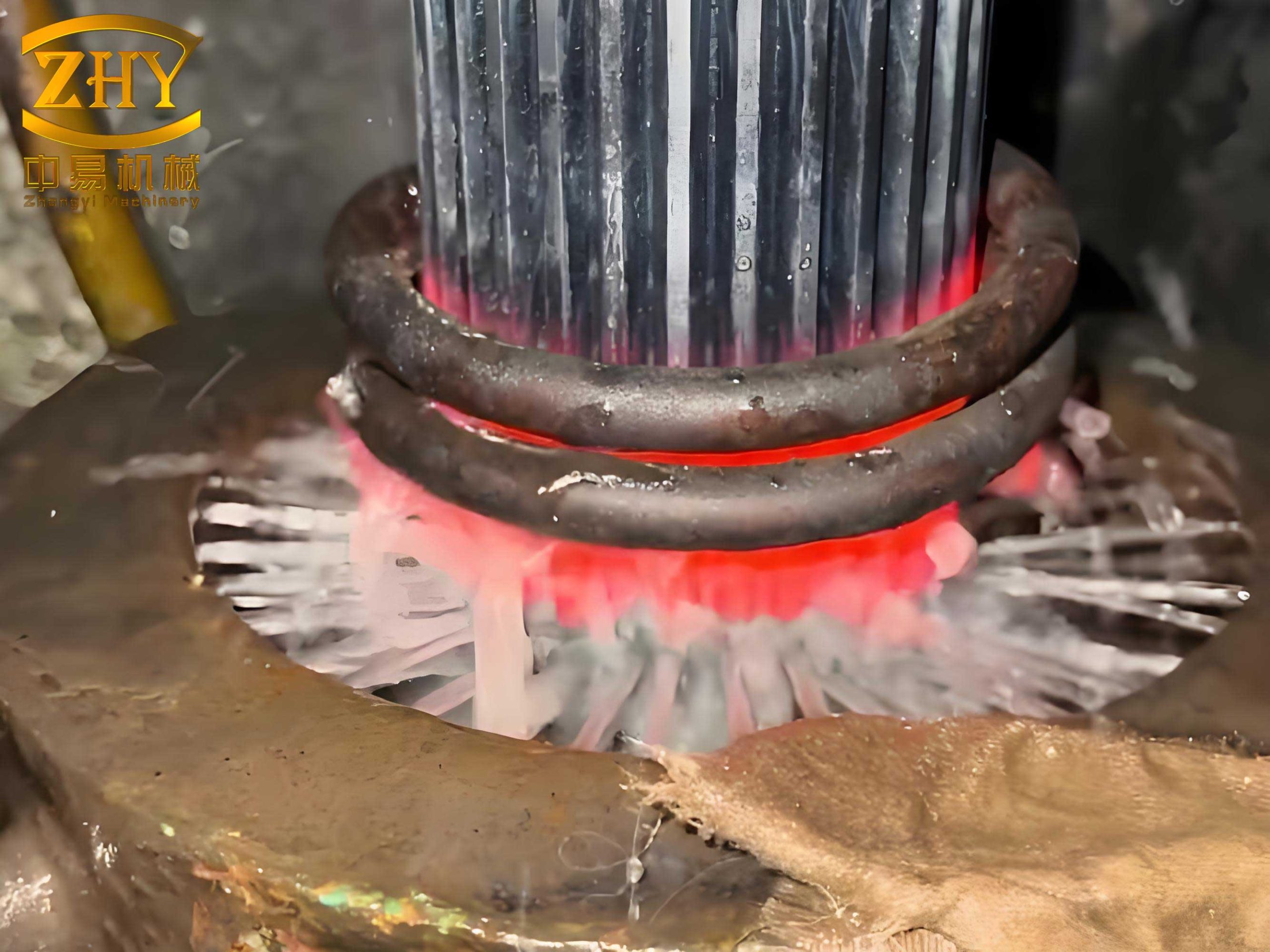
3. Nitrocarburizing and Carbonitriding: Hybrid Solutions
Nitrocarburizing, performed at similar temperatures to nitriding (570-580°C is common), introduces both nitrogen and carbon to produce a compound layer rich in the ε-carbonitride phase. This phase offers superior anti-scuffing and corrosion-resistant properties compared to the nitride-only layer. The defect risks parallel those of nitriding, with the added complexity of carbon source control. Sooting, a heat treatment defect where soot deposits on the workpiece, can occur if the carbon potential from the enriching gas (e.g., CO2, endogas) is too high, leading to poor surface finish and non-uniform treatment.
Carbonitriding is a modified form of carburizing conducted in an atmosphere that provides both carbon and nitrogen, typically at 815-900°C. The dissolved nitrogen lowers the austenite transformation temperature, increasing hardenability. This allows the use of less expensive steels or oil quenching instead of a more severe fast gas quench. However, the major heat treatment defect risk here is excessive nitrogen uptake, which can lead to high levels of retained austenite in the case. Retained austenite is a soft, metastable phase that reduces surface hardness and can later transform under service loads, causing dimensional instability and potential microcracking.
A Systematic Framework for Heat Treatment Defects
Understanding and categorizing heat treatment defects is essential for root cause analysis and prevention. These defects can be broadly classified based on their origin and manifestation.
| Defect Category | Specific Defect | Primary Cause | Consequence | Preventive Measure |
|---|---|---|---|---|
| Metallurgical/Structural | Excessive White Layer (Nitriding) | Nitriding potential ($K_N$) too high for too long. | Brittleness, spalling, crack initiation. | Precision control of $K_N$, use of post-oxidation or two-stage processes. |
| Intergranular Oxidation (Carburizing) | Presence of oxidizing species (O2, H2O, CO2) at high temperature. | Reduced fatigue strength, subsurface weakness. | Use of high-purity carrier gases, furnace integrity, low-oxygen potentials. | |
| Retained Austenite (Carbonitriding/Carburizing) | Surface carbon/nitrogen content too high, quenching temperature or rate inappropriate. | Reduced hardness, dimensional instability during service. | Control of carbon/nitrogen potential, proper quench design, sub-zero treatment. | |
| Dimensional | Distortion/Warpage | Non-uniform heating/cooling, residual stresses, poor fixturing. | Component out of geometric tolerance, assembly issues. | Slow heating rates, stress-relief prior to treatment, optimized racking and quenching. |
| Excessive Growth (Nitriding) | High nitrogen concentration and compound zone formation causing volumetric expansion. | Size out of specification, fit problems. | Control of compound layer thickness, use of lower $K_N$ processes. | |
| Process-Related | Non-Uniform Case Depth | Poor furnace atmosphere circulation, localized temperature variations, overcrowding. | Inconsistent performance, premature failure at weak points. | Regular furnace maintenance, CFD modeling of airflow, proper load spacing. |
| Sooting (Nitrocarburizing/Carburizing) | Carbon potential too high, leading to soot precipitation from gas phase. | Poor surface finish, blocked diffusion paths, non-uniform treatment. | Accurate carbon probe calibration and control, proper gas ratios. |
The Critical Role of Process Control and Equipment in Defect Prevention
Modern, advanced thermal processing equipment is no longer just a heating chamber; it is an integrated process control system designed to eliminate the variables that cause heat treatment defects. Key features include:
- Advanced Atmosphere Control: Modern systems use real-time sensors (oxygen probes, hydrogen analyzers, infrared) in closed-loop feedback with gas injection valves. This allows for dynamic adjustment of $C_p$ or $K_N$ throughout the cycle (e.g., boost-diffuse cycles in carburizing), optimizing case profile while minimizing heat treatment defects like IGO or excessive white layer.
- Thermal Uniformity: Sophisticated heating element layouts, high-efficiency fans for forced convection, and multi-zone temperature control ensure temperature uniformity within ±5°C or better throughout the workload. This is fundamental to achieving consistent case depth and preventing distortion.
- Process Repeatability and Data Logging: 100% process repeatability is not a slogan but a technical requirement. Every process parameter (temperature, gas flows, pressures, potentials) is logged with time stamps. This creates a traceable “heat treat fingerprint” for every batch, enabling rigorous statistical process control (SPC) and immediate root cause analysis if a heat treatment defect is later detected.
- Quenching Integration: For processes requiring it, integrated quench systems (oil, gas, or polymer) with controlled agitation and temperature management are vital. A non-uniform or poorly controlled quench is a primary source of distortion, cracking, and soft spots—all severe heat treatment defects.
The economic and performance argument is clear. While advanced furnaces represent a significant capital investment, they pay for themselves by virtually eliminating scrapped parts due to heat treatment defects, reducing energy and gas consumption through efficient process cycles, and ensuring the consistent quality required by high-end automotive, aerospace, and energy applications.
Conclusion and Future Perspectives
The surface chemical heat treatment of gears is a discipline that marries deep metallurgical science with precision engineering. The goal is always to create a synergistic material: a surface that resists the relentless demands of friction and contact stress, backed by a core that absorbs shock and provides structural integrity. Achieving this goal consistently requires moving beyond simply applying a process recipe. It demands a fundamental understanding of the diffusion kinetics, phase transformations, and stress states involved, and a relentless focus on the control parameters that govern them.
Every heat treatment defect—from a brittle white layer to a warped bore—is a symptom of a deviation in one or more of these parameters. The future of the field lies in even greater integration of intelligence: machine learning algorithms that predict optimal cycles and preemptively adjust parameters, real-time microstructure sensors, and advanced simulation software that models not just temperature and case depth, but also predicts distortion and residual stresses. By treating the furnace as a controlled scientific reactor rather than a simple heating box, we can continue to push the boundaries of gear performance while driving the occurrence of heat treatment defects asymptotically toward zero.