
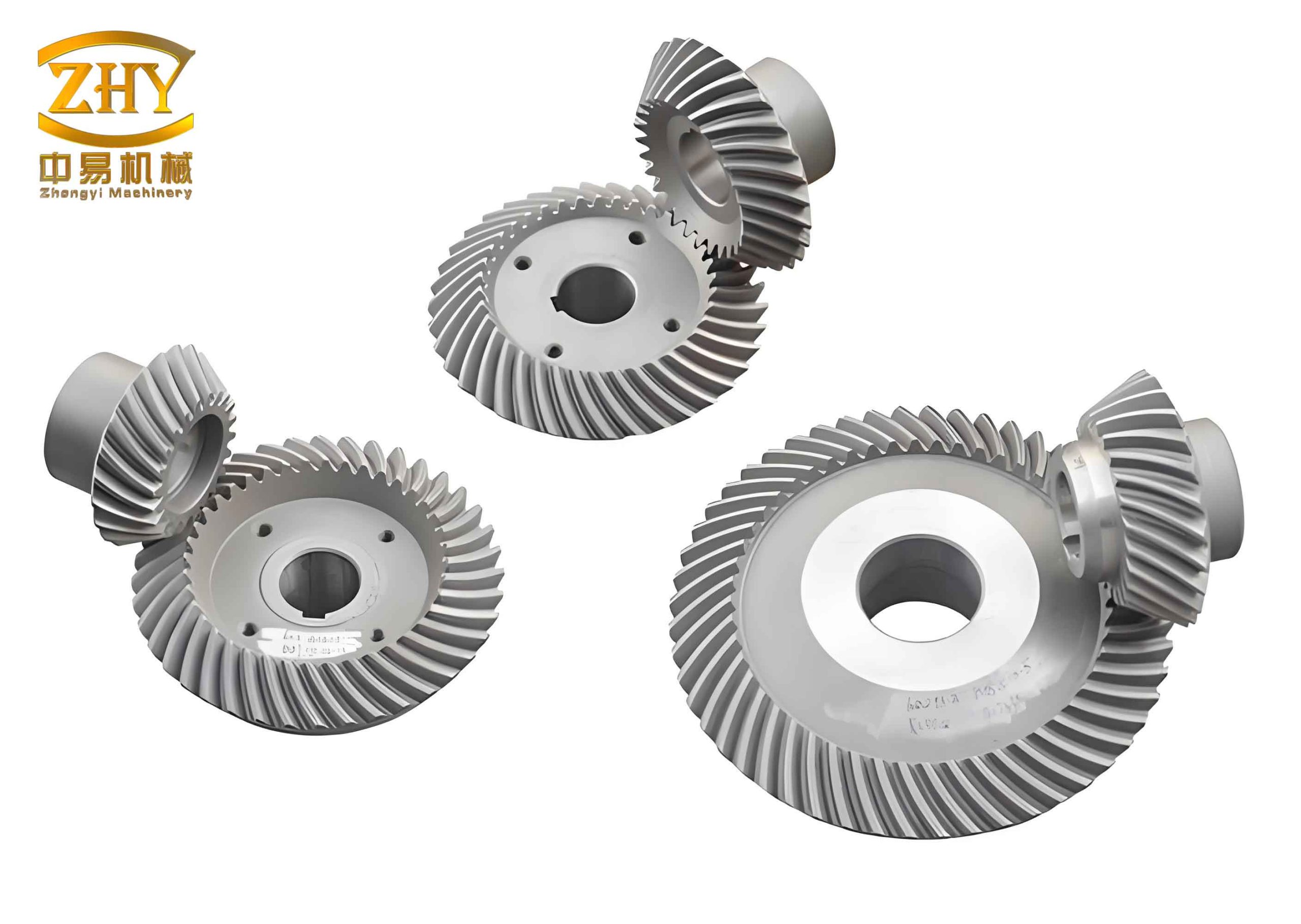
In the design of automotive final drives, hyperboloid gears play a critical role due to their ability to transmit power between non-intersecting axes with high efficiency and compactness. However, the design process is inherently complex, involving over 150 calculation formulas, with at least 47 requiring iterative solutions three times or more. This complexity arises from the interdependent relationships among key parameters, such as pitch diameter, tooth numbers, offset distance, and face width. Traditional design methods often struggle to balance multiple objectives like strength, transmission smoothness, and minimal volume. To address this, I propose a novel approach integrating the three-stage design method with fuzzy comprehensive evaluation, referred to as the fuzzy three-stage design method. This method not only optimizes design parameters for hyperboloid gear pairs but also elucidates the combined influences of these parameters, offering a robust framework for automotive applications.
The three-stage design method, comprising system design, parameter design, and tolerance design, provides a structured approach to product development. For hyperboloid gears, system design establishes the functional requirements and basic model, parameter design seeks optimal parameter combinations using orthogonal arrays and signal-to-noise (SN) ratios, and tolerance design refines allowable variations. In this work, I focus on system and parameter design, as tolerance design is beyond the scope due to space constraints. A key innovation here is the application of fuzzy comprehensive judgment to handle multiple characteristics, overcoming issues like cross-level effects in significance testing and reducing computational overhead in statistical analysis. This approach ensures that design objectives—such as minimizing bending stress, contact stress, and volume, while maximizing transmission smoothness—are effectively balanced.
Hyperboloid gears are widely used in automotive differentials, where their skewed axis configuration allows for lower vehicle profiles and improved drivability. The design of these gears must account for various performance metrics simultaneously. For instance, in a lightweight passenger vehicle, the main reducer hyperboloid gear pair must withstand maximum torque while ensuring smooth operation and compact size. The fuzzy three-stage design method enables a holistic optimization by treating these metrics as fuzzy sets, where uncertainties and interdependencies are managed through membership functions and weighted evaluations. This paper details the methodology, from selecting controllable factors and levels to computing SN ratios and performing fuzzy judgments, ultimately yielding an optimized parameter set for a case study involving a light bus.
To begin, system design defines the target functions for the hyperboloid gear pair. These functions represent multiple characteristics that must be optimized. Let $x_k$ denote the controllable factors, where $k = 1, 2, \ldots, n$. The objectives include:
- Smaller-the-better characteristics for stress: Minimize bending stress for both the pinion and gear, and minimize contact stress. Mathematically, this is expressed as:
$$ y_1 = F_1(x_k) = \sigma_{w1} $$
$$ y_2 = F_2(x_k) = \sigma_{w2} $$
$$ y_3 = F_3(x_k) = \sigma_j $$
where $\sigma_{w1}$ and $\sigma_{w2}$ are the bending stresses for the pinion and gear, respectively, and $\sigma_j$ is the contact stress. - Larger-the-better characteristic for transmission smoothness: Maximize the transverse contact ratio to ensure smooth meshing:
$$ y_4 = F_4(x_k) = \varepsilon_\alpha $$
where $\varepsilon_\alpha$ is the transverse contact ratio. - Smaller-the-better characteristic for volume: Minimize the total volume of the gear pair to reduce weight and space:
$$ y_5 = F_5(x_k) = V_1 + V_2 $$
where $V_1$ and $V_2$ are the volumes of the pinion and gear, respectively.
These objectives often conflict; for example, increasing tooth numbers may improve smoothness but raise volume. Thus, a multi-objective optimization framework is essential. The fuzzy three-stage design method addresses this by aggregating these characteristics through SN ratios and fuzzy logic.
Parameter design is the core of the three-stage method, where orthogonal arrays facilitate the exploration of parameter spaces. For hyperboloid gears, the controllable factors include the gear pitch diameter $d_2$, pinion tooth number $z_1$, gear tooth number $z_2$, offset distance $E$, and face width $b_2$. These factors are selected as they directly influence the gear’s performance and can be adjusted during design. To capture their effects comprehensively, I assign multiple levels to each factor. Specifically, $d_2$ is set to six levels, while $z_1$, $z_2$, $E$, and $b_2$ are set to three levels each. This arrangement allows for a broad exploration of the design space. Note that $z_2$, $E$, and $b_2$ are treated as active levels, meaning their values depend on other parameters; for instance, $E$ is expressed as a percentage of $d_2$. The levels are detailed in Table 1.
| Level | $d_2$ (mm) | $z_1$ | $z_2$ | $E$ | $b_2$ |
|---|---|---|---|---|---|
| 1 | 177.5 | 8 | $4.2z_1 – 1$ | $0.106d_2$ | $0.155d_2 – 1$ |
| 2 | 180.0 | 9 | $4.2z_1$ | $0.156d_2$ | $0.155d_2$ |
| 3 | 182.5 | 10 | $4.2z_1 + 1$ | $0.206d_2$ | $0.155d_2 + 1$ |
| 4 | 185.0 | – | – | – | – |
| 5 | 187.5 | – | – | – | – |
| 6 | 190.0 | – | – | – |
For inner design, an $L_{18}(6 \times 3^6)$ orthogonal array is employed to arrange the controllable factors. This array accommodates one six-level factor and six three-level factors, making it suitable for this study. The factors are assigned to columns as follows: $d_2$ and $E$ are placed in the first two columns due to the active nature of $E$. The inner design matrix, along with computed SN ratios for each characteristic, is shown in Table 2. Each row represents a design condition, and the SN ratios are calculated based on output characteristics from outer design simulations.
| No. | $d_2$ | $E$ | $z_1$ | $z_2$ | $b_2$ | $\eta_{\sigma_{w1}}$ | $\eta_{\sigma_{w2}}$ | $\eta_{\sigma_j}$ | $\eta_{\varepsilon_\alpha}$ | $\eta_V$ |
|---|---|---|---|---|---|---|---|---|---|---|
| 1 | 1 | 1 | 1 | 1 | 1 | -56.77 | -57.49 | -68.45 | 3.37 | -104.95 |
| 2 | 1 | 2 | 2 | 2 | 2 | -55.76 | -57.31 | -66.33 | 5.32 | -105.88 |
| 3 | 1 | 3 | 3 | 3 | 3 | -54.37 | -56.00 | -63.89 | 6.58 | -106.91 |
| 4 | 2 | 1 | 1 | 2 | 3 | -56.48 | -57.28 | -68.26 | 4.17 | -105.28 |
| 5 | 2 | 2 | 2 | 3 | 1 | -56.14 | -57.71 | -66.59 | 5.07 | -105.74 |
| 6 | 2 | 3 | 3 | 1 | 2 | -54.19 | -55.86 | -63.82 | 5.84 | -107.60 |
| 7 | 3 | 1 | 2 | 1 | 3 | -56.54 | -57.50 | -68.03 | 4.45 | -105.78 |
| 8 | 3 | 2 | 3 | 2 | 1 | -54.07 | -56.58 | -65.80 | 5.90 | -106.77 |
| 9 | 3 | 3 | 1 | 3 | 2 | -54.86 | -56.91 | -64.68 | 4.52 | -107.12 |
| 10 | 4 | 1 | 3 | 3 | 2 | -56.04 | -56.60 | -67.53 | 5.71 | -105.91 |
| 11 | 4 | 2 | 1 | 1 | 3 | -54.22 | -56.12 | -65.68 | 4.31 | -107.54 |
| 12 | 4 | 3 | 2 | 2 | 1 | -54.10 | -55.83 | -64.02 | 5.20 | -108.00 |
| 13 | 5 | 1 | 2 | 3 | 1 | -55.85 | -56.53 | -67.67 | 5.20 | -107.53 |
| 14 | 5 | 2 | 3 | 1 | 2 | -54.70 | -56.21 | -65.54 | 5.20 | -107.53 |
| 15 | 5 | 3 | 1 | 2 | 3 | -53.50 | -55.67 | -63.91 | 4.57 | -108.55 |
| 16 | 6 | 1 | 3 | 2 | 3 | -55.70 | -56.50 | -67.36 | 5.25 | -106.71 |
| 17 | 6 | 2 | 1 | 3 | 1 | -54.56 | -56.08 | -65.72 | 4.71 | -107.62 |
| 18 | 6 | 3 | 2 | 1 | 2 | -52.62 | -54.44 | -63.22 | 5.62 | -109.56 |
Error factors are considered to account for manufacturing variations in hyperboloid gears. These include deviations in $d_2$, $E$, and $b_2$, denoted as $d’_2$, $E’$, and $b’_2$, respectively. Each error factor is assigned three levels: nominal value minus a tolerance, nominal value, and nominal value plus a tolerance. For outer design, an $L_9(3^4)$ orthogonal array is used to simulate these variations. The output characteristics $y$ are computed for each inner design condition across all outer design runs, resulting in $18 \times 9 = 162$ values per characteristic. This approach captures the robustness of each design condition against noise factors.
The SN ratio is a key metric in parameter design, measuring the robustness of a system to noise. For smaller-the-better characteristics, such as stress and volume, the SN ratio is computed as:
$$ \eta_{x_{il}} = -10 \log_{10} \left( \frac{1}{n} \sum_{j=1}^{n} y_{ilj}^2 \right) $$
where $i$ indexes the inner design condition, $j$ indexes the outer design run, $l$ denotes the characteristic, and $n$ is the number of outer runs (here, $n=9$). For larger-the-better characteristics, like transmission smoothness, the SN ratio is:
$$ \eta_{d_{il}} = -10 \log_{10} \left( \frac{1}{n} \sum_{j=1}^{n} \frac{1}{y_{ilj}^2} \right) $$
These formulas ensure that higher SN ratios indicate better performance. The SN ratios for all characteristics under maximum torque conditions are listed in Table 2.
Next, I compute the average SN ratio for each factor level across all characteristics. Let $\eta_{lp}$ represent the average SN ratio for factor $l$ at level $p$, calculated as:
$$ \eta_{lp} = \frac{\sum_{k=1}^{p_k} \eta_{(il)p}}{p_k} $$
where $p_k$ is the total number of levels for factor $l$. The results are summarized in Table 3. This step aggregates the performance data, facilitating the fuzzy evaluation.
| Factor | Level 1 | Level 2 | Level 3 | Level 4 | Level 5 | Level 6 |
|---|---|---|---|---|---|---|
| $d_2$ for $F_1$ | -55.63 | -55.60 | -55.49 | -54.79 | -54.68 | -54.29 |
| $d_2$ for $F_2$ | -56.93 | -56.95 | -57.00 | -56.18 | -56.14 | -55.67 |
| $d_2$ for $F_3$ | -66.22 | -66.22 | -66.17 | -65.74 | -65.71 | -65.43 |
| $d_2$ for $F_4$ | 5.09 | 5.027 | 4.957 | 5.073 | 5.02 | 5.193 |
| $d_2$ for $F_5$ | -105.91 | -106.21 | -106.56 | -107.15 | -107.46 | -107.96 |
| $E$ for $F_1$ | -56.23 | -55.07 | -53.94 | – | – | – |
| $E$ for $F_2$ | -56.98 | -56.67 | -55.79 | – | – | – |
| $E$ for $F_3$ | -67.88 | -65.07 | -63.92 | – | – | – |
| $E$ for $F_4$ | 4.707 | 5.085 | 5.388 | – | – | – |
| $E$ for $F_5$ | -105.82 | -106.85 | -107.96 | – | – | – |
| $z_1$ for $F_1$ | -55.06 | -55.17 | -55.01 | – | – | – |
| $z_1$ for $F_2$ | -55.59 | -56.56 | -56.29 | – | – | – |
| $z_1$ for $F_3$ | -66.12 | -65.97 | -65.65 | – | – | – |
| $z_1$ for $F_4$ | 4.275 | 5.158 | 5.747 | – | – | – |
| $z_1$ for $F_5$ | -106.84 | -106.88 | -106.91 | – | – | – |
| $z_2$ for $F_1$ | -54.84 | -55.10 | -55.30 | – | – | – |
| $z_2$ for $F_2$ | -56.27 | -56.53 | -56.64 | – | – | – |
| $z_2$ for $F_3$ | -65.79 | -65.94 | -66.01 | – | – | – |
| $z_2$ for $F_4$ | 4.798 | 5.068 | 5.313 | – | – | – |
| $z_2$ for $F_5$ | -107.16 | -106.87 | -106.60 | – | – | – |
| $b_2$ for $F_1$ | -55.37 | -55.10 | -54.77 | – | – | – |
| $b_2$ for $F_2$ | -55.78 | -56.50 | -56.16 | – | – | – |
| $b_2$ for $F_3$ | -66.10 | -65.89 | -65.75 | – | – | – |
| $b_2$ for $F_4$ | 4.768 | 5.101 | 5.338 | – | – | – |
| $b_2$ for $F_5$ | -106.68 | -106.89 | -107.06 | – | – | – |
To construct fuzzy judgment matrices, the SN ratios must be normalized. Since SN ratios can be negative, I first apply an increasing transformation:
$$ \eta’_{lp} = \begin{cases}
\eta_{lp} & \text{if } \eta_{lp} \geq 0 \\
\frac{1}{\eta_{lp}} & \text{if } \eta_{lp} < 0
\end{cases} $$
Then, normalization is performed to obtain the fuzzy membership values:
$$ \tilde{R}_{kl} = \frac{\eta’_{lp}}{\sum_{p=1}^{p_k} \eta’_{lp}} $$
where $\tilde{R}_{kl}$ represents the fuzzy judgment matrix for factor $k$ across characteristic $l$. The normalized values are shown in Table 4. Each matrix encapsulates the relative performance of factor levels, serving as input for fuzzy comprehensive evaluation.
| Factor | Level 1 | Level 2 | Level 3 | Level 4 | Level 5 | Level 6 |
|---|---|---|---|---|---|---|
| $d_2$ for $F_1$ | 0.1650 | 0.1651 | 0.1654 | 0.1675 | 0.1679 | 0.1691 |
| $d_2$ for $F_2$ | 0.1653 | 0.1653 | 0.1651 | 0.1675 | 0.1677 | 0.1691 |
| $d_2$ for $F_3$ | 0.1659 | 0.1659 | 0.1660 | 0.1671 | 0.1672 | 0.1679 |
| $d_2$ for $F_4$ | 0.1676 | 0.1656 | 0.1633 | 0.1671 | 0.1653 | 0.1711 |
| $d_2$ for $F_5$ | 0.1682 | 0.1677 | 0.1672 | 0.1662 | 0.1657 | 0.1650 |
| $E$ for $F_1$ | 0.3264 | 0.3333 | 0.3403 | – | – | – |
| $E$ for $F_2$ | 0.3304 | 0.3322 | 0.3374 | – | – | – |
| $E$ for $F_3$ | 0.3235 | 0.3330 | 0.3435 | – | – | – |
| $E$ for $F_4$ | 0.3100 | 0.3350 | 0.3550 | – | – | – |
| $E$ for $F_5$ | 0.3366 | 0.3334 | 0.3300 | – | – | – |
| $z_1$ for $F_1$ | 0.3334 | 0.3328 | 0.3338 | – | – | – |
| $z_1$ for $F_2$ | 0.3327 | 0.3339 | 0.3344 | – | – | – |
| $z_1$ for $F_3$ | 0.3323 | 0.3330 | 0.3347 | – | – | – |
| $z_1$ for $F_4$ | 0.2816 | 0.3398 | 0.3786 | – | – | – |
| $z_1$ for $F_5$ | 0.3334 | 0.3333 | 0.3333 | – | – | – |
| $z_2$ for $F_1$ | 0.3348 | 0.3332 | 0.3320 | – | – | – |
| $z_2$ for $F_2$ | 0.3346 | 0.3330 | 0.3324 | – | – | – |
| $z_2$ for $F_3$ | 0.3340 | 0.3332 | 0.3328 | – | – | – |
| $z_2$ for $F_4$ | 0.3161 | 0.3339 | 0.3500 | – | – | – |
| $z_2$ for $F_5$ | 0.3324 | 0.3334 | 0.3342 | – | – | – |
| $b_2$ for $F_1$ | 0.3316 | 0.3332 | 0.3352 | – | – | – |
| $b_2$ for $F_2$ | 0.3316 | 0.3332 | 0.3352 | – | – | – |
| $b_2$ for $F_3$ | 0.3324 | 0.3335 | 0.3341 | – | – | – |
| $b_2$ for $F_4$ | 0.3141 | 0.3360 | 0.3499 | – | – | – |
| $b_2$ for $F_5$ | 0.3340 | 0.3333 | 0.3327 | – | – | – |
The weight vector $\tilde{A} = (a_1, a_2, a_3, a_4, a_5)$ assigns importance to each characteristic based on hyperboloid gear requirements. For automotive applications, stress durability and compactness are prioritized. Through expert judgment and performance analysis, I set the weights as:
$$ \tilde{A} = (0.18, 0.15, 0.17, 0.15, 0.35) $$
where $a_1$ to $a_5$ correspond to $F_1$ (pinion bending stress), $F_2$ (gear bending stress), $F_3$ (contact stress), $F_4$ (transverse contact ratio), and $F_5$ (volume), respectively. This weighting reflects the criticality of volume minimization in vehicle design, while ensuring adequate strength and smoothness for hyperboloid gears.
Fuzzy comprehensive evaluation is conducted using the generalized fuzzy operator, defined as:
$$ \alpha \cdot \beta = \alpha \beta $$
$$ \alpha \oplus \beta = (\alpha + \beta, 1) $$
This operator combines the weight vector and fuzzy judgment matrices to yield comprehensive scores. For each factor, the evaluation is computed as:
$$ \tilde{B}_k = \tilde{A} \cdot \tilde{R}_k $$
where $\tilde{B}_k$ is the fuzzy evaluation result for factor $k$. The calculations yield:
$$ \tilde{B}_1 = (0.1667, 0.1663, 0.1658, 0.1669, 0.1678) \quad \text{for } d_2 $$
$$ \tilde{B}_2 = (0.3276, 0.3334, 0.3390) \quad \text{for } E $$
$$ \tilde{B}_3 = (0.3253, 0.3341, 0.3406) \quad \text{for } z_1 $$
$$ \tilde{B}_4 = (0.3310, 0.3333, 0.3357) \quad \text{for } z_2 $$
$$ \tilde{B}_5 = (0.3300, 0.3337, 0.3363) \quad \text{for } b_2 $$
In each vector, the highest value indicates the optimal level. Thus, the best parameter combination is: $d_2$ at level 6, $E$ at level 3, $z_1$ at level 3, $z_2$ at level 3, and $b_2$ at level 3.
However, practical considerations for hyperboloid gears necessitate adjustments. Statistical analysis reveals that the offset distance $E$ has the most significant effect, followed by $z_1$. The factors $b_2$, $z_2$, and $d_2$ are less significant under maximum torque but become highly significant under average torque conditions. For hyperboloid gears, excessive $E$ can increase longitudinal sliding, leading to wear or scuffing. In light vehicles, $E$ should not exceed 40% of the gear outer cone distance, approximately 20% of $d_2$. Therefore, I select $E = 34$ mm, corresponding to $E/d_2 = 18.378\%$, slightly below the 20% threshold.
The tooth numbers $z_1$ and $z_2$ must avoid common divisors and approximate the desired gear ratio. The fuzzy-optimized ratio is $z_2/z_1 = 43/10 = 4.3$, yielding an error of $\delta = (4.3 – 4.2)/4.2 = 2.38\%$, which is acceptable. The face width $b_2$ is rounded from $0.155d_2 + 1$ to 29 mm. For $d_2$, although level 6 is optimal, level 4 is chosen to enhance ground clearance in vehicles, as $d_2$ has lower significance. Thus, the final optimized parameters are:
– Pitch diameter $d_2 = 185$ mm
– Offset distance $E = 34$ mm
– Pinion tooth number $z_1 = 10$
– Gear tooth number $z_2 = 43$
– Face width $b_2 = 29$ mm
Using these parameters in the system design equations, the performance under maximum torque is computed as:
– Pinion bending stress: $\sigma_{w1} = 550.92$ N/mm²
– Gear bending stress: $\sigma_{w2} = 665.08$ N/mm²
– Contact stress: $\sigma_j = 1674.43$ N/mm²
– Transverse contact ratio: $\varepsilon_\alpha = 2.1136$
– Total volume: $V = 238731.3$ mm³
These values meet design specifications, demonstrating the effectiveness of the fuzzy three-stage method for hyperboloid gears.
In conclusion, the fuzzy three-stage design method offers a powerful approach for optimizing hyperboloid gear pairs. By integrating orthogonal experiments, SN ratios, and fuzzy logic, it efficiently handles multiple conflicting objectives, such as strength, smoothness, and compactness. This method simplifies the design process compared to conventional optimization techniques, especially given the complex interdependencies in hyperboloid gears. The use of fuzzy comprehensive judgment resolves cross-level issues in significance testing and reduces computational burden, making it suitable for practical engineering applications.
Key insights from this study include:
1. The offset distance $E$ and pinion tooth number $z_1$ should be set to higher values to enhance performance, contrary to the notion that smaller $z_1$ is always better for hyperboloid gears.
2. Face width $b_2$ and gear tooth number $z_2$ also benefit from larger values.
3. Pitch diameter $d_2$ has variable significance but can be adjusted based on design constraints like ground clearance.
These findings underscore the adaptability of the method in tailoring hyperboloid gear designs to specific automotive needs.
Future work could extend this approach to tolerance design, further refining parameter variations for mass production. Additionally, incorporating dynamic analysis or thermal effects could enhance the model’s realism. Overall, the fuzzy three-stage design method proves to be a robust tool for advancing hyperboloid gear technology, ensuring reliable and efficient performance in automotive systems.