
In the engineering of automotive drivetrains, the design of hypoid gears presents a significant challenge due to the complex interdependencies among numerous parameters and the extensive computational requirements involved. Traditional design methods often struggle to balance multiple conflicting objectives, such as strength, transmission smoothness, and minimal volume, while accounting for parameter variations. To address this, I propose and implement a three-stage design methodology, enhanced with fuzzy comprehensive evaluation, specifically tailored for hypoid gear pairs in automotive final drives. This approach, which I refer to as the fuzzy three-stage design method, systematically navigates the design space to identify optimal parameter sets and elucidate their combined influences. The core of this method lies in integrating system design, parameter design, and tolerance design principles, with a novel application of fuzzy logic to handle multi-objective optimization, thereby overcoming limitations like cross-level issues in significance testing and reducing computational overhead.
The design of a hypoid gear pair involves over 150 calculation formulas, with at least 47 requiring iterative solutions three times or more. This complexity makes the rational selection of basic parameters crucial. The three-stage design method decomposes this problem into manageable phases: system design (functional design), parameter design (optimization of nominal values), and tolerance design (analysis of variation effects). In this discussion, I focus on the system and parameter design stages, applying fuzzy comprehensive judgment to synthesize multiple performance characteristics. The primary goal is to achieve an optimal balance for the hypoid gear pair, ensuring durability, efficiency, and compactness. Throughout this process, the term ‘hypoid gear’ is central, as its unique geometry—characterized by offset axes—dictates specific design considerations distinct from other gear types.
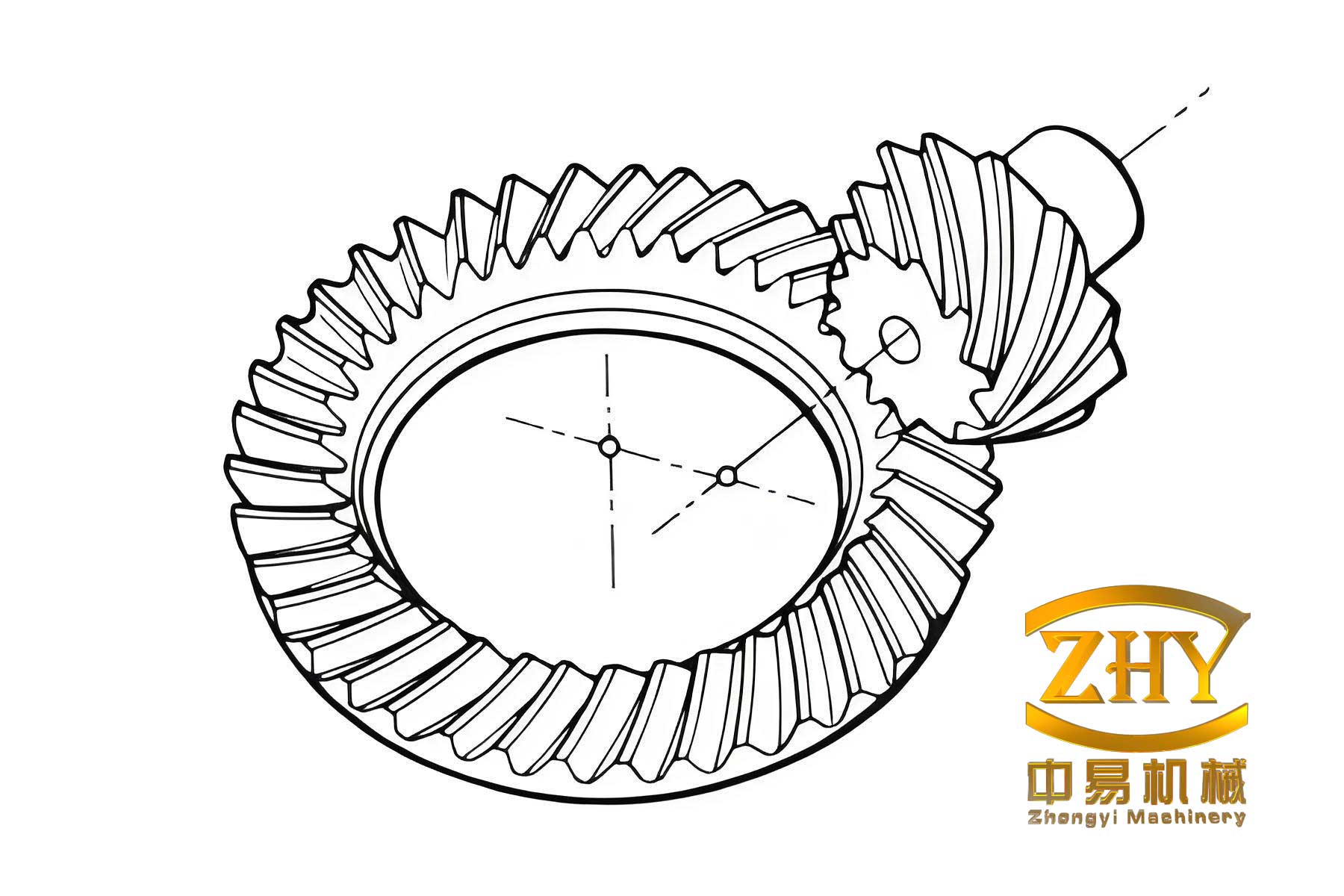
The system design phase establishes the fundamental model and target functions. For a hypoid gear pair, multiple characteristics are considered as design objectives, formulated mathematically. Let the design variables be denoted as $x_k$ for $k = 1, 2, \ldots, n$, where $n$ is the number of controllable factors. The key objectives include:
- Stress Characteristics (Smaller-the-Better): Minimize bending stress for both the pinion and gear, and minimize contact stress. For a hypoid gear, these are critical for longevity and reliability.
$$ \min y_1 = F_1(x_k) = \sigma_{w1} $$
$$ \min y_2 = F_2(x_k) = \sigma_{w2} $$
$$ \min y_3 = F_3(x_k) = \sigma_j $$
Here, $\sigma_{w1}$ and $\sigma_{w2}$ are the bending stresses of the pinion and gear, respectively, and $\sigma_j$ is the contact stress. - Transmission Smoothness (Larger-the-Better): Maximize the transverse contact ratio to ensure smooth and quiet operation of the hypoid gear pair.
$$ \max y_4 = F_4(x_k) = \varepsilon_\alpha $$
where $\varepsilon_\alpha$ is the transverse contact ratio. - Volume/Weight (Smaller-the-Better): Minimize the total volume of the hypoid gear pair to reduce material usage and weight.
$$ \min y_5 = F_5(x_k) = V_1 + V_2 $$
Here, $V_1$ and $V_2$ are the volumes of the pinion and gear, respectively.
These objectives often conflict; for instance, increasing gear size may improve strength but increase volume. The fuzzy three-stage method harmonizes these via parameter design. To illustrate, I consider a case study based on a light passenger vehicle with the following specifications: maximum engine torque $M_{emax} = 140 \, \text{Nm}$, maximum transmission ratio $i = 4.8956$, full-load vehicle mass $G_a = 1880 \, \text{kg}$, final drive ratio $i_0 \approx 4.2$, and wheel rolling radius $r_k = 0.295 \, \text{m}$. The hypoid gear pair for the final drive must meet these operational demands.
Parameter design is the core of the optimization process. It involves selecting the best combination of controllable factor levels using design of experiments (DoE) techniques, notably orthogonal arrays. For the hypoid gear, the controllable factors are chosen as those with significant influence on the objectives: the gear pitch diameter $d_2$, pinion teeth number $z_1$, gear teeth number $z_2$, offset distance $E$, and face width $b_2$. These factors are set at various levels to explore their effects comprehensively. Notably, $z_2$, $E$, and $b_2$ are treated as active levels that depend on other parameters. The levels are selected to cover a practical range for hypoid gear design, as shown in Table 1.
| Level | $d_2$ (mm) | $z_1$ | $z_2$ | $E$ | $b_2$ |
|---|---|---|---|---|---|
| 1 | 177.5 | 8 | $4.2 z_1 – 1$ | $0.106 d_2$ | $0.155 d_2 – 1$ |
| 2 | 180.0 | 9 | $4.2 z_1$ | $0.156 d_2$ | $0.155 d_2$ |
| 3 | 182.5 | 10 | $4.2 z_1 + 1$ | $0.206 d_2$ | $0.155 d_2 + 1$ |
| 4 | 185.0 | – | – | – | – |
| 5 | 187.5 | – | – | – | – |
| 6 | 190.0 | – | – | – | – |
Here, $d_2$ has six levels, while others have three, allowing a broad investigation. The inner array, or inner design, uses an orthogonal table to arrange these factors. I select the $L_{18}(6 \times 3^6)$ orthogonal array, suitable for mixed-level factors, and assign $d_2$ and $E$ to the first two columns due to their activity properties. The inner array layout and subsequent calculations form the basis for evaluating each design combination. The inner array assignments are summarized in Table 2, which also includes the Signal-to-Noise (SN) ratios computed later.
To account for manufacturing variations, error factors are introduced: deviations in $d_2$, $E$, and $b_2$, denoted as $d’_2$, $E’$, and $b’_2$, respectively. Each error factor is set at three levels: nominal value, nominal minus a tolerance, and nominal plus a tolerance. For the outer design, an $L_9(3^4)$ orthogonal array is used to simulate these variations. For each combination in the inner array (18 conditions), the output characteristics $y_1$ to $y_5$ are computed across the outer array (9 conditions), resulting in $18 \times 9 = 162$ values per objective. This approach assesses the robustness of each hypoid gear design to parameter fluctuations.
The SN ratio is a metric used in quality engineering to evaluate performance stability. For smaller-the-better characteristics (like stress and volume), the SN ratio $\eta$ is calculated as:
$$ \eta_{il} = -10 \log_{10} \left( \frac{1}{n} \sum_{j=1}^{n} y_{ilj}^2 \right) $$
For larger-the-better characteristics (like contact ratio), it is:
$$ \eta_{il} = -10 \log_{10} \left( \frac{1}{n} \sum_{j=1}^{n} \frac{1}{y_{ilj}^2} \right) $$
where $i$ indexes the inner array condition ($i = 1, 2, \ldots, 18$), $j$ indexes the outer array condition ($j = 1, 2, \ldots, 9$), and $l$ indexes the objective ($l = 1, 2, \ldots, 5$). The SN ratios for the maximum torque condition are computed and listed in Table 2.
| No. | $d_2$ | $E$ | $z_1$ | $z_2$ | $b_2$ | $\eta_{\sigma_{w1}}$ | $\eta_{\sigma_{w2}}$ | $\eta_{\sigma_j}$ | $\eta_{\varepsilon_\alpha}$ | $\eta_V$ |
|---|---|---|---|---|---|---|---|---|---|---|
| 1 | 1 | 1 | 1 | 1 | 1 | -56.77 | -57.49 | -68.45 | 3.37 | -104.95 |
| 2 | 1 | 2 | 2 | 2 | 2 | -55.76 | -57.31 | -66.33 | 5.32 | -105.88 |
| 3 | 1 | 3 | 3 | 3 | 3 | -54.37 | -56.00 | -63.89 | 6.58 | -106.91 |
| 4 | 2 | 1 | 1 | 2 | 2 | -56.48 | -57.28 | -68.26 | 4.17 | -105.28 |
| 5 | 2 | 2 | 2 | 3 | 3 | -56.14 | -57.71 | -66.59 | 5.07 | -105.74 |
| 6 | 2 | 3 | 3 | 1 | 1 | -54.19 | -55.86 | -63.82 | 5.84 | -107.60 |
| 7 | 3 | 1 | 2 | 1 | 3 | -56.54 | -57.50 | -68.03 | 4.45 | -105.78 |
| 8 | 3 | 2 | 3 | 2 | 1 | -54.07 | -56.58 | -65.80 | 5.90 | -106.77 |
| 9 | 3 | 3 | 1 | 3 | 2 | -54.86 | -56.91 | -64.68 | 4.52 | -107.12 |
| 10 | 4 | 1 | 3 | 3 | 2 | -56.04 | -56.60 | -67.53 | 5.71 | -105.91 |
| 11 | 4 | 2 | 1 | 1 | 3 | -54.22 | -56.12 | -65.68 | 4.31 | -107.54 |
| 12 | 4 | 3 | 2 | 2 | 1 | -54.10 | -55.83 | -64.02 | 5.20 | -108.00 |
| 13 | 5 | 1 | 2 | 3 | 1 | -55.85 | -56.53 | -67.67 | 5.20 | -107.53 |
| 14 | 5 | 2 | 3 | 1 | 2 | -54.70 | -56.21 | -65.54 | 5.20 | -107.53 |
| 15 | 5 | 3 | 1 | 2 | 3 | -53.50 | -55.67 | -63.91 | 4.57 | -108.55 |
| 16 | 6 | 1 | 3 | 2 | 3 | -55.70 | -56.50 | -67.36 | 5.25 | -106.71 |
| 17 | 6 | 2 | 1 | 3 | 1 | -54.56 | -56.08 | -65.72 | 4.71 | -107.62 |
| 18 | 6 | 3 | 2 | 1 | 2 | -52.62 | -54.44 | -63.22 | 5.62 | -109.56 |
Next, the average SN ratio for each factor level across all objectives is computed to understand individual effects. For a factor $x_k$ with level $p$ (where $p = 1, 2, \ldots, p_k$, and $p_k$ is the total levels for that factor), the average SN ratio $\eta_{lp}$ for objective $l$ is:
$$ \eta_{lp} = \frac{\sum_{p} \eta_{(il)p}}{p_k} $$
where the summation is over all inner array conditions corresponding to level $p$ of factor $x_k$. The results are tabulated in Table 3, showing how each factor level influences the hypoid gear performance metrics.
| Factor | Level | $F_1$: $\eta_{\sigma_{w1}}$ | $F_2$: $\eta_{\sigma_{w2}}$ | $F_3$: $\eta_{\sigma_j}$ | $F_4$: $\eta_{\varepsilon_\alpha}$ | $F_5$: $\eta_V$ |
|---|---|---|---|---|---|---|
| $d_2$ | 1 | -55.63 | -56.93 | -66.22 | 5.09 | -105.91 |
| 2 | -55.60 | -56.95 | -66.22 | 5.027 | -106.21 | |
| 3 | -55.49 | -57.00 | -66.17 | 4.957 | -106.56 | |
| 4 | -54.79 | -56.18 | -65.74 | 5.073 | -107.15 | |
| 5 | -54.68 | -56.14 | -65.71 | 5.02 | -107.46 | |
| 6 | -54.29 | -55.67 | -65.43 | 5.193 | -107.96 | |
| $E$ | 1 | -56.23 | -56.98 | -67.88 | 4.707 | -105.82 |
| 2 | -55.07 | -56.67 | -65.07 | 5.085 | -106.85 | |
| 3 | -53.94 | -55.79 | -63.92 | 5.388 | -107.96 | |
| $z_1$ | 1 | -55.06 | -55.59 | -66.12 | 4.275 | -106.84 |
| 2 | -55.17 | -56.56 | -65.97 | 5.158 | -106.88 | |
| 3 | -55.01 | -56.29 | -65.65 | 5.747 | -106.91 | |
| $z_2$ | 1 | -54.84 | -56.27 | -65.79 | 4.798 | -107.16 |
| 2 | -55.10 | -56.53 | -65.94 | 5.068 | -106.87 | |
| 3 | -55.30 | -56.64 | -66.01 | 5.313 | -106.60 | |
| $b_2$ | 1 | -55.37 | -55.78 | -66.10 | 4.768 | -106.68 |
| 2 | -55.10 | -56.50 | -65.89 | 5.101 | -106.89 | |
| 3 | -54.77 | -56.16 | -65.75 | 5.349 | -107.06 |
To facilitate fuzzy comprehensive evaluation, the SN ratios must be normalized, as they contain negative values. First, I apply an increasing transformation to ensure all values are non-negative for normalization. For each $\eta_{lp}$:
$$ \eta’_{lp} = \begin{cases}
\eta_{lp} & \text{if } \eta_{lp} \geq 0 \\
\frac{1}{|\eta_{lp}|} & \text{if } \eta_{lp} < 0
\end{cases} $$
This adjustment preserves the ordinal relationships while making data suitable for fuzzy sets. Then, normalization is performed to convert these into membership degrees for each factor level relative to each objective:
$$ r_{lp} = \frac{\eta’_{lp}}{\sum_{p=1}^{p_k} \eta’_{lp}} $$
where $r_{lp}$ represents the normalized value, forming the fuzzy evaluation matrix $\tilde{R}_k$ for each factor $x_k$. The normalized results are shown in Table 4, which serves as the basis for fuzzy judgment.
| Factor | Level | $F_1$ | $F_2$ | $F_3$ | $F_4$ | $F_5$ |
|---|---|---|---|---|---|---|
| $d_2$ | 1 | 0.1650 | 0.1653 | 0.1659 | 0.1676 | 0.1682 |
| 2 | 0.1651 | 0.1653 | 0.1659 | 0.1656 | 0.1677 | |
| 3 | 0.1654 | 0.1651 | 0.1660 | 0.1633 | 0.1672 | |
| 4 | 0.1675 | 0.1675 | 0.1671 | 0.1671 | 0.1662 | |
| 5 | 0.1679 | 0.1677 | 0.1672 | 0.1653 | 0.1657 | |
| 6 | 0.1691 | 0.1691 | 0.1679 | 0.1711 | 0.1650 | |
| $E$ | 1 | 0.3264 | 0.3304 | 0.3235 | 0.3100 | 0.3366 |
| 2 | 0.3333 | 0.3322 | 0.3330 | 0.3350 | 0.3334 | |
| 3 | 0.3403 | 0.3374 | 0.3435 | 0.3550 | 0.3300 | |
| $z_1$ | 1 | 0.3334 | 0.3327 | 0.3323 | 0.2816 | 0.3334 |
| 2 | 0.3328 | 0.3339 | 0.3330 | 0.3398 | 0.3333 | |
| 3 | 0.3338 | 0.3344 | 0.3347 | 0.3786 | 0.3333 | |
| $z_2$ | 1 | 0.3348 | 0.3346 | 0.3340 | 0.3161 | 0.3324 |
| 2 | 0.3332 | 0.3330 | 0.3332 | 0.3339 | 0.3334 | |
| 3 | 0.3320 | 0.3324 | 0.3328 | 0.3500 | 0.3342 | |
| $b_2$ | 1 | 0.3316 | 0.3316 | 0.3324 | 0.3141 | 0.3340 |
| 2 | 0.3332 | 0.3332 | 0.3335 | 0.3360 | 0.3333 | |
| 3 | 0.3352 | 0.3352 | 0.3341 | 0.3499 | 0.3327 |
The fuzzy comprehensive evaluation requires a weight vector $\tilde{A} = (a_1, a_2, a_3, a_4, a_5)$ to reflect the relative importance of each objective for the hypoid gear design. Based on engineering expertise and the operational requirements of automotive final drives, I assign weights that prioritize volume reduction and strength, while also considering smoothness. The determined weights are:
$$ \tilde{A} = (0.18, 0.15, 0.17, 0.15, 0.35) $$
These correspond to $F_1$ (bending stress of pinion), $F_2$ (bending stress of gear), $F_3$ (contact stress), $F_4$ (transverse contact ratio), and $F_5$ (volume), respectively. The high weight for volume aligns with the goal of compact hypoid gear designs in vehicles.
Using the generalized fuzzy operator, which combines multiplication and bounded sum operations, I perform the comprehensive evaluation. For two fuzzy values $\alpha$ and $\beta$, the operations are defined as:
$$ \alpha \cdot \beta = \alpha \beta $$
$$ \alpha \oplus \beta = \min(\alpha + \beta, 1) $$
This operator is applied to aggregate the weighted evaluations. The fuzzy comprehensive judgment for each factor is computed as $\tilde{B}_k = \tilde{A} \cdot \tilde{R}_k$, resulting in a vector for each factor indicating the overall preference for each level. The calculations yield:
– For $d_2$: $\tilde{B}_1 = (0.1667, 0.1663, 0.1658, 0.1669, 0.1678)$
– For $E$: $\tilde{B}_2 = (0.3276, 0.3334, 0.3390)$
– For $z_1$: $\tilde{B}_3 = (0.3253, 0.3341, 0.3406)$
– For $z_2$: $\tilde{B}_4 = (0.3310, 0.3333, 0.3357)$
– For $b_2$: $\tilde{B}_5 = (0.3300, 0.3337, 0.3363)$
From these results, the optimal level for each factor is the one with the highest value in $\tilde{B}_k$: level 6 for $d_2$ (value 0.1678), level 3 for $E$ (0.3390), level 3 for $z_1$ (0.3406), level 3 for $z_2$ (0.3357), and level 3 for $b_2$ (0.3363). Thus, the best parameter combination from fuzzy evaluation is: $(d_2)_6 = 190.0 \, \text{mm}$, $E_3 = 0.206 d_2 = 39.14 \, \text{mm}$, $(z_1)_3 = 10$, $(z_2)_3 = 4.2 \times 10 + 1 = 43$, and $(b_2)_3 = 0.155 d_2 + 1 = 30.45 \, \text{mm}$.
However, practical considerations for hypoid gear design necessitate adjustments. The offset $E$ is critical; excessive offset can increase sliding velocities, leading to wear and scoring. For passenger cars and light trucks, $E$ should not exceed 40% of the gear outer cone distance (approximately 20% of $d_2$). Here, $E_3 = 39.14 \, \text{mm}$ gives $E/d_2 = 20.6\%$, which is slightly above the recommended threshold. Therefore, I adjust $E$ to a more typical value, such as $34 \, \text{mm}$, resulting in $E/d_2 = 17.9\%$, which balances performance and durability. Similarly, the gear ratio should match the required $i_0 \approx 4.2$: with $z_1=10$ and $z_2=43$, the ratio is $4.3$, yielding an error $\delta = (4.3-4.2)/4.2 = 2.38\%$, acceptable in practice. The face width $b_2$ is rounded to $29 \, \text{mm}$ for manufacturability. For $d_2$, statistical analysis from variance studies (not detailed here) shows that in maximum torque conditions, $d_2$ has insignificant effects, so it can be chosen flexibly to improve ground clearance; hence, I select $(d_2)_4 = 185.0 \, \text{mm}$, the second-best per fuzzy evaluation.
The final optimized parameters for the hypoid gear pair are: $d_2 = 185.0 \, \text{mm}$, $E = 34.0 \, \text{mm}$, $z_1 = 10$, $z_2 = 43$, and $b_2 = 29 \, \text{mm}$. Using the system design formulas, the performance under maximum torque conditions is computed:
– Bending stress, pinion: $\sigma_{w1} = 550.92 \, \text{N/mm}^2$
– Bending stress, gear: $\sigma_{w2} = 665.08 \, \text{N/mm}^2$
– Contact stress: $\sigma_j = 1674.43 \, \text{N/mm}^2$
– Transverse contact ratio: $\varepsilon_\alpha = 2.1136$
– Total volume: $V = 238731.3 \, \text{mm}^3$
These values meet typical design criteria for hypoid gears in automotive applications, demonstrating the effectiveness of the method.
In conclusion, the fuzzy three-stage design method offers a robust framework for optimizing hypoid gear pairs. It simplifies the complex design process by leveraging orthogonal experiments and fuzzy logic to handle multiple objectives seamlessly. Key advantages include:
– Efficiency: The three-stage approach (system, parameter, tolerance design) streamlines optimization, making it more accessible than conventional methods for hypoid gears.
– Flexibility: Fuzzy comprehensive judgment resolves cross-level conflicts in multi-objective optimization, where a factor may have contrasting effects on different goals, without extensive statistical testing.
– Insight: The method elucidates parameter influences; for instance, it reveals that for hypoid gears, larger values of $E$, $z_1$, $z_2$, and $b_2$ generally improve multiple objectives, while $d_2$ can be tuned based on secondary constraints.
– Practicality: Results are directly applicable, as seen in the case study, and the method can be extended to other gear types or mechanical systems.
This methodology underscores the importance of integrated design strategies in advancing hypoid gear technology, ensuring reliable and efficient power transmission in vehicles. Future work could explore tolerance design to further enhance robustness against manufacturing variations, solidifying the holistic design of hypoid gear pairs.