
In my experience working with gear manufacturing, I have observed that deformation during carburizing heat treatment significantly impacts the lifespan, strength, and precision of gear components. Even with post-heat treatment grinding processes, the accuracy grade of gears can be compromised. Through extensive research and practical applications, I have identified that multiple factors contribute to these heat treatment defects. Controlling these factors is essential to minimize deformation. This article delves into the deformation mechanisms, influencing factors, and countermeasures, incorporating tables and formulas to summarize key insights.
Heat treatment deformation in gears manifests in various forms, such as dimensional changes, warping, ovality, and bending. Fundamentally, these deformations can be categorized into two types: volumetric deformation and plastic deformation. Volumetric deformation results from changes in specific volume due to phase transformations, while plastic deformation arises from internal stresses induced by non-uniform heating and cooling. Understanding these root causes is crucial for addressing heat treatment defects.
Root Causes of Heat Treatment Deformation
From my analysis, deformation primarily stems from internal stress-induced plastic deformation and specific volume-induced deformation. Internal stresses develop due to uneven temperature distribution during heating and cooling, leading to plastic strain when the material’s yield strength is exceeded. This type of deformation is directional and does not alter the overall volume of the part. In contrast, specific volume deformation occurs during phase transitions, such as austenite to martensite, where different crystal structures have distinct densities. This deformation is isotropic and affects the part’s dimensions uniformly.
The relationship between stress and deformation can be expressed using Hooke’s law for elastic regions and plasticity models for yielding. For instance, the thermal stress (\(\sigma_{th}\)) during cooling can be approximated as:
$$\sigma_{th} = E \alpha \Delta T$$
where \(E\) is Young’s modulus, \(\alpha\) is the coefficient of thermal expansion, and \(\Delta T\) is the temperature gradient. When \(\sigma_{th}\) exceeds the yield strength, plastic deformation occurs, contributing to heat treatment defects.
To summarize these causes, I have compiled Table 1, which outlines the characteristics and mechanisms of deformation types.
| Deformation Type | Primary Cause | Characteristics | Mathematical Representation |
|---|---|---|---|
| Volumetric Deformation | Phase transformation (e.g., martensitic change) | Isotropic, changes volume, depends on microstructure | $$\Delta V = V_0 (\beta_m – \beta_a)$$ where \(\beta\) is specific volume of phase |
| Plastic Deformation | Internal stresses (thermal or transformational) | Directional, no volume change, influenced by cooling rate | $$\epsilon_p = \int_{0}^{t} \frac{\sigma – \sigma_y}{K} dt$$ where \(\sigma_y\) is yield stress |
These heat treatment defects are exacerbated by factors like material composition and processing parameters, which I will explore in detail.
Factors Influencing Deformation and Countermeasures
Based on my observations, deformation in carburized gears is influenced by a multitude of factors. Addressing these requires a holistic approach throughout the manufacturing process. Below, I discuss each factor and propose countermeasures, emphasizing the reduction of heat treatment defects.
Material Metallurgical Factors
The steel’s hardenability plays a critical role in deformation. Higher hardenability often leads to greater distortion due to increased martensite formation. I recommend using steels with narrow hardenability bands to ensure consistent response to heat treatment. The Al/N ratio should be controlled between 1 and 2.5 to minimize deformation. Additionally, banded structures and segregation can cause uneven carburizing, leading to localized heat treatment defects. Table 2 summarizes material-related factors and solutions.
| Factor | Impact on Deformation | Countermeasure |
|---|---|---|
| High Hardenability | Increases distortion, especially with core hardness >40 HRC | Use low-deformation steels with controlled hardenability |
| Banded Structures | Causes non-uniform carburizing and stress concentration | Apply normalizing or isothermal annealing to homogenize |
| Al/N Ratio | Affects hardenability bandwidth; improper ratio increases deformation | Maintain Al/N ratio between 1 and 2.5 |
By selecting appropriate materials, we can mitigate these heat treatment defects at the source.
Pre-Heat Treatment Effects
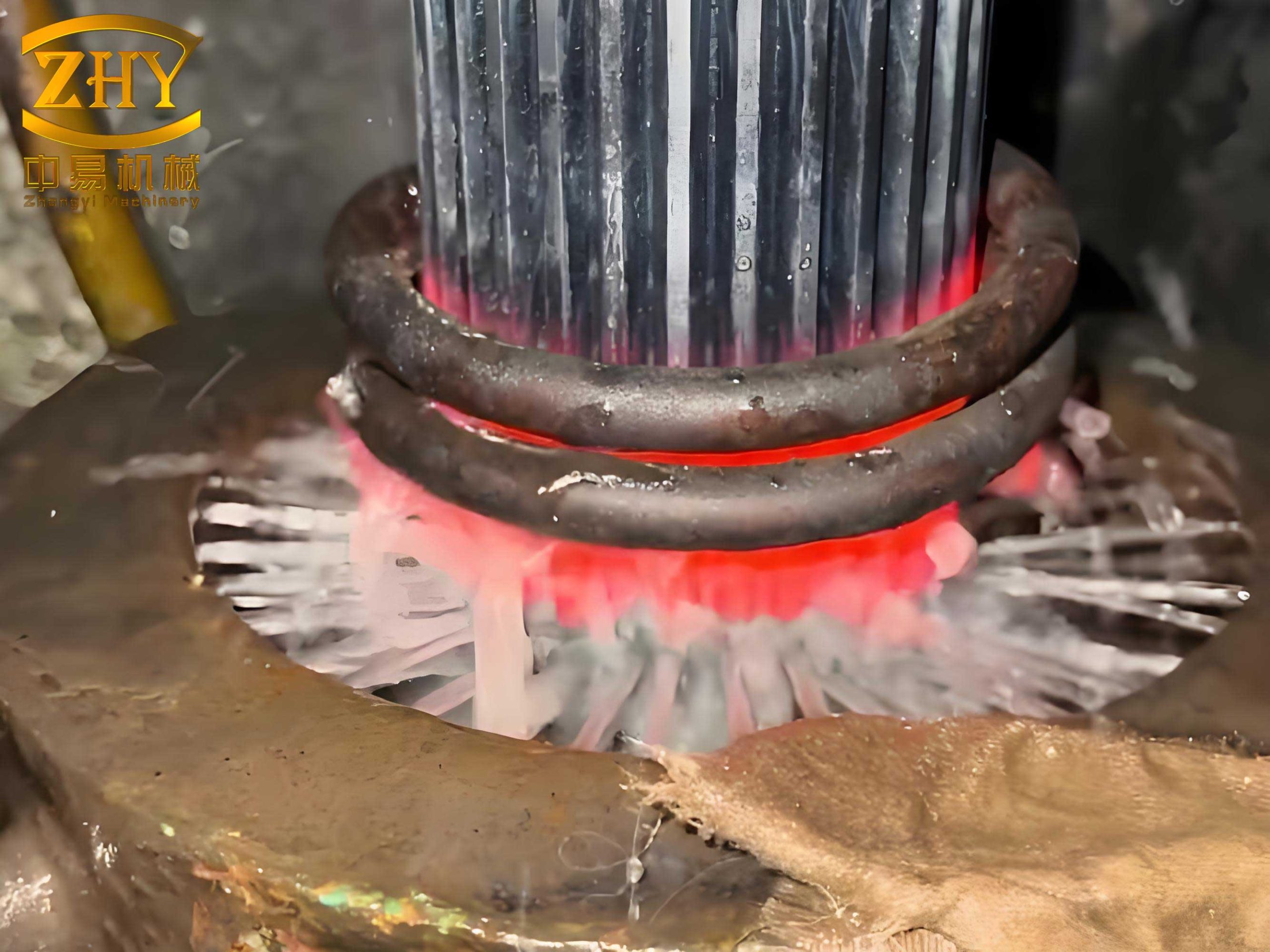
Pre-heat treatment processes, such as normalizing or annealing, set the microstructure before carburizing. Improper pre-treatment can result in Widmanstätten structures or mixed grains, increasing deformation during subsequent heating. I advocate for controlled temperature normalizing or isothermal annealing to achieve a uniform ferrite-pearlite structure. This reduces internal stresses and minimizes heat treatment defects. The temperature and time for pre-heat treatment can be optimized using kinetics models, such as:
$$T_{norm} = A_e + \Delta T_{opt}$$
where \(A_e\) is the eutectoid temperature and \(\Delta T_{opt}\) is an optimized overheat parameter derived from experimental data.
Carburizing Process Parameters
During carburizing, temperature uniformity and carbon diffusion consistency are vital. Higher carburizing temperatures accelerate diffusion but increase thermal gradients, leading to distortion. I suggest using lower temperatures with longer times to achieve desired case depth while reducing heat treatment defects. The carbon profile can be modeled using Fick’s second law:
$$\frac{\partial C}{\partial t} = D \frac{\partial^2 C}{\partial x^2}$$
where \(C\) is carbon concentration, \(D\) is diffusion coefficient, and \(x\) is depth. By controlling atmosphere and temperature, we can achieve a uniform case, as outlined in Table 3.
| Parameter | Effect on Deformation | Optimal Setting |
|---|---|---|
| Carburizing Temperature | Higher temperature increases case depth but raises distortion risk | 850-930°C, depending on steel grade |
| Atmosphere Control | Uneven carbon potential leads to non-uniform case and stresses | Use precise endothermic gas with carbon potential sensors |
| Time at Temperature | Longer times increase productivity but may exacerbate deformation | Balance based on case depth requirements |
Implementing these settings helps control heat treatment defects related to carburizing.
Quenching Process Influence
Quenching is the most critical stage for deformation control. The cooling rate, medium, and agitation affect residual stresses and phase transformations. I prefer using hot oil quenching at 120°C ± 20°C rather than cold oil, as it reduces thermal shock and minimizes heat treatment defects. The quenching intensity can be described by the Grossmann number (\(H\)), which relates to heat transfer coefficients. For oil quenching, \(H\) typically ranges from 0.2 to 0.5. Additionally, press quenching for disk-shaped gears allows precise control over distortion by adjusting parameters like oil flow and pressure. The deformation during quenching can be estimated using:
$$\delta = k \cdot \frac{Q}{A} \cdot \frac{1}{T_{ms}}$$
where \(\delta\) is deformation, \(k\) is a material constant, \(Q\) is heat extracted, \(A\) is surface area, and \(T_{ms}\) is martensite start temperature. Table 4 provides quenching countermeasures.
| Factor | Impact on Deformation | Countermeasure |
|---|---|---|
| Quenching Medium | Higher cooling rates increase thermal stresses | Use hot oil or polymer quenchants with controlled agitation |
| Press Quenching | Allows distortion correction for specific geometries | Adjust pressure, oil jets, and die dimensions dynamically |
| Agitation Level | Non-uniform cooling causes warping | Implement uniform spray or immersion systems |
These steps are essential for reducing heat treatment defects during quenching.
Fixturing and Loading Techniques
Proper fixturing ensures uniform cooling and stress distribution. I recommend using dedicated jigs and fixtures that align with gear geometry to prevent bending or twisting. For instance, stacking gears with spacers or orienting them perpendicular to the oil surface can mitigate heat treatment defects. The use of carburizing mandrels for parts with keyways helps maintain dimensional stability. The effectiveness of fixturing can be quantified by the uniformity index (\(U\)), defined as:
$$U = 1 – \frac{\sigma_T}{\bar{T}}$$
where \(\sigma_T\) is the standard deviation of temperature across the part and \(\bar{T}\) is the average temperature. Higher \(U\) indicates better uniformity, reducing deformation risks.
Mechanical Processing Coordination
Collaboration between heat treatment and machining stages is crucial. By understanding deformation patterns, we can pre-adjust dimensions to compensate for shrinkage or expansion. For example, pre-expanding holes or applying reverse deformation based on historical data can improve post-quench accuracy. For asymmetric parts, leaving extra machining stock before heat treatment allows final sizing after distortion occurs. Additionally, finishing processes like honing after heat treatment can correct minor heat treatment defects. Table 5 summarizes these strategies.
| Strategy | Application | Benefit |
|---|---|---|
| Pre-Expansion of Holes | Gears with inner diameters prone to shrinkage | Compensates for post-quench contraction, maintaining tolerances |
| Reverse Deformation Design | Parts with predictable warp patterns | Counters distortion during cooling, reducing rework |
| Extra Stock Allowance | Complex or thin-walled components | Enables final machining after heat treatment to achieve specs |
Implementing these mechanical adjustments minimizes heat treatment defects in the final product.
Advanced Techniques for Deformation Control
In recent years, I have explored advanced methods like finite element analysis (FEA) to predict and control deformation. FEA uses numerical simulations to model thermal and structural behaviors during heat treatment, allowing optimization without extensive trial-and-error. This approach is particularly effective for addressing heat treatment defects in complex geometries. The governing equations for thermo-mechanical analysis include the heat conduction equation and equilibrium equations:
$$\rho c_p \frac{\partial T}{\partial t} = \nabla \cdot (k \nabla T) + Q_{source}$$
$$\nabla \cdot \sigma + F = 0$$
where \(\rho\) is density, \(c_p\) is specific heat, \(k\) is thermal conductivity, \(Q_{source}\) is heat generation, \(\sigma\) is stress tensor, and \(F\) is body force. By solving these equations iteratively, FEA predicts distortion and residual stresses, enabling proactive countermeasures.
Another innovative technique is low-stress no-distortion welding, adapted for heat treatment. It involves preheating zones around the weld to reduce thermal gradients, thus preventing buckling in thin sections. This method can be applied to gear repairs or assemblies to avoid heat treatment defects.
Comprehensive Countermeasure Framework
To systematically address deformation, I propose an integrated framework that combines material selection, process optimization, and technological innovations. The key is to view heat treatment as part of a holistic manufacturing chain. Below, Table 6 outlines a step-by-step approach to mitigate heat treatment defects.
| Stage | Action | Expected Outcome |
|---|---|---|
| Material Preparation | Select steel with narrow hardenability; apply homogenization annealing | Uniform microstructure, reduced segregation-induced defects |
| Pre-Heat Treatment | Perform controlled normalizing at optimized temperatures | Refined grains, lower residual stresses before carburizing |
| Carburizing | Use lower temperatures with precise atmosphere control | Consistent case depth, minimized thermal gradients |
| Quenching | Implement hot oil quenching with press fixtures | Controlled cooling, reduced distortion and cracks |
| Post-Processing | Apply stress relief tempering and final machining | Dimensional stability, improved mechanical properties |
| Monitoring | Utilize FEA simulations and in-process sensors | Real-time correction, predictive maintenance |
This framework emphasizes continuous improvement to tackle heat treatment defects effectively.
Conclusion
In my professional journey, I have learned that controlling deformation in gear carburizing heat treatment requires a multifaceted strategy. By understanding the root causes—such as internal stresses and phase transformations—and addressing factors like material properties, process parameters, and fixturing, we can significantly reduce heat treatment defects. The integration of advanced technologies like finite element analysis further enhances our ability to predict and mitigate distortion. As industries demand higher precision and durability, adopting these countermeasures will be essential for producing reliable gear components. Through persistent research and practical application, we can minimize heat treatment defects and advance manufacturing excellence.