
In my extensive work with gear manufacturing and quality control, I have come to understand that heat treatment is an indispensable process in gear production, one that crucially determines the longevity and reliability of gears. However, ensuring high-quality heat treatment is not merely about applying the right thermal cycle; it fundamentally starts with material selection and design. Only superior materials combined with rational heat treatment processes can guarantee safe and dependable gear performance. Throughout this discussion, I will delve into the factors that govern heat treatment quality and the profound impact of microstructural defects, often termed heat treatment defects, on gear integrity. These heat treatment defects are a primary concern in metallurgy, and their mitigation is key to enhancing gear life.
From my perspective, the journey to optimal gear heat treatment begins long before the furnace is ignited. It commences with the inherent quality of the steel itself. I consider surface quality and macrostructure as the foundational elements. The steel must possess a flawless surface, free from folds, decarburization, scratches, or scoring. Such surface imperfections can become stress raisers and lead to cracking during forging or subsequent heat treatment. Moreover, the macrostructure must be examined for segregation, porosity, inclusions, shrinkage cavities, blowholes, and flakes (white spots). According to standard rating charts for low-magnification structure defects in structural steels, the total severity of these defects should not exceed grade 5.5. Higher grades indicate inferior material quality, which inevitably translates to unpredictable failures post-heat treatment. The presence of these flaws can act as nucleation sites for cracks, severely compromising fatigue strength. This interplay between initial material condition and final heat treatment outcome underscores why a holistic approach is necessary to prevent heat treatment defects.
Another critical factor I always emphasize is hardenability. Hardenability refers to the ability of steel to form martensite upon quenching from the austenitizing temperature, dictating the depth of hardened layer and the hardness distribution from surface to core. For gears, especially carburized ones, performance hinges on this hardness profile: surface hardness, effective case depth, and core hardness. Hardenability is influenced by chemical composition, austenitizing temperature, grain size, and the stability of undercooled austenite. In mathematical terms, the hardenability can be related to composition using multiplicative factors, often approximated for ideal critical diameter calculations. For instance, the ideal critical diameter \( D_I \) for a steel can be expressed as a function of alloying elements:
$$ D_I = D_{Ibase} \cdot f_{Mn} \cdot f_{Si} \cdot f_{Cr} \cdot f_{Mo} \cdots $$
where \( D_{Ibase} \) is the base hardenability from carbon content, and \( f_{X} \) are multiplicative factors for each alloying element. This equation highlights how chemistry governs the depth of hardening. For carburized gears, the effective case depth, typically 15–20% of the module at the pitch circle, optimizes bending and contact fatigue resistance. The core hardness, ideally between HRC 33 and 48, is vital for impact toughness and overall fatigue strength. Insufficient hardenability leads to soft spots and non-martensitic transformations, which are classic heat treatment defects that degrade gear performance.
Grain size is a parameter I scrutinize closely. Fine-grained steels, with grain sizes between 5 to 8 on the ASTM scale, are preferred. For case-hardening steels, a grain size of 6 or finer is optimal. Fine grains enhance the stability of undercooled austenite, improve mechanical properties, and reduce the risk of brittle fracture. Coarse grains, often resulting from excessive austenitizing temperatures, lead to a significant drop in tensile strength, bend strength, and impact toughness. The relationship between grain size and yield strength is often described by the Hall-Petch equation:
$$ \sigma_y = \sigma_0 + k_y \cdot d^{-1/2} $$
where \( \sigma_y \) is the yield strength, \( \sigma_0 \) is the friction stress, \( k_y \) is the strengthening coefficient, and \( d \) is the average grain diameter. This inverse square-root dependence shows that finer grains (smaller \( d \)) yield higher strength. Coarse austenite grains can also promote the formation of Widmanstätten structures in low- and medium-carbon steels, further embrittling the material. Thus, controlling grain size is paramount to avoiding heat treatment defects like coarse martensite and excessive retained austenite.
Non-metallic inclusions are inevitable in steelmaking, but their quantity and morphology must be controlled. In my experience, inclusions—whether exogenous (from slag or refractories) or endogenous (oxides, sulfides, nitrides from reactions)—act as stress concentrators. They create micro-notches that initiate fatigue cracks, leading to premature failure. For automotive gears, excessive inclusions can cause quench cracking along their clusters. The stress concentration factor \( K_t \) around an inclusion can be approximated based on its shape and orientation, exacerbating local stresses. Thus, inclusion rating is a critical quality check; high inclusion content is a direct contributor to severe heat treatment defects and in-service failures.
Chemical composition uniformity is another area I focus on. Severe segregation can cause banded structures, which persist even after normal forging and normalizing. This heterogeneity leads to uneven carbon and alloy concentration, resulting in inconsistent hardenability across the gear. Upon quenching, the non-simultaneous phase transformations generate varying volumetric changes, inducing high internal stresses. These stresses can cause distortion, cracking, or erratic dimensional changes. The volumetric strain \( \epsilon_v \) during phase transformation can be related to the change in specific volume \( \Delta V \):
$$ \epsilon_v = \frac{\Delta V}{V_0} $$
where \( V_0 \) is the initial volume. Non-uniform composition magnifies these strains, promoting quench cracks—a detrimental heat treatment defects category.
To summarize these factors, I have compiled a table that encapsulates the key elements influencing gear heat treatment quality:
| Factor | Description | Optimal Range/Requirement | Impact on Heat Treatment |
|---|---|---|---|
| Surface Quality & Macrostructure | Freedom from folds, decarburization, scratches; low macro-defects | Defects ≤ Grade 5.5 per rating charts | Prevents cracking, ensures consistent response |
| Hardenability | Ability to form martensite to a certain depth | Core HRC 33–48; case depth 15–20% of module | Determines hardness profile and fatigue resistance |
| Grain Size | ASTM grain size number | 5–8 (fine grain), ≥6 for case-hardening steels | Affects toughness, strength, and defect susceptibility |
| Non-Metallic Inclusions | Oxides, sulfides, nitrides | Minimized; strict rating limits | Stress concentrators, crack initiation sites |
| Chemical Composition Uniformity | Homogeneity of alloying elements | Low segregation, no banding | Reduces distortion and quench cracking risk |
Moving to the manifestation of problems, I often encounter specific microstructural anomalies post-heat treatment, which are direct heat treatment defects. One common issue is coarse martensite accompanied by excessive retained austenite. This typically arises from overly high quenching temperatures or excessive surface carbon content in carburized gears. Coarse martensite plates have low toughness and may contain micro-cracks that propagate under stress. Retained austenite, while sometimes beneficial up to 25% for contact fatigue, in excess reduces surface hardness and compressive residual stresses. The volume fraction of retained austenite \( V_{\gamma} \) can be estimated from X-ray diffraction, and its instability can lead to dimensional changes over time. For steels like 20CrMnTi, controlling retained austenite is crucial to avoid this heat treatment defects.
Another severe defect is excessive carbonitrides. In carburizing or carbonitriding, if the surface concentration is too high, carbonitrides precipitate in angular or networked forms. These brittle phases act as stress raisers and micro-crack nucleation points, reducing bending strength and promoting tooth flank fatigue. The critical stress intensity factor \( K_{IC} \) of the surface layer diminishes with such precipitates, accelerating failure. This type of heat treatment defects is particularly detrimental to gear life.
Excessive core ferrite is also problematic. Depending on the quenching process—direct quenching after carburizing or reheating—ferrite can appear as grain-boundary networks or blocky forms. This occurs due to low hardenability, slow cooling, or insufficient heating. Ferrite softens the core, lowering fatigue strength. In practice, I recommend keeping core ferrite within grades 1 to 5, based on gear module size. The ferrite volume fraction \( V_{\alpha} \) directly correlates with core hardness \( H_{core} \):
$$ H_{core} \propto \frac{1}{V_{\alpha}} $$
High \( V_{\alpha} \) thus signifies a heat treatment defects that compromises load-bearing capacity.
In carbonitriding, specific defects like “black组织” (black structures) are prevalent. These include black bands, black networks, and black pores, all of which degrade contact fatigue, bending fatigue, and wear resistance. Black bands result from internal oxidation of alloy elements like Mn and Cr, forming oxides and carbonitrides that deplete the matrix, reducing hardenability. Under the microscope, this zone comprises troostite, bainite, retained austenite, and carbonitrides. The depth of this band critically affects performance; if it exceeds a few micrometers, surface hardness and compressive stresses drop markedly. Black networks form along grain boundaries due to oxidation and preferential precipitation of troostite during slow cooling. When the network depth surpasses 0.06 mm, it severely shortens gear life by acting as a crack path. Black pores arise from nitrogen bubble formation and subsequent graphitization in carbon-saturated regions, further weakening the surface. All these carbonitriding anomalies are classic examples of heat treatment defects that require precise atmosphere control.
To illustrate the typical appearance of such microstructural flaws, the following image provides a visual reference common in failure analysis. It depicts various heat treatment defects like coarse martensite, retained austenite, and non-martensitic transformations that undermine gear integrity.
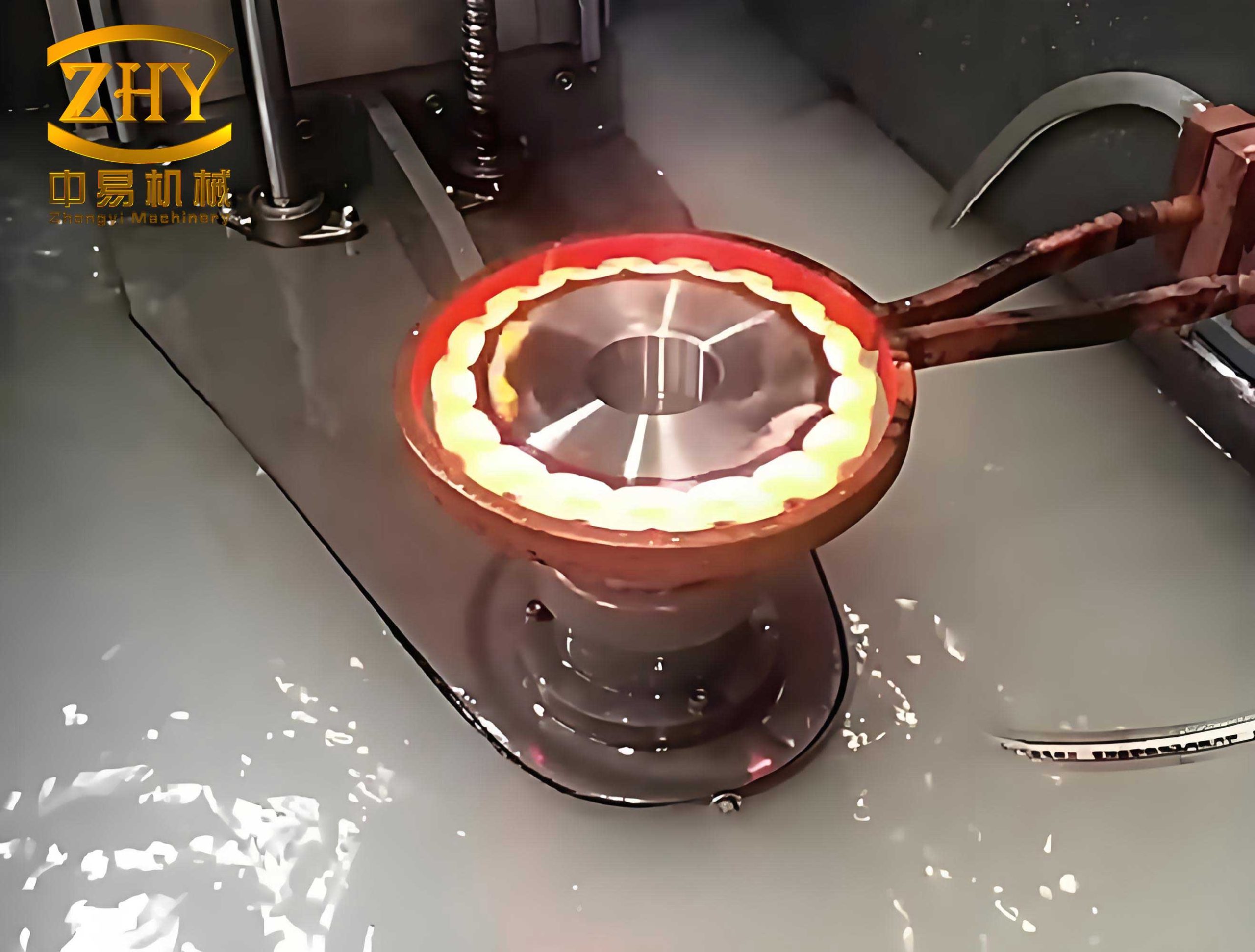
To better organize these defects, I present a table summarizing their characteristics, causes, and effects:
| Defect Type | Microstructural Features | Primary Causes | Consequences on Gear Performance |
|---|---|---|---|
| Coarse Martensite & Excessive Retained Austenite | Large martensite plates, high \( V_{\gamma} \) | High quench temperature, high surface carbon | Reduced toughness, lower hardness, micro-cracking |
| Excessive Carbonitrides | Angular/networked precipitates | Over-saturation of C/N in surface | Brittleness, stress concentration, fatigue crack initiation |
| Excessive Core Ferrite | Network or blocky ferrite | Low hardenability, slow cooling, banding | Soft core, lowered fatigue strength, poor impact resistance |
| Carbonitriding Black Band | Troostite, bainite, oxides, carbonitrides | Internal oxidation, alloy depletion | Reduced surface hardness, lower compressive stress, early spalling |
| Carbonitriding Black Network | Troostite along grain boundaries | Grain boundary oxidation, slow cooling | Crack propagation path, severe fatigue life reduction |
| Carbonitriding Black Pores | Voids with graphitization | Nitrogen bubbling, carbon saturation | Surface weakening, stress raisers, reduced wear resistance |
From my standpoint, preventing these heat treatment defects requires a systematic approach. First, material selection must be rigorous, choosing steels with fine grain, low inclusion content, and appropriate hardenability. Second, forging practices should aim to homogenize the structure, reducing banded segregation and subsequent volumetric strain differences. The forging reduction ratio \( R \) should be sufficient to break up as-cast structures:
$$ R = \frac{A_0}{A_f} $$
where \( A_0 \) and \( A_f \) are initial and final cross-sectional areas. A high \( R \) promotes uniformity. Third, heat treatment parameters must be meticulously controlled. For carburizing, the carbon potential \( C_p \) in the atmosphere should match the desired surface carbon content \( C_s \), often governed by equilibrium equations:
$$ C_p = C_s \cdot \exp\left(-\frac{Q}{RT}\right) $$
where \( Q \) is activation energy, \( R \) the gas constant, and \( T \) temperature. Deviations can lead to excessive carbonitrides or retained austenite. Quenching media and agitation must ensure cooling rates above the critical velocity \( V_c \) to avoid ferrite or pearlite formation. The critical cooling rate can be estimated from time-temperature-transformation (TTT) diagrams, integrating over the temperature range:
$$ V_c = \frac{T_A – T_M}{t_{min}} $$
with \( T_A \) austenitizing temperature, \( T_M \) martensite start temperature, and \( t_{min} \) the minimum time to avoid nose of transformation curve.
Furthermore, post-heat treatment inspections, like microhardness traverses and microstructural rating per ASTM standards, are essential. Non-destructive testing can detect surface cracks linked to heat treatment defects. In essence, the synergy of material science and process engineering is vital. Each factor interlinks; for instance, poor hardenability due to chemistry can exacerbate core ferrite, while grain coarsening from high temperature aggravates martensite brittleness. Therefore, a holistic view—from steelmaking to final tempering—is indispensable to minimize heat treatment defects.
In conclusion, based on my observations, heat treatment is a transformative process that defines gear performance. The factors influencing its quality are multifaceted, encompassing material inherent properties and process parameters. The defects that arise, collectively referred to as heat treatment defects, such as coarse microstructures, undesirable phases, and oxidation products, drastically impair mechanical properties and fatigue life. By prioritizing material quality, optimizing forging and heat treatment cycles, and implementing stringent quality controls, these heat treatment defects can be mitigated. This proactive approach ensures gears meet demanding service conditions, highlighting that excellence in heat treatment is not an isolated step but a comprehensive strategy woven into every stage of manufacturing.