
Abstract
Gear honing, as a precision finishing process for hard-surfaced gears, plays a crucial role in achieving high accuracy and surface finish. This paper delves into the study of honing forces and dynamic characteristics of an internal mesh power gear honing machine. Through theoretical analysis, experimental validation, and finite element simulation, the research aims to provide insights into optimizing honing parameters and enhancing machine structure for better processing performance.
Keywords: Gear honing, honing forces, dynamic characteristics, modal analysis, finite element simulation
1. Introduction
Gear honing is widely recognized for its capability to improve gear tooth accuracy and surface quality. The process involves complex interactions between the honing wheel and workpiece, generating honing forces that influence the quality of the finished product and tool life. Moreover, the dynamic behavior of the honing machine significantly affects process stability and accuracy. Therefore, understanding and modeling the honing forces and analyzing the dynamic characteristics of the honing machine are essential for optimizing the honing process.
2. Theoretical Background and Methodology
2.1 Gear Honing Process Principles
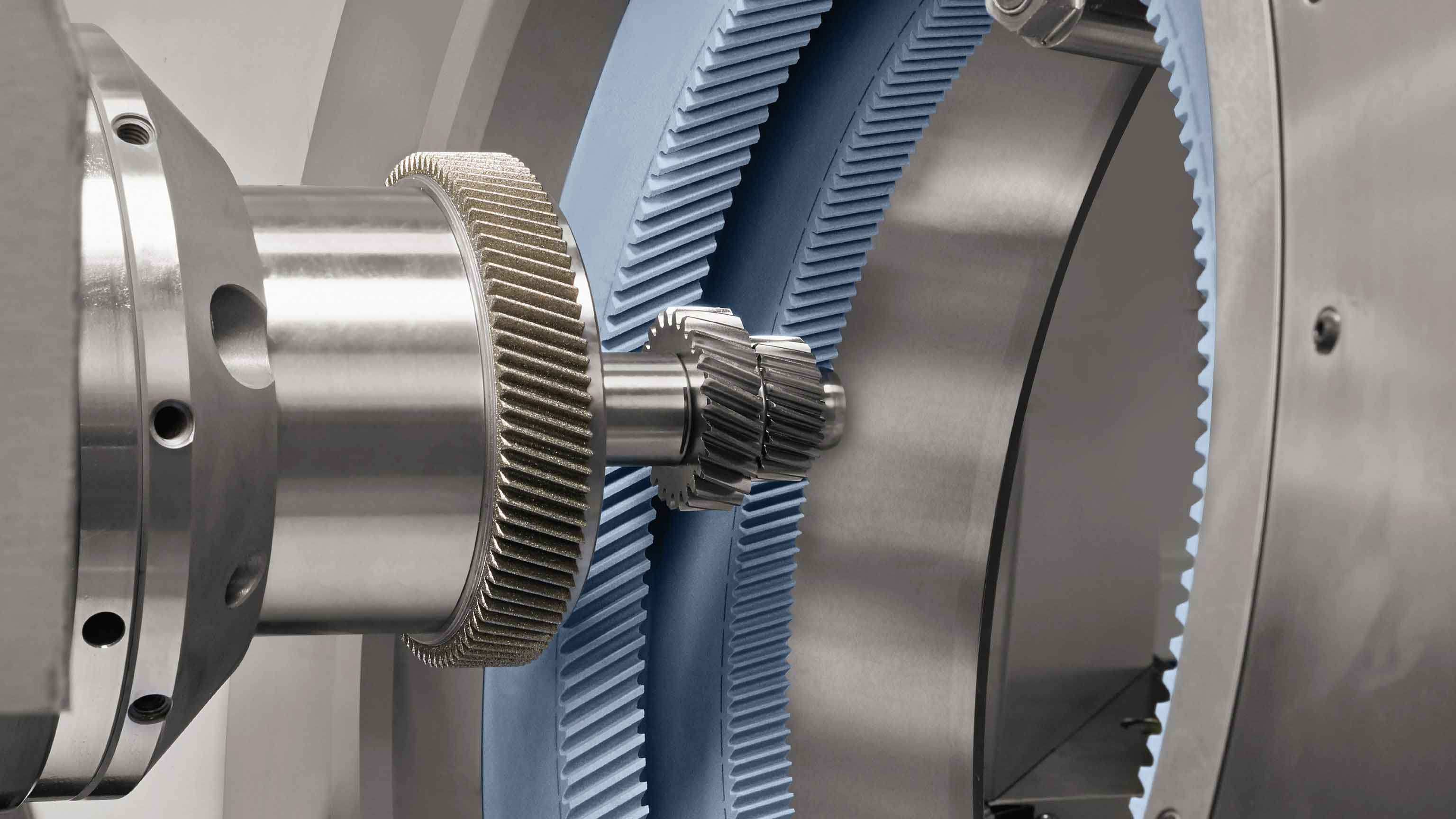
The internal mesh power gear honing process can be approximated as a special type of crossed helical gear meshing motion. The honing wheel, covered with abrasive grains, grinding the workpiece tooth surface. Three primary feeding methods are employed in gear honing: radial feeding, axial feeding, and tangential feeding, each with unique advantages and applications.
2.2 Modeling of Honing Forces
To predict and analyze honing forces, a theoretical model was established based on the discrete planar grinding process of the honing wheel’s micro-grinding edges. The model considers factors such as the distribution of cutting allowance, grinding force components, and the influence of process parameters.
2.3 Dynamic Characteristics Analysis
The dynamic characteristics of the honing machine were analyzed using finite element simulation. Modal analysis was conducted to determine the natural frequencies and mode shapes of the machine, workpiece spindle system, and honing wheel system. Harmonic response analysis was also performed to evaluate the machine’s response to excitation frequencies generated during the honing process.
3. Experimental Validation
3.1 Experimental Setup
Experiments were conducted on a Fassler HMX-400 gear honing machine to validate the honing force model. Various process parameters, including rotational speeds and radial feed rates, were varied to observe their effects on honing forces.
3.2 Experimental Results
The experimental results showed that honing forces varied periodically with time, following the engagement process of the gear teeth. As radial feed increased, honing forces increased linearly due to an increase in grinding depth and engagement area. The predicted values from the model were generally larger than experimental values, attributed to differences in actual cutting thickness.
Table 1. Summary of Experimental Conditions
| Parameter | Values |
|---|---|
| Rotational Speed (r/min) | 800, 1000, 1200 |
| Radial Feed (μm) | 4, 6, 8 |
Table 2. Comparison of Model and Experimental Honing Forces
| Radial Feed (μm) | Predicted Force (N) | Experimental Force (N) |
|---|---|---|
| 4 | F1 | f1 |
| 6 | F2 | f2 |
| 8 | F3 | f3 |
4. Modal Analysis and Dynamic Characteristics
4.1 Modal Analysis of the Honing Machine
Modal analysis was performed on the Y4830CNC gear honing machine using ANSYS. The machine model was simplified to ignore small features that had minimal impact on overall structure. The results revealed the natural frequencies and mode shapes of the machine.
Table 3. Modal Analysis Results of the Gear Honing Machine
| Modal Order | Natural Frequency (Hz) | Mode Shape Description |
|---|---|---|
| 1st | 108.26 | Swing of honing wheel frame (up-down) |
| 2nd | 116.74 | Swing of honing wheel frame (left-right) |
| 3rd | 167.02 | Symmetrical swing of honing wheel frame and workpiece spindle system along YOZ plane |
| 4th | 194.49 | Swing of honing wheel frame and column (left-right) |
| 5th | 219.17 | Swing of bed and column (up-down), left-right swing of honing wheel frame |
| 6th | 249.7 | Symmetrical swing of the entire machine along the centerline |
4.2 Dynamic Characteristics of Workpiece Spindle and Honing Wheel Systems
The workpiece spindle and honing wheel systems were analyzed separately for their dynamic characteristics. Modal analysis identified their natural frequencies and mode shapes, while harmonic response analysis evaluated their response to excitation frequencies.
Table 4. Natural Frequencies and Mode Shapes of Workpiece Spindle System
| Modal Order | Natural Frequency (Hz) | Mode Shape Description |
|---|---|---|
| 1st | (value) | Swing of spindle front end along X direction |
| 2nd | (value) | Swing of spindle front end along Y direction |
| … | … | … |
Table 5. Natural Frequencies and Mode Shapes of Honing Wheel System
| Modal Order | Natural Frequency (Hz) | Mode Shape Description |
|---|---|---|
| 1st | (value) | Description |
| 2nd | 180.61 | Left-right swing of honing wheel |
| … | … | … |
5. Dynamic Response and Gear Accuracy
The dynamic response of the honing wheel-workpiece gear system was analyzed using a centralized mass method, based on the honing force model. The analysis revealed the influence of process parameters on vibration and gear accuracy. Resonance was observed at specific excitation frequencies, emphasizing the importance of selecting parameters to avoid these frequencies.
6. Conclusion
This paper presents a comprehensive study of honing forces and dynamic characteristics in internal mesh power gear honing. The theoretical honing force model was validated experimentally, showing good agreement despite some discrepancies. Modal analysis and harmonic response analysis provided insights into the machine’s dynamic behavior.
However, several areas require further research:
- Inhomogeneous Cutting Allowance: The honing force model assumes uniform cutting allowance. Further work is needed to investigate force variations with inhomogeneous cutting allowance.
- Experimental Validation: The finite element models should be experimentally validated to refine and correct the models.
- Dynamic Factors: The dynamic response model could incorporate axial torsion stiffness and thermal deformation for higher accuracy.
In conclusion, this research contributes to the understanding and optimization of gear honing processes. Future work will build upon these findings to enhance the accuracy and efficiency of gear honing.