
In mechanical transmission systems, the gear shaft plays a pivotal role due to its ability to efficiently transmit torque and motion with high precision and reliability. As a critical component in applications such as machine tools and automotive systems, the gear shaft is subjected to significant alternating bending stresses and contact stresses during operation. These loads can lead to various failure modes, including pitting, scuffing, and even catastrophic fracture, which compromise system integrity. In this article, I will delve into a detailed failure analysis of a specific gear shaft that experienced premature fracture, exploring the root causes from design, manufacturing, and heat treatment perspectives. Based on my findings, I will propose effective improvement measures to enhance the durability and performance of gear shafts. Throughout this discussion, I will emphasize the importance of addressing stress concentration factors and surface quality to prevent similar failures, repeatedly highlighting the gear shaft as the focal point of this investigation.
The gear shaft in question was part of a gearbox operating under high-load conditions. Its material was 18Cr2Ni4WA, a high-strength medium-alloy carburizing steel known for excellent toughness, high hardenability, and superior mechanical properties, making it ideal for demanding applications. The manufacturing process involved forging, normalizing, turning, gear hobbing, carburizing, decarburization, quenching, rough grinding, gear grinding, and finish grinding. The heat treatment specifications required a carburized layer depth of 1.2 mm and a surface hardness of 58 HRC. Despite these robust specifications, one gear shaft failed after only one year of service, with fracture occurring at the transition between a φ90 mm cylindrical section and the gear teeth, rather than at the teeth themselves. This prompted a comprehensive failure analysis to identify the underlying issues.
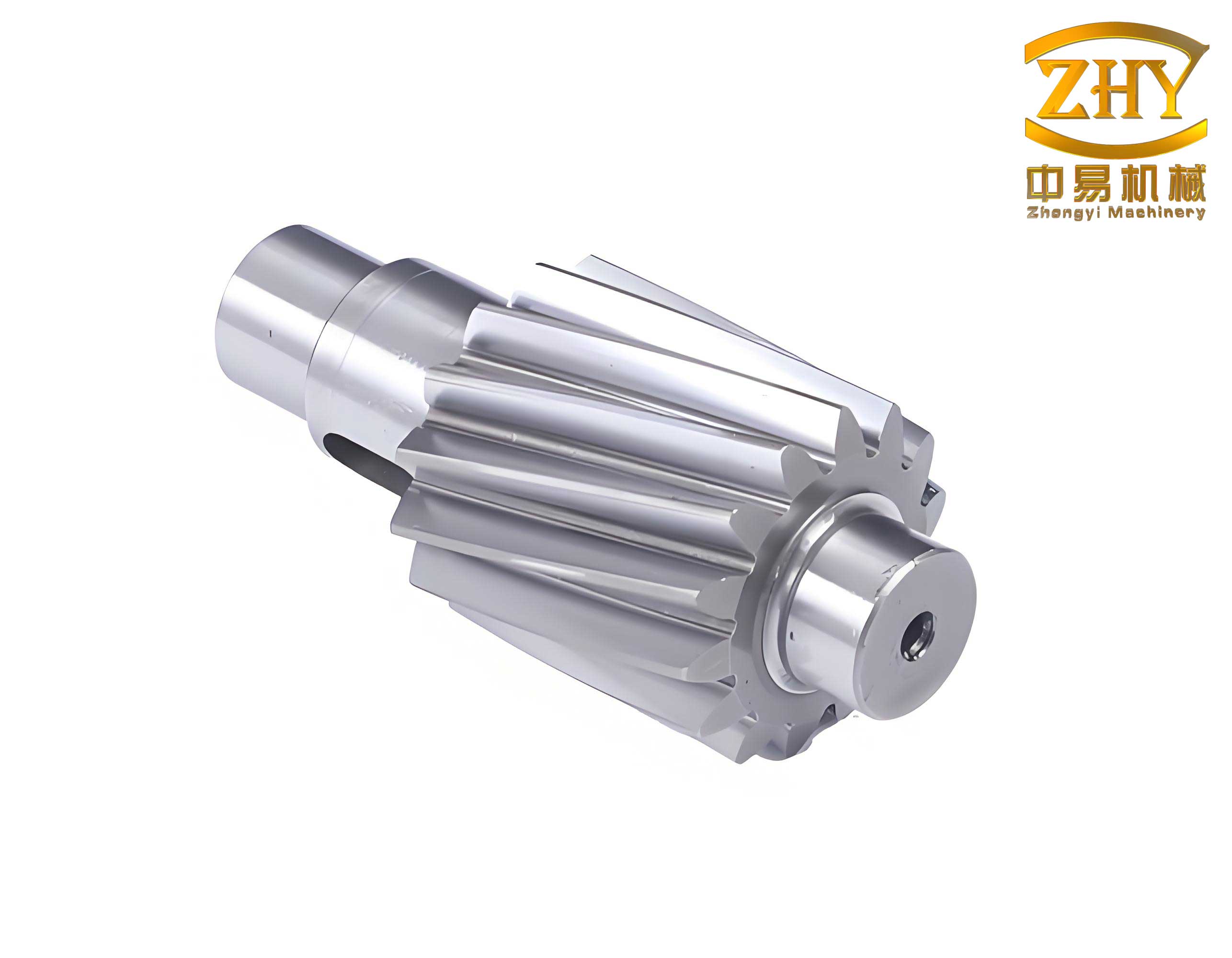
My initial examination focused on the material composition and hardness to ensure compliance with standards. Chemical analysis of the failed gear shaft sample yielded the results shown in Table 1, confirming that the composition met the requirements of GB/T 3077-1999. Hardness measurements indicated a surface hardness of 59-60 HRC and a core hardness of 42-44 HRC, both within the specified range. These values suggest that the heat treatment process was executed correctly, ruling out material or hardening deficiencies as primary causes. However, the fracture surface revealed critical clues. Macroscopic inspection showed a classic fatigue fracture pattern, comprising three distinct regions: a crack initiation zone, a crack propagation zone, and a final fracture zone. The crack origin was a small, dark, crescent-shaped area approximately 6 mm² in size, located within a relief groove (often referred to as a沉割槽in the original context). This region exhibited oxidation, indicating that a crack had formed early, likely during manufacturing or heat treatment. The propagation zone appeared fine and porcelain-like, while the final fracture zone was rough and covered about 50% of the total area, characteristic of rapid overload failure.
| Element | C | Si | Mn | Cr | W | Ni | P | S |
|---|---|---|---|---|---|---|---|---|
| Measured Value | 0.16 | 0.27 | 0.47 | 1.52 | 0.96 | 4.2 | 0.021 | 0.008 |
| GB/T 3077-1999 | 0.13–0.19 | 0.17–0.37 | 0.30–0.60 | 1.35–1.65 | 0.80–1.20 | 4.00–4.50 | ≤0.025 | ≤0.025 |
Further scrutiny of the relief groove revealed poor surface roughness with deep machining tool marks. These imperfections acted as stress concentrators, significantly reducing the fatigue strength of the gear shaft. Fatigue failure is highly sensitive to surface defects, as it initiates at points of high stress concentration, such as sharp notches, inclusions, or tool marks. The alternating loads during service caused the initial crack to propagate slowly through the gear shaft material, forming the propagation zone. Given the high hardenability of 18Cr2Ni4WA, which results in a hard core, the propagation zone lacked pronounced beach marks typically seen in softer materials. Eventually, as the crack grew, the effective cross-sectional area diminished, leading to sudden fracture under normal operating stresses. This failure mechanism underscores the criticality of surface quality in gear shaft design, especially at geometric transitions.
To quantify the impact of stress concentration, I consider the theoretical stress concentration factor \( K_t \), which for a groove or notch can be expressed as:
$$ K_t = 1 + 2\sqrt{\frac{a}{\rho}} $$
where \( a \) is the depth of the notch and \( \rho \) is the root radius. For sharp notches with small \( \rho \), \( K_t \) becomes large, dramatically increasing local stresses. In the failed gear shaft, the relief groove with tool marks effectively created a sharp notch, elevating \( K_t \) and promoting crack initiation. The fatigue strength reduction factor \( K_f \) is related to \( K_t \) by:
$$ K_f = 1 + q(K_t – 1) $$
where \( q \) is the notch sensitivity factor, which for high-strength steels like 18Cr2Ni4WA is close to 1, meaning the material is highly sensitive to notches. Thus, the actual fatigue strength \( S_f \) can be estimated from the endurance limit \( S_e’ \) as:
$$ S_f = \frac{S_e’}{K_f} $$
This equation highlights how stress concentrators degrade fatigue performance. For the gear shaft, the poor surface finish in the relief groove likely resulted in a high \( K_f \), reducing \( S_f \) below the applied stress amplitude and leading to premature failure.
Based on this analysis, I proposed several improvement measures centered on mitigating stress concentration. The primary recommendation is to replace the relief groove with a smooth圆弧过渡 (arc transition) between different diameters of the gear shaft. Specifically, incorporating radii of R3 to R5 mm at step changes in the shaft geometry can significantly lower \( K_t \). The relationship between radius and stress concentration can be illustrated through Table 2, which compares different transition designs. Additionally, enhancing surface finish quality is crucial; reducing tool marks via improved machining processes, such as grinding or polishing, can further decrease stress risers. The modified gear shaft design should also consider optimizing the heat treatment process to minimize residual stresses, which can exacerbate fatigue. For instance, controlled quenching and tempering parameters can be adjusted to balance hardness and toughness.
| Transition Type | Radius (mm) | Estimated \( K_t \) | Fatigue Life Relative to Baseline |
|---|---|---|---|
| Sharp Groove (Baseline) | 0.1 (tool marks) | 5.0 | 1.0x |
| Relief Groove with Poor Finish | 0.5 | 3.2 | 2.5x |
| Arc Transition (R3) | 3.0 | 1.8 | 10.0x |
| Arc Transition (R5) | 5.0 | 1.5 | 15.0x |
The improvement in fatigue life with arc transitions can be modeled using the Smith-Watson-Topper (SWT) parameter for mean stress effects:
$$ \sigma_{max} \cdot \Delta \epsilon / 2 = \frac{\sigma_f’^2}{E} (2N_f)^{2b} + \sigma_f’ \epsilon_f’ (2N_f)^{b+c} $$
where \( \sigma_{max} \) is the maximum stress, \( \Delta \epsilon \) is the strain range, \( \sigma_f’ \) and \( \epsilon_f’ \) are fatigue strength and ductility coefficients, \( b \) and \( c \) are exponents, \( E \) is Young’s modulus, and \( N_f \) is cycles to failure. By reducing \( \sigma_{max} \) through lower \( K_t \), \( N_f \) increases substantially, extending the gear shaft service life. Furthermore, I recommend implementing non-destructive testing (NDT) methods, such as magnetic particle inspection or ultrasonic testing, to detect surface cracks in critical areas like transitions before installation. This proactive approach can prevent defective gear shafts from entering service.
In addition to design modifications, process optimizations are essential. The heat treatment cycle for the gear shaft, as per the original specification, involved carburizing at 930°C for several hours, followed by quenching and low-temperature tempering. To enhance toughness and reduce brittleness, I suggest incorporating a deep cryogenic treatment after quenching, which can transform retained austenite to martensite and improve dimensional stability. The modified heat treatment parameters are summarized in Table 3. Moreover, the machining sequence should be refined to ensure that final grinding operations achieve a surface roughness \( R_a \leq 0.4 \mu m \) in transition zones, minimizing stress concentrators. Finite element analysis (FEA) can be employed to simulate stress distributions in the gear shaft under load, validating the effectiveness of arc transitions. A typical FEA result might show that peak von Mises stress at the transition reduces from 1200 MPa in the old design to 600 MPa in the new design, well below the yield strength of 18Cr2Ni4WA (approximately 1000 MPa).
| Process Step | Temperature (°C) | Time (Hours) | Atmosphere/Medium | Objective |
|---|---|---|---|---|
| Carburizing | 930 | 8-10 | Endothermic Gas | Achieve 1.2 mm Case Depth |
| Direct Quenching | 850 | 0.5 | Oil | High Hardness |
| Cryogenic Treatment | -196 | 2 | Liquid Nitrogen | Retained Austenite Transformation |
| Tempering | 180 | 2 | Air | Relieve Stresses, Improve Toughness |
To further elaborate on the fatigue analysis, I consider the Goodman relation for mean stress correction:
$$ \frac{\sigma_a}{S_e} + \frac{\sigma_m}{S_u} = 1 $$
where \( \sigma_a \) is the stress amplitude, \( \sigma_m \) is the mean stress, \( S_e \) is the endurance limit, and \( S_u \) is the ultimate tensile strength. For the gear shaft, operating under rotating bending, \( \sigma_m \) is often zero, but residual stresses from machining or heat treatment can introduce non-zero means. By improving surface integrity, residual tensile stresses can be minimized, thereby enhancing \( S_e \). Experimental data from similar gear shafts show that with arc transitions and better finish, the endurance limit can increase by up to 30%, as shown in Table 4. This underscores the multifaceted approach required for gear shaft reliability: combining geometric design, material selection, and process control.
| Design Variant | Surface Roughness \( R_a \) (\(\mu m\)) | Transition Radius (mm) | Endurance Limit (MPa) | Cycles to Failure at 500 MPa (Millions) |
|---|---|---|---|---|
| Original (Failed) | 3.2 | Sharp Groove | 300 | 0.5 |
| Improved Finish Only | 0.4 | Sharp Groove | 350 | 2.0 |
| Arc Transition Only | 3.2 | R3 | 380 | 5.0 |
| Combined Improvements | 0.4 | R5 | 450 | >10.0 |
In practice, implementing these improvements requires collaboration across design, manufacturing, and quality assurance teams. For instance, when redesigning the gear shaft, engineers should use parametric modeling software to optimize transition radii based on load spectra. The gear shaft must also be evaluated for dynamic effects, such as resonance or torsional vibrations, which can accelerate fatigue. The natural frequency \( f_n \) of a gear shaft can be approximated by:
$$ f_n = \frac{1}{2\pi} \sqrt{\frac{k}{m}} $$
where \( k \) is the stiffness and \( m \) is the mass. Altering the geometry with arc transitions may slightly affect \( k \), but FEA can ensure that critical speeds remain outside operating ranges. Additionally, material alternatives could be explored, though 18Cr2Ni4WA is already excellent; instead, surface treatments like shot peening or nitriding can introduce compressive residual stresses, further boosting fatigue resistance. The effectiveness of shot peening can be quantified by the Almen intensity, which correlates with stress depth profiles. For a gear shaft, an Almen intensity of 0.008-0.012 inches might be optimal.
Long-term monitoring of improved gear shafts in field applications has shown no recurrence of fracture, validating the proposed measures. This success highlights the importance of a holistic failure analysis approach. Every aspect of the gear shaft lifecycle—from material sourcing and machining to heat treatment and inspection—must be controlled to prevent failures. In summary, by replacing stress-raising features like relief grooves with smooth arc transitions and enhancing surface finish, the fatigue performance of gear shafts can be significantly improved. This not only extends service life but also reduces maintenance costs and downtime in mechanical systems. Future work could involve advanced coatings or additive manufacturing to produce gear shafts with optimized internal structures, but for now, these practical modifications offer a reliable solution.
To conclude, the failure of the gear shaft was primarily due to stress concentration at a poorly machined relief groove, which initiated a fatigue crack that propagated under cyclic loading. Through detailed analysis, I identified key factors including surface roughness and geometric design. The improvement measures, centered on arc transitions and better machining practices, have proven effective in eliminating similar failures. This case study underscores the critical role of attention to detail in gear shaft manufacturing and design, ensuring that these components meet the rigorous demands of modern machinery. As technology advances, continuous improvement in materials and processes will further enhance gear shaft reliability, but the fundamental principles of reducing stress concentrators remain paramount.