
In modern industrial applications, the gear shaft at the input end of reducers plays a pivotal role in transmitting power from prime movers to internal mechanisms, enabling torque amplification and speed reduction. As a critical component, the gear shaft is subjected to high cyclic loads, leading to various failure modes that compromise equipment reliability and operational efficiency. In this study, I explore the common failure mechanisms of the gear shaft, analyze root causes, and evaluate effective maintenance strategies to enhance longevity and performance. By integrating failure analysis with practical repair techniques, this research aims to provide a comprehensive framework for minimizing downtime and optimizing the service life of gear shafts in reducer systems.
The gear shaft in reducer input systems typically comprises several integral sections: the shaft body, keyways, positioning rings, bearing fits, and gear engagement segments. This gear shaft connects directly to the motor via keys or expansion sleeves, transmitting torque while the central gear meshes with subsequent gears to facilitate power transfer. During operation, the gear shaft endures significant torsional and axial forces, making it prone to fatigue-induced damage over time. Understanding the structural dynamics and load distribution is essential for identifying potential weak points and implementing preventive measures.
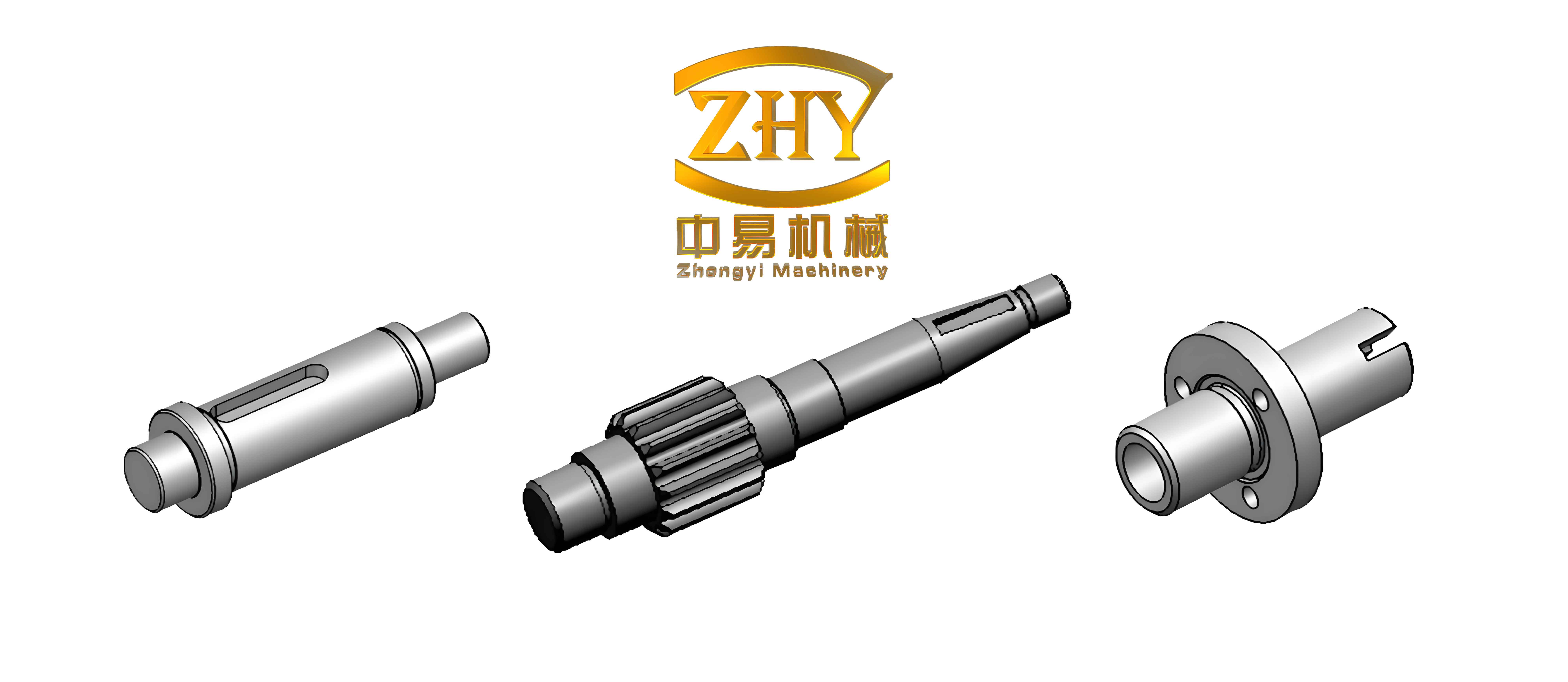
One of the most prevalent failure types in gear shafts is bending fatigue fracture, which results from cyclic alternating loads during operation. The repeated impacts and fluctuating bending moments generated by gear meshing induce stress concentrations at geometric discontinuities, such as keyway roots and shaft shoulder transitions. These stress risers initiate micro-cracks that propagate under continued loading, ultimately leading to fracture. The fatigue life of a gear shaft can be estimated using the following formula:
$$N = \left( \frac{\sigma_{-1}}{\sigma_a} \right)^m$$
where \(N\) represents the fatigue life in cycles, \(\sigma_{-1}\) is the material’s fatigue limit, \(\sigma_a\) denotes the actual working stress, and \(m\) is the material’s fatigue strength exponent. To mitigate bending fatigue, it is crucial to optimize the gear shaft design by incorporating smooth transitions, adequate fillet radii, and surface treatments like induction hardening, which enhance fatigue resistance and extend service intervals.
Another common issue is journal wear, which occurs at the bearing fit sections of the gear shaft due to inadequate lubrication, excessive assembly clearance, bearing failure, or contaminant ingress. This wear manifests as fretting or adhesive damage, increasing operational clearance and inducing vibrations that can escalate to catastrophic failure. The wear volume can be modeled using the Archard wear equation:
$$V = \frac{K F s}{H}$$
Here, \(V\) is the wear volume, \(K\) is the wear coefficient, \(F\) is the normal force, \(s\) is the sliding distance, and \(H\) represents the material hardness. Implementing high-strength, wear-resistant materials and maintaining optimal lubrication conditions are key strategies to reduce journal wear in gear shafts.
Gear meshing failures, including pitting, scuffing, plastic deformation, and tooth breakage, are also frequent in gear shafts. These failures arise when the contact stress exceeds the material’s endurance limit, often exacerbated by heavy loads, frequent starts/stops, or insufficient lubrication. The contact stress on the gear shaft tooth surface can be calculated based on Hertzian contact theory:
$$\sigma_H = \frac{F_t K_A K_V}{b d}$$
where \(\sigma_H\) is the contact stress, \(F_t\) is the tangential force, \(K_A\) and \(K_V\) are application and dynamic factors, \(b\) is the face width, and \(d\) is the pitch diameter. Enhancing gear meshing reliability involves optimizing tooth profiles, selecting high-strength steel grades, and applying surface hardening treatments like carburizing to the gear shaft.
Failure causes for gear shafts are multifaceted, often stemming from design flaws, manufacturing inaccuracies, material deficiencies, and operational misuse. Design defects include improper dimensional ratios, insufficient transition radii, and inadequate consideration of stress concentrations, which elevate the risk of fatigue crack initiation in the gear shaft. For instance, abrupt changes in shaft diameter without smooth fillets can lead to localized stress peaks, accelerating failure. Additionally, mismatched gear module and face width combinations may undermine root strength, predisposing the gear shaft to meshing failures.
Manufacturing errors significantly impact gear shaft performance, as dimensional deviations, misalignment, and poor surface finish disrupt assembly precision and load distribution. The relationship between machining accuracy and failure rates is evident from empirical data. Below is a table summarizing the failure rates of gear shafts under different machining tolerance grades, based on industry data.
| Machining Tolerance Grade (GB/T 1800) | Average Roundness (mm) | Surface Roughness Ra (µm) | Failure Rate (%) |
|---|---|---|---|
| IT6 | ≤0.005 | ≤0.8 | 0.9 |
| IT7 | ≤0.010 | ≤1.6 | 2.3 |
| IT8 | ≤0.015 | ≤3.2 | 5.7 |
As shown, higher precision grades like IT6 result in lower failure rates for the gear shaft, underscoring the importance of tight tolerances and superior surface quality in manufacturing processes. Conversely, lower grades such as IT8 exhibit a failure rate over five times higher, highlighting how increased roundness errors and roughness exacerbate stress concentrations and wear in the gear shaft.
Material-related problems are another critical factor in gear shaft failures. Alloy steels like 42CrMo and 20CrMnTi are commonly used for gear shafts due to their high yield strength, hardenability, and fatigue resistance. However, improper material selection or suboptimal heat treatment can lead to inadequate mechanical properties. For example, 42CrMo typically achieves a tensile strength of 1080 MPa and yield strength exceeding 900 MPa after quenching and tempering, making it suitable for medium-to-high load applications. If the gear shaft is fabricated from low-grade carbon steel or materials with internal inclusions and coarse grains, it becomes susceptible to reduced fracture toughness and accelerated crack propagation. Inconsistent heat treatment, such as excessive quenching temperatures or insufficient tempering, can induce brittleness or residual stresses, further compromising the gear shaft integrity.
Operational misuse, including overloading, frequent cycling, poor lubrication, and inadequate maintenance, also contributes to gear shaft failures. Overloading subjects the gear shaft to stresses beyond its design capacity, while frequent start-stop cycles amplify impact loads and surface wear. Environmental factors like dust and moisture ingress can accelerate corrosion and abrasion in the gear shaft. Regular monitoring of lubrication conditions, vibration levels, and temperature variations is essential to prevent premature failures in the gear shaft.
When failures occur, various maintenance methods can be employed to restore the gear shaft functionality. Welding repair is suitable for addressing cracks, localized spalling, or wear on the gear shaft. This technique involves depositing compatible filler material, such as low-hydrogen electrodes or alloy powders, onto the damaged area after thorough cleaning and preheating. Post-weld heat treatment, like stress relief annealing, is often necessary to mitigate residual stresses and prevent embrittlement in the gear shaft. Although welding offers cost-effectiveness and rapid turnaround, it is best applied to low-stress regions of the gear shaft due to potential microstructural alterations in the heat-affected zone.
Sleeve repair is an alternative for severely worn or damaged gear shafts where welding is impractical. This method entails machining a precision groove on the affected section and press-fitting a sleeve made of materials like 45 steel or 40Cr. The sleeve is often heat-treated or surface-hardened to match the gear shaft’s mechanical properties. Key advantages of sleeve repair include reduced downtime and lower costs compared to full replacement; however, it demands high machining accuracy to ensure proper fit and avoid eccentricity in the gear shaft assembly.
Component replacement becomes necessary when the gear shaft experiences extensive damage, such as fractures or irreversible deformation. This approach involves manufacturing a new gear shaft according to original specifications, using materials like 42CrMo or 40CrNiMo that undergo tailored heat treatments for optimal strength and hardness. Post-replacement checks, including dimensional verification, dynamic balancing, and trial runs, are critical to ensure seamless integration with associated components like bearings and couplings. While replacement entails higher costs and longer lead times, it guarantees restored performance and reliability for the gear shaft in demanding applications.
To proactively enhance gear shaft durability, a holistic improvement strategy encompassing design optimization, precise manufacturing, material selection, and operational best practices is imperative. Finite element analysis (FEA) can be employed to simulate stress distributions in the gear shaft under operational loads, identifying and reinforcing critical areas. For example, incorporating generous fillet radii and stress-relief grooves minimizes concentration effects in the gear shaft. Material-wise, high-performance alloys subjected to processes like carburizing or induction hardening bolster surface hardness and fatigue resistance. Manufacturing controls should focus on achieving tight tolerances and superior surface finishes, as evidenced by the correlation between precision and failure rates. Operational measures include implementing robust lubrication systems, avoiding overload conditions, and conducting regular inspections to monitor gear shaft health. By integrating these measures, the overall reliability and service life of the gear shaft can be significantly extended, contributing to enhanced reducer system efficiency and reduced maintenance costs.
In conclusion, the gear shaft is a fundamental element in reducer input systems, and its failure modes—ranging from fatigue fractures to wear and meshing issues—pose significant challenges to industrial operations. Through detailed analysis and the application of targeted maintenance techniques like welding, sleeving, and replacement, the functionality of the gear shaft can be effectively restored. Moreover, preventive strategies involving design refinements, precision machining, and material enhancements play a crucial role in mitigating failures. This comprehensive approach not only prolongs the lifespan of the gear shaft but also fosters sustainable and efficient machinery performance, underscoring the importance of continuous innovation in gear shaft maintenance and optimization.