
In this study, we investigate the fracture failure of an output gear shaft from a polypropylene extrusion granulator main gearbox. The gear shaft experienced sudden fracture during operation, leading to significant downtime and potential safety hazards. Through comprehensive analysis including fracture surface examination, material testing, and strength verification, we aim to identify the root causes and propose mitigation strategies. The gear shaft is a critical component in transmitting torque and handling complex loads, and its failure can stem from various factors such as material defects, improper design, or operational overloading. By focusing on this specific gear shaft failure, we provide insights that can enhance the reliability of similar systems in industrial applications.
The extrusion granulator system is essential in polypropylene production, where it processes polymer materials into granules. The main gearbox, which houses the output gear shaft, operates under high power and torque conditions. In this instance, the gear shaft fractured near a bearing location, which prompted an in-depth failure analysis. We begin by reviewing the operational history and maintenance events to contextualize the failure. Subsequently, we detail the manufacturing process of the gear shaft, followed by an examination of the fracture characteristics. Our analysis incorporates macroscopic and microscopic fractography, material chemical composition checks, mechanical property evaluations, and theoretical stress calculations to build a holistic understanding of the failure mechanisms.
Operational records indicate that the granulator system underwent several maintenance activities prior to the gear shaft failure. For instance, in April 2019, inspections revealed issues with output shaft systems and screw sleeves, leading to replacements of multiple components, including the output gear shaft assembly. The system was then operated at full capacity until May 2020, when abnormal noises were detected, followed by the fracture of a corresponding screw shaft. Despite continued operation for 48 hours under these conditions, the system was eventually shut down, and further inspection uncovered the fractured output gear shaft. This timeline suggests that cumulative damage from previous incidents, such as the screw shaft fracture, may have contributed to the gear shaft failure through induced shock loads or misalignments.
The manufacturing process of the output gear shaft involved several stages to ensure high strength and durability. The material used was 18CrNiMo7-6, sourced from an electroslag remelted ingot, which was forged, heat-treated, and machined to specifications. Key steps included rough turning, ultrasonic testing, carburizing, quenching, and precision grinding. Technical requirements mandated high purity, specific grain size, and absence of defects like grinding cracks, as per standards such as GB/T 3480.5-2021 and ASTM E1444-05. However, despite these measures, the gear shaft failed, indicating potential issues in material processing or operational stresses beyond design limits.
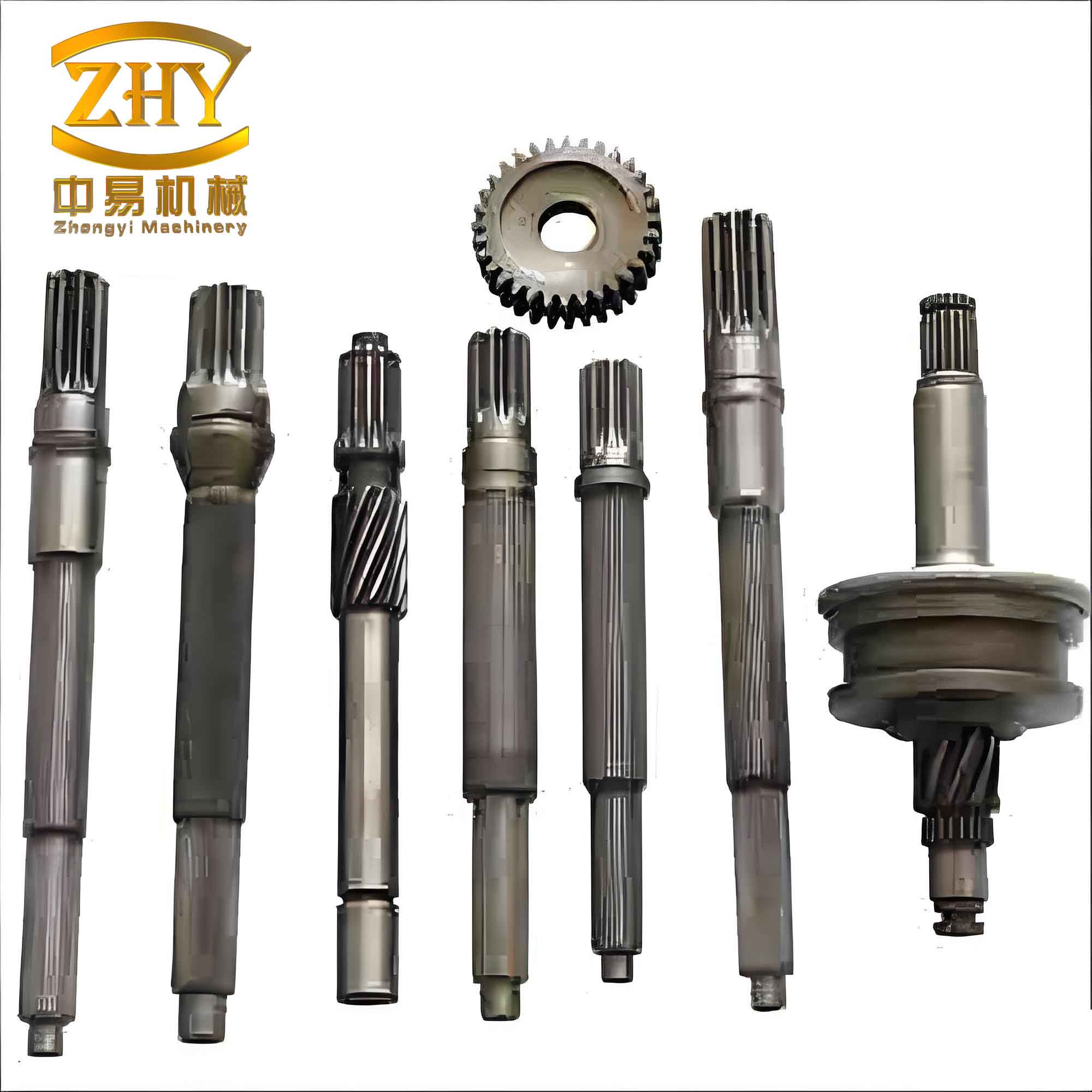
Upon examining the failed gear shaft, we observed that the fracture occurred adjacent to a bearing position, specifically at the intersection with a relief groove for a diameter change. The fracture surface exhibited characteristics typical of fatigue failure, with distinct regions including a fatigue initiation zone, propagation area, and final rupture section. Macroscopic analysis revealed relative rotation marks on the bearing seat, suggesting micro-movements between the bearing inner ring and the gear shaft surface. The final fracture area was centrally located and displayed significant tearing, indicating high torsional stresses at the moment of failure. To illustrate the fracture location and features, we include a visual reference below.
For the fractography analysis, we utilized scanning electron microscopy (SEM) to examine the micro-features of the fracture surfaces. The fatigue initiation zone appeared relatively smooth, with evidence of fretting damage, likely caused by instantaneous impacts from the screw shaft fracture. The propagation region showed clear fatigue striations, indicative of cyclic loading under combined torsion and bending moments. The final rupture area exhibited river-like cleavage patterns, consistent with sudden overload failure. These observations align with the hypothesis that the gear shaft experienced progressive crack growth due to alternating stresses, ultimately leading to catastrophic fracture when the remaining cross-sectional area could no longer sustain the applied loads.
To assess the material integrity, we conducted chemical composition tests on samples from the gear shaft. The results, compared against EN 10084-2008 standards for 18CrNiMo7-6 steel, are summarized in the table below. All elemental concentrations fell within specified limits, confirming that the material met compositional requirements.
| Element | Required (%) | Measured (%) |
|---|---|---|
| C | 0.15–0.21 | 0.18 |
| Cr | 1.50–1.80 | 1.61 |
| Ni | 1.40–1.70 | 1.44 |
| Mn | 0.50–0.90 | 0.61 |
| Mo | 0.25–0.35 | 0.27 |
| Si | ≤0.40 | 0.23 |
| P | ≤0.025 | 0.015 |
| S | ≤0.035 | 0.001 |
Further material evaluations included microstructural analysis and hardness measurements at various depths from the surface. Samples taken near the bearing position and away from it revealed a microstructure of low-carbon martensite and granular bainite, which is acceptable for carburized and quenched 18CrNiMo7-6 steel. However, the surface hardness at the bearing location (32–34 HRC) was lower than that in non-bearing areas (36–38 HRC), and below the specified range of 38–42 HRC for core hardness. This reduction suggests localized annealing due to fretting between the bearing and gear shaft, which could have initiated micro-cracks and compromised the gear shaft’s fatigue resistance.
Mechanical property tests were performed on specimens extracted from the core of the gear shaft. The results, including tensile strength, yield strength, elongation, reduction in area, and impact energy, are presented in the following table. All values satisfied the EN 10084-2008 requirements, indicating that the base material possessed adequate mechanical properties for the application.
| Property | Measured Value | Required Value |
|---|---|---|
| Yield Strength (Rp0.2, MPa) | 885 | ≥685 |
| Tensile Strength (Rm, MPa) | 990 | ≥980 |
| Elongation (A, %) | 13.0 | ≥8 |
| Reduction in Area (Z, %) | 64 | ≥35 |
| Impact Energy (KV2, J) | 49.2, 52.2, 57.5 | ≥41 |
To understand the stress conditions leading to failure, we performed theoretical calculations and finite element analysis using KISSsoft software. The gear shaft was subjected to a torque derived from the operational power and speed. The torsional moment \( T \) is given by:
$$ T = \frac{9549 \times P}{n} $$
where \( P = 1400 \, \text{kW} \) (half of the total power for a twin-screw setup) and \( n = 242 \, \text{r/min} \). Substituting the values:
$$ T = \frac{9549 \times 1400}{242} = 55,242.15 \, \text{N·m} $$
The safety factor for torsional fatigue \( S_\tau \) was calculated using the formula:
$$ S_\tau = \frac{\tau_{-1}}{\frac{K_\tau}{\beta \varepsilon_\tau} \tau_a + \phi_\tau \tau_m} $$
where \( \tau_{-1} = 300 \, \text{MPa} \) (torsional fatigue limit), \( K_\tau = 2.40 \) (stress concentration factor), \( \beta = 1.65 \) (surface factor), \( \varepsilon_\tau = 0.60 \) (size factor), \( \tau_a = \frac{16T}{2\pi d^3} = 28.65 \, \text{MPa} \) (stress amplitude), \( \phi_\tau = 0.29 \) (mean stress factor), and \( \tau_m = \tau_a = 28.65 \, \text{MPa} \). Plugging in the numbers:
$$ S_\tau = \frac{300}{\frac{2.40}{1.65 \times 0.60} \times 28.65 + 0.29 \times 28.65} = 3.86 $$
This result indicates that the gear shaft should have been safe under normal operating conditions, as \( S_\tau > 1.8 \). However, the presence of additional bending moments and shock loads likely altered the stress state.
In the KISSsoft model, we simulated the gear shaft with applied boundary conditions, including bearings and gear meshing forces. The analysis considered static strength, infinite life fatigue, and crack initiation safety factors. For the critical cross-section at 979 mm (corresponding to the fracture location), the strength utilization rates and safety factors are summarized below:
| Calculation Method | Static Strength Utilization (%) | Infinite Life Utilization (%) | Fatigue Safety Factor | Yield Safety Factor | Crack Initiation Safety Factor |
|---|---|---|---|---|---|
| AGMA 6101:E08 | 16.73 | 72.03 | 1.40 | 5.98 | – |
| DIN 743:2012 | 35.21 | 43.60 | 2.75 | 3.41 | 8.32 |
| FKM Guideline | 44.14 | 64.79 | 2.32 | – | – |
| Hänchen & Decker | 58.74 | 44.21 | 2.72 | 2.40 | 11.03 |
All calculated safety factors exceeded the minimum required value of 1.20, suggesting that the gear shaft design was adequate for expected loads. Nevertheless, the fracture occurred due to unforeseen dynamic effects.
Based on our analysis, the fracture mechanism of the gear shaft can be described as follows: The initial failure likely originated from micro-tearing at the bearing seat, induced by instantaneous impact loads when the corresponding screw shaft fractured. This created stress concentrations at the relief groove, where the geometry promotes high stress levels. Under combined torsional and bending cyclic loads, micro-cracks initiated and propagated through the gear shaft material. The number of load cycles, estimated at approximately \( 242 \, \text{r/min} \times 60 \, \text{min/h} \times 48 \, \text{h} = 6.9696 \times 10^5 \) cycles, approached the fatigue endurance limit, facilitating crack growth. Eventually, the reduced cross-sectional area could not withstand the operational torque, leading to sudden fracture. The stress intensity factors for mixed-mode cracking, such as Mode I (opening) and Mode III (tearing), can be expressed using fracture mechanics concepts. For a crack under shear, the stress field near the tip is given by:
$$ \tau_{xz} = -\frac{K_{\text{III}}}{\sqrt{2\pi r}} \sin\left(\frac{\theta}{2}\right) $$
$$ \tau_{yz} = \frac{K_{\text{III}}}{\sqrt{2\pi r}} \cos\left(\frac{\theta}{2}\right) $$
where \( K_{\text{III}} \) is the stress intensity factor for Mode III, \( r \) is the radial distance, and \( \theta \) is the angle. These equations highlight how stress concentrations can drive crack propagation in the gear shaft under torsional loading.
To prevent similar failures, we recommend several improvements. First, operational practices should minimize load fluctuations and shock impacts; any unusual noises should trigger immediate inspection of the gear shaft and associated components. Second, assembly processes must adhere strictly to specifications to ensure proper fitting of bearings and avoid micro-movements. Third, material quality control should be enhanced through rigorous incoming inspections, heat treatment monitoring, and mechanical testing. Fourth, design modifications, such as replacing sharp relief grooves with larger radii, can reduce stress concentrations. For example, the maximum stress at a notch can be estimated using:
$$ \sigma_{\text{max}} = K_t \times \sigma_{\text{nom}} $$
where \( K_t \) is the theoretical stress concentration factor. By optimizing the geometry, \( K_t \) can be minimized, thereby extending the gear shaft’s fatigue life.
In conclusion, our investigation into the gear shaft fracture reveals that the failure was primarily due to fatigue initiated by shock loads from a preceding screw shaft fracture. Material and design analyses confirmed that the gear shaft met standard requirements, but operational dynamics introduced unexpected stresses. The relief groove acted as a stress raiser, exacerbating crack propagation. By implementing the proposed measures, such as improved monitoring and design adjustments, the reliability of gear shafts in similar applications can be significantly enhanced. This case underscores the importance of holistic analysis in failure prevention, combining material science, mechanical engineering, and operational insights to safeguard critical components like the gear shaft.
Further research could explore advanced non-destructive testing methods for early crack detection in gear shafts, or computational models that simulate transient loads in granulator systems. Additionally, life prediction models incorporating fracture mechanics parameters could provide more accurate estimates of gear shaft durability under variable operating conditions. As industries push for higher efficiencies and longer equipment lifecycles, understanding and mitigating gear shaft failures will remain a key focus in mechanical design and maintenance strategies.